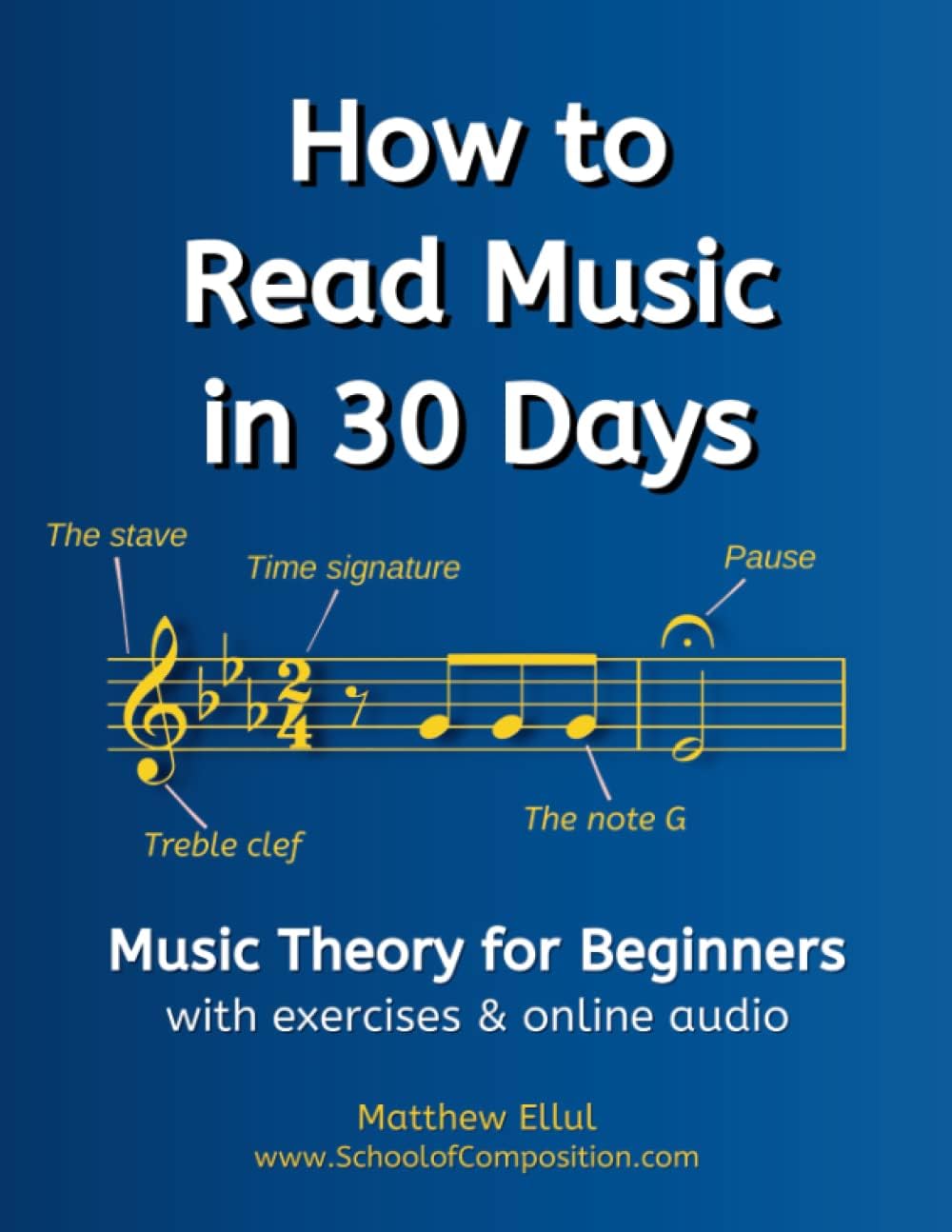
How to Read Music in 30 Days: Music Theory for Beginners - with exercises & online audio (Practical Musical Theory)
Product ID: 102372302
Buy anything from 5,000+ international stores. One checkout price. No surprise fees. Join 2M+ shoppers on Desertcart.
Desertcart purchases this item on your behalf and handles shipping, customs, and support to Vanuatu.
Do you want to learn how to read music notation with easy-to-follow, step-by-step lessons? Did you ever try to learn music theory but got frustrated with complicated jargon and mysterious terms? If so, this book is perfect for you! This book offers a unique 30-day program that makes learning how to read music simple and fun. Imagine how, in just about a month, you’ll be able to look at sheet music and know exactly what every symbol, sign, and term means. You’ll know the fundamental theory behind the how, why, and what of the music that's in front of you! With over 150 music examples, over 100 written exercises, 10 listening experiences, expert tips, lesson summaries, a final test, and online access to the audio examples, you will steadily progress towards learning: • The absolute essentials of music theory, • How rhythm REALLY works, • The complete system behind musical notes, • The crucial details of music notation, • How specific musical symbols give life to all written music. A strong foundation in the basics is essential if you want to read music, play an instrument for your friends and fans, sing in a choir or as a solo, record in a studio, compose music, write songs, or anything else in music. This book is your practical, step-by-step guide to building that foundation. Finally, you can stop searching the web endlessly in hopes of finding the right information. With this comprehensive but practical approach, your music theory questions are answered in full. And thanks to the valuable feedback of hundreds of students of all ages and backgrounds, “How to Read Music in 30 days” is now in its 3rd edition, revised and expanded to suit all types of beginner musicians. Hundreds of students have successfully gone through this practical system to master musical notation and fundamental music theory. Now, it’s your turn! Let’s get started! Frequently Asked Questions Can I really learn how to read music in 30 days? Absolutely! In fact, we start reading our most basic symbols as from day 1. You will not become an expert sight-reader in 30 days: no book, no teacher, and no program can replace the practice it takes to become a professional. But you can significantly cut down on the time it takes to get there by learning the foundations in the right way and in the right order. This is what this book is for. Are music terms in American English or British English? Both are included throughout. Although not that many terms are different in the 2 systems, there are added benefits to being aware of both sets of terms. Is this book for guitarists, pianists, singers, and other instrumentalists? Since the basics are the same for all instruments, this book will benefit anyone who is a beginner no matter which instruments they play. If you’re looking to refresh your music theory basics, fill any gaps in your knowledge of musical notation, or start from absolute scratch in reading music, this book is for you. Can I skip through lessons? The author suggests going through the program as it is presented. The comprehensive curriculum is designed to: progress in small steps, fill any knowledge gaps for those returning to music after a long pause, and build a foundation for any exams, tests, or diplomas you might someday want to sit for. Is this book suitable for young children? No. This method is designed for adults that are either self-teaching or working with a teacher. However, it does work for parents or guardians who want to take part in their young ones’ music lessons. Do I have to sign up to get the audio clips? You don't have to if you don't want to. There are three options to access the audio and the answers to the exercises. One requires signing up but the other two do not. Review: The most impactful self help book I've ever used - It's a very thorough step by step book to assist with music reading and rhythm. I haven't gotten far into it despite having had it for a year. Not sure if I'll ever get the time to do it, but it's definitely designed for the beginner and is so easily understandable. I would recommend this book for someone who has the time/motivation to dedicate to learning it. UPDATE: If I could give this book TEN stars, I would. I am going back through this book (faster) four years later, and I finally used the online tools that came with it. Usually I don't use the online tools that come with a book because they're piecemeal and wonky. This book, however, has an entire course online that goes with this book!! It's laid out in an organized way, just like you were taking an online credit course. It's beautifully easy to use and really solidifies everything the book is explaining. I can't recommend this book enough! Of all self teaching books I've read and used over the years, this one absolutely rivals the most impactful. TEN STARS!! Review: Excellent resource for a beginner - My son joined the school orchestra but he doesn't have much experience, so we got him this book to help him learn to read music. It's a great resource, with clear information, good exercises for practice, and a nice flow to the material. My son had no trouble with the concepts or activities because they were explained so well, and he feels much more confident in his music reading ability now. It's really coming through in his performance, as well - good book.


| Best Sellers Rank | #10,030 in Books ( See Top 100 in Books ) #1 in Music Appreciation (Books) #3 in Music Theory (Books) #3 in Music Exercises |
| Customer Reviews | 4.6 out of 5 stars 3,403 Reviews |
N**G
The most impactful self help book I've ever used
It's a very thorough step by step book to assist with music reading and rhythm. I haven't gotten far into it despite having had it for a year. Not sure if I'll ever get the time to do it, but it's definitely designed for the beginner and is so easily understandable. I would recommend this book for someone who has the time/motivation to dedicate to learning it. UPDATE: If I could give this book TEN stars, I would. I am going back through this book (faster) four years later, and I finally used the online tools that came with it. Usually I don't use the online tools that come with a book because they're piecemeal and wonky. This book, however, has an entire course online that goes with this book!! It's laid out in an organized way, just like you were taking an online credit course. It's beautifully easy to use and really solidifies everything the book is explaining. I can't recommend this book enough! Of all self teaching books I've read and used over the years, this one absolutely rivals the most impactful. TEN STARS!!
A**A
Excellent resource for a beginner
My son joined the school orchestra but he doesn't have much experience, so we got him this book to help him learn to read music. It's a great resource, with clear information, good exercises for practice, and a nice flow to the material. My son had no trouble with the concepts or activities because they were explained so well, and he feels much more confident in his music reading ability now. It's really coming through in his performance, as well - good book.
C**M
Great intro to music theory
I bought this book because I'm currently studying voice (with a teacher) and piano (myself, primarily from Alfred books) and decided I needed a much better music theory foundation for both. I'm happy to say that after completing the book I feel that I have that. Separated into three basic sections — rhythm, pitch, and expression — it takes you from the most basic "this is what a quarter note looks like" to increasingly more advanced (but still appropriate for beginners) lessons in understanding how to read, write, and hear the different aspects of music. The structure and division of these concepts is well-paced and laid out. In each lesson, there are audio examples (which you're given a download link for when you get the book) which really help you understand the application of the concepts being discussed. Most of these are excerpts from well-known classical pieces. At the end of each lesson, there are written exercises (an answer key is provided in the download for these and the book's final test). On many days, there are additionally "listening challenges" where you're given a set of excerpts (some included in the download, others you can look up on YouTube or elsewhere) and are asked to determine things related to the lesson, like whether each one is a march or a waltz. Later you're also encouraged to follow along with the piece's sheet music as you listen for certain things. I found the exercises, audio, and listening challenges extremely helpful as I learn best with a combination of types of input — not just reading but writing, seeing, and hearing the music in action really helped cement the ideas for me. Throughout the book, the author gives his email address and says to contact him at any time. I took him up on that and he was extremely responsive, even updating the book itself based on my question. If you're looking for a good way to learn or brush up on music notation and basic theory, this is a great intro.
J**E
The book served me its purpose! I can now read music
Over a month ago, I started reading this book. Just from the thought that I wanted to be able to read music before I started learning violin. I read reviewed of many books on Amazon and decided to buy this book. I am happy with the book. I made right decision. I now can absolutely read musics and started playing violin. I learned how to read music from zero. This book explained things very simple and easy to understand. Believe me, there are other books I bought and I had no idea what the author talked about in many sections. Matthew explained things clearly and simply. There are some chapters that required more times and concentration to revisit and review what message he just said. But once you understand then you understand clearly. Matthew is a great teacher. He does create this book with his heart. The book reveals his care, his good intention. You pay so little for the book that come with load of samples (online access) and you can easily reach Matthew via email. He responds you quickly! Such as awesome teacher.
S**S
Great to use as a reference
I really have liked this book. Both when I first purchased it and as a reference. Highly recommend it.
M**A
Great book and online course companion
This book helped me so much! I joined a choir last September and I did not know how to read music! They allowed me to join because they were singing many songs in Spanish, my native language. It was so hard to try to follow my voice (alto) without understanding the scores!!! I decided to try harder and got the book! I cannot explain how much it helped me to understand rhythm, notes, pulse, tempo etc and follow our director!!! In January, to continue with the choir for Spring, I had to have an audition and I was successful. I ow this course (book and online companion) 80% or more of that success. Thank you so much! Now I am using book 2, Music Theory in 30 days. It is a challenge for me, but I love the way Matthew Ellul combines the written lesson, with the practice in the online companion and the listening experience!!! Thank you so much!
K**S
Spoiler alert: you can't
This is an enjoyable book. It covers the basics, it’s clearly and concisely written, has only a handful of typos, and provides plenty of visual aid. It’s a great starting point, for certain. But unfortunately, if you want to be a musician the best next step is to get another book on how to teach oneself the piano. Or get a piano teacher. Or a keyboard with the notes mapped out. Or simply accept that you won’t ever be a proper composer unless you’re willing to read a whole lot more literature on the subject. This feels like an unfinished or, at least, crunched book: the author seemed to notice, “Oh wait, you can’t learn all this in just 30 days. Guess I’ll shove everything left to talk about into the last part and call it a day.” I have a sneaking suspicion there was a deadline straining the writing process. See, the first chapters each take five or more pages to over-explain notation and meter; then by the end of the book, you get chapters crammed with terminologies that should be approached more generously. True, tempo and notation are far more important to music theory than articulation symbols; but imagine reading fifty pages on, say, what makes a sentence a sentence, then a single extra page on what colons and semicolons do. That’s what this feels like. All in all, this book will explain the essentials…but there is still something critical missing. It reminds me of that thought experiment, Mary in the black-and-white room: you might feel confident about your technical knowledge of music after reading this, but you won’t truly understand it without the sensuous experience. You will be able to read the symbols on the page, but there’s no way you’ll be able to read the MUSIC so easily. This is will become abundantly clear after you try some of the “Listening Challenges” in the book. Also, if you get this and don’t have some kind of keyboard or an internet connection, you’re doomed.
M**N
A GREAT INTRODUCTION TO MUSIC!
One regret I've had was never learning music, but it's never too late! This book is exactly what I needed to become aware and start understanding what lies within the lines of those staves! Well written and easy to follow, there are also many web-based audio examples which support the text making the lessons easier to comprehend! I might take a slight bit more than 30 days to read music but that's my choice! I have also ordered his Music Theory book to further my studies in music! 5 STARS!!!
M**E
Excellent book for beginners or re-learners
I love this book. I'm learning to read music again after 40 years but even if you're a complete beginner this book is the one to use. Even though it's American the UK terms are also given where they're different. Don't be put off by the "30 days", it's just split up into 30 small chunks of information which you can learn at your leisure. Each chapter (day) explains one aspect of musical theory, each one building on the previous one. The writing is clear, precise and very understandable and you don't feel as if you are being taught like a child. This is a perfect book for adults. Each chapter is summarised at the end with Exercise questions that make you think. The answers aren't in the book itself, you need to go to the website to find them, details of this are in the book. The most important aspect of this book for me are the "Listening Experiences" from Day 2 onwards, which are also on the website. These are short audio extracts of music by different composers to illustrate the points in the book. Exercises in the book, with questions to answer, lead you to the audio extracts. I found these invaluable to really bring the information alive. This book covers all aspects of musical notation and is the only one you'll need in order to read music, although there is a follow up book if you want to go deeper into composing your own music. I have looked at several different books on learning to read music and this one is by far the best.
R**O
MUY DIDACTICO
FANTASTICO LIBRO PARA PRINCIPIANTES.
J**H
Excellent start for learning sight reading
Written in a lucid manner, the book is worth the money spent. Sight reading can be intimidating for beginners like me, however this book made it easy and fun to learn. Filled with exercises, audio examples and an online community for support, readers will have rich learning experience using this book and will feel confident reading music.
C**L
Easy to read and learn
This book is very helpful for musical theory. It is easy to read and understand because of the drawings, examples, downloadable music, and exercises. It is a good refresher for things I already know and helpful tips for those I have not learnt or not remembered. I can recommend this book. It is summed up in a simple, comprehensive, uncomplicated manner.
A**R
More than a how-to book
This book has two elements that other books either don't have or don't do as well: breaking down certain aspects of music in a way you will understand forever and audio examples that accompany each and every single lesson. The best way to use this book is to have your browser opened on the online companion (called "school of composition") and go through each lesson, listening to all the samples provided and going through the listening challenged and quizzes. I suppose that the people wondering whether to buy this book or not are new to music and want to start somewhere, find a course or method that isn't too demanding or intimidating. But there is no such thing. Learning music is not like learning a new language, it is learning a new language and it requires effort, focus and dedication. Some will find certain lessons in this book easy to understand and apply, others will have to go through them again and again. But it's worth it and at the end of this book you will have fairly good knowledge of the basics of music theory and a solid well-rounded knowledge of how to read a music sheet. This is just one of many many books and courses you should go through in order to have a solid grasp of music, and the author's other book on music theory is the one I plan on reading next. For me the real gem of this book were the audio samples that Matthew Ellul has picked as examples which are excerpts of a very wide variety of classical music pieces. This has truly awakened me to the depth and beauty of classical music, and that's all I've been listening to on my spotify.
Trustpilot
1 week ago
1 month ago