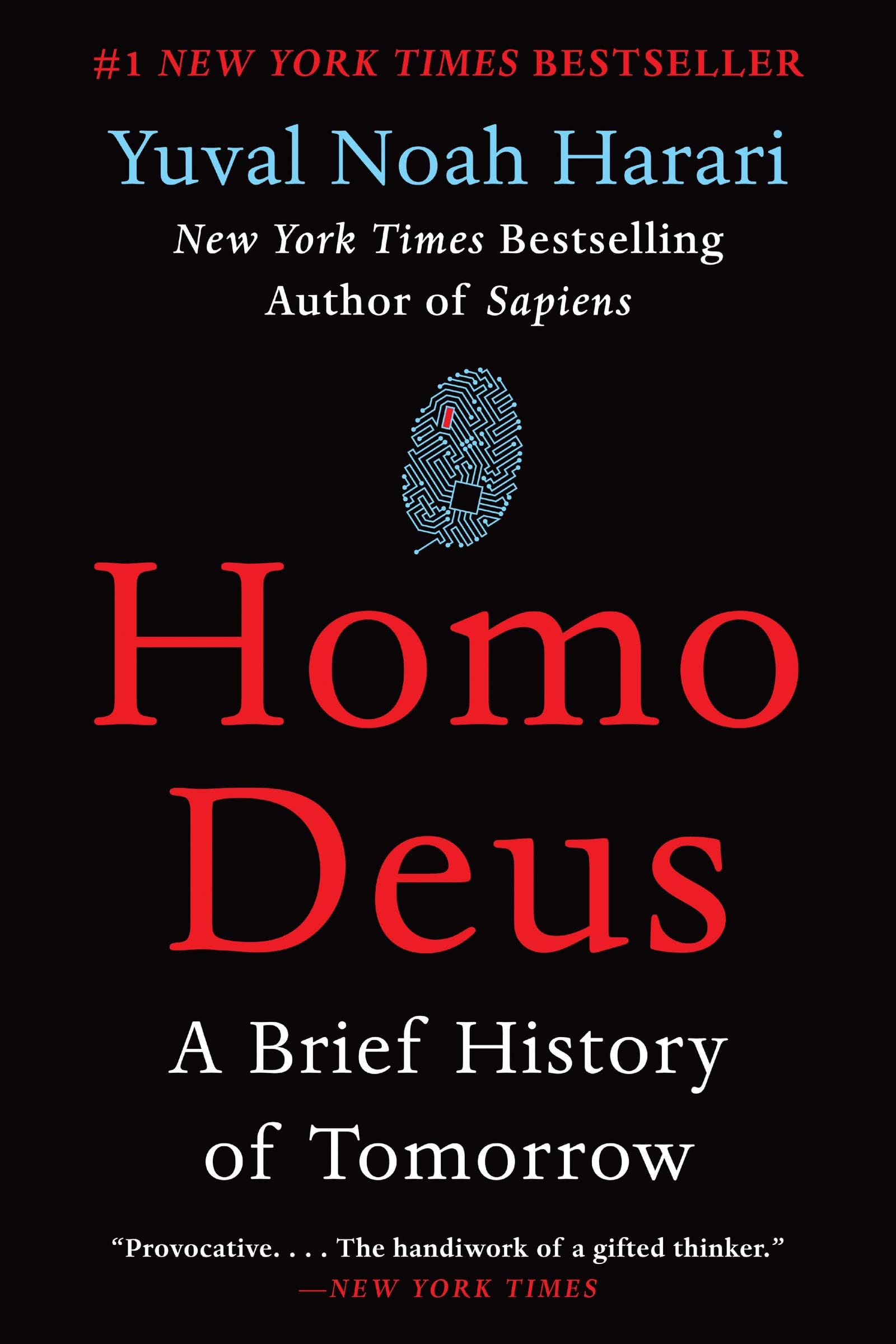
Homo Deus: A Brief History of Tomorrow
Product ID: 105268526
Official U.S. edition with full color illustrations throughout. NEW YORK TIMES BESTSELLER Yuval Noah Harari, author of the critically-acclaimed New York Times bestseller and international phenomenon Sapiens , returns with an equally original, compelling, and provocative book, turning his focus toward the future of humanity, and our quest to upgrade humans into gods. Over the past century humankind has managed to do the impossible and rein in famine, plague, and war. This may seem hard to accept, but, as Harari explains in his trademark style—thorough, yet riveting—famine, plague and war have been transformed from incomprehensible and uncontrollable forces of nature into manageable challenges. For the first time ever, more people die from eating too much than from eating too little; more people die from old age than from infectious diseases; and more people commit suicide than are killed by soldiers, terrorists and criminals put together. The average American is a thousand times more likely to die from binging at McDonalds than from being blown up by Al Qaeda. What then will replace famine, plague, and war at the top of the human agenda? As the self-made gods of planet earth, what destinies will we set ourselves, and which quests will we undertake? Homo Deus explores the projects, dreams and nightmares that will shape the twenty-first century—from overcoming death to creating artificial life and artificial intelligence. It asks the fundamental questions: Where do we go from here? And how will we protect this fragile world from our own destructive powers? This provocative work of popular science is the next stage of evolution. This is Homo Deus . With the same insight and clarity that made Sapiens an international hit and a New York Times bestseller, Harari maps out our future. But as we stand on the verge of godhood, what new challenges will replace the old ones? The New Human Agenda: With famine, plague, and war no longer seen as uncontrollable forces of nature, Harari argues that humanity will aim for immortality, happiness, and divinity. What happens when we try to play God? Upgrading Humankind: Explore the profound implications of biotechnology and genetic engineering as Homo sapiens attempts to evolve into Homo deus . Is this the next stage of evolution, or the beginning of the end? The Rise of Dataism: Discover the emergence of a new religion where information is the ultimate value. What happens to human free will when external algorithms know us better than we know ourselves? The Future of Consciousness: This groundbreaking book examines the decoupling of intelligence from consciousness and asks the fundamental question: will a world dominated by super-intelligence and AI have any room left for the human spirit? Review: Humans are toast; the data religion will rule - Most of this is not about “tomorrow” but about yesterday and today. Most of the material that pertains most directly to the future begins with Chapter 8 which is two-thirds of the way into the book. But no matter. This is another brilliant book by the very learned and articulate Professor Harari. It should be emphasized that Harari is by profession a historian. It is remarkable that he can also be not only a futurist but a pre-historian as well as evidenced by his previous book, “Sapiens.” This quote from page 15 may serve as a point of departure: “Previously the main sources of wealth were material assets such as gold mines, wheat fields and oil fields. Today the main source of wealth is knowledge.” (p. 15) In the latter part of the book Harari defines this knowledge more precisely as algorithms. We and all the plants in the ground and all fish in the sea are biological algorithms. There is no “self,” no free will, no individuals (he says we are “dividuals”) no God in the sky, and by the way, humans as presently constituted are toast. The interesting thing about all this from my point of view is that I agree almost completely. I came to pretty much the same conclusions in my book, “The World Is Not as We Think It Is” several years ago. What I want to do in this review is present a number of quotes from the book and make brief comments on them, or just let them speak for themselves. In this manner I think the reader can see how beautifully Harari writes and how deep and original a thinker he is. “Islamic fundamentalists could never have toppled Saddam Hussein by themselves. Instead they enraged the USA by the 9/11 attacks, and the USA destroyed the Middle Eastern china shop for them. Now they flourish in the wreckage.” (p. 19) Notice “fundamentalists” instead of “terrorists.” This is correct because ISIS, et al., have been financed by Muslim fundamentalists in places like Saudi Arabia. “You want to know how super-intelligent cyborgs might treat ordinary flesh-and-blood humans? Better start by investigating how humans treat their less intelligent animal cousins.” (p. 67) Harari speaks of a “web of meaning” and posits, “To study history means to watch the spinning and unravelling of these webs, and to realise that what seems to people in one age the most important thing in life becomes utterly meaningless to their descendants.” (p. 147) One of the themes begun in “Sapiens” and continued here is the idea that say 20,000 years ago humans were not only better off than they were in say 1850, but smarter than they are today. (See e.g., page 176 and also page 326 where Harari writes that it would be “immensely difficult to design a robotic hunter-gatherer” because of the great many skills that would have to be learned.) In “The World Is Not as We Think It Is” I express it like this: wild animals are smarter than domesticated animals; humans have domesticated themselves. For Harari Nazism, Communism, “liberalism” humanism, etc. are religions. I put “liberalism” in quotes because Harari uses the term in a historical sense not as the opposite of conservatism in the contemporary parlance. “For religions, spirituality is a dangerous threat.” (p. 186) I would add that religions are primarily social and political organizations. “If I invest $100 million searching for oil in Alaska and I find it, then I now have more oil, but my grandchildren will have less of it. In contrast, if I invest $100 million researching solar energy, and I find a new and more efficient way of harnessing it, then both I and my grandchildren will have more energy.” (p. 213) “The greatest scientific discovery was the discovery of ignorance.” (p. 213) On global warming: “Even if bad comes to worse and science cannot hold off the deluge, engineers could still build a hi-tech Noah’s Ark for the upper caste, while leaving billions of others to drown….” (p. 217) “More than a century after Nietzsche pronounced Him dead, God seems to be making a comeback. But this is a mirage. God is dead—it’s just taking a while to get rid of the body.” (p. 270) “…desires are nothing but a pattern of firing neurons.” (p. 289) Harari notes that a cyber-attack might shut down the US power grid, cause industrial accidents, etc., but also “wipe out financial records so that trillions of dollars simply vanish without a trace and nobody knows who owns what.” (p. 312) Now THAT ought to scare the bejesus out of certain members of the one percent! On the nature of unconscious cyber beings, Harari asserts that for armies and corporations “intelligence is mandatory but consciousness is optional.” (p. 314) This seems obvious but I would like to point out that what “consciousness” is is unclear and poorly defined. While acknowledging that we’re not there yet, Harari thinks it’s possible that future fMRI machines could function as “almost infallible truth machines.” Add this to all the knowledge that Facebook and Google have on each of us and you might get a brainstorm: totalitarianism for humans as presently constituted is inevitable. One of conundrums of the not too distance future is what are we going to do with all the people who do not have jobs, the unemployable, what Harari believes may be called the “useless class”? Answer found elsewhere: a guaranteed minimum income (GMI). Yes, with cheap robotic labor and AI, welfare is an important meme of the future. Harari speculates on pages 331 and 332 that artificial intelligence might “exterminate human kind.” Why? For fear humans will pull the plug. Harari mentions “the motivation of a system smarter than” humans. My problem with this is that machines, unless it is programmed in, have no motivations. However it could be argued that they must be programmed in such a way as to maintain themselves. In other words they do have a motivation. Recently I discussed this with a friend and we came to the conclusion that yes the machines will protect themselves and keep on keeping on, but they would not reproduce themselves because new machines would be taking resources from themselves. Harari believes that we have “narrating selves” that spew out stories about why we do what we do, narratives that direct our behavior. He believes that with the mighty algorithms to come—think Google, Microsoft and Facebook being a thousand times more invasive and controlling so that they know more about us than we know about ourselves. Understanding this we will have to realize that we are “integral parts of a huge global network” and not individuals. (See e.g., page 343) Harari even sees Google voting for us (since it will know our desires and needs better than we do). (p. 344) After the election of Trump in which some poor people voted to help billionaires get richer and themselves poorer, I think perhaps democracy as presently practiced may go the way of the dodo. An interesting idea taking this further is to imagine as Harari does that Google, Facebook, et al. in say the personification of Microsoft’s Cortana, become first oracles, then agents for us and finally sovereigns. God is dead. Long live God. Along the way we may find that the books you read “will read you while you reading them.” (p. 349) In other words what is coming are “techno-religions” which Harari sees as being of two types: “techno-humanism and data religion.” He writes that “the most interesting place in the world from a religious perspective is…Silicon Valley.” (p. 356) The last chapter in the book, Chapter 11 is entitled “The Data Religion” in which the Dataists create the “Internet-of-All-Things.” Harari concludes, “Once this mission is accomplished, Homo sapiens will vanish.” (p. 386) --Dennis Littrell, author of “Hard Science and the Unknowable” Review: Homo Deus is a must read for modern Sapiens - Harari hits another home run. I love the subtitle of this book, A Brief History of Tomorrow. And Harari builds a solid case for his views of how the world of technology might blend with or destroy Homo Sapiens. His book is broken into three parts and takes us through human history (much more detail in Harari’s book Sapiens: A brief history of humankind), how we add meaning to the world and then how we lose control. Premise: The New Human Agenda In Chapter 1, Harari suggests that there is an entirely new agenda for human beings. What will we strive for? We have never settled for our achievements but rather we crave for more, better, faster, different. “And having raised humanity above the beastly level of survival struggles, we will now aim to upgrade humans into gods, and turn Homo sapiens into Homo deus.”—Harari, Yuval Noah. Homo Deus: A Brief History of Tomorrow (p. 21). HarperCollins. Kindle Edition. The hypothesis is that we will not be satisfied to do any less than continue down the path that technology and so-called Artificial Intelligence is paving for us. Part I: Homo Sapiens Conquers the World In Chapters 2 & 3, Harari takes us through a brief history of the Anthropocene period and how the human “spark” ignited the creation of a totally new world. He asks three provocative questions, and then goes about answering them: What is the difference between humans and all other animals? How did our species conquer the world? Is Homo sapiens a superior life form, or just the local bully? From these questions and Harari’s astute observations, we learn that no matter what we think, we humans will shape our world and create a religion to follow. What will the next religion be? Part II: Homo Sapiens Gives Meaning to the World Again, three questions set up this section of the book: What kind of world did humans create? How did humans become convinced that they not only control the world, but also give it meaning? How did humanism – the worship of humankind – become the most important religion of all? In Chapters 4 through 7 Harari takes us through the history of how humans created meaning for themselves through a framework of beliefs we call religion. From the storytellers to the Humanist revolution, we see how Homo sapiens wrestle with nature and human nature for control and destiny. “Yet in fact modernity is a surprisingly simple deal. The entire contract can be summarised in a single phrase: humans agree to give up meaning in exchange for power.” (p. 199) Part III: Homo Sapiens Loses Control Up until this section, Harari spent most of his time discussing how we got to where we find ourselves today. And now we find several hypotheses or scenarios for the future. And as usual, three questions: Can humans go on running the world and giving it meaning? How do biotechnology and artificial intelligence threaten humanism? Who might inherit humankind, and what new religion might replace humanism? Chapters 8 through 11 takes us on a journey from the time bomb in the laboratory (no free will) to the new Data Religion. “For example, when a neuron fires an electric charge, this may be either a deterministic reaction to external stimuli, or perhaps the outcome of a random event such as the spontaneous decomposition of a radioactive atom. Neither option leaves any room for free will. Decisions reached through a chain reaction of biochemical events, each determined by a previous event, are certainly not free. Decisions resulting from random subatomic accidents aren’t free either; they are just random. And when random accidents combine with deterministic processes, we get probabilistic outcomes, but this too doesn’t amount to freedom.” (pp. 282-283) In other words, “Free will exists only in the imaginary stories we humans have invented.” This undermines the story we tell about our liberal philosophy and also undermines the concept of the individual. A scenario for the future is that we humans will become gods in our own minds—for a while at least. Harari suggests that, “Since intelligence is decoupling from consciousness, and since non-conscious intelligence is developing at breakneck speed, humans must actively upgrade their minds if they want to stay in the game.” He calls this new religion “Techno-humanism.” Dataism In Chapter 11, Harari introduces Dataism. Dataism declares that the universe consists of data flows, and the value of any phenomenon or entity is determined by its contribution to data processing. This may strike you as some eccentric fringe notion, but in fact it has already conquered most of the scientific establishment. (p. 367) Dataism declares that organisms are algorithms. And, Harari states, that this is the current scientific dogma. He goes on to say that, “If humankind is indeed a single data-processing system, what is its output? Dataists would say that its output will be the creation of a new and even more efficient data-processing system, called the Internet-of-All-Things. Once this mission is accomplished, Homo sapiens will vanish.” Read This Book! No short review can do this book justice. It is my opinion that we all need to be thinking deeply about this topic. Where are we humans taking our species? How will we find meaning in the future? I leave you with one last quotation from the book: “Sapiens evolved in the African savannah tens of thousands of years ago, and their algorithms are just not built to handle twenty-first-century data flows. We might try to upgrade the human data-processing system, but this may not be enough. The Internet-of-All-Things may soon create such huge and rapid data flows that even upgraded human algorithms would not be able to handle them. When cars replaced horse-drawn carriages, we didn’t upgrade the horses – we retired them. Perhaps it is time to do the same with Homo sapiens.”—Harari, Yuval Noah. Homo Deus: A Brief History of Tomorrow (p. 388). HarperCollins. Kindle Edition. I hope you will get the book and make time to give it a thoughtful reading.


| Best Sellers Rank | #17,357 in Kindle Store ( See Top 100 in Kindle Store ) #1 in History of Biology & Nature #2 in Physics of Time (Kindle Store) #3 in Evolution (Kindle Store) |
D**L
Humans are toast; the data religion will rule
Most of this is not about “tomorrow” but about yesterday and today. Most of the material that pertains most directly to the future begins with Chapter 8 which is two-thirds of the way into the book. But no matter. This is another brilliant book by the very learned and articulate Professor Harari. It should be emphasized that Harari is by profession a historian. It is remarkable that he can also be not only a futurist but a pre-historian as well as evidenced by his previous book, “Sapiens.” This quote from page 15 may serve as a point of departure: “Previously the main sources of wealth were material assets such as gold mines, wheat fields and oil fields. Today the main source of wealth is knowledge.” (p. 15) In the latter part of the book Harari defines this knowledge more precisely as algorithms. We and all the plants in the ground and all fish in the sea are biological algorithms. There is no “self,” no free will, no individuals (he says we are “dividuals”) no God in the sky, and by the way, humans as presently constituted are toast. The interesting thing about all this from my point of view is that I agree almost completely. I came to pretty much the same conclusions in my book, “The World Is Not as We Think It Is” several years ago. What I want to do in this review is present a number of quotes from the book and make brief comments on them, or just let them speak for themselves. In this manner I think the reader can see how beautifully Harari writes and how deep and original a thinker he is. “Islamic fundamentalists could never have toppled Saddam Hussein by themselves. Instead they enraged the USA by the 9/11 attacks, and the USA destroyed the Middle Eastern china shop for them. Now they flourish in the wreckage.” (p. 19) Notice “fundamentalists” instead of “terrorists.” This is correct because ISIS, et al., have been financed by Muslim fundamentalists in places like Saudi Arabia. “You want to know how super-intelligent cyborgs might treat ordinary flesh-and-blood humans? Better start by investigating how humans treat their less intelligent animal cousins.” (p. 67) Harari speaks of a “web of meaning” and posits, “To study history means to watch the spinning and unravelling of these webs, and to realise that what seems to people in one age the most important thing in life becomes utterly meaningless to their descendants.” (p. 147) One of the themes begun in “Sapiens” and continued here is the idea that say 20,000 years ago humans were not only better off than they were in say 1850, but smarter than they are today. (See e.g., page 176 and also page 326 where Harari writes that it would be “immensely difficult to design a robotic hunter-gatherer” because of the great many skills that would have to be learned.) In “The World Is Not as We Think It Is” I express it like this: wild animals are smarter than domesticated animals; humans have domesticated themselves. For Harari Nazism, Communism, “liberalism” humanism, etc. are religions. I put “liberalism” in quotes because Harari uses the term in a historical sense not as the opposite of conservatism in the contemporary parlance. “For religions, spirituality is a dangerous threat.” (p. 186) I would add that religions are primarily social and political organizations. “If I invest $100 million searching for oil in Alaska and I find it, then I now have more oil, but my grandchildren will have less of it. In contrast, if I invest $100 million researching solar energy, and I find a new and more efficient way of harnessing it, then both I and my grandchildren will have more energy.” (p. 213) “The greatest scientific discovery was the discovery of ignorance.” (p. 213) On global warming: “Even if bad comes to worse and science cannot hold off the deluge, engineers could still build a hi-tech Noah’s Ark for the upper caste, while leaving billions of others to drown….” (p. 217) “More than a century after Nietzsche pronounced Him dead, God seems to be making a comeback. But this is a mirage. God is dead—it’s just taking a while to get rid of the body.” (p. 270) “…desires are nothing but a pattern of firing neurons.” (p. 289) Harari notes that a cyber-attack might shut down the US power grid, cause industrial accidents, etc., but also “wipe out financial records so that trillions of dollars simply vanish without a trace and nobody knows who owns what.” (p. 312) Now THAT ought to scare the bejesus out of certain members of the one percent! On the nature of unconscious cyber beings, Harari asserts that for armies and corporations “intelligence is mandatory but consciousness is optional.” (p. 314) This seems obvious but I would like to point out that what “consciousness” is is unclear and poorly defined. While acknowledging that we’re not there yet, Harari thinks it’s possible that future fMRI machines could function as “almost infallible truth machines.” Add this to all the knowledge that Facebook and Google have on each of us and you might get a brainstorm: totalitarianism for humans as presently constituted is inevitable. One of conundrums of the not too distance future is what are we going to do with all the people who do not have jobs, the unemployable, what Harari believes may be called the “useless class”? Answer found elsewhere: a guaranteed minimum income (GMI). Yes, with cheap robotic labor and AI, welfare is an important meme of the future. Harari speculates on pages 331 and 332 that artificial intelligence might “exterminate human kind.” Why? For fear humans will pull the plug. Harari mentions “the motivation of a system smarter than” humans. My problem with this is that machines, unless it is programmed in, have no motivations. However it could be argued that they must be programmed in such a way as to maintain themselves. In other words they do have a motivation. Recently I discussed this with a friend and we came to the conclusion that yes the machines will protect themselves and keep on keeping on, but they would not reproduce themselves because new machines would be taking resources from themselves. Harari believes that we have “narrating selves” that spew out stories about why we do what we do, narratives that direct our behavior. He believes that with the mighty algorithms to come—think Google, Microsoft and Facebook being a thousand times more invasive and controlling so that they know more about us than we know about ourselves. Understanding this we will have to realize that we are “integral parts of a huge global network” and not individuals. (See e.g., page 343) Harari even sees Google voting for us (since it will know our desires and needs better than we do). (p. 344) After the election of Trump in which some poor people voted to help billionaires get richer and themselves poorer, I think perhaps democracy as presently practiced may go the way of the dodo. An interesting idea taking this further is to imagine as Harari does that Google, Facebook, et al. in say the personification of Microsoft’s Cortana, become first oracles, then agents for us and finally sovereigns. God is dead. Long live God. Along the way we may find that the books you read “will read you while you reading them.” (p. 349) In other words what is coming are “techno-religions” which Harari sees as being of two types: “techno-humanism and data religion.” He writes that “the most interesting place in the world from a religious perspective is…Silicon Valley.” (p. 356) The last chapter in the book, Chapter 11 is entitled “The Data Religion” in which the Dataists create the “Internet-of-All-Things.” Harari concludes, “Once this mission is accomplished, Homo sapiens will vanish.” (p. 386) --Dennis Littrell, author of “Hard Science and the Unknowable”
D**R
Homo Deus is a must read for modern Sapiens
Harari hits another home run. I love the subtitle of this book, A Brief History of Tomorrow. And Harari builds a solid case for his views of how the world of technology might blend with or destroy Homo Sapiens. His book is broken into three parts and takes us through human history (much more detail in Harari’s book Sapiens: A brief history of humankind), how we add meaning to the world and then how we lose control. Premise: The New Human Agenda In Chapter 1, Harari suggests that there is an entirely new agenda for human beings. What will we strive for? We have never settled for our achievements but rather we crave for more, better, faster, different. “And having raised humanity above the beastly level of survival struggles, we will now aim to upgrade humans into gods, and turn Homo sapiens into Homo deus.”—Harari, Yuval Noah. Homo Deus: A Brief History of Tomorrow (p. 21). HarperCollins. Kindle Edition. The hypothesis is that we will not be satisfied to do any less than continue down the path that technology and so-called Artificial Intelligence is paving for us. Part I: Homo Sapiens Conquers the World In Chapters 2 & 3, Harari takes us through a brief history of the Anthropocene period and how the human “spark” ignited the creation of a totally new world. He asks three provocative questions, and then goes about answering them: What is the difference between humans and all other animals? How did our species conquer the world? Is Homo sapiens a superior life form, or just the local bully? From these questions and Harari’s astute observations, we learn that no matter what we think, we humans will shape our world and create a religion to follow. What will the next religion be? Part II: Homo Sapiens Gives Meaning to the World Again, three questions set up this section of the book: What kind of world did humans create? How did humans become convinced that they not only control the world, but also give it meaning? How did humanism – the worship of humankind – become the most important religion of all? In Chapters 4 through 7 Harari takes us through the history of how humans created meaning for themselves through a framework of beliefs we call religion. From the storytellers to the Humanist revolution, we see how Homo sapiens wrestle with nature and human nature for control and destiny. “Yet in fact modernity is a surprisingly simple deal. The entire contract can be summarised in a single phrase: humans agree to give up meaning in exchange for power.” (p. 199) Part III: Homo Sapiens Loses Control Up until this section, Harari spent most of his time discussing how we got to where we find ourselves today. And now we find several hypotheses or scenarios for the future. And as usual, three questions: Can humans go on running the world and giving it meaning? How do biotechnology and artificial intelligence threaten humanism? Who might inherit humankind, and what new religion might replace humanism? Chapters 8 through 11 takes us on a journey from the time bomb in the laboratory (no free will) to the new Data Religion. “For example, when a neuron fires an electric charge, this may be either a deterministic reaction to external stimuli, or perhaps the outcome of a random event such as the spontaneous decomposition of a radioactive atom. Neither option leaves any room for free will. Decisions reached through a chain reaction of biochemical events, each determined by a previous event, are certainly not free. Decisions resulting from random subatomic accidents aren’t free either; they are just random. And when random accidents combine with deterministic processes, we get probabilistic outcomes, but this too doesn’t amount to freedom.” (pp. 282-283) In other words, “Free will exists only in the imaginary stories we humans have invented.” This undermines the story we tell about our liberal philosophy and also undermines the concept of the individual. A scenario for the future is that we humans will become gods in our own minds—for a while at least. Harari suggests that, “Since intelligence is decoupling from consciousness, and since non-conscious intelligence is developing at breakneck speed, humans must actively upgrade their minds if they want to stay in the game.” He calls this new religion “Techno-humanism.” Dataism In Chapter 11, Harari introduces Dataism. Dataism declares that the universe consists of data flows, and the value of any phenomenon or entity is determined by its contribution to data processing. This may strike you as some eccentric fringe notion, but in fact it has already conquered most of the scientific establishment. (p. 367) Dataism declares that organisms are algorithms. And, Harari states, that this is the current scientific dogma. He goes on to say that, “If humankind is indeed a single data-processing system, what is its output? Dataists would say that its output will be the creation of a new and even more efficient data-processing system, called the Internet-of-All-Things. Once this mission is accomplished, Homo sapiens will vanish.” Read This Book! No short review can do this book justice. It is my opinion that we all need to be thinking deeply about this topic. Where are we humans taking our species? How will we find meaning in the future? I leave you with one last quotation from the book: “Sapiens evolved in the African savannah tens of thousands of years ago, and their algorithms are just not built to handle twenty-first-century data flows. We might try to upgrade the human data-processing system, but this may not be enough. The Internet-of-All-Things may soon create such huge and rapid data flows that even upgraded human algorithms would not be able to handle them. When cars replaced horse-drawn carriages, we didn’t upgrade the horses – we retired them. Perhaps it is time to do the same with Homo sapiens.”—Harari, Yuval Noah. Homo Deus: A Brief History of Tomorrow (p. 388). HarperCollins. Kindle Edition. I hope you will get the book and make time to give it a thoughtful reading.
M**T
Entertaining if presumptuous take on the future of mankind
God-Man is what this title means, but the content isn’t quite so literal. There are no themes in this book that haven’t been dealt with by numerous science fiction novels. But this isn’t supposed to be fiction, instead a sober look at where the history of humans, coupled with the technology of the twenty-first century, is taking us. So where is that? The author cites three overall goals motivating humanity since its inception, and, according to Harari, now nascent and imbedded in modern technology. They are: (1) to be ageless, literally to live forever (beginning with living much longer than we do now) provided that we are not killed in accidents or murdered, (2) to be happy always, and (3) to acquire god-like (small ‘g’) powers of mind and body through mechanics, genetics, and cybernetics, All of these are, he thinks, possible in the next 50 or so years despite the first’s violating the second law of thermodynamics, the second being a mental state that appears to demand an occasional (at least) lapse into something else to reset itself, leaving the third as the only one understood well enough to be achievable in some measure. Interestingly, achieving the third goal would have the most predictable negative impact on our present value systems and ways of life–illustrated to chilling effect in his last chapter. Putting it bluntly, post-sapiens humans take over the world, enslaving (or just eliminating, there being no further need for human labor) the rest of us. In a further twist, cybernetic intelligence eventually eliminates even those quasi-sapiens for its own sake, there being no further need for humans of any sort. Concerning these specific prognostications, Harari gives himself an out. This is only speculation. The future is open, and there are many ways our technology might develop, and not everything we want may be possible. He also understands that perhaps time is not on our side. Some near future events (global nuclear war or civilizational collapse due to climate or ecological disaster) might derail our progress. Concerning the foundational assumptions of his projections, what makes them reasonable (and possible), he leaves himself no wiggle room. Three things he assures us must be true: (1) the universe is entirely physical (no God, no extra-physical mind). As a consequence (2), free will is an illusion, and (3) so is the self. This leads him down a path of epistemic nihilism. Our brains react to every sensory input and make every decision some seconds (or fractions of seconds) before we are even aware of them. Our experiential arena is subjectively real (how this is given there is no subject) but has no impact whatsoever on what we think, feel, or do–there being no individual “us” anyway. The absurd consequences of these assumptions (he is not alone in believing these and cites long-challenged experiments purporting to prove them), for example, that there is no “he,” no Yuval Harari to whom we might give credit for this book, escape him. Homo Deus is rich with philosophical implications, but the author is writing from a historical perspective and a forecast of “future history.” He is not trying to do philosophy, so I leave explorations of these implications for a blog essay. The book is well-written and entertaining. His take on human history from the paleolithic to the Enlightenment, the book’s part one, is novel. He credits literal religion (among other things) with pushing mankind forward until our own discoveries dethroned it, installing a new [metaphorical] religion, Humanism, the book’s part two, which brought us to the edge of the present age. Humanism is to be dethroned now, part three, and yet another [metaphorical] religion Harari calls Dataism is emerging. This overall thesis is coherent given his assumptions and gracefully presented with considerable humor, so four stars, even if it is more than a bit presumptuous!
P**R
Intriguing and profound
Sapiens is among my favorite books, and its full of fascinating ideas. To my eyes, that book firmly established that its the Inter-subjective realm (our ability to create and share fictions) that gives humanity its power in nature, and essentially separates us from other animals. He makes an absolutely compelling and practical case for that. I managed to get through years of College philosophy without realizing anything even remotely similar to that. And how that has changed my worldview! Ever since I read that book I can understand better the madness of the modern world; our religions, nation-states, companies and media personalities. What was formerly incomprehensible; people glued to their cell phones and Facebook profiles, throngs chanting midevil rituals on Sunday, wild celebrity worship, bizarre legal and religious doctrines, bureaucracy and its true power, all these mysteries are suddenly clear and connected thanks to Sapiens. Homo Deus summarizes the fundamentals of Sapiens in the first half of the book. Then it goes to dramatic new places which are a projection and warning about modern technologies and trends. To me his writing is always carefully and reasonably articulated and he states plainly when and where he is speculating. Sure he draws many extrapolations forward but that's the point of this book! When he presupposes he admits it as such, exactly as he did in Sapiens. If the 20th Century was really was a war among Humanist sects (as he contends)...then the advances of 21st Century science and technology are beginning to chip away at what has been assumed to be our sacred and individual human essence. That's an idea with major implications. Do you agree that Humanism is the modern world's primary underlying religion and that it is now (possibly) in danger? After some consideration, I agree with the notion, and also that it seems to be at risk as new discoveries chip away at the sacred notion of self. Everything that underpins the modern world: consumerism (the customer is always right), our political system (democratic voting), and our psychology (do what feels right) are all based on the assumption that the 'self' is irreducible. But what if that 'self' isn't so clear or autonomous? It appears less so every day, as computer/person hybrid thinking becomes more common (think GPS navigation), and as new understandings emerge about what makes us, well...US. Meanwhile, computer AI advances accelerate at an insane pace, doing things declared previously impossible only months earlier. Medicine does the same. New cheaper DNA sequencing and practical DNA splicing/editing reveal mechanics that underlie our physiology and psychology. And hey, we're on the verge of 3d printing organs! Even without something like an AI consciousness emerging, the fact is that most of what we do really can be off-loaded to more efficient computer algorithms. When today the most powerful entities in the world are not people but rather inter-subjective entities like Google, will our children's world still be ruled by the 'sacred' self? Can that 'sacred' self be defined clearly, or rather manipulated, ostracized, dissected, distracted, drug-altered, or click-baited one way or another? Or is that not already a pretty darn good description of our modern world? You be the judge, but this book speculates reasonably about plenty of reasons to be nervous.
W**N
Plenty to ponder
This is the most challenging book I’ve read since – well perhaps ever, not because the author’s style is in any way difficult but because it challenged my basic beliefs of about everything from the first page. The first two thirds of the book bring us up to date from the time of the primordial ooze to the present; then the author takes all of the knowledge we have acquired in all the sciences and arts and basically debunks much of it, and quite effectively. Spoiler alert: this book is not for the seriously religious among us. He makes no bones about it: God is dead and has been for most moderns for several centuries. He assumes his readers are liberal humanists and wastes little time defending his position; that given, he allows us to keep our religion as the useful fount of morality since we’re not very good creatures without it. But make no mistake there’s no real God in this religion. Modern liberal humanism allowed us – all of us moderns – to throw off religion although it gave thousands of years of satisfaction to our forbears by promising them meaningful survival after death if not in this life. Humanism gave us liberty and freedom and provided meaning for us while we strode the planet through love, art, scientific achievement, business acumen, governance or anything else that we might favor. But that left us relatively empty and that’s when we brought back the trappings of religion to provide us with a little comfort. After establishing us as the dominant species and killing off all that had made life unbearable for our ancestors, he states that we really have no free will which is the basis of liberal humanism. Between biology and computer science and neurobiology, science has concluded our minds are simply mathematical algorithms. These algorithms have been honed by eons of evolution to provide us with the best possible outcomes from flight or fight and for passing along our best genetic outcomes. But, but along come supercomputing algorithms which even now in the hands of Google, Microsoft, Facebook and others are beginning to know us better than we can possibly know ourselves. These algorithms make human decision making obsolete since we just can’t know ourselves as well as the algorithms and thus cannot compete with them in knowing ourselves and for making our best personal decisions. The author discusses many of the long held positions of members of this group and more often than not blows holes in each of our favorite positions. Walt’s fear of cyber warfare (no debunking here); Walt and Frank’s faith in job retraining; my concern AI will displace almost all workers; the fear – held by none of us that – computers will do away with humans; and many others are trotted out and handled with great skill…if not entirely believably. While I’d give it less than five stars on Amazon’s scale, it held my attention for the days it took me to read it. The first two thirds are absolutely devastating to my long held views on many subjects particularly free will. As a liberal humanist from my youth, free will has always been front and center in my thinking. Harari makes a strong case against this and while I reject the point, I can martial few answers to reject it. The final third contains Harari’s views on the most likely futures for the world and its human inhabitants. While I’ve argued that computers and artificial intelligence will probably wipe out more jobs than it creates, he takes it – in the very out years – that these forces may wind up with no use for us and could let us die or even exterminate us. That was far too dystopian for me and I rejected most of what he says the further he gets from our time. The guy has a very fluid style and I recommend the read highly. Beyond the review of content, the book while ONLY about 450 pages, including notes and index, it is printed on high quality heavy paper and it actually hurt my hands to read for long periods.
M**E
important for developing a perspective about the future
I liked the approach to developing a "history of tomorrow". Dr. Harari set the stage by discussing a panoramic view of history, and emphasizing human narratives and their importance for history. A principal aspect of this is that narratives change and evolve much more rapidly than we can biologically. They can provide our lives with reference points and establish meaning in the context of the world. These narratives are just slivers of the total spectrum of possibility. They not only help us understand the larger scheme and meaning of our lives, but can guide impersonal efforts such as the development of science or technology. Even when they revolve around fantasies and dreams and illusions, they can be extremely important in our lives. Dr. Harari takes, as his stepping off point for the future, a modern narrative or myth, namely liberal humanism, which he is careful to define, and place in context with the great struggles with communism and Nazism in the twentieth century. He sees the modern humanism as one that now regards the pressing human problems associated with economics, politics and social systems as technical problems that experts and specialists in science and technology can solve for us. He emphasizes the importance of capitalism. In contrast to this positive view, which would merely see, as the future unfolds, further successes of liberal humanism, he exposes what he sees as the outright fantasies of humanism. He thinks that one of these fantasies is the notion of "free will". When the limitations of liberal humanism confront the modern progress, especially in biology and computer science, and the enormous recent surge in the importance of algorithms and data streams, Dr. Harari spins for us new narratives. In one, for example, he sees the possibility of the essential extinction of humanity in the rise of a data stream religion. To discuss this, he must broaden the concept of religion considerably over its narrow traditional meaning. In another narrative, he pictures the rise of the superhuman, a small elite group, probably coming out of the wealthy, that will separate humanity into a very, very large class of essentially useless (because their places in the world of productivity and work have been taken over by automation) people, and this small group of superhumans. Overall, the clarity of his presentation can be very helpful in not only thinking about the future, but in considering the present moment as well. I recommend this for anyone who is interested in developing a perspective about the future.
K**.
Interesting but perhaps too bold
Harari is a good writer, but I often find the way he forms his arguments in this book to be a bit frustrating. It's true that he says none of these are "prophecies" but possibilities. On the other hand, these scenarios must not be too improbable or else they wouldn't even be worth talking about. Anyway, Harari lays out the progress humanity has made, and points out that the future may have some radical changes that will not allow the same paradigm that got us here to continue forward. What I find frustrating is that he lays out definitions and arguments that without a few caveats are way too broad. For example he has his own definition of humanism, and says things like "while theists worship theos (Greek for 'god'), humanists worship humans". If all that is meant by worship is afforded great respect, then sure, but it certainly seems like humanists do not worship humans like theists worship God (something I would think both theists and humanists would agree on). I'd prefer that he acknowledge that sometimes when he uses words, he isn't using them as we would colloquially use them. As an aside, I'd say he botches a concept in quantum mechanics by off-handedly saying that it allows "a cat can be both alive and dead at the same time" which is not what quantum mechanics says. The cat's state may be in a superposition of alive and dead to a particular observer, but that doesn't mean it is both alive and dead at the same time. Certainly, to the cat, it is never both alive and dead. Harari also makes statements that don't seem like they could be knowable. Like robots do not feel things and that animals and humans do. I have no idea how he can know this. This is especially confusing since he even brings up the problem that we cannot know if other beings are conscious, because we cannot be sure anyone else feels anything (the problem of other minds). I certainly understand that in all probability animals are more likely to have a consciousness similar to humans in some way and robots probably do not, but I would prefer Harari just say it that way and explain why. I also just don't find all of his arguments convincing on consciousness as they seem merely to be assertions that we experience things and it isn't clear why we feel an experience. I simply am not sure that there is "more" than saying that people feel things because of reactions in their brains. Harari and many others point out that this doesn't explain why we actually experience things, but I simply don't know that this is a big problem. If we could predict exactly what you are thinking and will do from your brain state, then I don't see why it's so important to understand the "experience" of those brain states to have understanding. As an example Harari states "'anger' isn't an abstract term we have decided to use as a shorthand for billions of electric brain signals. Anger is an extremely concrete experience which people were familiar with long before they knew anything about electricity." I think people knew what pressure was before the discovery of statistical mechanics, but that doesn't change the fact that pressure is a shorthand for billions and billions of molecules reflecting off of a surface. Maybe anger isn't like that, but Harari doesn't provide any reason it must not be a shorthand. Harari also gives a lot of credence to computers getting to know us amazingly well through better computational power, algorithms, and data. I think he often overreaches with this argument, but he's free to explore this possibility. I just wish he'd put caveats on the things he presents. For example he talks about Google Flu Trends, but Google Flu Trends turned out to systematically overpredict flu outbreaks (which I think Harari should have known as the July 2014 Wikipedia entry talks about the problems with the data). The CDC data turned out to be better (though CDC and Google data together did much better), as you can discover by googling google flu trends failure. This is of course just one example, but I think many of the examples Harari gives have similar caveats. They might have amazing power some day, but it seems a lot farther off than Harari acknowledges (at least to me). As one final example, that gives you a flavor of why I found the book frustrating, even if I found it insightful, is his talk of the "modern deal". We're told it requires us to give up meaning for power. But later Harari says "The modern deal offers us power, on condition that we renounce our belief in a great cosmic plan that gives meaning to life. Yet when you examine the deal closely, you find a cunning escape clause". It's not much of a deal if you simply get power in exchange for nothing. I might add more examples some day, but honestly, I think this gives the gist of what I didn't like. The good is that Harari writes clearly, and lays out his arguments systematically, so that you can easily evaluate them yourself. The advantage of his method is that he brings out points of view that are not commonly stated in such an obvious and systematic way. While I disagree with some of his interpretations, Harari does lay out most of the problems of consciousness well, and explores possibilities well if machines become super-intelligent without consciousness.
A**R
A mix of deft writing, sweeping ideas and incomplete speculation: 3.5 stars
Yuval Noah Harari's "Homo Deus" continues the tradition introduced in his previous book "Sapiens": clever, clear and humorous writing, intelligent analogies and a remarkable sweep through human history, culture, intellect and technology. In general it is as readable as "Sapiens" but suffers from a few limitations. On the positive side, Mr. Harari brings the same colorful and thought-provoking writing and broad grasp of humanity, both ancient and contemporary, to the table. He starts with exploring the three main causes of human misery through the ages - disease, starvation and war - and talks extensively about how improved technological development, liberal political and cultural institutions and economic freedom have led to very significant declines in each of these maladies. Continuing his theme from "Sapiens", a major part of the discussion is devoted to shared zeitgeists like religion and other forms of belief that, notwithstanding some of their pernicious effects, can unify a remarkably large number of people across the world in striving together for humanity's betterment. As in "Sapiens", Mr. Harari enlivens his discussion with popular analogies from current culture ranging from McDonald's and modern marriage to American politics and pop music. Mr. Harari's basic take is that science and technology combined with a shared sense of morality have created a solid liberal framework around the world that puts individual rights front and center. There are undoubtedly communities that don't respect individual rights as much as others, but these are usually seen as challenging the centuries-long march toward liberal individualism rather than upholding the global trend. The discussion above covers about two thirds of the book. About half of this material is recycled from "Sapiens" with a few fresh perspectives and analogies. The most important general message that Mr. Harari delivers, especially in the last one third of the book, is that this long and inevitable-sounding imperative of liberal freedom is now ironically threatened by the very forces that enabled it, most notably the forces of technology and globalization. Foremost among these are artificial intelligence (AI) and machine learning. These significant new developments are gradually making human beings cede their authority to machines, in ways small and big, explicitly and quietly. Ranging from dating to medical diagnosis, from the care of the elderly to household work, entire industries now stand to both benefit and be complemented or even superseded by the march of the machines. Mr. Harari speculates about a bold vision in which most manual labor has been taken over by machines and true human input is limited only to a very limited number of people, many of whom because of their creativity and demand will likely be in the top financial echelons of society. How will the rich and the poor live in these societies? We have already seen how the technological decimation of parts of the working class was a major theme in the 2016 election in the United States and the vote for Brexit in the United Kingdom. It was also a factor that was woefully ignored in the public discussion leading up to these events, probably because it is much easier to provoke human beings against other human beings rather than against cold, impersonal machines. And yet it is the cold, impersonal machines which will increasingly interfere with human lives. How will social harmony be preserved in the face of such interference? If people whose jobs are now being done by machines get bored, what new forms of entertainment and work will we have to invent to keep them occupied? Man after all is a thinking creature, and extended boredom can cause all sorts of psychological and social problems. If the division of labor between machines and men becomes extreme, will society fragment into H. G. Wells's vision of two species, one of which literally feeds on the other even as it sustains it? These are all tantalizing as well as concerning questions, but while Mr. Harari does hold forth on them with some intensity and imagination, this part of the book is where his limitations become clear. Since the argument about ceding human authority to machines is also a central one, the omission also unfortunately appears to me to be a serious one. The problem is that Mr. Harari is an anthropologist and social scientist, not an engineer, computer scientist or biologist, and many of the questions of AI are firmly grounded in engineering and software algorithms. There are mountains of literature written about machine learning and AI and especially their technical strengths and limitations, but Mr. Harari makes few efforts to follow them or to explicate their central arguments. Unfortunately there is a lot of hype these days about AI, and Mr. Harari dwells on some of the fanciful hype without grounding us in reality. In short, his take on AI is slim on details, and he makes sweeping and often one-sided arguments while largely skirting clear of the raw facts. The same goes for his treatment for biology. He mentions gene editing several times, and there is no doubt that this technology is going to make some significant inroads into our lives, but what is missing is a realistic discussion of what biotechnology can or cannot do. It is one thing to mention brain-machine interfaces that would allow our brains to access supercomputer-like speeds in an offhand manner; it's another to actually discuss to what extent this would be feasible and what the best science of our day has to say about it. In the field of AI, particularly missing is a discussion of neural networks and deep learning which are two of the main tools used in AI research. Also missing is a view of a plurality of AI scenarios in which machines either complement, subjugate or are largely tamed by humans. When it comes to AI and the future, while general trends are going to be important, much of the devil will be in the details - details which decide how the actual applications of AI will be sliced and diced. This is an arena in which even Mr. Harari's capacious intellect falls short. The ensuing discussion thus seems tantalizing but does not give us a clear idea of the actual potential of machine technology to impact human culture and civilization. For reading more about these aspects, I would recommend books like Nick Bostrom's "Superintelligence", Pedro Domingos's "The Master Algorithm" and John Markoff's "Machines of Loving Grace". All these books delve into the actual details that sum up the promise and fear of artificial intelligence. Notwithstanding these limitations, the book is certainly readable, especially if you haven't read "Sapiens" before. Mr. Harari's writing is often crisp, the play of his words is deftly clever and the reach of his mind and imagination immerses us in a grand landscape of ideas and history. At the very least he gives us a very good idea of how far we as human beings have come and how far we still have to go. As a proficient prognosticator Mr. Harari's crystal ball remains murky, but as a surveyor of past human accomplishments his robust and unique abilities are still impressive and worth admiring.
N**A
Perfect
Perfect
A**R
Great book. My bestie.
One of the best books I've ever read.
J**N
For anyone who likes to challenge their thinking
Terrific and somewhat frightening read, that really gets the thinking juices going. Where are we headed in the information and big data age...
Ł**I
Must-read
I think this book is essential for everyone who wants to understand the chaotic world around us. The author has a unique ability to synthesize scattered pieces of information and build coherent generalizations. At the same time the narration does not force any conclusions, just encourages to draw your own ones. Summing up, if you are looking not just for information, but also for some wisdom, then this is it.
A**L
Make sure you read Sapiens first
A must read after Sapiens.
Trustpilot
3 weeks ago
2 months ago