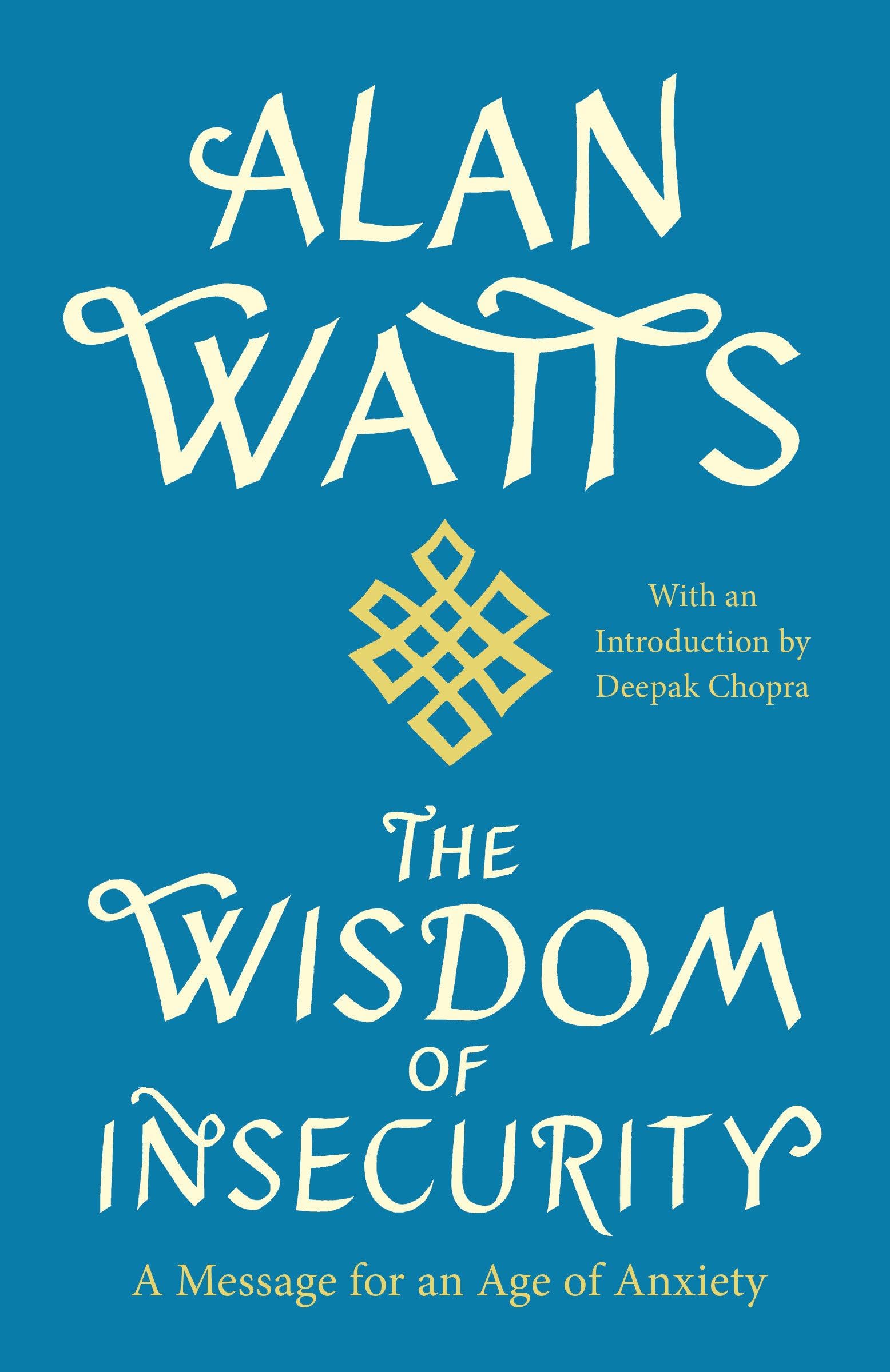
The Wisdom of Insecurity: A Message for an Age of Anxiety
Product ID: 1187748
Buy anything from 5,000+ international stores. One checkout price. No surprise fees. Join 2M+ shoppers on Desertcart.
Desertcart purchases this item on your behalf and handles shipping, customs, and support to Vanuatu.
An acclaimed philosopher shows us how—in an age of unprecedented anxiety—we can find fulfillment by embracing the present and living more fully in the now. He is "the perfect guide for a course correction in life" (from the Introduction by Deepak Chopra). The brain can only assume its proper behavior when consciousness is doing what it is designed for: not writhing and whirling to get out of present experience, but being effortlessly aware of it. Alan Watts draws on the wisdom of Eastern philosophy and religion in this timeless and classic guide to living a more fulfilling life. His central insight is more relevant now than ever: when we spend all of our time worrying about the future and lamenting the past, we are unable to enjoy the present moment—the only one we are actually able to inhabit. Watts offers the liberating message that true certitude and security come only from understanding that impermanence and insecurity are the essence of our existence. He highlights the futility of endlessly chasing moving goalposts, whether they consist of financial success, stability, or escape from pain, and shows that it is only by acknowledging what we do not know that we can learn anything truly worth knowing. In The Wisdom of Insecurity, Watts explains complex concepts in beautifully simple terms, making this the kind of book you can return to again and again for comfort and insight in challenging times. “Perhaps the foremost interpreter of Eastern disciplines for the contemporary West, Watts had the rare gift of ‘writing beautifully the unwritable.’” — Los Angeles Times Review: The best book on reality and living as a human within it. - I have read practically every meditation, Buddhism and philosophic book published during my 60 years on the planet.. This is by far the simplest to understand and the best. You want a firmer grip on the human condition, and how to live in the moment within it? - then this is the book for you. Some of Watts books are not easy to follow- but not this one. Will settle you mind and thoughts and direct you to living this life in the present while enjoying the movement and change inherent in all things. I am on my third marked up copy since I bought my first one years ago. Review: Short but good - This book is an excellent place to start reading philosophy. _The Wisdom of Insecurity_ was obviously written for the layman, making it ideal for those who are new to this type of nonfiction. In it, Alan Watts explains to us various ways of accepting and dealing with anxiety and insecurity in spiritual matters. This technique of acceptance was clearly derived from the Hindu and Buddhist methods of establishing a calm and mellow outlook on life. Like these great Eastern religions, Alan Watts does not try to tackle issues of theological truth head-on, but instead sidesteps the eternal questions. This is not because he is incapable of dealing with more complex metaphysical issues - he does so in great depth in his other, longer works. Neither is this method of sidestepping our sources of anxiety an evasion of rational, empirical truth. This book is not a rigorous empiricist study, and never claimed to be. It is instead a psychotheapeutic work verging on the anti-intellectual, but at the same time embracing meditation and contemplation. Watts shows us ways to act out our love for wisdom and enlightenment by concentrating on the positive and accepting (but not dwelling on) disturbing questions which he considers to be unanswerable. This is not an atheistic work nor is it a tale of despair. This is a work infused with hope, while being mindful of the truth. It succeeds in treading a sort of middle ground between the love of knowledge and anti-intellectualism. The only problem with this book is its short length, although some might consider this an advantage. If you are looking for a more in-depth and rigorous study, try _Behold the Spirit_ or _Psychotherapy East and West_, also by Alan Watts.


| Best Sellers Rank | #5,054 in Books ( See Top 100 in Books ) #3 in Zen Spirituality #9 in Spiritualism #60 in Happiness Self-Help |
| Customer Reviews | 4.6 out of 5 stars 6,756 Reviews |
H**D
The best book on reality and living as a human within it.
I have read practically every meditation, Buddhism and philosophic book published during my 60 years on the planet.. This is by far the simplest to understand and the best. You want a firmer grip on the human condition, and how to live in the moment within it? - then this is the book for you. Some of Watts books are not easy to follow- but not this one. Will settle you mind and thoughts and direct you to living this life in the present while enjoying the movement and change inherent in all things. I am on my third marked up copy since I bought my first one years ago.
R**E
Short but good
This book is an excellent place to start reading philosophy. _The Wisdom of Insecurity_ was obviously written for the layman, making it ideal for those who are new to this type of nonfiction. In it, Alan Watts explains to us various ways of accepting and dealing with anxiety and insecurity in spiritual matters. This technique of acceptance was clearly derived from the Hindu and Buddhist methods of establishing a calm and mellow outlook on life. Like these great Eastern religions, Alan Watts does not try to tackle issues of theological truth head-on, but instead sidesteps the eternal questions. This is not because he is incapable of dealing with more complex metaphysical issues - he does so in great depth in his other, longer works. Neither is this method of sidestepping our sources of anxiety an evasion of rational, empirical truth. This book is not a rigorous empiricist study, and never claimed to be. It is instead a psychotheapeutic work verging on the anti-intellectual, but at the same time embracing meditation and contemplation. Watts shows us ways to act out our love for wisdom and enlightenment by concentrating on the positive and accepting (but not dwelling on) disturbing questions which he considers to be unanswerable. This is not an atheistic work nor is it a tale of despair. This is a work infused with hope, while being mindful of the truth. It succeeds in treading a sort of middle ground between the love of knowledge and anti-intellectualism. The only problem with this book is its short length, although some might consider this an advantage. If you are looking for a more in-depth and rigorous study, try _Behold the Spirit_ or _Psychotherapy East and West_, also by Alan Watts.
J**A
4.5/5; A Great Read
This is the first book by Alan Watts that I’ve read. I’ve seeing him quoted countless times and this book was on a great sale one day so I bought it and started reading. What’s fascinating is he’s writing gives off an impression of being technical but reading it, it just flowed. I really enjoyed it. I look forward to reading more from Alan Watts.
P**F
You Are the Moment
Alan Watts writes with simple, lucid logic that is nearly impossible for me to summarize. His argument holds together like a long string of connected puzzle pieces and to take any out is to lose the impact of his philosophy. I would thoroughly recommend reading Watts’ work, but would recommend against trusting me to accurately convey his system of thought aside from this one major point: live in the present. Watts begins right at the heart of the matter by emphasizing why it is illogical to live for the future or to dwell on the past. He writes, “If happiness always depends on something expected in the future, we are chasing a will-o’-the-wisp that ever eludes our grasp, until the future, and ourselves, vanish into the abyss of death” (15). He takes time to explore how the modern western mind is plagued by anxiety and hope for the future while forgetting that the future is an eternally moving goalpost. While some of his ideas certainly buck the prevailing mindset--especially that held by wide swaths of Christians--Watts proceeds graciously and with respect to the difficulty some will have with digesting the idea that we ought not be fixated on heaven but experience the eternal in the present moment alone. Watts continues with some linguistically based logical arguments exploring the concepts of faith, belief, God. He peppers in difficult concepts and then immediately explains them with such clarity that his system of thought is obviously in concert with the workings of the universe. Watts’ next chapter argues for the need of accepting both pleasure and pain in the present moment and to avoid chasing the future as it invalidates the present. In writing about the pursuit of financial stability, he notes, “Instead of earning a living [many people] are mostly earning an earning and thus when the time comes to relax they are unable to do so” (36). Change, Watts proclaims in his next chapter, is an unchanging reality of life. Everything changes and “when we fail to see that our life is change, we set ourselves against ourselves and become like the Ouroboros” (43). Watts argues that words cannot capture reality, but are only symbols representing parts of the infinitely complex, interconnected universe. He takes time to explore the inadequacy of both science and religion in grasping reality through defining it--a slippery and unsatisfying pursuit. So, what is reality? It is “this ultimate something which cannot be defined or fixed [and] can be represented by the word God” (55). Some more interesting ideas: “Since what we know of the future is made up of purely abstract and logical elements--inferences, guesses, deductions--it cannot be eaten, felt, smelled, seen, heard, or otherwise enjoyed. To pursue it is to pursue a constantly retreating phantom, and the faster you chase it, the faster it runs ahead” (60-61). “The brain can only assume its proper behavior when consciousness is doing what it is designed for: not writhing and whirling to get out of present experience, but being effortlessly aware of it” (73). “A society based on the quest for security is nothing but a breath-retention contest in which everyone is as taut as a drum and as purple as a beet” (78). “The craving for security is itself a pain and a contradiction...the more we pursue it, the more painful it becomes” (78). “To be aware of reality, of the living present, is to discover that each moment the experience is all. There is nothing else beside it--no experience of ‘you’ experiencing the experience” (89). On being the present moment (Watts says we are not to live in the present moment so much as to realize that we inescapably are the present moment) and experiencing pain: “Seeing that there is no escape from the pain, the mind yields to it, absorbs it, and becomes conscious of just pain without any ‘I’ feeling it or resisting it. It experiences pain in the same complete, unselfconscious way in which it experiences pleasure. Pain is the nature of this present moment, and I can only live in this moment...pain and the effort to be separate from it are the same thing” (97-98). “Realize that you live in, that indeed you are this moment now, and no other, that apart from this there is no past and no future, you must relax and taste to the full, whether it be pleasure or pain” (115-116). While some of these notions may seem so abstract, Watts takes time and care to illustrate how Western religions have put forward the same ideas couched in different language and distorted by time. If I keep writing quotations, you’ll eventually read the whole book. Much of the power of Watts’ thought, I’m realizing, cannot be captured in soundbytes, but must be considered in context. I would encourage any reader seeking to find simple fulfillment in the present moment to give Watts a chance. I will certainly return to this book in the future and I look forward to reading more of what Watts has to say. A-
C**S
"Belief clings, but faith lets go."
One of my favorite books of all time. I've reread it more times than any other, but never without reaching new insights and finding new inspiration. It's filled with wisdom like the following: "[I]t is a serious misapplication of psychology to make the presence or absence of neurosis the touchstone of truth, and to argue that if a man's philosophy makes him neurotic, it must be wrong. `Most atheists and agnostics are neurotic, whereas most simple Catholics are happy and at peace with themselves. Therefore the views of the former are false, and of the latter true.' Even if the observation is correct, the reasoning based on it is absurd. It is as if to say, `You say there is a fire in the basement. You are upset about it. Because you are upset, there is obviously no fire." Watts talks about the many subtle proprieties of life in which we are all engaged but which we seldom discuss. Then, the instant you read them, you feel as if your own thoughts had been read aloud. I can't recommend this book highly enough.
T**T
First half is the strongest
In 1951, Alan Watts wrote about the increasing pace of life and the challenges to maintain one's moorings in turbulent times. If only he were around today to see what has happened recent years and to comment accordingly! Perhaps he would give similar advice, as his principles should not be subject to the current events or fashion. His two main themes from my perspective, at least in the first half that I found much more enlightening, were that humans do not need traditional religion and that humans should not fight anxiety. In the first case, his analysis is not that science has solved everything, a topic lively today and likely to continue as a perpetual debate. It is more that the human soul can find nourishment and understanding in other ways, and does not need the tenets of religion to make life whole. He does, however, concede that belief has been undermined by the ceaseless march of human intelligence, while claiming that the coldly intellectual angle often leaves the human soul unsatisfied. Mystery helps feed the mind and spirit. Mr. Watts' insights on anxiety as the necessary complement to freedom and pleasure were particularly succinct and sharp. A favorite quote is, "If, then, we are to be fully human and fully alive and aware, it seems that we must be willing to suffer for our pleasures. Without such willingness there can be no growth in the intensity of consciousness. Yet, generally speaking, we are not willing, and it may be thought strange to suppose that we can be. For 'nature in us' so rebels against pain that the very notion of 'willingness' to put up with it beyond a certain point may appear impossible and meaningless. "Under these circumstances, the life that we live is a contradiction and a conflict. Because consciousness must involve both pleasure and pain, to strive for pleasure to the exclusion of pain is, in effect, to strive for the loss of consciousness. Because such a loss is in principle the same as death, this means that the more we struggle for life (as pleasure), the more we are actually killing what we love." Well stated, obviously, and that is one of many. I endorse the modest length of the book, its lack of deep theological argument, and light touch on Eastern thought. Those topics are best served in other works dedicated to the proper depth and sophistication. I especially recommend a look back at Mr. Watts with the wave of anti-religion books by Hitchens, et al. Read them and compare to Alan Watts.
U**E
Not impressed
I enjoyed reading this book; however, I felt that it was light conjecture and for lack of a better description, off the cuff, perhaps dated. There is one quote, well over halfway into the book that resonated with me, but I have forgotten it by now. That seems to be the case for much of what is stated in this book; the insights don't strike me as rare or what one wouldn't find upon living their own life. It may be possible that these insights were revolutionary when the book was first written, but no longer and this, at least for me, disqualifies the book as a classic. This may be a good starting point for younger people or those who've had little experience with Buddhism, eastern philosophy or reflection in navigating the uncertainty of life. For a better guide, I recommend Phillip Moffett's Dancing with Life: Buddhist Insights for Finding Meaning and Joy in the Face of Suffering, which is wonderful and a book I return to often since its publication in 2008.
J**R
Great book by a wonderful author!
Great read! Highly recommended!
R**O
Mesmerised
A book that everyone should read.
S**I
Great book
Brilliant book for understanding how to experience life.
E**S
Another masterpiece of Alan Watts
Alan Watts managed to express complicated philosophical issues in an accessible way. Our western way of thinking is governed by dualism (body-mind, matter-form, good-evil, cause-effect), eschatology (salvation in pre-modern times, technological perfection in modernity) and the illusion of an immutable ego (soul, person). To this dualism Alan Watts opposes the non-dualism of eastern tradition and - being well acquainted with western philosophy and Christianity - dares the difficult task of trans-lating terminology from a different culture. As the title implies Alan Watts does not propose a recipe or a dogma but describes living your a life of letting things happen by being part and not an adversary of the stream of life. To all those who wonder why we are thrown into existence, why we are subject to pain and death, why we are just a glimpse of existence between two eternal phases of non-existence, and who cannot subscribe to metaphysics of life after death, Alan Watts gives a new perspective of not looking at life but living life. Emmanouil Pajatakis
F**S
Absolutely Perfect!
Everything was good and I've received the item in perfect conditions. Customer service has been very kind and really useful.
J**E
One of the best books I've ever read
I love the work of Allan Watts. I feel that he explains The Ego, Religion, and the present moment so well compared to many other authors out there. I'm not discrediting anyone else's work but Allan Watts has an amazing way of explaining his beliefs through his unique way of writing. I recommend this book to anyone who struggles with a racing mind and to anyone who deals with insecurity (which is all of us to a certain degree). He really drives his point well about way we are always looking for certainty. I do recommend.
Trustpilot
2 weeks ago
2 weeks ago