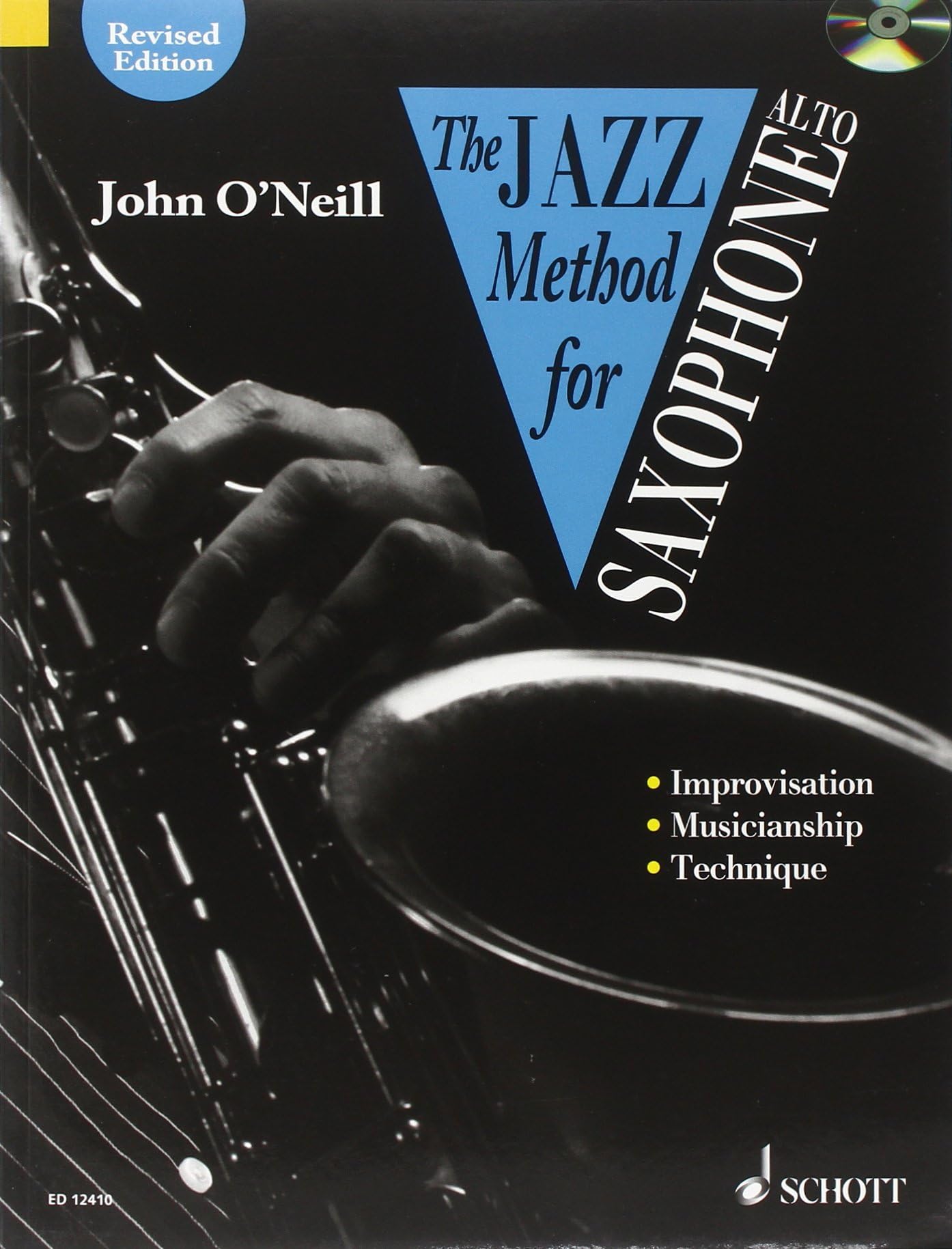
The Jazz Method for Alto Saxophone (Book & CD) Paperback – September 1, 1994
Product ID: 1256290
Buy anything from 5,000+ international stores. One checkout price. No surprise fees. Join 2M+ shoppers on Desertcart.
Desertcart purchases this item on your behalf and handles shipping, customs, and support to Vanuatu.
Full description not available
J**F
Excellent beginner level introduction to jazz
I'm an intermediate level player, currently doing self-study on alto sax. I was interested in getting deeper into jazz. I have purchased a number of guides from a variety of authors. In my opinion, this one is by far the best. Most of the books I purchased are heavily steeped in theory, with some (difficult) transcribed solos from the masters to practice on. In contrast, the author of this book seems to believe that the best way to learn jazz is to play jazz. It starts at a very simple level and progresses from there. There is some elementary theory in the later chapters such as pentatonic scales, the circle of fifths, and transposition, but mostly the book focuses on practical aspects. This book is fun to play through.Is this book at the right level for you? Here are my thoughts:(1) If you are an ABSOLUTE BEGINNER (ie, have never played a woodwind instrument and don't know how to read music), then probably not. There is a lot of material in the first few pages that is targeted to someone who has never picked up a horn, but after that it progresses too quickly to be a stand-alone program, in my opinion. HOWEVER, it would make an excellent supplemental book for a brand new player who is already working through another program.(2) If you are a RELATIVE BEGINNER (ie, have played a woodwind instrument for a few months, can play a few easy scales, and are comfortable in simple key signatures), then this book is perfect for you. You don't need to be able to hit the full 2.5 octave range of your instrument, for example, and it's OK if you've never heard of minor scales.(3) If you are a student with a few years of experience under your belt and want to try out for jazz band in middle school - but have never played jazz before, this book is perfect for you. You will probably be able to skim over the first 50 pages or so before it gets challenging. There is a lot of content on topics like swing and syncopation, some good advice on soloing and improvising, and a good selection of styles to practice such as blues, rock, and bossa nova.(4) If you are an INTERMEDIATE level player, you might or might not benefit from the last 1/3 of the book. It all depends on your experience level; it is entirely possible that it could be too easy for you.This book is not appropriate for ADVANCED level players. The content will be far too easy.
R**A
This book is part of my daily practice routine
This is the best book with backing tracks I have found for learning and improving saxophone playing. He starts off assuming the student is new to the instrument with some very easy exercises. From the very first exercise, you can hear how it should sound with the backing track and then play it yourself with only the backing track. This not only teaches how to work with a band, and to stay with the beat, but also makes practice more fun. For an intermediate student such as myself, I found I quickly worked through the first 1/3 of the book, but am now finding the material properly challenging, but still fun to learn and play. There are a huge number of tunes, each providing the opportunity to work on new types of material. He intersperses useful tips and advice for how to practice, keep track of the beat, play syncopated rhythms and so forth. He also gets you started on improvisation from the very start. At first with only simple changes in phrasing, but quickly encourages further exploration. I highly recommend this book for beginner and intermediate players.Tip for iTunes users: The tracks with John playing sax with the band are all on the CD, but the band-only backing tracks are MP3s that can be downloaded. I pulled all of them into a single album in iTunes and went to the trouble of setting up the sequence so they are all in the order as in the book. It took me about 30 minutes to sequence them, but now I just work with my iPhone and Bluetooth Bose speaker and can listen to John play it, play along with him, then when I'm confident, immediately jump to the backing track and have fun with it.
M**D
For adult beginners
Maybe the book is nice. But its for total beginner. I was thinking to improve my improvisational skills, but this book just teach the basics. Its like college level, more suitable for adult beginner.
M**R
Great Book for Jazz Saxophone Instruction
Jazz saxophone instructors often use this book as part of their teaching curriculum. The book is "graded", which means that the selections get more difficult as you move thru the book. I teach private saxophone lessons on a full-time basis and most of my beginner students can't keep up with challenges presented in this book well enough to make it my primary method book, but I do recommend it to more advanced students. The book introduces the reader to various techniques, posture, embouchure, music theory, etc., so it is good resource for someone who would like to teach him or herself the instrument. Popular jazz songs are presented throughout the book, and the play-along tracks are authentic and well recorded. In recent printings, the publisher changed the design of the book's cover, so don't be surprised if the cover of the book that you get looks different than the one listed here (eg. black and white photo of a saxophonist).
K**B
Takes too long to ship
The book is great, but shipping took almost a month.
J**N
Fun, from the start.
Fun and engaging. This is a great way to learn and be headed for music fun quickly. The included accompaniment CD is great to practice with.
R**L
The best and ear
Great book to learn
L**N
I have no direct experience with this product.
I bought this for someone else....I hope it was worth it.He is a beginner and hasn't opened this book yet.
A**S
Superb. No other word for it. This is a brilliant resource. I doubt that it can be bettered.
If the Amazon rating scale went to 100, I'd have to give this book 99. As it is, 5 stars is barely enough.It's SUPERB.UNBEATABLE.AMAZINGLY MOTIVATIONAL.BRILLIANTLY SEQUENCED.COMPREHENSIVELY SUPPORTED by both the enclosed CD and the free, downloadable mp3 files for both alto and tenor.So after that mildly over-the-top introduction, why do I think it's so good?I'm a beginner and at 71, with COPD that's a big deal for me. I came to the sax via a love of jazz and the likes of Stan Getz, Paul Desmond, Charlie Parker et al. I'm sure you get the picture. I could also throw in mention of Jan Garbarek whom I've seen twice, just to show I'm not totally 'old school'. However, this book is written for students of alto and begins with some of the most concise and yet detailed introductions I've ever come across for such topics as ...The aims of the book and how to use itAbout the saxophoneSome thoughts about practiceBreathingInstrument assemblyPostureEmbouchureFirst notesImagining the toneTuningTonguingFingeringThere is then a good but not over-complex nor daunting section about reading music, pulse and rhythm and the use of a metronome.Where the book and accompanying CD and mp3s really starts to score is when you start with those early single and then two-note exercises. How many of us have been fed up with the irrelevant but chirpy titles used by so many books for those potentially boring practice pieces? What you get in this book are unpretentious, descriptive titles such as 'The intro' - 'Blues for beginners' - 'A la mode' - 'Progression'. It's in those supportive music files that the REAL difference comes to the fore. These are all in the jazz idiom, but there's nothing freaky or outlandish and they are very, very well performed. So even 'The intro' which just uses 2 notes (B and A), you truly feel as if you're playing some jazz. I know it sounds crazy, but that's how it feels.After these early exercises, the instructions tend towards following this pattern ...Listen and imitate (using an mp3 track)Listen (to a demonstrated improvisation in the mp3 set of tracks)Improvise (over the CD track).All mp3 files and CD tracks are numbered and indicated clearly throughout the book by every example.All of the above covers pages 5-23 inc.I could go on, but I'm hoping that by now you have the picture. This is without a doubt the best sax tutor book I've ever come across and it will be the core of my own attempt to learn to play alto.For those who are well-versed in the use of chord progressions for jazz backings, there is also a separate supplement which lists every chord sequence used for the music you will play with and against. This isn't essential for those who aren't that knowledgeable, but it's a very nice touch for those who are.Oh yes ---- why that deduction of 1 star if the scale had been up to 100?Although a thick book, it does open easily and lie fairly flat, but on a music stand, a spiral binding would have been better.-----------------------------------------------------I'm using this book as the 'core'. As at least one other reviewer has said, you may also want an additional resource to support your learning. There are many such items you can look for. Here are just three as a starter. the first two give you a good range of additional pieces for each stage of learning. The third is a separate tutor in its own right, and is also well thought-out. Tons of Tunes for the Beginner: Alto Saxophone [With CD (Audio) ] A New Tune a Day Alto Saxophone: Books 1 & 2 [With 2 CDs and Pull-Out Fingering Chart for Alto Saxophone] (New Tune a Day (Unnumbered)) Some tutors can be bought with a DVD, this is one such example Play Alto Sax Today! Beginner's Pack: Book/Online Audio/DVD PackTons of Tunes for the Beginner: Alto Saxophone [With CD (Audio)A New Tune a Day Alto Saxophone: Books 1 & 2 [With 2 CDs and Pull-Out Fingering Chart for Alto Saxophone] (New Tune a Day (Unnumbered))Play Alto Sax Today! Beginner's Pack: Book/Online Audio/DVD Pack
M**P
Best Sax Tutor Book I Have Tried
I started learning the sax three months ago in my late 60's. I have bought 8 sax tutor books but this one eclipses them all. It's aimed at adults and the exercises and tunes sound like they were actually composed for the sax (which they were). This is so much better approach than the "Three Blind Mice" kind of song book tutor that I have wasted money on in the past. This is just what I needed and is really helping me progress. I can't recommend this book enough.
L**R
Excellent teaching material
This book was recommended to me by my saxophone teacher and I think it's absolutely brilliant. The beginning chapters are all about the theory - it goes into a lot of description about breathing and tonguing, something which seems to be skimmed over far too quicly in other books.I love the fact that even when you're doing the basic exercises there is a backing track which makes it sound as though you're playing real music right from the start. As well as having exercises and tunes for you to work through it also shows you the scales and encourages you to improvise, giving you tips on how this should be done. Throughout the chapters are recomendations for music to listen to and books to purchase which will build on what you've just learnt.When I first started on this book I just played by myself, after a few weeks I started to play with the backing track - this really makes a difference and I don't think I'll consider a book now without an accompanying cd as it makes a real difference to how you play. The book moves on quite quickly while still giving you plenty to play, I think this will keep me going for a while but I'm confident that by the time I've finished it I'll be playing reasonably well.
A**R
Brilliant
I'm sure that many people who take up the saxophone, particularly later in life, are mostly interested in playing jazz, and this is a great place to start. The clever backing tracks make even the simplest run of notes sound like real music and give the impression that you really are getting somewhere right from the start.One very minor point - the label on the included CD correctly stated 'alto' but the title appeared on the screen as 'for tenor' .
E**M
This learning method is more effective than having lessons with my last 2 teachers!
After month of private lessons during which I struggled to produce a decent sound and was unable to play any long notes due to getting out of breath, I've come across this book.Thanks to the detailed descriptions on how to form correct embouchure, do tonguing and sustain breath I can now produce pitch perfect sounds and my long notes get longer and longer from one practice session to the next.I like the fact that this book introduces notes gradually reinforcing what you've learned previously. Despite very easy to play tunes, all of them come with backing tracks making them sound much more advanced and pleasing to the ear :)All in all, it's a great method. It's so good that I've decided to stop my private lessons and follow this course instead.
Trustpilot
2 weeks ago
2 months ago