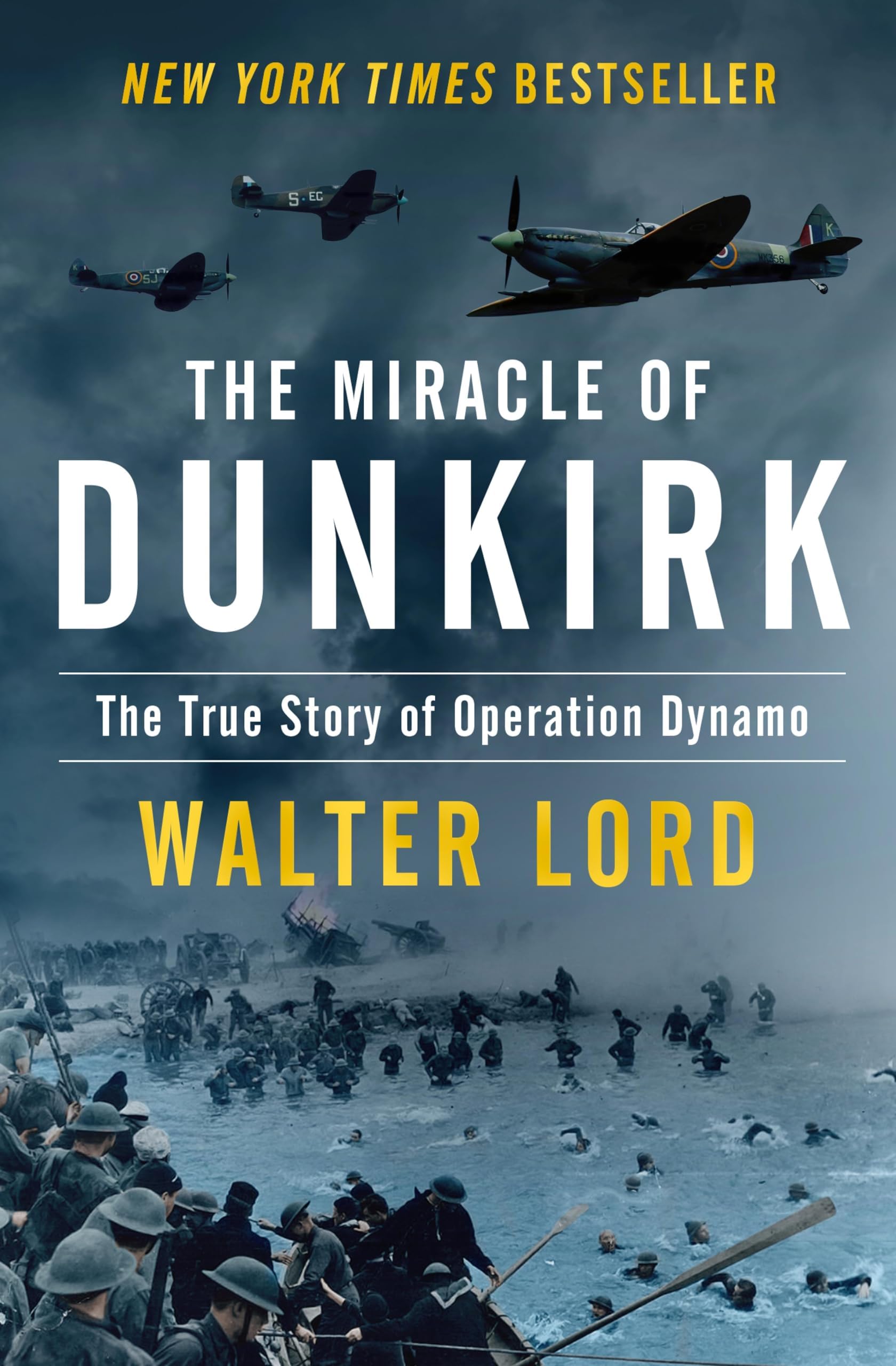
The Miracle of Dunkirk: The True Story of Operation Dynamo
Product ID: 125849388
The true story of the World War II evacuation portrayed in the Christopher Nolan film Dunkirk , by the #1 New York Times –bestselling author of Day of Infamy . In May 1940, the remnants of the French and British armies, broken by Hitler’s blitzkrieg, retreated to Dunkirk. Hemmed in by overwhelming Nazi strength, the 338,000 men gathered on the beach were all that stood between Hitler and Western Europe. Crush them, and the path to Paris and London was clear. Unable to retreat any farther, the Allied soldiers set up defense positions and prayed for deliverance. Prime Minister Winston Churchill ordered an evacuation on May 26, expecting to save no more than a handful of his men. But Britain would not let its soldiers down. Hundreds of fishing boats, pleasure yachts, and commercial vessels streamed into the Channel to back up the Royal Navy, and in a week nearly the entire army was ferried safely back to England. Based on interviews with hundreds of survivors and told by “a master narrator,” The Miracle of Dunkirk is a striking history of a week when the outcome of World War II hung in the balance (Arthur Schlesinger Jr.). Review: Great View on the Miracle of Dunkirk - I thoroughly enjoyed this well-written and researched book on Dunkirk. Walter Lord did a very convincing job of telling the story and delved into many of the facets that I had PRE-existing questions about such as 1) why did the panzers halt, 2) what happened to the BEF and French divisions covering the retreat, 3) how did they organize so many non-Navy boats so quickly, 4) where were the Spitfires and Hurricanes and 5) how did they get so many troops off the beaches/docks in so short of a time period and during Stuka attacks? I had just finished Horne’s “To Lose a Battle” so this was the perfect follow-up, especially as this book (and the Dunkirk movie a few years back) was a bit light in Operation Dynamo although it did cover the Encirclement very well. This book covered exactly what I wanted to know in regard to where the troops were and where the ships and planes were during during the 26 May-4 June time period. It also got into the key personalities involved from Churchill to Ramsay, Gort, Clouston, Wake-Walker, etc. I also wanted some of the detail on important facts like weather and tides and the impact on evacuations. I like the ship by ship research as the role played by smaller ships was incredible, especially on the beach loadings. The German decision-making was very interesting from how the panzer divisions were deployed to how the Luftwaffe was used and also the increasing focus on the Somme and Paris which seemed to snub the huge momentum to the coast that Guderian and Rommel has following the Meuse break-out. The role played by average citizenry during this operation was amazing and deserved to be told and told again. Many rushed to aid an army that needed them most at this critical juncture. Also, the French covered the BEF in a manner that has been rather unsung compared to the Maginot collapse. Key units played critical roles during this week and despite the British attempt to evacuate as many French as possible, between 30-40,000 were left behind. I also appreciated the role played by the BEF rearguard and the elite units that came out last like the Coldstream Guards and Green Howards. The French paid a larger price but they were directly fighting for their country. The BEF and Allies with Free French would regroup but it would take time. The Alliance was tricky to manage at times but personalities such as Eisenhower and Churchill were able to hold it together. The what Ifs surrounding Dunkirk are huge. What would have happened if Germany closed the noose right away and the impact on the overall war effort well before D-Day was even a thought. Germany would have been able to focus more solely on the Eastern Front. Many large questions to ponder. I wholly recommend this book for a top to bottom look at Dunkirk and why it probably deserves more attention for military historians and others who just like to read about ‘miracles.’ Review: Better than the movie - The Miracle of Dunkirk is about Operation Dynamo, the evacuation of Dunkirk by the British Expeditionary Force at the start of World War 2 after the rout of the French Marginot line. The book attempts to do what I think is pretty much an impossible job, a coherent narrative of an event from multiple simultaneous perspectives while providing personal interesting stories and anecdotes. As a result, I came away from the book feeling rather disjointed, as not everything came together. Compared to the Christopher Nolan film, the book lacks a central cohesive story. But of course, the book provides way more context and ties together actions from the command side as well as the actions of the rank and file. As a matter of fact, I think the film provides a misleading view of the events at Dunkirk. If you've read the book, the movie makes a lot more sense. If you've watched the movie, I think the book's much better. Recommended.


| Best Sellers Rank | #261,485 in Kindle Store ( See Top 100 in Kindle Store ) #68 in Maritime History & Piracy (Kindle Store) #158 in Naval Military History #175 in Military Naval History |
F**K
Great View on the Miracle of Dunkirk
I thoroughly enjoyed this well-written and researched book on Dunkirk. Walter Lord did a very convincing job of telling the story and delved into many of the facets that I had PRE-existing questions about such as 1) why did the panzers halt, 2) what happened to the BEF and French divisions covering the retreat, 3) how did they organize so many non-Navy boats so quickly, 4) where were the Spitfires and Hurricanes and 5) how did they get so many troops off the beaches/docks in so short of a time period and during Stuka attacks? I had just finished Horne’s “To Lose a Battle” so this was the perfect follow-up, especially as this book (and the Dunkirk movie a few years back) was a bit light in Operation Dynamo although it did cover the Encirclement very well. This book covered exactly what I wanted to know in regard to where the troops were and where the ships and planes were during during the 26 May-4 June time period. It also got into the key personalities involved from Churchill to Ramsay, Gort, Clouston, Wake-Walker, etc. I also wanted some of the detail on important facts like weather and tides and the impact on evacuations. I like the ship by ship research as the role played by smaller ships was incredible, especially on the beach loadings. The German decision-making was very interesting from how the panzer divisions were deployed to how the Luftwaffe was used and also the increasing focus on the Somme and Paris which seemed to snub the huge momentum to the coast that Guderian and Rommel has following the Meuse break-out. The role played by average citizenry during this operation was amazing and deserved to be told and told again. Many rushed to aid an army that needed them most at this critical juncture. Also, the French covered the BEF in a manner that has been rather unsung compared to the Maginot collapse. Key units played critical roles during this week and despite the British attempt to evacuate as many French as possible, between 30-40,000 were left behind. I also appreciated the role played by the BEF rearguard and the elite units that came out last like the Coldstream Guards and Green Howards. The French paid a larger price but they were directly fighting for their country. The BEF and Allies with Free French would regroup but it would take time. The Alliance was tricky to manage at times but personalities such as Eisenhower and Churchill were able to hold it together. The what Ifs surrounding Dunkirk are huge. What would have happened if Germany closed the noose right away and the impact on the overall war effort well before D-Day was even a thought. Germany would have been able to focus more solely on the Eastern Front. Many large questions to ponder. I wholly recommend this book for a top to bottom look at Dunkirk and why it probably deserves more attention for military historians and others who just like to read about ‘miracles.’
P**A
Better than the movie
The Miracle of Dunkirk is about Operation Dynamo, the evacuation of Dunkirk by the British Expeditionary Force at the start of World War 2 after the rout of the French Marginot line. The book attempts to do what I think is pretty much an impossible job, a coherent narrative of an event from multiple simultaneous perspectives while providing personal interesting stories and anecdotes. As a result, I came away from the book feeling rather disjointed, as not everything came together. Compared to the Christopher Nolan film, the book lacks a central cohesive story. But of course, the book provides way more context and ties together actions from the command side as well as the actions of the rank and file. As a matter of fact, I think the film provides a misleading view of the events at Dunkirk. If you've read the book, the movie makes a lot more sense. If you've watched the movie, I think the book's much better. Recommended.
D**F
A gripping account of the chaos and heroism of the famous evacuation.
Walter Lord has written a detailed account of the famous evacuation of the British Expeditionary Force (and substantial French forces) from entrapment at Dunkirk near the start of World War II. First, Lord's account is an enjoyable and relatively easy read. The story is bracketed mainly from May 24th to June 3rd, 1940; and is an hour-by-hour account of the fighting, retreat, and seaborne extraction. Lord's descriptions of the chaos, desperation, frustrations, and tragedies associated with war seem to be spot-on; and paint vivid pictures for the reader. He uses numerous short personal stories of the individuals involved (from interviews, diaries, letters, family accounts, etc.) to drive the points home. The willingness and heroics of ordinary British citizens to come to the aid of their armed forces is truly amazing. And Lord pulls no punches, with accounts of cowardice as well as heroism. His research was extensive and expert. Lord's account will give you great insight into the British psyche. He was a prolific and award-winning history author, with books about the sinking of the Titanic, Pearl Harbor, the Alamo, an others. I truly recommend the book to anyone interested in this period's history, or World War II.
R**H
Understanding Dunkirk
I have always been curious about what actually happened at Dunkirk. At times I even thought it was in WWI. After reading this book I won't make that mistake again. The book is very interesting, if, at times, sometimes somewhat hard to follow. That is mainly because I am not English. Therefore I have some trouble appreciating references to certain English units and expressions. Same comment with respect to French units. Well worth reading if the subject is of interest as it seems incredibly researched. How did they track all these people?
C**Y
and the courage of their mostly part-time crews became better reading than most fine fiction
At the time of "Dunkirk", I was a High school student in Canada. I thought our media had fully reported it, but I see now that there was a lot more fear of failure at the time than was apparent. This book is a very complete story of the miracle that was the evacuation of a major portion of the British Expeditionary Force (later revealed to be the almost complete British Army at the time), and a large group of the French. The near minute-by-minute descriptions of the parts played by about anything afloat, and the courage of their mostly part-time crews became better reading than most fine fiction. Its a wonderful read and will become an exhaustive resource for anyone who searches the names of participants, boat-identifications, Military unit activity, etc., all in great detail. One doesn't often get a chance to look behind history's curtain to see the interior workings of a great Miracle. Here's a fine chance to do so.
J**N
Much better than the movie
This is going to be a short review. If you want to know how harrowing it was for the French, British and Belgian forces who made the “miracle” possible, this is a great work. Unlike the movie Chris Nolan attempted to make, this is the true story of heroism, girt and cooperation. Many times, through history, the French Army hasn’t been shown in, shall we say, a great light. During the encirclement, if it weren’t for their steadfastness in holding the outer perimeter defenses as the BEF withdrew to the beaches, perhaps only half of those trapped would have been rescued. One of the most fascinating portions of the story is the utter lack of sleep of those who were holding off the Germans and those who were in charge of the evacuation. I don’t ever remember reading any story were those involved lived on as little sleep as the men and women who manned the lines. Another item I wasn’t familiar with was the mutinous acts that occurred in the navy. The crew of three destroyers refused to return to Dunkirk. Their nerves were frayed and the lack of sleep was too much to deal with. Instead of being courts martialed, the Admiralty found other men to man the ships and send them back one more time. In a normal scenario, one would call them cowards. After reading this account and the harrowing trips across the channel, one can empathize with their plight. Unlike the move this is a five star work!
D**.
An interesting read, for WWII history buffs in particular.
This is great reading for the history buffs (especially WWII). Mr. Lord has done massive research (once again) to provide both the big picture, by interviewing and researching the various government sources, and the up close 'personal' stories from those 'on the ground' who were most affected by this massive event. The many triumphs and tragedies involved are uncountable; but Mr. Lord provides more than enough personal stories from both the 'rescuers' (many/most of whom were actually civilians) and the 'rescued'. Also there is very interesting information presented from the German records and some surviving military men. This presentation of historical events from both sides provides much needed information and helps explain how certain key things happened (especially Hitler's famous 'halt order') that helped tens of thousands more men to be rescued. It will be interesting to see how the new movie portrays all this, since it is impossible to cover any event of this magnitude in anywhere near complete fashion.
O**R
enough intelligent and insightful Allied minds were able to overcome the ...
superb detailed account of the rout of most Allied troops in northern France and Belgium in May 1940, and the ensuing evacuation from the Dunkirk area....how events can change quickly - sometimes for obvious reasons, other times, how seemingly minor events can change the overall outlook (a refinery fire lays a cover of smoke that hides the main evacuation points from the German high command for days, and a combination of unusually calm weather for two weeks and low stratus clouds hinder German bombers)...how thinking on the front lines is hindered by distant command planning as well as political interference occurring with both Allied and Axis command...you wonder at times just how the hell the British were able to evacuate almost all troops in the end, but at the same time, enough intelligent and insightful Allied minds were able to overcome the confusion, little or no communication in the field, language issues and thousands of leaderless and disorganized troops to organize literally an armada of hundreds of ships and boats - mostly commercial mid-size to very small personal size to ferry the troops away from Dunkirk. Dunkirk, combined with the Battle of Britain later that year made 1940 a huge turning point in WWII morale for the Allies that bore victorious fruit four years later with D-Day. Had those troops been captured and / or the Royal Air Force not had their Spitfires, the US entry in the war a year and a half later might have been too little, too late.
H**H
One of the two best books about the Dunkirk Evacuation, full of textual detail.
This is my replacement copy of the book which I originally bought fresh off the Press as a First Edition. It is one of the best "broad-spectrum" books about the Dunkirk evacuation, [and I think I have now read them all while doing research into a so-far unreported aspect of the history of the "inshore flotilla".] You won't get a lot of pictures of the little ships involved or the chaos ashore, but Mr Lord - even though researching from the USA, - was very successful in tracking down survivors, and getting their stories recorded, so the book is packed with textual detail in précis form. With the aid of this book and further contact facilitated by the Author, I was able to contact the man who as a very young and not-fully-trained Naval Officer - had been given charge of my family's 150ton Fleet flagship on May 28th, 1940, - and get from him in a couple of very detailed letters the story of her last four days, before she was sunk. In exchange for Mr Lord's help, I was able to gift him with the background story of the requisitioning of our Family's little fleet of 7 excursion boats with pictures of the original Requisitioning and Compensation Claim documents ; and information about the aftermath - when owners were told their boats had been "lost"; and about the process of owners trying to claim compensation from a miserly Government - information which Mr Lord, working from his home in America had not been able to find from other sources.
M**D
An erudite book
Having seen the new movie Dunkirk I decided there were too many gaps in my knowledge of what really happened at Dunkirk. This book has certainly given me much more insight. It is very thoroughly researched and put together in a very scholarly fashion while still retaining the best qualities of a well-told story. There are numerous first-hand accounts and even humour in what can only be described as organised chaos. I'm sure I'll forget most of it but the main thesis will remain - that the miracle of Dunkirk' was more than the small boats evacuating British troops. Well worth the read.
L**K
A great book for those of us who know nothing about Dunkirk than the name.
I wanted to read about Dunkirk after seeing the latest movie. I knew a bit about the events but was realy curious for more. I'm not a military history buff but I really enjoyed this book. It gives lots of detail but is realy easy to read. It is kind of exciting, more like a novel than a history book. If you like nonfiction, this is a good choice.
A**R
a good read.
With the incompetence of allied commanders on the whole, it's surprising that disaster was avoided. Well written and researched book, a good read.
A**N
Good read
A good full book of accounts
Trustpilot
2 weeks ago
2 weeks ago