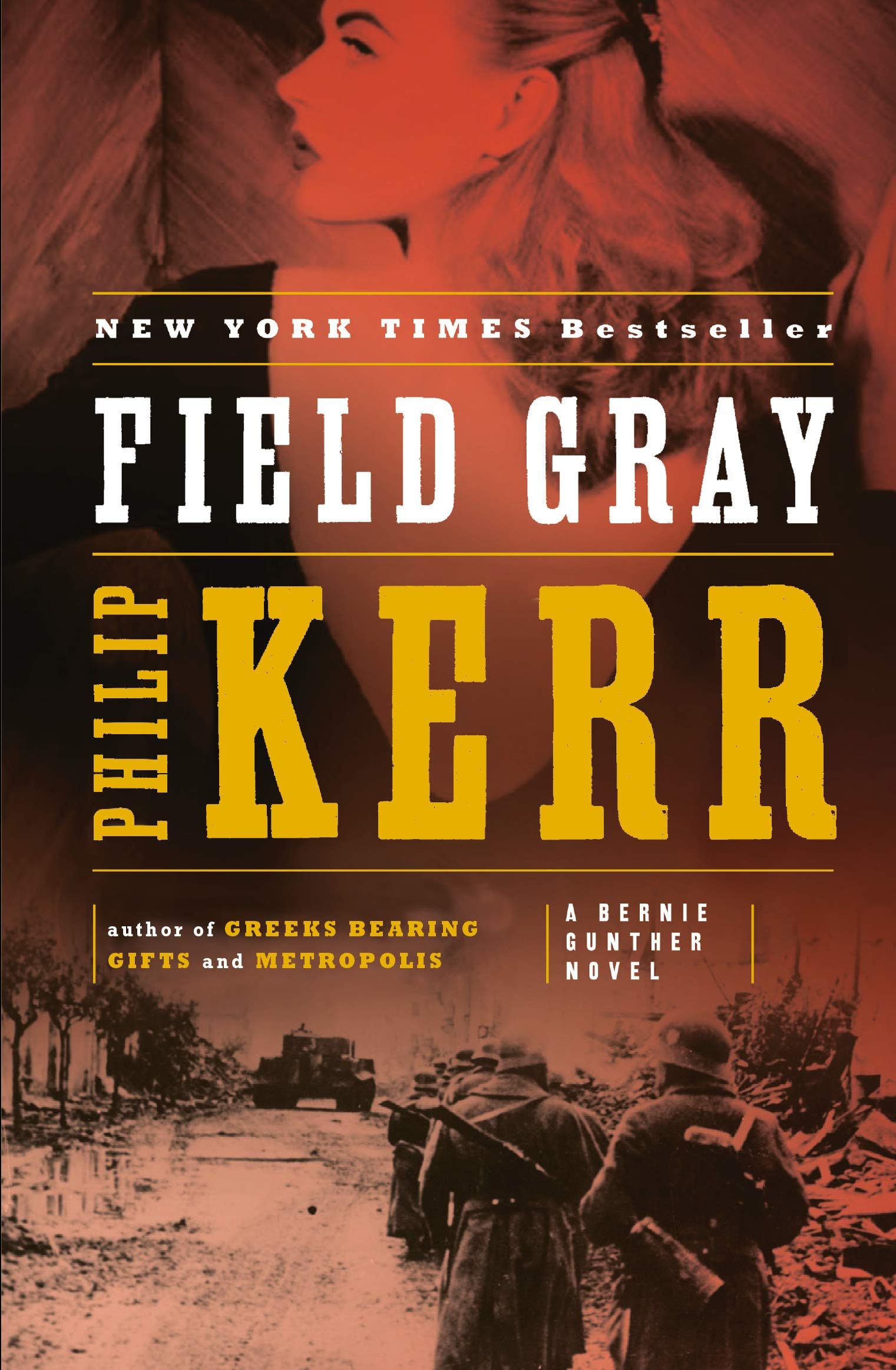
Field Gray (A Bernie Gunther Novel Book 7)
Product ID: 129140669
Field Gray (A Bernie Gunther Novel Book 7) - Kindle edition by Kerr, Philip. Download it once and read it on your Kindle device, PC, phones or tablets. Use features like bookmarks, note taking and highlighting while reading Field Gray (A Bernie Gunther Novel Book 7). Review: "Life is trouble. Only the naiive and the young imagine that it's anything else." - After A Quiet Flame: A Bernie Gunther Novel and If the Dead Rise Not: A Bernie Gunther Novel I had concerns that Kerr was becoming formulaic and was running out of material for Bernie Gunther. _Field Grey_ put those worries to rest in what I think is one of his strongest stories in the series. Certainly there are some flaws, most glaringly being the Zelig-like appearance of Gunther at critical junctures of history - with Heydrich, or at the Eden Dance Palace trial for example. The introduction of a chess-piece (a gift from chess great Lasker in 1933) so late in the book and late in the series was also irritating. However, the way in which Kerr blends elements of spy fiction with historical pieces, the autobiography of Gunther and crime thriller far outweigh any reservations or complaints that I have otherwise. Picking up where _If the Dead Rise Not_ ended, Gunther attempts to flee Cuba - and ends up spending time in several different prisons (in the US, West Germany and France), working for first the CIA and then the SDECE (Service de Documentatioan Exterieure et de Contre-Espionnage - French intelligence). As part of his debriefing and related to the work Gunther is asked to do by these security agencies, much of Gunther's wartime past is dredged up - a past that has been alluded to broadly in previous books, but never detailed. It made for riveting reading and provided depth and detail to an already fascinating character. The avoidance of the plot develoopments that made for such formulaic reading previously - the femme fatale, sacrificing a love interest, the improbable way Gunther pulls himself out of danger at the last moment - instead giving readers a labyrinth of double-crosses and double-agents further kept me on the edge of my seat. Gunther himself remains beholding to no man, independent in thought and word, even though the price for such freedom is steep: first with the Nazis, then the Soviets and in _Field Grey_ with the Americans, Kerr shows how trecherous power can be and how easily it can be manipulated by "true believers" of an ideology towards evil ends. Given the way in which Kerr ends _Field Grey_, I am at a loss to see where Gunther's narrative can be taken next, given the influence and reach of those he has crossed. I am anxious to see what Kerr has in store for readers. The Bernie Gunther series ( Berlin Noir: March Violets; The Pale Criminal; A German Requiem , The One from the Other: A Bernie Gunther Novel , A Quiet Flame: A Bernie Gunther Novel , If the Dead Rise Not: A Bernie Gunther Novel )is great story-telling, _Field Grey_ among the best. Highly recommended. Review: Solid WWII epic novel - FIELD GRAY by Philip Kerr (Putnum, $26.95) Rating: B+ Bernie Gunther, a PI who worked in Berlin during WWII in Nazi Germany, is now living in Cuba after the war. He is taking a woman out of Cuba when American agents stop him in the aftermath of the war. He soon finds himself back in Germany where he is undergoing questioning in an effort to determine the whereabouts of Nazi war criminals. They want him for information and initially torture him. Eventually, he takes the inquisitors through his life before, during and after the war. In a long sweeping chronicle, Gunther tells the tale of his time in France looking for a Communist accused of killing two German policemen to his time on the Eastern front. He is interrogated by agents from different countries providing information while telling his fascinating tale. FIELD GRAY seems more like an historical novel than a mystery in that there is no definite crime that is at the center of the story. It is most definitely not a thriller in that any exciting scenes are few and far between. Make no mistake, the plot is truly compelling and will hold the reader's interest throughout this very long book. It provides great insight into the war on both fronts and in between. For those readers who have read the Gunther novels (and I am not one of them) this might provide some good background information on this character. This is an interesting novel but is it actually of the mystery genre? Not sure. (shortlisted for an Edgar Award best novel 2012)
| ASIN | B004IYITLQ |
| Accessibility | Learn more |
| Best Sellers Rank | #566,730 in Kindle Store ( See Top 100 in Kindle Store ) #1,637 in Historical Thrillers (Kindle Store) #1,779 in Historical Thrillers (Books) #3,263 in War Fiction (Books) |
| Book 7 of 14 | Bernie Gunther |
| Customer Reviews | 4.4 4.4 out of 5 stars (5,802) |
| Enhanced typesetting | Enabled |
| File size | 2.1 MB |
| ISBN-13 | 978-1101513811 |
| Language | English |
| Page Flip | Enabled |
| Print length | 460 pages |
| Publication date | April 14, 2011 |
| Publisher | G.P. Putnam's Sons |
| Screen Reader | Supported |
| Word Wise | Enabled |
| X-Ray | Enabled |
D**N
"Life is trouble. Only the naiive and the young imagine that it's anything else."
After A Quiet Flame: A Bernie Gunther Novel and If the Dead Rise Not: A Bernie Gunther Novel I had concerns that Kerr was becoming formulaic and was running out of material for Bernie Gunther. _Field Grey_ put those worries to rest in what I think is one of his strongest stories in the series. Certainly there are some flaws, most glaringly being the Zelig-like appearance of Gunther at critical junctures of history - with Heydrich, or at the Eden Dance Palace trial for example. The introduction of a chess-piece (a gift from chess great Lasker in 1933) so late in the book and late in the series was also irritating. However, the way in which Kerr blends elements of spy fiction with historical pieces, the autobiography of Gunther and crime thriller far outweigh any reservations or complaints that I have otherwise. Picking up where _If the Dead Rise Not_ ended, Gunther attempts to flee Cuba - and ends up spending time in several different prisons (in the US, West Germany and France), working for first the CIA and then the SDECE (Service de Documentatioan Exterieure et de Contre-Espionnage - French intelligence). As part of his debriefing and related to the work Gunther is asked to do by these security agencies, much of Gunther's wartime past is dredged up - a past that has been alluded to broadly in previous books, but never detailed. It made for riveting reading and provided depth and detail to an already fascinating character. The avoidance of the plot develoopments that made for such formulaic reading previously - the femme fatale, sacrificing a love interest, the improbable way Gunther pulls himself out of danger at the last moment - instead giving readers a labyrinth of double-crosses and double-agents further kept me on the edge of my seat. Gunther himself remains beholding to no man, independent in thought and word, even though the price for such freedom is steep: first with the Nazis, then the Soviets and in _Field Grey_ with the Americans, Kerr shows how trecherous power can be and how easily it can be manipulated by "true believers" of an ideology towards evil ends. Given the way in which Kerr ends _Field Grey_, I am at a loss to see where Gunther's narrative can be taken next, given the influence and reach of those he has crossed. I am anxious to see what Kerr has in store for readers. The Bernie Gunther series ( Berlin Noir: March Violets; The Pale Criminal; A German Requiem , The One from the Other: A Bernie Gunther Novel , A Quiet Flame: A Bernie Gunther Novel , If the Dead Rise Not: A Bernie Gunther Novel )is great story-telling, _Field Grey_ among the best. Highly recommended.
L**Y
Solid WWII epic novel
FIELD GRAY by Philip Kerr (Putnum, $26.95) Rating: B+ Bernie Gunther, a PI who worked in Berlin during WWII in Nazi Germany, is now living in Cuba after the war. He is taking a woman out of Cuba when American agents stop him in the aftermath of the war. He soon finds himself back in Germany where he is undergoing questioning in an effort to determine the whereabouts of Nazi war criminals. They want him for information and initially torture him. Eventually, he takes the inquisitors through his life before, during and after the war. In a long sweeping chronicle, Gunther tells the tale of his time in France looking for a Communist accused of killing two German policemen to his time on the Eastern front. He is interrogated by agents from different countries providing information while telling his fascinating tale. FIELD GRAY seems more like an historical novel than a mystery in that there is no definite crime that is at the center of the story. It is most definitely not a thriller in that any exciting scenes are few and far between. Make no mistake, the plot is truly compelling and will hold the reader's interest throughout this very long book. It provides great insight into the war on both fronts and in between. For those readers who have read the Gunther novels (and I am not one of them) this might provide some good background information on this character. This is an interesting novel but is it actually of the mystery genre? Not sure. (shortlisted for an Edgar Award best novel 2012)
K**Y
Well-written and Accurate
Field Gray is a realistic, tightly plotted, multi-level mystery novel, firmly grounded in detail--both historical and geographical--that accomplishes the primary objective of historical fiction: it recreates the past in order to illuminate the present and warns subtly not to commit the same mistakes yet again.And, although it is modern in its approach and structure and does demonstrate an obvious agenda, it remains true to its subject, its milieu, its characters, and its historical framework. Kerr, through the interrogation of his protagonist, Bernie Gunther, in five different prisons in 1954 recounts two stories--the lives of Bernie Gunther, ex-Berlin detective, and Erich Mielke, the minister of state security of the German Democratic Republic from 1957 to 1989. The story begins in Cuba in 1954, where Bernie is working for Meyer Lansky, Jewish crime lord and one of the original founders of Murder Incorporated. Castro is active and Baptista's regime is in serious trouble. After meeting Graham Greene in a local brothel, Bernie sets sail to help a friend of a friend, a young woman, who has killed a police officer, with a United States sailor's stolen weapon. So begins a series of incidences that result in Bernie's incarceration in five different prisons, where he is interrogated by various intelligence agencies and remembers his past, until he finds himself back in Berlin and in the middle of a clandestine operation being conducted by the French, Russians, and the CIA. To survive and also mete out a bit of revenge, Bernie revisits his past and plays one country's intelligence service against another. As the adage goes, the devil is in the details, and Kerr's command of early twentieth-century history is staggering. He knows what happened when and where; and, when I say "where," I mean he knows the street address. This attention to detail provides a sense of verisimilitude that is lacking in many historical crime novels. Kerr seems to be particularly well versed in legal matters and procedure, which in this novel in particular, is used to great effect. Kerr dominates his corner of the historical/mystery genre.
S**I
Great. It's like Marlow
E**R
I like Kerr’s writing style and sense of under-cut drama. I was sorry to hear of his death - RIP
W**G
An excellent book evoking vividly the period in which it is set I could not possibly recommend it more highly.
R**N
Field Grey is the seventh Bernie Gunther novel. In my view it's one of the best crime series presently being written. The last book - If the Dead Rise Not - was probably the weakest book in the series (despite winning the CWA Ellis Peters award for historical crime fiction), but Field Grey is a real return to form. It is a big book linking together parts of Bernie's life between 1931 and 1954 and a connected set of events and actors in Germany, France, Ukraine and Russia. As usual, Kerr manages to blend in many well-known real life characters and events, and this book focuses in particular on Erich Mielke, a communist who murdered two policemen in 1931 and later became head of the Stasi in post-war East Germany. The plotting is intricate, with the flashbacks skilfully interwoven with the 1954 narrative, and dotted with insightful observations and history. The pacing is well judged, the characterization excellent, the dialogue and action credible and engaging, and the balance between show and tell just right. A very entertaining read.
W**N
No voy a poner ningun opinion en espanol por un libro que he leido in mi proprio idioma. Faltan dos palabras? entonces, aqui les tienen: no me molesteis mas si no puedo dar un opinion en mi propio idioma, vale? saludos
Trustpilot
3 weeks ago
2 weeks ago