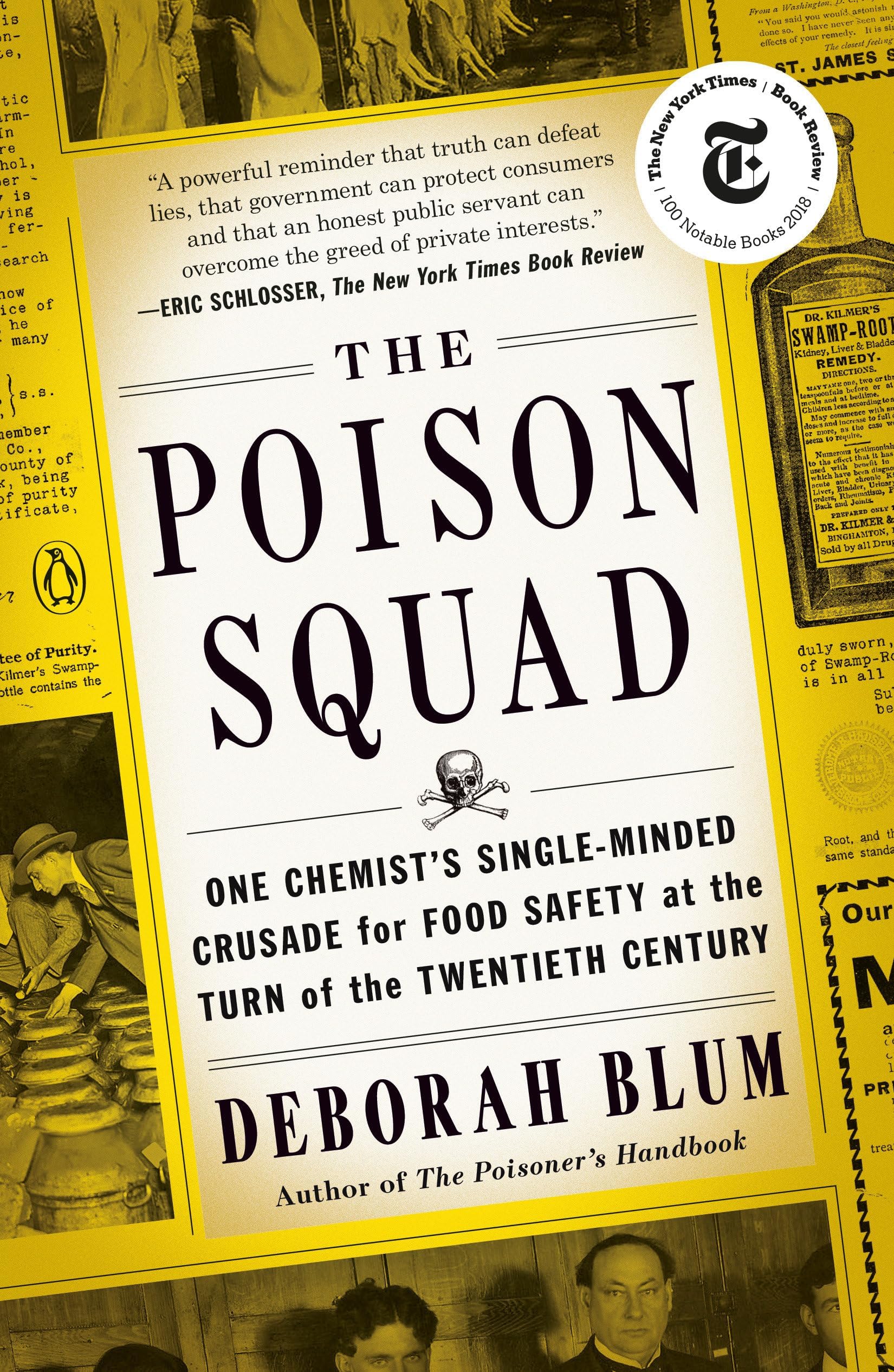
The Poison Squad: One Chemist's Single-Minded Crusade for Food Safety at the Turn of the Twentieth Century
Product ID: 130996216
Buy anything from 5,000+ international stores. One checkout price. No surprise fees. Join 2M+ shoppers on Desertcart.
Desertcart purchases this item on your behalf and handles shipping, customs, and support to Vanuatu.
desertcart.com: The Poison Squad: One Chemist's Single-Minded Crusade for Food Safety at the Turn of the Twentieth Century: 9780143111122: Blum, Deborah: Books Review: interesting & depressing - I have a tendency to romanticize history. This book disabused me if that notion. Food manufacturers in the US used FORMALDEHYDE as a preservative. As early as 1910 manufacturers were trying out corn syrup and saccharine because they were cheaper than sugar. The more things change, the more they stay the same I guess. It’s depressing that we are still fighting for food safety against the almighty dollar. This book is well written and researched. The author does a fantastic job of making all these historical figures come alive on the page. Truly an excellent read. Review: Great Book! - Very well written- it was also very informative! Scary, how unsafe our food used to be- but today's food, with all the untested additives, is unsafe as well, but instead of being immediately deadly like arsenic in candy (as the book discusses), additives today are a lot more insidious, causing 'sleeper diseases' like heart disease, cancer, diabetes...but there is hope! Once, the American people fought the big manufacturers and won. We can do it again!
| Best Sellers Rank | #159,298 in Books ( See Top 100 in Books ) #17 in Agriculture & Food Policy (Books) #93 in Social Activist Biographies #163 in Culinary Biographies & Memoirs |
| Customer Reviews | 4.5 4.5 out of 5 stars (733) |
| Dimensions | 8.43 x 5.51 x 0.79 inches |
| Edition | Reprint |
| ISBN-10 | 0143111124 |
| ISBN-13 | 978-0143111122 |
| Item Weight | 11.2 ounces |
| Language | English |
| Print length | 352 pages |
| Publication date | September 24, 2019 |
| Publisher | Penguin Books |
C**S
interesting & depressing
I have a tendency to romanticize history. This book disabused me if that notion. Food manufacturers in the US used FORMALDEHYDE as a preservative. As early as 1910 manufacturers were trying out corn syrup and saccharine because they were cheaper than sugar. The more things change, the more they stay the same I guess. It’s depressing that we are still fighting for food safety against the almighty dollar. This book is well written and researched. The author does a fantastic job of making all these historical figures come alive on the page. Truly an excellent read.
C**R
Great Book!
Very well written- it was also very informative! Scary, how unsafe our food used to be- but today's food, with all the untested additives, is unsafe as well, but instead of being immediately deadly like arsenic in candy (as the book discusses), additives today are a lot more insidious, causing 'sleeper diseases' like heart disease, cancer, diabetes...but there is hope! Once, the American people fought the big manufacturers and won. We can do it again!
D**F
The dangers of completely unfettered greed!
“The Poison Squad” by Deborah Blum is the well-told story of the first American attempts to protect consumers from dangerous food manufacturing practices at the beginning of the twentieth century. It follows Harvey Washington Wiley, an MD and chemist in his single-minded quest. If you ever read the novel "The Jungle" by Upton Sinclair about the brutal working conditions in the Chicago Stockyards of the same time period, this book will fill in a lot more of that picture. Food manufacturing on an industrial scale was in its infancy and corporate greed was unrestrained for a portion of the industry. American consumers were at their mercy and regulatory protection was sorely needed. But as is always the case, money ruled and the fight to protect ordinary people was a very tough and long battle. Sound familiar? This book is well-timed in my opinion. This is a good nonfiction tale, 4 to 4.5 stars. Author Deborah Blum is a Pulitzer Prize winning journalist. This appears to be her first book, she's a very good writer. I’ll be watching for her next one. I recommend “The Poison Squad”.
W**Y
Who knew! They have been poiosing our food for over 100 years!
This is first and foremost a story about a chemist and his drive to expose the corrupt food industry as it knowingly profited from including harmful chemicals and additives in every day food. Along the way, the reader also learns about Harvey Wiley and the decades long journey that would not have been possible without dedicated volunteers, a sympathetic media, and growing strength of the Progressive movement. Throughout the 1880’s America was the Wild West for putting all kinds of chemicals in food until Harvey Wiley, a chemist and his group of volunteers known as the Poison Squad, began to prove how food manufacturers were literally killing thousands of people by fraudulently adultering their processed foods with all types of chemicals and toxic metals in order to maximize profits. Their collective efforts eventually led to passing the first consumer protection law in 1902 (Pure Food Act). Up until then, the United States was alone amongst industrialized nations without food regulations as the food lobby was simply too powerful with all their lawyers and political contributions that successfully pushed back any regulation. By 1860, Britain had already passed a law trying to limit the chemical adulteration of food. This was after in just one town alone, 20 people died by eating arsenic laced food coloring candy. By 1881, France had banned the use of toxic salicylic acid in their wine and Germany also banned chemicals in their beer. During this period, America was in the midst of an industrial revolution with factories and railroads now able to produce and distribute food across American like never before. Cities swelled with the migration of millions of factory workers that also saw the rise of a new food manufacturing industry with companies such as Heinz, Nabisco, Coca Cola, and Campbell. In fact, by 1890, Chicago’s Union Stockyard was already processing over nine million head of cattle each year as they perfected the assembly line (this would later inspire Henry Ford when building automobile factory). So, without refrigeration, the industry turned to chemical companies like Dow and Monsanto to provide them chemicals such as formaldehyde, sodium benzoate, and borax to preserve food as well as toxic metals such as copper sulfate to keep canned food colorful. Asearly as 1881 while working in the lab at Purdue University, Wiley discovered that up to 90% of all honey and maple syrup being sold was fake. Wiley immediately faced an industry backlash and smear campaign and was dismissed from Purdue for scientifically proving that these commercially produced food products were mostly corn syrup with artificial additives to deceive consumer (sound familiar)! Wiley then went onto the Department of Agriculture and began to investigate how dairy was being deliberately adulterated and poisoned to increase industry profits as well. For example, water was added to dilute the milk; plaster and chalk added to turn it white; formaldehyde to counter the sour taste; and pureed calf brain give the top layer a yellow like cream color. This is to say nothing of how horrendously malnourished and mistreated the cows were in the first place feeding mostly on swill waste from local breweries. Other discoveries written about included how coffee was found to be made primarily from sawdust, chicory, and ash; Pepper was found to contain mostly fillers of charcoal and coconut shells; white bread flour laced with aluminum; and the excess amount of caffeine and cocaine found in Coca Cola. After the powerful dairy industry was able to significantly weaken the Butter Act of 1886, Wiley soon realized that the only way to fight the corruption between big food and Congress was to broaden his message beyond fellow scientists and alert and educate the public to call for action. Shrewdly, Wiley hired a professional writer that would translate his science into stories that began to resonate with the public. Not surprisingly, this was soon met with resistance from his politically connected superiors at the Department of Agriculture that began stifled his findings. Ironically, it was during the Spanish American War in 1898 and the reporting of the Army’s cover up “embalmed” meat being consumed by the soldiers that the broader public started to take more notice. Soon thereafter, the public would not look back as the newspapers began following Wiley with his human experiments on his volunteer “Poison Squad”. Eventhough the chemical and food industries tried to smear Wiley with their campaign of personal public attacks, women’s groups and trade unions during the Progressive movement ultimately turned the tide and became the force to pressure vote conscious politicians to finally take food safety seriously. By 1906, these forces as well as below actions helped passing the landmark Food and Drug Act, as well as the Meat Inspection Act -Wiley eventually pressured President Rooseveltdirectly by leveraging the new women voting block. -The publication of Upton Sinclair’s, The Jungle further outraged the public -Henry J. Heinz decided to capitalize on the public’s growing food safety awareness bydesigning a “pure food” catsup and lobbied his support for pure food labeling As it turns out, passing this historic bill was entirely different than enforcing the new regulations. Within just two years, industry lobbyists were able to create a new group of industry-friendly scientists that began to craft doubt on Wiley and the Poison Squad. When that failed, he was isolated within the administration and effectively forced out. Wiley’s next move though turned out to be with the extremely popular Good Housekeeping Magazine where he was able to create their Good Housekeeping Seal of Approval to educate and encourage its readers to keep the pressure on politicians and industry. In the end Wiley’s legacy is not just one man’s determination for food safety, ingredient labeling, and the ultimate creation of the Food and Drug Administration, but the primary reason one can go buy a gallon of milk today and not die!
A**A
Important Story of Government Action to Protect Public
May be one of the better ways to learn of government efforts to reduce public health risks that still have relevance today. Easy read and clearly understandable; reminds one of great action that precedes by decades one's expectation of what science can and did do.
T**E
Nice gift! Informative! Factual!
Gift my Dad enjoys reading.
W**I
Food Adulteration and Political Pressure
Excellent read. Thorough in exploring the food adulteration problem. A continuing problem fraught with political pressures today. Author is an excellent story teller with great expository skill.
A**N
This is not the book to read before dinner. However it is a fascinating account of mass adulteration of food and drink in the USA and the emergence of scientific testing, laws and regulations designed to protect the public and insure certain minimum standards of purity and public safety. Well written, well paced and detailed without ever becoming mired in chemistry or obscure science. You don't need to be a lab technician to understand and enjoy this compelling history. If you thought the cow stepping in the milk bucket was bad, let me assure you, back in the day that was nothing. Read this book and you will never complain about FDA regulations again.
L**W
Our country is so screwed but, this book as good
L**H
Excelente título!
G**L
History of how we wade through the adulterated foods and how the battle is still going on. Must read.
G**R
According to the author, well over a century ago, the food eaten by our ancestors was not as healthy and wholesome as we have been led to believe. In order to give a longer shelf life to such foods as milk, canned goods, breads, etc., preservatives, often of dubious gastronomic characteristics were mixed in. And in addition, very often, the food was rotting before being preserved/canned and the overall health effects on the consumers were appalling. Enter Dr. Harvey Wiley, a physician-turned-chemist, employed by the U.S. Dept. of Agriculture, to the rescue. This book outlines Dr. Wiley’s relentless campaign in trying to improve the quality of food eaten by consumers. I found the book interesting. There is much political wrangling and efforts at government legislating in light of scientific evidence in order to pass laws to control/limit dangerous contaminants in foods – despite powerful business corporations who were fighting against this. The so-called “Poison Squad” was a group of individuals hired to eat specific foods in a controlled manner in order to observe any ill health effects upon them by specific contaminants. The Poison Squad is mentioned a few times in the book but is not the main focus despite the book’s title.
Trustpilot
1 month ago
3 weeks ago