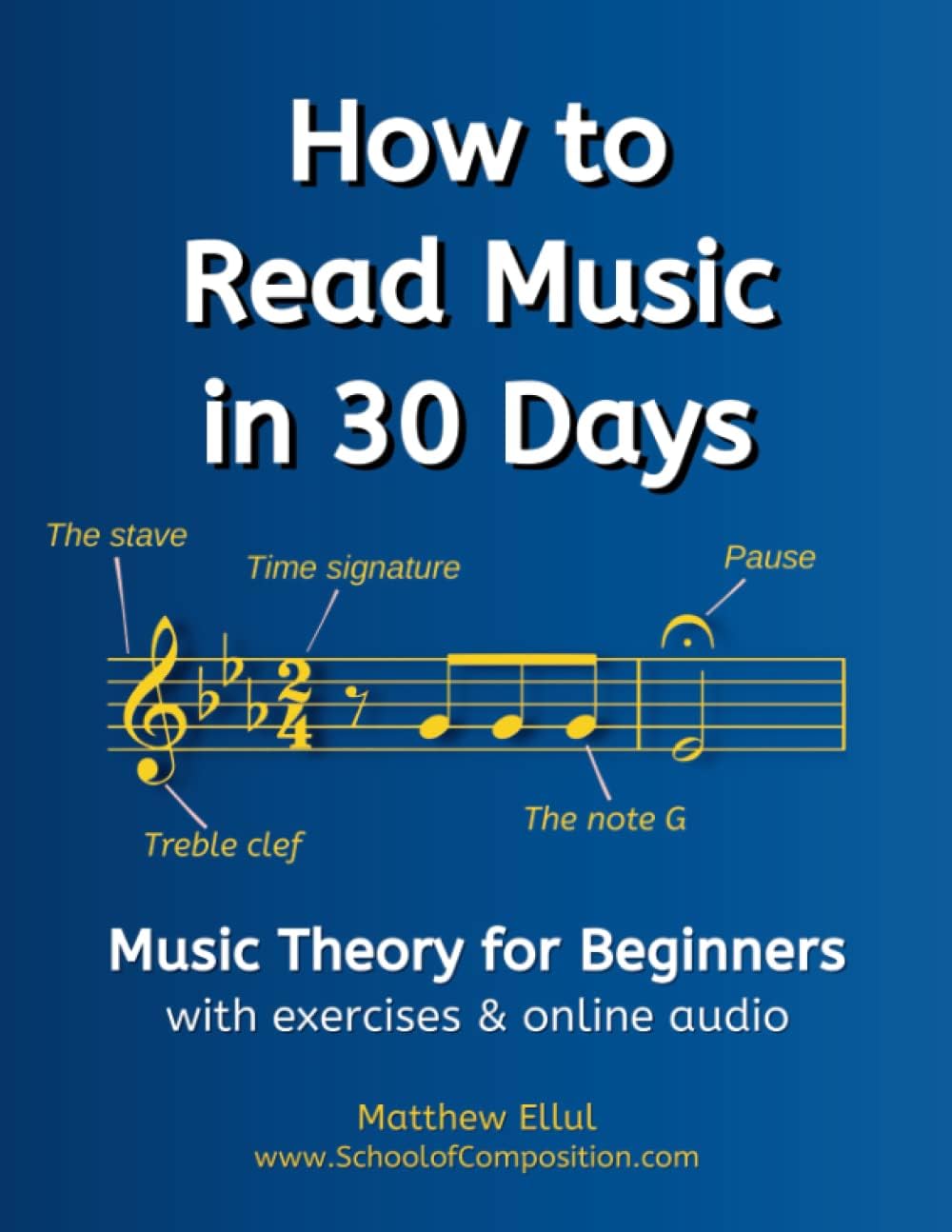
How to Read Music in 30 Days: Music Theory for Beginners - with exercises & online audio: 1 (Practical Musical Theory)
Product ID: 144908061
Buy anything from 5,000+ international stores. One checkout price. No surprise fees. Join 2M+ shoppers on Desertcart.
Desertcart purchases this item on your behalf and handles shipping, customs, and support to Vanuatu.
Do you want to learn how to read music notation with easy-to-follow, step-by-step lessons? Did you ever try to learn music theory but got frustrated with complicated jargon and mysterious terms? If so, this book is perfect for you! This book offers a unique 30-day program that makes learning how to read music simple and fun. Imagine how, in just about a month, you’ll be able to look at sheet music and know exactly what every symbol, sign, and term means. You’ll know the fundamental theory behind the how, why, and what of the music that's in front of you! With over 150 music examples, over 100 written exercises, 10 listening experiences, expert tips, lesson summaries, a final test, and online access to the audio examples, you will steadily progress towards learning: • The absolute essentials of music theory, • How rhythm REALLY works, • The complete system behind musical notes, • The crucial details of music notation, • How specific musical symbols give life to all written music. A strong foundation in the basics is essential if you want to read music, play an instrument for your friends and fans, sing in a choir or as a solo, record in a studio, compose music, write songs, or anything else in music. This book is your practical, step-by-step guide to building that foundation. Finally, you can stop searching the web endlessly in hopes of finding the right information. With this comprehensive but practical approach, your music theory questions are answered in full. And thanks to the valuable feedback of hundreds of students of all ages and backgrounds, “How to Read Music in 30 days” is now in its 3rd edition, revised and expanded to suit all types of beginner musicians. Hundreds of students have successfully gone through this practical system to master musical notation and fundamental music theory. Now, it’s your turn! Let’s get started! Frequently Asked Questions Can I really learn how to read music in 30 days? Absolutely! In fact, we start reading our most basic symbols as from day 1. You will not become an expert sight-reader in 30 days: no book, no teacher, and no program can replace the practice it takes to become a professional. But you can significantly cut down on the time it takes to get there by learning the foundations in the right way and in the right order. This is what this book is for. Are music terms in American English or British English? Both are included throughout. Although not that many terms are different in the 2 systems, there are added benefits to being aware of both sets of terms. Is this book for guitarists, pianists, singers, and other instrumentalists? Since the basics are the same for all instruments, this book will benefit anyone who is a beginner no matter which instruments they play. If you’re looking to refresh your music theory basics, fill any gaps in your knowledge of musical notation, or start from absolute scratch in reading music, this book is for you. Can I skip through lessons? The author suggests going through the program as it is presented. The comprehensive curriculum is designed to: progress in small steps, fill any knowledge gaps for those returning to music after a long pause, and build a foundation for any exams, tests, or diplomas you might someday want to sit for. Is this book suitable for young children? No. This method is designed for adults that are either self-teaching or working with a teacher. However, it does work for parents or guardians who want to take part in their young ones’ music lessons. Do I have to sign up to get the audio clips? You don't have to if you don't want to. There are three options to access the audio and the answers to the exercises. One requires signing up but the other two do not. Review: Excellent book for beginners or re-learners - I love this book. I'm learning to read music again after 40 years but even if you're a complete beginner this book is the one to use. Even though it's American the UK terms are also given where they're different. Don't be put off by the "30 days", it's just split up into 30 small chunks of information which you can learn at your leisure. Each chapter (day) explains one aspect of musical theory, each one building on the previous one. The writing is clear, precise and very understandable and you don't feel as if you are being taught like a child. This is a perfect book for adults. Each chapter is summarised at the end with Exercise questions that make you think. The answers aren't in the book itself, you need to go to the website to find them, details of this are in the book. The most important aspect of this book for me are the "Listening Experiences" from Day 2 onwards, which are also on the website. These are short audio extracts of music by different composers to illustrate the points in the book. Exercises in the book, with questions to answer, lead you to the audio extracts. I found these invaluable to really bring the information alive. This book covers all aspects of musical notation and is the only one you'll need in order to read music, although there is a follow up book if you want to go deeper into composing your own music. I have looked at several different books on learning to read music and this one is by far the best. Review: Hands down the best introduction music theory book I have come across - This has to be hands down the best introduction music theory book I have come across. I picked up this book after I heard the author interviewed on a podcast. I wanted to improve my composition for music exams and it seemed like that was where the author was coming from but the book and accompanying free course have done so much more. To help embed the theory you are learning the author has included score reading challenges (the scores can all be found for free online). This has really improved my active listening and ability to hear subtleties in music. The book used in this way creates a solid practice link between music theory and ear training. This part of the book/course is over two hours of active listening. Likewise playing music will improve. The way the material is explained I could make a solid connection between theory and my performance. One specific example is the discussion on syncopation. At the moment I’m working on Maple Leaf Rag and the explanation gave me a light bulb moment. At the end of every chapter is a short quiz and at the very end is a course quiz. This helps to embed what you have learned before you move on further grounding your theory . Because the book is self published the the need to pay for full publisher’s production costs were avoided and consequently the book is great value. I would imagine if it was produced by a publisher the cost would be at least twice what it is especially with the course that accompanies the book. Being self published there are some minor typos but nothing that affects the accuracy of the information. They are mostly of the kind where the text says ’10 examples’ and 8 examples are provided. For me this book is a solid 5 stars and I was surprised to see people give it one star. I had a quick look to see why their experience differed to mine. Some people criticised the lack of author response to download issues. This may have been a past problem that has been resolved. The course to accompany the book has an active discussion board where you can post questions as you go through the book’s material. I always got a reply within 24 hours. One person complained that the examples were of for a keyboard and not other instruments. I’m not a piano player (stringed instruments), however the linear pitch layout of the piano and white natural notes with black accented notes makes it a very clear tool for explanation that every musician can benefit from. It would be impossible to include examples for all instruments and only one chapter is piano specific when piano pedal marks were discussed. In summary great a value and engaging book with a well thought out and supportive course which will help me with composition, appreciation and performance. This will definitely improve my enjoyment of listening to and playing music and isn’t that what it’s all about?


| Best Sellers Rank | 9,208 in Books ( See Top 100 in Books ) 3 in Music Appreciation 6 in Musical Theory & Composition Exercises 19 in Musical Theory |
| Customer Reviews | 4.6 out of 5 stars 3,245 Reviews |
M**E
Excellent book for beginners or re-learners
I love this book. I'm learning to read music again after 40 years but even if you're a complete beginner this book is the one to use. Even though it's American the UK terms are also given where they're different. Don't be put off by the "30 days", it's just split up into 30 small chunks of information which you can learn at your leisure. Each chapter (day) explains one aspect of musical theory, each one building on the previous one. The writing is clear, precise and very understandable and you don't feel as if you are being taught like a child. This is a perfect book for adults. Each chapter is summarised at the end with Exercise questions that make you think. The answers aren't in the book itself, you need to go to the website to find them, details of this are in the book. The most important aspect of this book for me are the "Listening Experiences" from Day 2 onwards, which are also on the website. These are short audio extracts of music by different composers to illustrate the points in the book. Exercises in the book, with questions to answer, lead you to the audio extracts. I found these invaluable to really bring the information alive. This book covers all aspects of musical notation and is the only one you'll need in order to read music, although there is a follow up book if you want to go deeper into composing your own music. I have looked at several different books on learning to read music and this one is by far the best.
H**E
Hands down the best introduction music theory book I have come across
This has to be hands down the best introduction music theory book I have come across. I picked up this book after I heard the author interviewed on a podcast. I wanted to improve my composition for music exams and it seemed like that was where the author was coming from but the book and accompanying free course have done so much more. To help embed the theory you are learning the author has included score reading challenges (the scores can all be found for free online). This has really improved my active listening and ability to hear subtleties in music. The book used in this way creates a solid practice link between music theory and ear training. This part of the book/course is over two hours of active listening. Likewise playing music will improve. The way the material is explained I could make a solid connection between theory and my performance. One specific example is the discussion on syncopation. At the moment I’m working on Maple Leaf Rag and the explanation gave me a light bulb moment. At the end of every chapter is a short quiz and at the very end is a course quiz. This helps to embed what you have learned before you move on further grounding your theory . Because the book is self published the the need to pay for full publisher’s production costs were avoided and consequently the book is great value. I would imagine if it was produced by a publisher the cost would be at least twice what it is especially with the course that accompanies the book. Being self published there are some minor typos but nothing that affects the accuracy of the information. They are mostly of the kind where the text says ’10 examples’ and 8 examples are provided. For me this book is a solid 5 stars and I was surprised to see people give it one star. I had a quick look to see why their experience differed to mine. Some people criticised the lack of author response to download issues. This may have been a past problem that has been resolved. The course to accompany the book has an active discussion board where you can post questions as you go through the book’s material. I always got a reply within 24 hours. One person complained that the examples were of for a keyboard and not other instruments. I’m not a piano player (stringed instruments), however the linear pitch layout of the piano and white natural notes with black accented notes makes it a very clear tool for explanation that every musician can benefit from. It would be impossible to include examples for all instruments and only one chapter is piano specific when piano pedal marks were discussed. In summary great a value and engaging book with a well thought out and supportive course which will help me with composition, appreciation and performance. This will definitely improve my enjoyment of listening to and playing music and isn’t that what it’s all about?
C**.
Suitable for all musicians who want to understand music theory
Very well constructed book. It's laid out in a way that covers the basics and graduates to more complicated aspects of music in a measured and logical way. Allows the student to make steady progress throughout their journey.
D**N
Excellent theory book
As an older person learning the piano I was looking forward to getting this book after reading the reviews. I wanted to learn more about music theory and understand time signatures, beams etc and I’ve not been disappointed This book has it all including exercises to try. As it says in the title it’s separated in to daily learnings which I’ve found great. Each section is well explained and has exercises after to have a go at what has just been covered. The online link to follow along with the book is excellent. There is a forum where you can ask questions. Be great if everyone who bought the book logged in here. Don’t stress on the maths comments. It’s explained so well you’ll soon get it. Notes are covered in American and English so I found it very easy to follow. All in all I can’t recommend this book more highly. amazing value for money I’ve already bought book 2 ready for when I’ve completed this one
B**M
EXCELLENT
Returning to the piano after years of not playing. This book is concise, easy to understand, gives the British and American note names, and despite having a couple of piano grades I am learning new things that were never explained to me during music lessons. There are exercises to check your understanding after each unit, audio clips to listen to, I cannot fault this book. I will definitely be buying his second book.
S**A
The Online links set this apart from other music theory publications.
This was excellent value. The on-line audio and other accompanying on line facilities really make this the full deal. You do the exercises, you go on line to check your answers, and also many of the questions involve listening on line. For me, that's the best way to learn music. A lot of music theory books don't have answers included, they have to be purchased separately. Very pleased with my purchase.
A**R
Not for a beginner
I think the author expects the reader to have at least some basic prior knowledge of music theory because how else can you explain why it take over 2 weeks to actually be taught about the musical alphabet? And it doesn’t even show their place on the stave. The first 15 days are difficult and very mathematical focused. I’m sure many of people are like me and really struggle with maths so the author choosing to have the 30 days start off with arguably the hardest stuff is a strange choice. I will say I appreciate the online interactive part of the course. The whole website is a great learning tool.
R**T
An excellent, comprehensive book on music theory and notation
This is a wonderful way to get to grips with music theory and learn music notation. The approach taken by Matt is clear and concise, plus the fact that he is contactable by email at any time, should one need clarification or have any further questions. I like the way the book is structured, with topics presented on a daily basis. At the end of each day there are exercises, to check progress and understanding. There are also supplementary audio clips, score reading and extra music training to further increase knowledge and understanding. All in all, a brilliant way to learn and appreciate the subject.
Trustpilot
4 days ago
2 months ago