

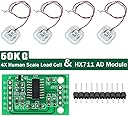



4pcs DIY 110lbs 50KG Half-bridge Body Load Cell Weight Strain Sensor Resistance + HX711 AD Module
Product ID: 146021581
📊HX711 AD module for precise digital readout
🔗Half-bridge strain gauge tech
⚖️50kg per sensor capacity
⚙️ Elevate your DIY projects with pro-grade precision and scalable power!
This 4-piece set features 50kg half-bridge strain gauge load cells with a 1000 Ohm resistance, paired with an HX711 AD module for accurate digital weight measurement. Modular design allows combining sensors to measure up to 200kg, making it perfect for advanced DIY, robotics, and industrial applications.
| ASIN | B07TWLP3X8 |
| Batteries Required? | No |
| Batteries included? | No |
| Best Sellers Rank | 86,365 in Business, Industry & Science ( See Top 100 in Business, Industry & Science ) 304 in Pressure & Vacuum Measurement 1,017 in Sensors (Business, Industry & Science) |
| Customer Reviews | 4.2 4.2 out of 5 stars (109) |
| Date First Available | 3 July 2019 |
| Item Weight | 80 g |
| Item model number | TS-YM-302 |
| Manufacturer | Youmile |
| Package Dimensions | 10.5 x 6.9 x 3 cm; 80 g |
| Part number | TS-YM-302 |
G**S
Works well
Printed a support for strain gauges, measuring 20kg accurately and consitently, gas bottle measurement system for motorhome. Rpi hx711 python libs really easy to use
D**D
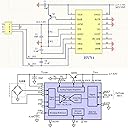
Error in diagram 4
I haven't used these properly yet, but there is an error in the 4th diagram, showing the wiring connection colours. It should be - R1: input+/power+, R2: output+/signal+, R3: input-/power-, R4: output-/signal-. The output +/- might be reversed - I haven't tested it properly yet and I will update this review when I have.
W**Y
They work if wired correctly, but response is a little slow
I used one of these cells (wired with two 1% 1K resistors to form a Wheatstone bridge) to make a load cell brake pedal for sim racing by converting a Logitech pedal set. It works fine for the purpose coupled to a ATMEGA 32u4 Arduino but there are a couple of non-obvious gotchas... For the uninitiated, each unit is a half-cell of a Wheatstone bridge; the red wire is the centre-tap (sense wire), and the black and white are the terminus(5v/0v excitation). Wiring diagrams are available on the net, but many are for 4 cells; they can be used as 4, 2, and 1 cell. 1) When you build something more permanent make sure all connections to the HX711 board are soldered correctly. *ANY* moveable connections will cause havoc with the readings because the system is so sensitive. You will need connectors for prototyping, just be aware of this source of error. 2) Get an HX711 library (I used "HX711 Arduino Library, by Bogdan Necula & Andreas Motl) and make sure the cell is powered-up (it's a library command) or you might have problems with consistent readings: don't power the cell up & down in the main loop if you are taking rapid readings. 3) If you read the cell too fast (i.e. less than 50ms) you might get incorrect readings. Check the cell is ready before reading every time. Look at the examples with the library. 4) The cell can have a different no-load reading on start-up sometimes. Check for this. 5) It is a little slow (few milliseconds lag) for rapid applications. 6) I divide the readings by 1,000 as the rest of the digits are more or less noise. 7) If speed is not required, use a rolling cumulative average algorithm over something like 4-16 samples. 8) The wires are a little flimsy so don't stress them. Other than those it works fine for this application, and would make a reasonably good custom scale from 0.5kg-200kg, but use something else for small scale measurement.
P**H
Does the job
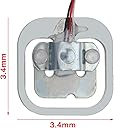
If you're trying to do anything that detects humans standing on it, pushing, or anything really, this is a decent solution. It's pitched as something for a scale but I think it's probably more suited (since scales are so cheap, even smart ones) as a sensor for load. You know, like a supermarket checkout or whatever, or maybe an alarm when someone picks up your precious thing. All good ideas. It seems to work well, theyve given you a lot of info in the screen shots so be sure to save them lest they disappear. packaging is sparse as usual.
I**C
Returned
The listing states it comes with a module and 4 x load cells. I got a module and no load cells. Totally useless so sent it back.
M**B
Well made, easy to set up.
This is my second review as apparently you can't post links, even to datasheets. Google !"HX711" to get more details on how to use this board and you'll get wiring and code examples galore. The board itself is well made, and with a bit of fiddling is producing consistent results. Basically the four strain gauges vary in resistance and this circuit is an analogue to digital converter. You just have to map the digital values to the weight you're putting on it.
V**D
Does the job
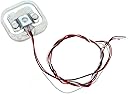
Can't really fault it for the price. The only complain I have with the cells is that the wires are way too thin and difficult to solder. I attached a photo next to a du pont cable for comparison
C**7
Fairly accurate
Used these to make a few sim racing brake load cells and these do work really well. This proved to be a good little project to better understand how they work and so forth. Needless to say they work great whether it be for this kind of use or whether you want to swap out the load cells in a set of scales.
Y**N
Problème de drift (200g) que je n'arrive pas à résoudre. J'ai un autre HX711 d'un autre annonceur : pas de soucis.
J**A
Very good and quickly
D**N
Ich habe die wägezellen gekauft um eine Stockwage zu bauen. Dafür hatte mir eine Genauigkeit von +-100 gramm gereicht. Nachdem ich als aufgebaut und mit einem esp32 das Gewicht über lorawan versenden lasse, habe ich gemerkt dass die Waage eine Genauigkeit von +- 1 gramm hat. Einziger Nachteil ist, dass man die Halter für die einzelnen Zellen noch bauen muss. Ich habe welche im 3D drucker gedruckt.
M**I
Perfetti per le applicazioni con arduino
A**R
Ottime celle di carico, abbastanza precise, facili da installare.
Trustpilot
5 days ago
3 days ago