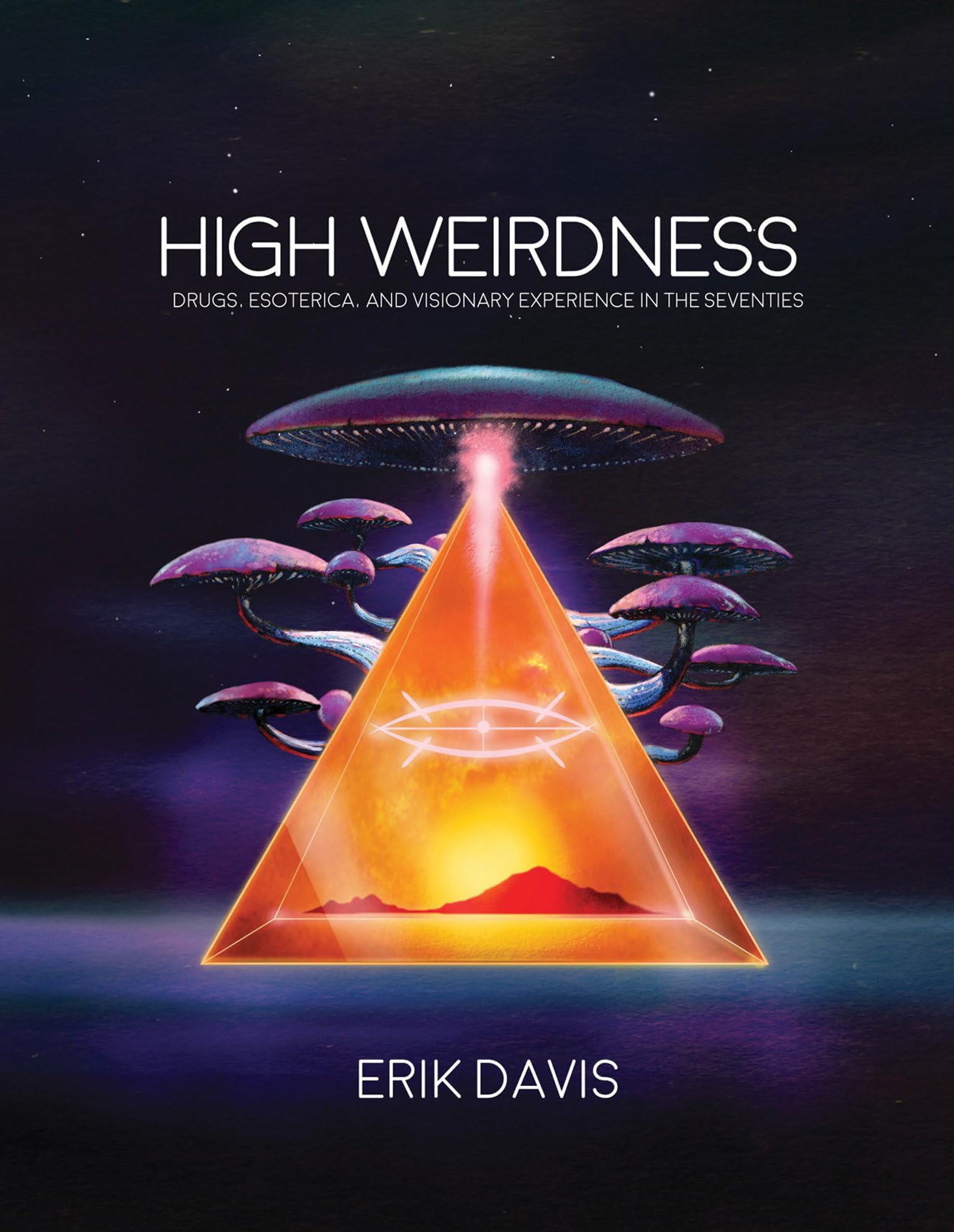
High Weirdness: Drugs, Esoterica, and Visionary Experience in the Seventies Paperback – November 5, 2019
Product ID: 165998676
Full description not available
R**N
a very long-lasting contact high for the stoned intelligentsia
This is jaw-dropping scholarship, eminently readable despite a healthy dollop of some French post-structuralist theory (which Davis makes more lucid) that, more than any book I've ever seen - and will probably ever see - makes the case for re-aligning our ideas about how to think about the "mundane" and how totally weird our existence is, right where you are sitting now.A prominent "skeptic" once titled his book How To Think About Weird Things, but he was wrong: High Weirdness is how you think about the weird.In Berger and Luckmann's classic sociology of knowledge text, The Social Construction of Reality, they make the point that the sociology of knowledge needed to consider anything "taken as knowledge" if we want to understand not just Others, but ourselves. By reading the entire oeuvres of his weirdo generalist "garage" (Davis's term) intellectuals (which alone must be 150 books, plus massive numbers of ephemera, interviews, archival material, etc), and combining the rigorous scholarship of the PhD thesis, PLUS a desire to engage a much wider reading audience than fellow PhDs, Erik Davis has given...I'll speak just for myself here...an encyclopedia that will lead me down an inexhaustible number of labyrinthine avenues of sheer weirdness. And let's face it: it's gotten pretty damned weird, and will only get even more so.I read every word. Closely. The footnotes are a blast. His reading hypermultidisciplinary reading is astonishing. Davis's own humor lightens the load and his awe at the worlds he's immersed himself in for over 30 years is palpable. He is THE great scholar of occulture, but he also wonders if the world's culture has exacted a heavy price for not paying attention to this stuff; his subject matter has been marginalized by "serious" academics for so long (now they're joining him, as he notes near the end), but is it too late? Davis: "It is as if civilization made a sorcerous pact with petroleum genies, and the debt is now coming due."Read Terence McKenna, Robert Anton Wilson and Philip K. Dick. I hope you already have. Then read Erik Davis, the one person in the world most qualified to flesh out the implications of their works and their exceedingly bizarre experiences in California in the 1970s. How did 1970s weirdness in California affect our entire culture? Read this. Because nothing has ever been the same, and it will only get weirder. For everyone.
L**Y
Phenomenal fascinating history
Erik Davis is a master of the weird. An endless font of insight and strange history in fine quality paperback. Eye-opening and powerful even if you don't care about the 70s or psychedelia. This is important and readable scholarship with profound insights for our present and future. Consciousness is the next frontier, as vast as space, and one which we've only hardly begun to explore. The "hard problems" of that topic are made accessible, profound, thrilling, and culturally relevant in the pages of this brilliant Wyrd opus. Fuel for the road ahead.
P**M
A Masterful Analysis of the "Peeling the Onion" Enigma
I enjoyed the entire book, not just the Phillip K. Dick section and the final chapter, but it was those chapters that I found the most helpful to me personally.Phillip K. Dick did the usual comparativist helical dissection, and attempted to do the reconstructivephase, the reification of the disparate elements, but didn't actually succeed.He deconstructed 'everything', but couldn't reassemble it, but he did us a huge service, leaving the chunkslying about, for the next generation to continue the work.I consider PKD utterly brilliant, and I consider the author quite comprehending and skilled with theanalysis, though the only minor thing I personally did not like is the usual 'academic, cloying sweet"I know the key words and tricky phrases" overlay a bit much in spots, but then I'm not an academic.I still give the book 5 stars, that should tell you something very positive.
A**R
Seventies California Weirdness
I was only alive for the last half-a-decade of the 1970s, but high weirdness of the 1970s was part of my formative childhood. As a kid, I was a consumer of '70s science fiction entertainment which took the form Star Wars, stories about the Lochness Monster, Big Foot, UFOs and assorted weird comic books - Marvel comics in the 1970s were really, really weird. I miss the era where there was an abundance of second hand bookstores from which you could find yellow-paged, dog-eared copies of books with far-out and strange psychedelic images on their covers, as seen with the covers of Robert Anton Wilson's Illuminatus Trilogy. This book transported me back to those, liminal days of my past. Terrance McKenna, Robert Anton Wilson and Phil K Dick, were perhaps more than just enthusiasts for the weird, they were philosophical thinkers who were asking themselves the big questions: what is reality and what does it mean to be a conscious experiencer of this strange universe? People still ask this question in the 21st century, but scientism and a pseudo-scientific rationalism has taken over the zeitgeist of this century. Ask what is reality and the standard response from our intellectuals today is to talk about how the brain creates a virtual simulation of the world from sensory data or to talk about how the universe and physical space-time, is (literally) spun out of particles whose interactions can be conceptualised as a kind abstract information network. These days, high weirdness is cloaked by a false scientific rationalism. People laughed, back in 1977, when PK Dick suggested that we are living in a simulated reality, now seemingly conservative philosophers and scientists debate whether or not what we call 'reality' is just a simulation. The physicalist doctrines to explain reality started gaining momentum in the 1970s with the rise of modern technology as an essential ingredient of everyday living: the birth of the computer and computer networks; the first signs that our day-to-day activities in society could be constantly recorded, for good or evil, thanks to what had then become the ubiquitous capacity for technology to capture events on film and tape and later, digital technology. The world became a strange place: where we now being monitored by inanimate technology, or by alien or human forces or by malevolent or benevolent Gods? Perhaps all of these meant the same thing? The author explains how the rise of technology and its emergence as a part of 1970s life in California influenced the ideas of McKenna, Wilson and Dick as they took their "trips" down the rabbit hole of 'high weirdness" with its far out psychedelic imaginative ideas and conspiratorial thinking. The author demonstrates an extensive knowledge of the background context in which to explore these three intellectual psychonauts of the seventies. He frames their work not just by explaining their ideas in the context of the Californian society they were living in, but also in terms of their philosophical, theological, occult/supernatural, psychological and literary influences, exploring how the likes of Carl Jung, Aleister Crowley, H.P. Lovercraft, Timothy Leary and Marshal Mcluhan, amongst others, influenced their modes of thinking. The book is well written and an enjoyable read, although I felt that it was little long winded at times (I feel like such a hypocrite saying that!). Particularly, the section on PK Dick and the analysis of Dick's Exegesis. Admittedly, the Exegesis covers thousands of pages of Dick's personal writings and I imagine that the author must have spent an enormous amount of time reading through it, but most of this Exegesis material is really just Dick putting his meandering thoughts down on to paper, whether in talking to friends or just talking to himself. The last pages of Dick's novel "Valis " summarises the Exegesis into a few simple statements or propositions reading like an abbreviated form of the philosopher, Ludwig Wittgenstein's Tractatus. For those who have read and enjoy the books: McKennas' "Invisible Landscapes" and his "True Hallucinations"; Wilson's "Illuminatus Trilogy" and his "Cosmic Trigger"; Dick's sci-fi novels such as "Man in the High Castle," "The Three Stigmata of Palmer Eldritch," etc. and some, or all, of Dick's Exegesis, than you must definitely read this book.
Trustpilot
4 days ago
1 month ago