
Buy anything from 5,000+ international stores. One checkout price. No surprise fees. Join 2M+ shoppers on Desertcart.
Desertcart purchases this item on your behalf and handles shipping, customs, and support to Vanuatu.
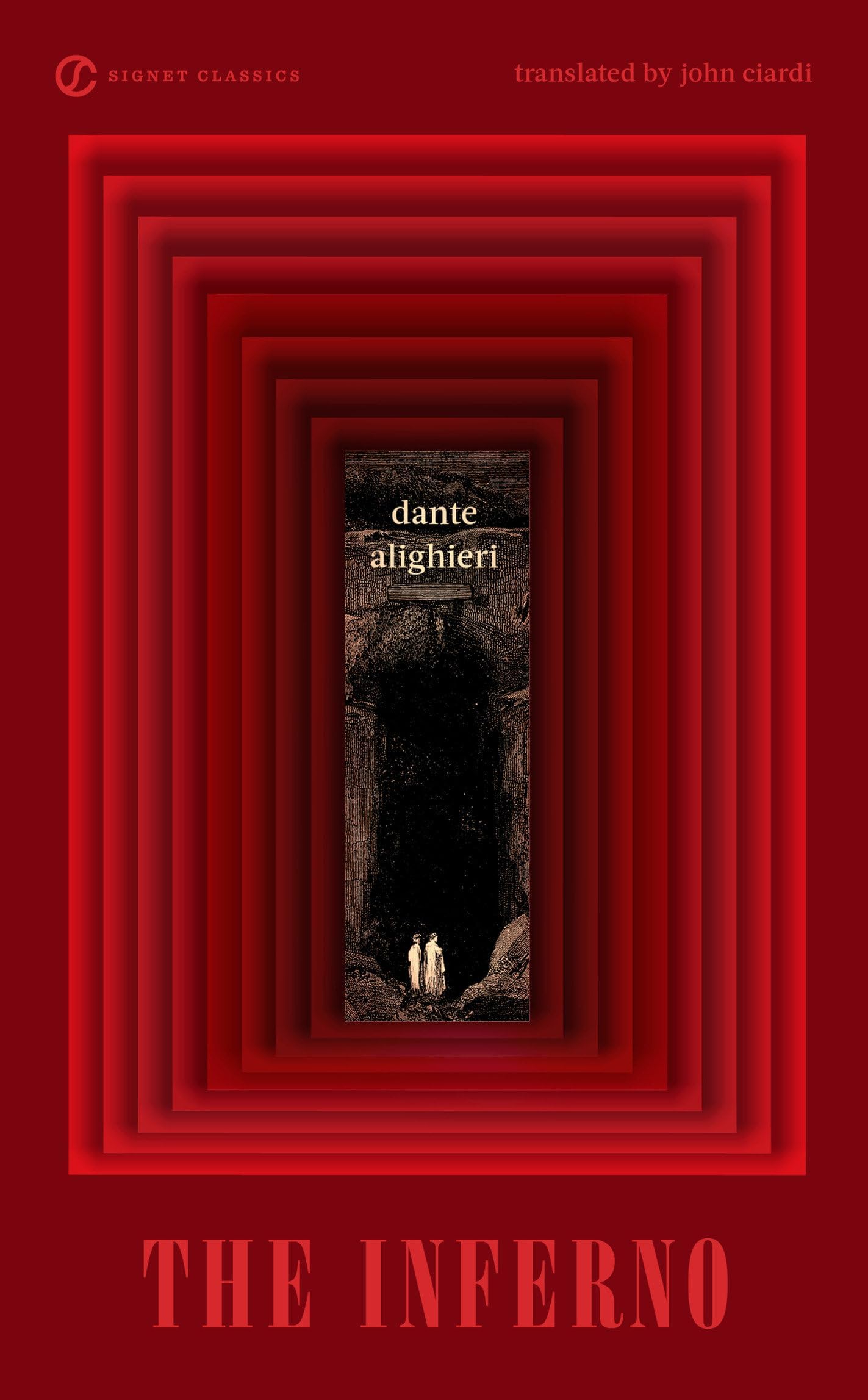
The Inferno (Signet Classics) [Alighieri, Dante, Ciardi, John, MacAllister, Archibald T., Cifelli, Edward M.] on desertcart.com. *FREE* shipping on qualifying offers. The Inferno (Signet Classics) Review: In the middle of our life's journey... - For years, we have been required to read Dante's "Inferno" in the classroom, either as high schoolers or undergrads in a survey class on Western literature. Even at that age, with so many distractions and with such a limited imagination, it is impossible to miss Dante's extraordinary literary talent. Acting as both author and narrator, Dante shares with us his vision of the afterlife, as he descends its depths and witnesses the varying degrees of torment that await the incontinent, the violent and the fraudulent. His sinners and the lairs they inhabit are thought-provoking and rich with a symbolism and imagery unrivaled by any other poet until that time. There are unforgettable stories of love, vengeance, betrayal, abuse-of-power, guilt and just about everything one can imagine in an underworld which teems with characters from mythology, history and the Bible. From the tempestuous love affair of Paolo and Francesca in the second circle to the chilling prophecy of Farinata in the sixth to the horrifying story of Count Ugliono in the ninth, the Underworld is vast and complex, and the punishment each sinner endures serves as both physical and mental penance for the wrongs they committed on earth; as they sinned, so do they now suffer and are forever reminded of what brought them there. Dante begins his journey on Good Friday 1300, when he is at the cross-roads of his life and just emerged from a dark wood "where the straight way was lost." He encounters three beasts: a she-wolf, a lion and a leopard, each representing the different types of sins of the Inferno. His guide is the poet Virgil, who represents reason in its purest form and who has been prompted to help Dante see the wages of sin by his departed Beatrice, who represents love and Christian charity in its purest form. Virgil himself occupies a circle of Hell, a circle occupied only by the most enlightened pagans the world has ever seen. Nevertheless, his seniority over the other wraiths of hell, as well his calmness in the face of all adversity, helps keeps Dante's fear in check, as they make their way through the gut-wrenching circles of hell. Virgil is there to bring order to the chaos, to remind Dante that these sinners have earned their judgment and to yell at any brazen demons, centaurs, giants or otherwise who block their path, ordained by the Divine. Dante is there to learn so that he may be spared the awful fate of the souls he meets. There is a Clifton Fadiman quote that "when you re-read a classic, you do not see more in the book than you did before; you see more in yourself than there was before." For this reason, I urge anyone who was compelled to read this timeless poem in school to revisit it as an adult. See how much more you appreciate Dante's terza rima, his epic similes, his imagery and his insight into the depths of human fallibility, now that you don't have to study for a quiz on it. And this particular translation, so carefully rendered by John Ciardi, reads so nicely, and his commentary is so exhaustive that you could not get lost if you wanted to. On the other hand, the ambitious reader who likes to unravel the symbolism on his/her own should be warned that this edition contains many spoilers if too much of the commentary is read. In any case, Dante's work is a triumph of the Medieval world, a classic that will be read and re-read until the end of time! Review: Nearly Perfect Work; Nearly perfect translation; Extremely poor OCR! - Rating: I gave this five stars only because it is the best translation of perhaps the finest literary achievement outside of the Bible. However, I MUST express my concerns as below: The original: TEN stars out of Five for it is unparalleled. The Translation by John Ciardi: FIVE stars out of FIVE for it is in itself a work of art! The OCR conversion: MINUS TEN out of FIVE; for numerous, glaring, disconcerting and inexcusable OCR errors!! I have been a dedicated fan of John Ciardi's inspired translation of Dante's Commedia for many years. The original work; The Commedia, by Dante is perhaps the closest thing to perfection outside of the Bible (which, I believe firmly was God-Authored, so, it would not be fair to compare any Man's work to that too closely). The appellation of 'Divine' to Dante's extraordinary allegory is a statement to its almost perfect quality. Now, the problem for me is that it is written in Italian. I speak English. So, I cannot read this work in its original form. The next best thing is to read a translation into English. Again, no matter the quality of the original, the translation can provide an experience near to that which the author intended, or it can mar the work beyond recognition. For this work, Dante's Commedia; the Inferno, Purgatorio and Paradiso, there exist several translations into English. For my dollar, John Ciardi's is the best. Others may disagree on this count, but there is no arguing that his translation is masterful. The added bonus is his short prose summaries of each canto (chapter) and his extensive footnotes for illumination of the text. Added together, John Ciardi and Dante Alighieri present, in this translation, a reading experience of scintillating excellence. Each and every reading from the first to the thousandth is wonderful, rich and even fresh. Now along comes the Kindle. Being an extreme bibliophile, I never thought I would like the ebook experience. Suffice it to say that I was quite wrong on that count. However, this is not a review of the Kindle or any e-reader. So, naturally, loving this translation and work like I do, I purchased the Kindle version without blinking. To my utter dismay, the text is sorely corrupted by errors. The OCR output does not seem to have been reviewed, edited or otherwise corrected at all. Having read this work as many times as I have, each canto, each stanza, each verse, and every word are precious and like old friends. (I re-read it for the same reasons one keeps returning to their favorite ice cream flavor, or their favorite song). But, in this case, the amount of error contained in this electronic copy is jarring and unpleasant and all too frequently encountered. So, if the nice folks at Penguin publishing should happen to read this review; I can only say: You have a gem on your hands, so why smear it with mud? Please, Please, correct the text errors, which are legion and most disconcerting, and restore this literary diamond to its original and deserved luster and brilliance and re-publish the work as it should have been done from the start.
| Best Sellers Rank | #30,539 in Books ( See Top 100 in Books ) #9 in Italian Poetry (Books) #956 in Classic Literature & Fiction #2,427 in Literary Fiction (Books) |
| Customer Reviews | 4.5 out of 5 stars 2,319 Reviews |
D**H
In the middle of our life's journey...
For years, we have been required to read Dante's "Inferno" in the classroom, either as high schoolers or undergrads in a survey class on Western literature. Even at that age, with so many distractions and with such a limited imagination, it is impossible to miss Dante's extraordinary literary talent. Acting as both author and narrator, Dante shares with us his vision of the afterlife, as he descends its depths and witnesses the varying degrees of torment that await the incontinent, the violent and the fraudulent. His sinners and the lairs they inhabit are thought-provoking and rich with a symbolism and imagery unrivaled by any other poet until that time. There are unforgettable stories of love, vengeance, betrayal, abuse-of-power, guilt and just about everything one can imagine in an underworld which teems with characters from mythology, history and the Bible. From the tempestuous love affair of Paolo and Francesca in the second circle to the chilling prophecy of Farinata in the sixth to the horrifying story of Count Ugliono in the ninth, the Underworld is vast and complex, and the punishment each sinner endures serves as both physical and mental penance for the wrongs they committed on earth; as they sinned, so do they now suffer and are forever reminded of what brought them there. Dante begins his journey on Good Friday 1300, when he is at the cross-roads of his life and just emerged from a dark wood "where the straight way was lost." He encounters three beasts: a she-wolf, a lion and a leopard, each representing the different types of sins of the Inferno. His guide is the poet Virgil, who represents reason in its purest form and who has been prompted to help Dante see the wages of sin by his departed Beatrice, who represents love and Christian charity in its purest form. Virgil himself occupies a circle of Hell, a circle occupied only by the most enlightened pagans the world has ever seen. Nevertheless, his seniority over the other wraiths of hell, as well his calmness in the face of all adversity, helps keeps Dante's fear in check, as they make their way through the gut-wrenching circles of hell. Virgil is there to bring order to the chaos, to remind Dante that these sinners have earned their judgment and to yell at any brazen demons, centaurs, giants or otherwise who block their path, ordained by the Divine. Dante is there to learn so that he may be spared the awful fate of the souls he meets. There is a Clifton Fadiman quote that "when you re-read a classic, you do not see more in the book than you did before; you see more in yourself than there was before." For this reason, I urge anyone who was compelled to read this timeless poem in school to revisit it as an adult. See how much more you appreciate Dante's terza rima, his epic similes, his imagery and his insight into the depths of human fallibility, now that you don't have to study for a quiz on it. And this particular translation, so carefully rendered by John Ciardi, reads so nicely, and his commentary is so exhaustive that you could not get lost if you wanted to. On the other hand, the ambitious reader who likes to unravel the symbolism on his/her own should be warned that this edition contains many spoilers if too much of the commentary is read. In any case, Dante's work is a triumph of the Medieval world, a classic that will be read and re-read until the end of time!
J**Y
Nearly Perfect Work; Nearly perfect translation; Extremely poor OCR!
Rating: I gave this five stars only because it is the best translation of perhaps the finest literary achievement outside of the Bible. However, I MUST express my concerns as below: The original: TEN stars out of Five for it is unparalleled. The Translation by John Ciardi: FIVE stars out of FIVE for it is in itself a work of art! The OCR conversion: MINUS TEN out of FIVE; for numerous, glaring, disconcerting and inexcusable OCR errors!! I have been a dedicated fan of John Ciardi's inspired translation of Dante's Commedia for many years. The original work; The Commedia, by Dante is perhaps the closest thing to perfection outside of the Bible (which, I believe firmly was God-Authored, so, it would not be fair to compare any Man's work to that too closely). The appellation of 'Divine' to Dante's extraordinary allegory is a statement to its almost perfect quality. Now, the problem for me is that it is written in Italian. I speak English. So, I cannot read this work in its original form. The next best thing is to read a translation into English. Again, no matter the quality of the original, the translation can provide an experience near to that which the author intended, or it can mar the work beyond recognition. For this work, Dante's Commedia; the Inferno, Purgatorio and Paradiso, there exist several translations into English. For my dollar, John Ciardi's is the best. Others may disagree on this count, but there is no arguing that his translation is masterful. The added bonus is his short prose summaries of each canto (chapter) and his extensive footnotes for illumination of the text. Added together, John Ciardi and Dante Alighieri present, in this translation, a reading experience of scintillating excellence. Each and every reading from the first to the thousandth is wonderful, rich and even fresh. Now along comes the Kindle. Being an extreme bibliophile, I never thought I would like the ebook experience. Suffice it to say that I was quite wrong on that count. However, this is not a review of the Kindle or any e-reader. So, naturally, loving this translation and work like I do, I purchased the Kindle version without blinking. To my utter dismay, the text is sorely corrupted by errors. The OCR output does not seem to have been reviewed, edited or otherwise corrected at all. Having read this work as many times as I have, each canto, each stanza, each verse, and every word are precious and like old friends. (I re-read it for the same reasons one keeps returning to their favorite ice cream flavor, or their favorite song). But, in this case, the amount of error contained in this electronic copy is jarring and unpleasant and all too frequently encountered. So, if the nice folks at Penguin publishing should happen to read this review; I can only say: You have a gem on your hands, so why smear it with mud? Please, Please, correct the text errors, which are legion and most disconcerting, and restore this literary diamond to its original and deserved luster and brilliance and re-publish the work as it should have been done from the start.
N**2
The 13th Century Speaks
How does one review the Great Dante? He is one of those pivotal authors in western history who influenced everything that followed him. Not only was he the greatest author his day, he also is responsible for the literary coming of age for the Italian language. Any major work before him was written in Latin. Dante changed that, he set authors free to speak in their own tongues, and this is the book in which he did it. The greatest challenge in reading him in English translation is that he cannot be done proper justice outside of Italian. His original text is exquisite in both sound and substance, and the best editions are those in which his prose is offered in both languages. You may be pleasantly surprised to read the Italian, only checking the English for comprehension. I know this happened with me. With that caveat in mind, the text offered here is adequate to the story, if not the substance. (I cannot recommend Dante's original prose highly enough.) The story is amazing, Dante finds himself lost in the middle of his life and finds that he cannot find his way back through the symbolic challenges that confront him. He is met by his literary mentor, Virgil, who informs him that he must face the path which leads through Hell, Purgatory, and Paradise. This book deals with the first leg of the journey; which takes him to the very depths of Hell Itself. As he goes, he is exposed to the various punishments doled out against sinners, based on the severity and content of their sins. His imagination is amazing. I won't attempt to describe the nature of his Divine Justice, but the journey is one of the strangest and most memorable in literature. In the course of this story you will also get a real sense of the 13th Century mind. Do not expect to enjoy or agree with it's attitudes, but you can learn a lot about how Western Culture got to where it is, and isn't today by experiencing it. Truly a book for the ages, this is a must-read for any student of History, Culture, Religion, and, most of all, Literature. Dante is truly one of those authors who dwells in the Pantheon with Shakespeare, Cervantes, Voltaire and Dostoyevsky, and he is oldest of them all.
S**E
Good translation - modern English and poetic
This is a well written translation, although I'm not a scholar on translations from the Italian of Dante. It's easy to read and poetic. Extensive annotations explain the characters and the process of translation, especially where there is ambiguity or nuances of the the Italian that can't be translated. Surprisingly enjoyable read. As for the work itself, it is important for its place in history and the effect it has had over the centuries. Much of it sounds like Dante's revenge against his political enemies (I wonder where his political opponents in Florence would put him it hell). The descriptions are vivid, horrid and fascinating. Being a non Christian, I would probably be in one of the rings of Dante's hell. However, it is only Dante's hell, after all.
A**R
Best to Read One Chapter A Day To Get The Most Out Of This Book
I really enjoyed this edition. I felt like the detail shared behind the people in Dante's Inferno taught me a lot of History and Greek mythology and I love Dante's quest to be true and virtuous and avoid the sins of others. It gave me a respect for some things today people take for granted that could be sins and reminded me to be ever mindful of my actions. It was so interesting how he portrays hell as different levels with different punishments based on how grievous the sin was. It gave me a lot to ponder. I also liked how its divided into chapters explaining in detail before you read the actual translation and then after are foot notes explaining all the references. That makes it easy to enjoy, understand and get a lot out of each passage. I suggest reading one chapter each day - takes 5 - 15 minutes . I started this as a full read - and got 3/4 of the way through and stopped, then picked it back up and read one chapter each day from the beginning again and I enjoyed it much more reading 1 chapter a day and thinking about what I read and the meaning. This isn't a book you should "speed read" or skim but savor. This book shows you there is nothing new in this world - and if we would all learn more history (me included) - perhaps we can stop the continuous cycle mankind is always in (wars and rumors of wars)...
C**N
Corgidogman
Is confusing the story is not hard is reading,but that it is I can't explain it but is for my college class so for a easy grade.
D**X
GREAT author & translator! - TERRIBLE formatting & editing!
Of course this is a stellar piece of work - and of course everyone should read it at least once. Alighieri was a true master and this is him at his finest. As well, Ciardi's translation is recognized as one of the best - and rightfully so. This is by far one of the most artful translations available, and very likely THE best for non-scholars (meaning most of us). The power, beauty, horror, and wonder are all there. The notes and summaries are very well done, and add greatly to the reader's experience. MacAllistar's introduction is also informative, and enlightening. However..... I can't believe more has not been written in these reviews about the absolutely horrendous job of formatting and editing done on this (kindle) version. Simply atrocious. Just about every single page had multiple spelling errors, words running together, bizarre & random upper/lower case lettering, missing or misplaced punctuation, oddball line breaks (NOT due to font sizing), etc. Did those who produced this not even glance once at the work before publishing? How could they treat such a masterpiece with so little consideration? So - is it recommended? Yes and no. For the story itself, and for this particular translation (and notes)? - absolutely yes. But for the quality of the formatting? - unfortunately no.
T**N
A powerful translation of a masterpiece
There have been several excellent translations of Dante in the past few years, all worth reading in their own right. But I retain a special affection for John Ciardi's version, as it's the first one I ever read, at the unprepared & overwhelmed age of 15. I knew of its reputation as a major classic & I was ignorant enough to be unfazed by the prospect of reading it. Well, to say that I was soon in over my head is an understatement! But Ciardi's fine, lyrical translation, as well as his extensive but always clear notes, enabled me to go on without drowning. And what a journey it was! At the time, I was simply dazzled by the invention & imagery of the work; now that I'm older, I can appreciate its many psychological & spiritual levels. Both the capstone of the Middle Ages & the gateway to the Renaissance, Dante's masterpiece is a stunning exploration of the religious & political world of its time. A lifetime of knowledge went into its creation, and every intricately woven thread of poetry shines like gold, without ever becoming pedantic. Whether you accept or reject a literal belief in God & Hell, the poem remains an astonishing revelation of & descent into the human psyche, the heart of darkness. Dante's insight that the damned have ultimately chosen their fate remains psychologically true today ... how many people trapped in the private hells of their own lives have placed themselves there, bemoaning their fate while unable to find the courage or strength to escape it? But that's merely one level of meaning in this magnificent work. A visionary epic of learning, of faith, of poetry, it becomes deeper & richer with every new reading. If you don't know the original language, the next best thing is to read as many translations as possible -- and I still recommend Ciardi's as one of the best. This is an illumination of Hell that can't dim or fade with the years -- most highly recommended!
Trustpilot
2 months ago
3 days ago