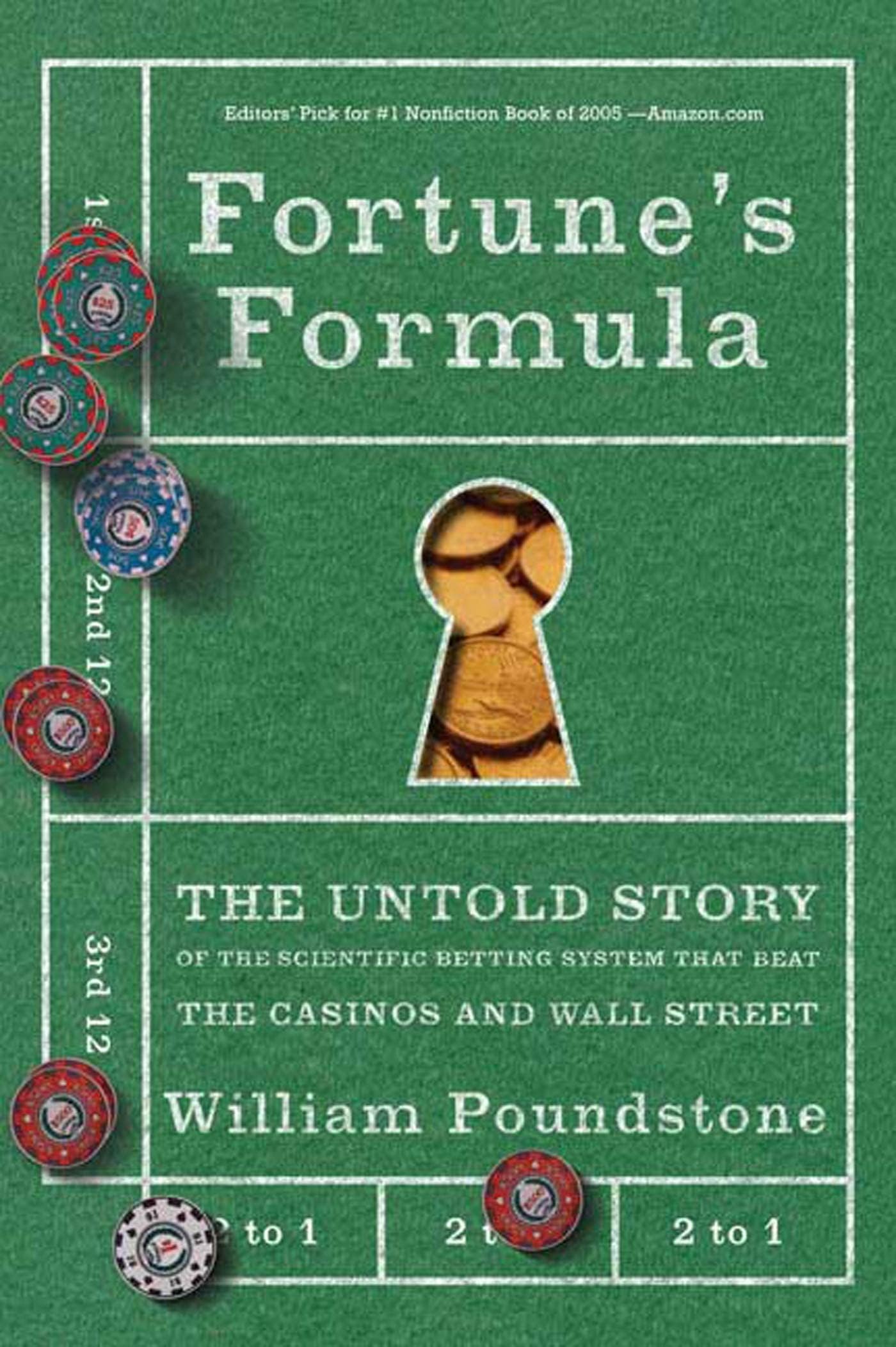
Fortune's Formula: The Untold Story of the Scientific Betting System That Beat the Casinos and Wall Street
Product ID: 1701873
Buy anything from 5,000+ international stores. One checkout price. No surprise fees. Join 2M+ shoppers on Desertcart.
Desertcart purchases this item on your behalf and handles shipping, customs, and support to Vanuatu.
Fortune's Formula: The Untold Story of the Scientific Betting System That Beat the Casinos and Wall Street [Poundstone, William] on desertcart.com. *FREE* shipping on qualifying offers. Fortune's Formula: The Untold Story of the Scientific Betting System That Beat the Casinos and Wall Street Review: Gangsters, gamblers, mathematicians, touts, hedge fund wizards, and more - “Fortune’s Formula” is the Kelly Criterion from J.L. Kelly Jr. who was a mathematician at Bell Labs in the 1950s. Essentially the formula gives the optimal size of bets in order to win as much as possible over time while reducing the risk of ruin. The thing for the reader to realize is that the Kelly Criterion has no utility unless the bettor or investor has an advantage. That needs to be repeated: on an even bet, such as tossing a coin the Kelly strategy is to bet nothing, zero, zilch. Before I get into the review of this excellent and very interesting book I want to relate an experience I had some years ago, sometime in the early 1980s. I thought I had come up with a way to bet on baseball games in Las Vegas with an advantage over the line (that is over the bookie’s vigorish). For a season I studied results compared to the betting line. I was so sure I had a clear advantage that the next problem became how to run up my money efficiently without taking the chance of going broke. In other words, non-mathematician that I am, I was seeking something like Kelly’s Criterion. And what I came up with turned out to be very similar to his formula, although I don’t recall exactly. Unfortunately when I got to Las Vegas it didn’t take me long to realize I had no advantage and therefore didn’t make any bets. Okay, back to the book. An excellent way to get an idea of the scope of this work is to look at the parts. Part One is titled “Entropy,” Part Two is “Blackjack,” Part Three is “Arbitrage,” Part Four is “St Petersburg Wager,” Part Five is “RICO” (Racketeer-Influenced and Corrupt Organization), Part Six is “Blowing Up,” and Part Seven is “Signal and Noise.” Along the way you will meet gangsters, the Italian and Jewish mafias, a young and very aggressive Rudolph Giuliani, the Hong Kong horseracing scene in which some people made millions (it was the only legal betting allowed by law in Hong Kong) and some keen ideas on how to make money gambling or investing. But what really makes this book so interesting is the light that Poundstone shines on two giants in the science of information, gambling and investing, namely Claude Shannon and Edward O. Thorp. Shannon is known as the father of information theory and in many respects as the founder of the digital world we live in today. He was also an astute investor as Poundstone reveals. I don’t think it would be an exaggeration to say that Shannon was a genius. Thorp first became known to the public with his book “Beat the Dealer” (first edition, 1962) which presented a winning strategy for blackjack. I read that book when I was still in my twenties with great enthusiasm but never employed the strategies since my memory is rather ordinary. Instead I played poker, but that, as they say, is another story. What is astonishing about Thorp that I learned here is that his hedge fund, Princeton-Newport Partners was one of the most successful ever. A dollar invested in the fund in 1969 would grow to $14.78 in1988. Yes, wow. Poundstone explains in detail how all this happened and it is a fascinating story. I’m amazed at how much work he put into this book and all the information he acquired. He is an outstanding and prolific journalist as well as an MIT grad, although I must say that the organization of the book was a bit freestyle. Additionally there are some errors and some unclear passages. Consider this on page 39: Ed Thorp (as a boy) “would buy a pack of Kool-Aid for five cents and sell the mixed beverage to hot WPA workers for one cent a glass. Ed could get six glasses from a pack for a penny profit.” What is not right here is that you needed to add sugar to the Kool Aid which would be an additional expense. On page 68, Poundstone writes: “Kelly described his idea this way: A ‘gambler with a private wire’ gets advanced word of the outcome of baseball games or horse races…” It’s unclear what year this was but regardless of the year you can’t get “advanced word of the outcome” of a baseball game. One more example: Poundstone writes: “In 1993 Ed Thorp” learned from a computer science person who “had discovered” that pro basketball teams “that had to travel to the city in which a game was played tended to do poorer than a team that didn’t have to travel. A team that had to play a number of games in a row did poorer on average than a team given more rest between games. These variables were not properly weighted in bookies’ odds.” (p. 322) This is not true even in 1993. The two factors mentioned are just exactly the sorts of factors that are built into the bookies’ betting line, as any serious sports bettor knows. Part of the pleasure in reading this book is in the way that Poundstone exposes stupidity in what would seem to be high places. Here’s a quote from Mark Rubenstein who is a professor of finance at UC Berkeley. He’s talking about the Black Monday stock market crash of October 19, 1987: “So improbable is such an event that it would not be anticipated to occur even if the stock market were to last for 20 billion years, the upper end of the currently estimated duration of the universe. Indeed, such an event should not occur even if the stock market were to enjoy a rebirth for 20 billion years in each of 20 billion big bangs.” Gee, I hope he was just funning us. (BTW, my baseball betting delusion came about because I used the line in the Los Angeles Herald Examiner which was a stale line that didn’t account for recency. My approach was to weight recent results more heavily that older results. When I got to Vegas and saw the Vegas line it was clear that their betting lines did indeed consider recency.) --Dennis Littrell, author of “The World Is Not as We Think It Is” Review: It takes exceptionally smart people to make truly massive blunders - This book is a concise look at the evolution of formal investment theory, with continual contextual references to its ties to gambling and to organized crime. It also is a hilarious and insightful history of gambling from the Bernoulli's in the 1700s through the hedge fund traders of the late 1990's. The author devotes over 50 pages to notes and the index. This was appreciated since I wanted to look up more about so many of the anecdotes he included. Mr. Poundstone poignantly describes the downfall of high-flying firms such as LTCM, where the investment wizards went from the darlings of Wall Street to the dredges of the investment community in large part because they were so clever; and they started to believe they were infallible. One LTCM road-show presentation was held at the insurance company Conseco in Indianapolis. Andrew Chow, a Conseco derivatives trader, interrupted Scholes. "There aren't that many opportunities," Chow objected. "You can't make that kind of money in Treasury markets." Scholes snapped: "You're the reason - because of fools like you we can." (Page 281) Warren Buffett marveled at how "ten or 15 guys with an average IQ of maybe 170" could get themselves "into a position where they can lose all their money." That was much the sentiment of Daniel Bernoulli, way back in 1738, when he wrote: "A man who risks his entire fortune acts like a simpleton, however great may be the possible gain." (Page 291) He also points out the real world flaws in some theoretically appealing scams. The St. Petersburg Wager seems mathematically correct; yet it overlooks a vitally important constraint (pages 182-184). Another is the unfounded weight we unconsciously give to historical returns, as evidenced by his retelling of another Warren Buffett story: In a 1984 speech, Buffett asked his listeners to imagine that all 215 million Americans pair off and bet a dollar on the outcome of a coin toss. The one who calls the toss incorrectly is eliminated and pays his dollar to the one who was correct. The next day, the winners pair off and play the same game with each other, each now betting $2. Losers are eliminated and that day's winners end up with $4. The game continues with a new toss at doubled stakes each day. After twenty tosses, 215 people will be left in the game. Each will have over a million dollars. According to Buffett, some of these people will write books on their methods: "How I Turned a Dollar into a Million in Twenty Days Working Thirty Seconds a Morning." Some will badger ivory-tower economists who say it can't be done: "If it can't be done, why are there 215 us?" "Then some business school professor will probably be rude enough to bring up the fact that if 215 million orangutans had engaged in a similar exercise, the result would be the same - 215 egotistical orangutans with 20 straight winning flips." (Page 314) The author follows the lives of a few major contributors to investment theory, information theory, and betting theory: Claude Shannon, who invented Information Theory and paved the way for the digital computer age; John Kelly, who developed the formula for gains with no possibility of ruin; and Edward Thorpe, who built upon these findings and beat the roulette wheels, the blackjack tables and the investment fund managers. It's a fast read - only 329 pages before the notes and index. I highly recommend it!
| ASIN | 0809045990 |
| Best Sellers Rank | #114,177 in Books ( See Top 100 in Books ) #1 in Roulette #90 in Stock Market Investing (Books) #117 in Introduction to Investing |
| Customer Reviews | 4.5 4.5 out of 5 stars (827) |
| Dimensions | 5.4 x 1.2 x 8.2 inches |
| Edition | First Edition |
| ISBN-10 | 9780809045990 |
| ISBN-13 | 978-0809045990 |
| Item Weight | 2.31 pounds |
| Language | English |
| Print length | 386 pages |
| Publication date | September 19, 2006 |
| Publisher | Hill and Wang |
D**L
Gangsters, gamblers, mathematicians, touts, hedge fund wizards, and more
“Fortune’s Formula” is the Kelly Criterion from J.L. Kelly Jr. who was a mathematician at Bell Labs in the 1950s. Essentially the formula gives the optimal size of bets in order to win as much as possible over time while reducing the risk of ruin. The thing for the reader to realize is that the Kelly Criterion has no utility unless the bettor or investor has an advantage. That needs to be repeated: on an even bet, such as tossing a coin the Kelly strategy is to bet nothing, zero, zilch. Before I get into the review of this excellent and very interesting book I want to relate an experience I had some years ago, sometime in the early 1980s. I thought I had come up with a way to bet on baseball games in Las Vegas with an advantage over the line (that is over the bookie’s vigorish). For a season I studied results compared to the betting line. I was so sure I had a clear advantage that the next problem became how to run up my money efficiently without taking the chance of going broke. In other words, non-mathematician that I am, I was seeking something like Kelly’s Criterion. And what I came up with turned out to be very similar to his formula, although I don’t recall exactly. Unfortunately when I got to Las Vegas it didn’t take me long to realize I had no advantage and therefore didn’t make any bets. Okay, back to the book. An excellent way to get an idea of the scope of this work is to look at the parts. Part One is titled “Entropy,” Part Two is “Blackjack,” Part Three is “Arbitrage,” Part Four is “St Petersburg Wager,” Part Five is “RICO” (Racketeer-Influenced and Corrupt Organization), Part Six is “Blowing Up,” and Part Seven is “Signal and Noise.” Along the way you will meet gangsters, the Italian and Jewish mafias, a young and very aggressive Rudolph Giuliani, the Hong Kong horseracing scene in which some people made millions (it was the only legal betting allowed by law in Hong Kong) and some keen ideas on how to make money gambling or investing. But what really makes this book so interesting is the light that Poundstone shines on two giants in the science of information, gambling and investing, namely Claude Shannon and Edward O. Thorp. Shannon is known as the father of information theory and in many respects as the founder of the digital world we live in today. He was also an astute investor as Poundstone reveals. I don’t think it would be an exaggeration to say that Shannon was a genius. Thorp first became known to the public with his book “Beat the Dealer” (first edition, 1962) which presented a winning strategy for blackjack. I read that book when I was still in my twenties with great enthusiasm but never employed the strategies since my memory is rather ordinary. Instead I played poker, but that, as they say, is another story. What is astonishing about Thorp that I learned here is that his hedge fund, Princeton-Newport Partners was one of the most successful ever. A dollar invested in the fund in 1969 would grow to $14.78 in1988. Yes, wow. Poundstone explains in detail how all this happened and it is a fascinating story. I’m amazed at how much work he put into this book and all the information he acquired. He is an outstanding and prolific journalist as well as an MIT grad, although I must say that the organization of the book was a bit freestyle. Additionally there are some errors and some unclear passages. Consider this on page 39: Ed Thorp (as a boy) “would buy a pack of Kool-Aid for five cents and sell the mixed beverage to hot WPA workers for one cent a glass. Ed could get six glasses from a pack for a penny profit.” What is not right here is that you needed to add sugar to the Kool Aid which would be an additional expense. On page 68, Poundstone writes: “Kelly described his idea this way: A ‘gambler with a private wire’ gets advanced word of the outcome of baseball games or horse races…” It’s unclear what year this was but regardless of the year you can’t get “advanced word of the outcome” of a baseball game. One more example: Poundstone writes: “In 1993 Ed Thorp” learned from a computer science person who “had discovered” that pro basketball teams “that had to travel to the city in which a game was played tended to do poorer than a team that didn’t have to travel. A team that had to play a number of games in a row did poorer on average than a team given more rest between games. These variables were not properly weighted in bookies’ odds.” (p. 322) This is not true even in 1993. The two factors mentioned are just exactly the sorts of factors that are built into the bookies’ betting line, as any serious sports bettor knows. Part of the pleasure in reading this book is in the way that Poundstone exposes stupidity in what would seem to be high places. Here’s a quote from Mark Rubenstein who is a professor of finance at UC Berkeley. He’s talking about the Black Monday stock market crash of October 19, 1987: “So improbable is such an event that it would not be anticipated to occur even if the stock market were to last for 20 billion years, the upper end of the currently estimated duration of the universe. Indeed, such an event should not occur even if the stock market were to enjoy a rebirth for 20 billion years in each of 20 billion big bangs.” Gee, I hope he was just funning us. (BTW, my baseball betting delusion came about because I used the line in the Los Angeles Herald Examiner which was a stale line that didn’t account for recency. My approach was to weight recent results more heavily that older results. When I got to Vegas and saw the Vegas line it was clear that their betting lines did indeed consider recency.) --Dennis Littrell, author of “The World Is Not as We Think It Is”
D**L
It takes exceptionally smart people to make truly massive blunders
This book is a concise look at the evolution of formal investment theory, with continual contextual references to its ties to gambling and to organized crime. It also is a hilarious and insightful history of gambling from the Bernoulli's in the 1700s through the hedge fund traders of the late 1990's. The author devotes over 50 pages to notes and the index. This was appreciated since I wanted to look up more about so many of the anecdotes he included. Mr. Poundstone poignantly describes the downfall of high-flying firms such as LTCM, where the investment wizards went from the darlings of Wall Street to the dredges of the investment community in large part because they were so clever; and they started to believe they were infallible. One LTCM road-show presentation was held at the insurance company Conseco in Indianapolis. Andrew Chow, a Conseco derivatives trader, interrupted Scholes. "There aren't that many opportunities," Chow objected. "You can't make that kind of money in Treasury markets." Scholes snapped: "You're the reason - because of fools like you we can." (Page 281) Warren Buffett marveled at how "ten or 15 guys with an average IQ of maybe 170" could get themselves "into a position where they can lose all their money." That was much the sentiment of Daniel Bernoulli, way back in 1738, when he wrote: "A man who risks his entire fortune acts like a simpleton, however great may be the possible gain." (Page 291) He also points out the real world flaws in some theoretically appealing scams. The St. Petersburg Wager seems mathematically correct; yet it overlooks a vitally important constraint (pages 182-184). Another is the unfounded weight we unconsciously give to historical returns, as evidenced by his retelling of another Warren Buffett story: In a 1984 speech, Buffett asked his listeners to imagine that all 215 million Americans pair off and bet a dollar on the outcome of a coin toss. The one who calls the toss incorrectly is eliminated and pays his dollar to the one who was correct. The next day, the winners pair off and play the same game with each other, each now betting $2. Losers are eliminated and that day's winners end up with $4. The game continues with a new toss at doubled stakes each day. After twenty tosses, 215 people will be left in the game. Each will have over a million dollars. According to Buffett, some of these people will write books on their methods: "How I Turned a Dollar into a Million in Twenty Days Working Thirty Seconds a Morning." Some will badger ivory-tower economists who say it can't be done: "If it can't be done, why are there 215 us?" "Then some business school professor will probably be rude enough to bring up the fact that if 215 million orangutans had engaged in a similar exercise, the result would be the same - 215 egotistical orangutans with 20 straight winning flips." (Page 314) The author follows the lives of a few major contributors to investment theory, information theory, and betting theory: Claude Shannon, who invented Information Theory and paved the way for the digital computer age; John Kelly, who developed the formula for gains with no possibility of ruin; and Edward Thorpe, who built upon these findings and beat the roulette wheels, the blackjack tables and the investment fund managers. It's a fast read - only 329 pages before the notes and index. I highly recommend it!
H**N
Good but muddled
It's hard to describe what this book is. Is it a primer on betting strategies? A look at practical math? A history of mathematically inclined gamblers? A "mob" story? A manual for cash management in investing? The book has facets of each, though in the end, the main takeaway is the superiority of the Kelly system for managing bankrolls whether gambling or investing. For the most part, it is an interesting read though there are sections that bog down. I'd recommend the book as an interesting historical look at some people who tried to beat the house - in gambling or investing - and as a primer on the Kelly method but I wouldn't suggest that anyone head to Vegas or Wall St. with their kid's college savings based on this book.
E**S
Fascinating historical account of Shannon, Kelly and Thorp.
I expected this book to be technical and focus of the Kelly Criterion only. Instead, I found myself exposed to a fascinating and entertaining, historical account of the lives of several mathematicians, academics and professional gamblers. The stories of these men, during from the 1960s to the early 2000s, demonstrate the inspiring intellect and application of knowledge to the challenge of making money.
G**Y
this book gives the best explaination on kelly formula - fact. apart from that it's a in depth story on investment theory and card counting in vegas to name a few wonders of this book... i give this book 5 stars because the explanation of kelly formula wont send you to sleep, and the rest of the book is well written and insightful. i feel that it's easy to learn something from this book while being a good read...
M**S
Excellent book worth taking the time to read and understand.
S**R
The book covers subject of scientific betting system developed by great minds like Claude Shannon and Ed Thorp. They used the system to beat casinos to start with and then used same principles to earn handsome returns in stock markets. The author has developed a dry subject into an interesting read with topics covering stories of mafias, casinos and activism of the likes of Rudy Giuliani, LTCM fiasco etc. Every story eventually leads to betting system and betting syndicates. In the process the author has explained the Kelly criterion in great details with ample examples of its practical use by successful investors and portfolio managers. We are also introduced to the genius of Claude Shannon, the father of Information Theory and Digital Revolution.The book is a must read for every serious investor. The book is highly recommended by no less than Charlie Munger.
K**K
This is a really interested book. I thought is started out a little slow and was hard to get into, but it picks up. It's super interesting how mathematical everything is. The book is good if you are into casinos and gambling, stock markets and wall street, or simply trying to money, as it blurs the line between wagering and investing which almost comes down to being the same thing. It is a good read and provides a fascinating look into how a couple guys developed a formula for making money.
M**I
Entertaining from the start till the end. Another great book from Poundstone shedding lights on fabulous characters of the 20th in various fields ranging from the fringe of the society to the scientific world. As usual the reader will gain great insight on the many topics covered.
Trustpilot
1 month ago
3 weeks ago