We remain fully operational. Our teams are working around the clock to ensure your deliveries continue safely.
DOWNLOAD THE APP


Copyright © 2025 Desertcart Holdings Limited
DOWNLOAD THE APP



Buy anything from 5,000+ international stores. One checkout price. No surprise fees. Join 2M+ shoppers on Desertcart.
Desertcart purchases this item on your behalf and handles shipping, customs, and support to Vanuatu.
🎧 Capture every moment like a pro—because your ideas deserve the best mic.
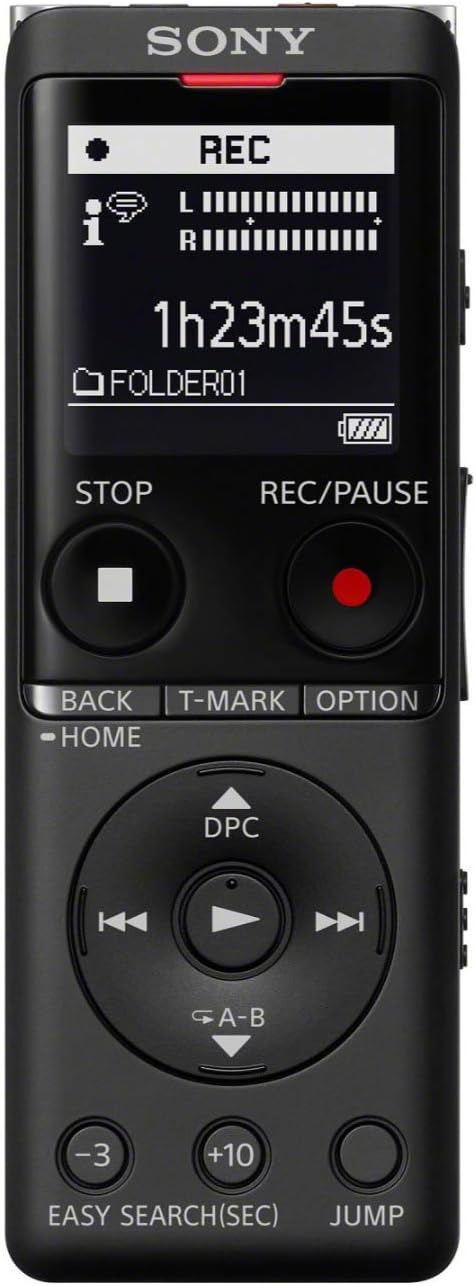
The Sony ICD-UX570 is a sleek, ultra-portable digital voice recorder featuring a built-in stereo microphone, three versatile recording modes, and 4GB of onboard memory expandable via MicroSD. With rapid 3-minute quick charging for 1-hour recording, customizable audio settings, and easy USB file management, it’s engineered for professionals and creatives who demand high-quality sound on the go.



| ASIN | B082QL6KLG |
| Battery Average Life | 1 minutes |
| Best Sellers Rank | #2,645 in Electronics ( See Top 100 in Electronics ) #15 in Digital Voice Recorders |
| Brand | Sony |
| Built-In Media | Voice Recorder |
| Customer Reviews | 4.5 out of 5 stars 3,799 Reviews |
| Digital Recording Time | 60 minutes |
| Format | MP3 Audio, WMA |
| Global Trade Identification Number | 00027242916258 |
| Hardware Interface | USB |
| Headphones Jack | 3.5 millimeters |
| Item Dimensions D x W x H | 1.43"D x 4.31"W x 6.13"H |
| Item Type Name | Voice Recorder |
| Item Weight | 50 Grams |
| Manufacturer | Sony |
| Memory Storage Capacity | 4 GB |
| Mfr Part Number | ICD-UX570BLK |
| Microphone Form Factor | Built-In |
| Microphone Operation Mode | Stereo |
| Model Number | ICDUX570BLK |
| Number of Batteries | 1 C batteries required. |
| Screen Size | 1.5 Inches |
| UPC | 027242916258 |
| Unit Count | 1.0 Count |
| Warranty Description | 1 year |
R**.
perfect for spontaneous sounds & sampling
if I could design the perfect little pocket recorder, it would probably look (and act) a lot like this one. pros: > very good mic quality (considering the size) > good size, weight and form factor - very pocketable > ability to save/load recorder settings to quickly tune for different scenes & environments > stereo 44.1KHz/16bit linear PCM recording > switchable mic/line levels on external input > switchable noise & low cut filters (while recording!) > OLED display is gorgeous > UI is distinctly Sony (very intuitive) - you may recognize some of the icons from the PS3 :p > almost no delay when seeking time or between track marks, even when the recording is stored on the SD card > seems to read MicroSDXC cards with no issues. popped in a 512GB Samsung Evo, which gives me 807 hours (or a little over 33 days) of recording memory (at 44.1/16 stereo!). > quick boot times (<2s) - seems to utilize some kind of sleep mode, as boot up takes noticeably longer after not using it for more than hew hours (overnight, for example) > realtime speed control during playback is very fun (paulstretch, anyone?) cons: > short battery life when recording - not terrible, but definitely best suited for short/medium length recordings. this is somewhat offset by the quick charge times. > USB 2.0 (seriously?) i can't really think of any other cons worth mentioning here. for the price, this little thing really is a gem. also, props to Sony for finally paying aesthetic to the design & aesthetic of a portable audio recorder. almost reminds me of the original iPod nano.... almost x3
M**N
Perfect with the Right Settings! (and YES, you can absolutely custom-edit folder and file names)
I was looking for something that could kill two birds with one stone: 1) allow me to create an audio journal which I could easily import to my MacBook and burn onto CD; and 2) play MP3s. The audio journal thing is admittedly a quirky little project of mine, as I would have given anything if my grandfather had left behind a shoebox of cassettes with his voice and thoughts, etc., and I'm arrogant enough to hope that someone will one day wish the same of me. The MP3 capabilities are also excellent with the use of the onboard software EQ. The interface might not be the most intuitive, but it doesn't take long to learn your way around within the menus. And with one of the menu items being the ability to reset the features to default, don't be afraid to experiment thinking you might somehow lock yourself into a setting you can't undo. For simple voice recording of one's thoughts, poems, dreams, and chronicling of life-events and oddities (one person, one MIC), I find that turning every setting/filter off and setting the MIC Sensitivity to LOW works best for an updated, modern version of talking into a microcassette recorder (no need to even set the range to FOCUS). For setting the device on a table and recording a gathering of friends or whatnot, turn all settings and filters off, set the range to WIDE and the MIC Sensitivity to medium and voila! You can even save these two settings (or any other custom recording settings) under MyScene1 and MyScene2. I actually advise against using the "AUTO" settings as this tends to record hot and loud at first and drop off in volume after a few seconds of recording due to the unit attempting to self-correct it's recording levels. For excellent, crisp playback of either of these scenarios through headphones, set the five Custom EQ sliders to the following (from left to right): +2, -1, +1, +1, +3. This is also the setting I use for 99.9% of my music MP3 playback. Another neat (and HANDY!) feature is that, if you are unsure of your MIC Sensitivity, before you actually begin recording, you can press and hold the record button rather than just pressing it. This puts the recording into pause mode right out of the gate but still displays the L and R level monitors. This is how..... well, maybe I'll get a ding against me for even bringing this up, but I'm about to be REAL with ya: You know how YouTube music doesn't allow you to export your downloads as MP3s? Well, by running an aux cable from my phone or MacBook headphone port into the MIC jack of this Sony unit, you can play a few seconds of a song with the above method to see what volume level to set your phone or computer at, pause the song and back it up to the beginning, hit Record on the Sony and Play on the player. Moral gray area? Probably, but the laws of physics as pertains to electronics says it CAN be done. Something I've seen often mentioned in reviews for this and other Sony recorder units is this supposed inability to rename a folder or file anything other than the broad and boring names Sony has pre-destined. While this may be true on the unit itself, it is NOT the case once you plug the device into a computer. Just right-click on the folder or file and give it any name you want... even "Crispy Bellowing Wobble-Mallows" if you're so inclined. Back over on the unit, even longer titles will slow-scroll across the screen (once, then you have to re-highlight it to see it do this nifty little trick again). Voice-activated recording is also present and accounted for, so if you want to know if you're talking in your sleep, have at it (and with 22-hour battery life at even the highest sound-quality settings, no worries!). Startup from off to recording is negligible... if you've used the unit within 4 hours, just slide the power switch down and press Record. If it's been OVER 4 hours since the last time, well... you're just going to have to wait 1.2 entire seconds. And if your screen cuts off (which it will after 30 seconds [and this amount of time is menu-adjustable]) don't panic about messing up your recording session by pressing a button to re-light the screen... just press "BACK" and your screen reappears with the current function uninterrupted. Unfortunately, it's true what others have said about not being able to adjust the screen brightness, so if you're using this in the pitch-black of a moonless night, you're gonna blind yourself... no way around it. The good news is you have a makeshift flashlight for just such a pitch-dark moonless night... BONUS! What you CAN do, however, is switch off the unit's use of its red/green indicator light (so if you want to lie and assure someone they're NOT being recorded, this gives you a leg up in that endeavor, you mischievous miscreant!). The 4gb of onboard memory should be plenty for most, granting 5 hours of the top-tier quality recording and 40 hours of the highest MP3 quality.. Just add a memory card for extra space (64gb or higher allows for 7.3 million years of recording time... which is just ungodly and, really, WHY?). When you plug the unit into a computer via USB, you will see two separate drives for the onboard memory and the memory card. And now you can open the REC_FILE folder of either drive, pic a folder and drag-and-drop your MP3s (or move things around from folder to folder if you don't want to take the time to do it on-unit). This also starts the charging process (and 3 minutes of charging grants 1 hour of recording battery time... 3 hours to charge from bone-dry to full). I haven't tested the "record a live band or rehearsal" capabilities, so I would be making it all up if I tried to review that particular aspect of this thing. I have no reason to believe that this device would fail at that endeavor though, given the sheer number of tweakable MIC and filter settings at your disposal. As for carrying the thing around.... I understand (from YouTube reviewers) that this gadget once came packaged with a nifty little neoprene sleeve. At the time of this review, new units are no longer shipping with such. As for me, I just slip it down into a leather pouch (felt-lined) made to hold three fountain pens (I think Pelikan made this pouch, and I just folded the two dividers backwards, and, with their tendency to want to move back forward, this just added to the snugness), and there she sits, all snug as a bug and felt-protected, and I stash it in a back pocket or jacket pocket (please do not sit on the Sony ICD-UX570... please just don't! I haven't yet but I highly advise against it). So anyway, that's my review of the Sony iPod Modern Tapeless Microcassette Recorder. I've had my say...... now buy this thing and have yours!
J**Y
Sony ICD-UX570 vs. Zoom HN1: Which is best?
I specialize in tech reviews and as a professional photographer and filmmaker have a good understanding of value vs. quality when it comes to recording devices. The two best in class for roughly $100 or less are the Zoom H1N vs. Sony ICD-UX570. Which is better? Read on: The better question really is “Which is best FOR YOU?” I own both and highly recommend each excellent values yet there are key differences. Let’s compare to help your decision process: SIZE AND STOWABILITY: In person each is likely quite a bit smaller than you may be expecting. The Sony is the smallest—quite tiny. This advantage is also a potential small disadvantage when standing up the recorder for interviews. While it is not likely to tip over you don’t a loud bang in the middle of an important speech. Thus, I found a great little Arae cell phone stand that weighs nearly nothing yet ensures the Sony’s not going to tip. The Zoom is bigger and bulbous around the top to protect its mics. Even though it has more size to its best it is still tipable, If you want to secure it, there is a plastic tripod thread on its sid. I use a great little mini tripod like the Manfrotto Pixi for various audio needs including holding the Zoom recorder. SOUND QUALITY AND VERSATILITY: Both superb. The Sony defaults to a darn near perfect setting for almost all uses: MP3 at 192KBPS. It’s broadcast quality yet makes for very small file sizes. If you don’t mind slightly bigger files, the Zoom has slightly higher quality MP3 setting giving the option to use 320 KBPS. If you don’t mind huge files, the absolute highest quality setting for the Sony is uncompressed LCPM. The Zoom has several WAV choices including 96KHZ/24 bit. Speaking of sound quality, when using meters to set optimal levels, Zoom makes it easy with a gain control dial right in front. However, that advantage can also be a job killer as the dial can easily be turned without you knowing it. I prefer to lock it out by most often selecting the Auto Level button also on the front of the recorder. In terms of sheer versatility, the Zoom does more but that makes it more complex to use. Its controls can be aggravating and are not particularly user friendly. Although the Sony selection menus are not the easiest to navigate, compared with the Zoom the selections are far more user friendly and easily tested to achieve excellence for any given situation. RECORDING TIME AND FLEXIBILITY: Sony wins due to several factors. It has a long lasting built in battery that is easily charged via its built in USB connector. Zoom takes two AAA batteries—no big deal but so its batteries don’t run out in the middle of a job I prefer to change to new ones each time I record. The Sony has 4GB of recording space built in. The Zoom has none. Lastly, the Sony can take a 64GB Mini SDXC cardwhile the Zoom will not formatny SDHC card bigger than 32GB. BUILT QUALITY: The Sony is solidly build and impressive. I was surprised by the Zoom’s cheap, plasticky feeling. Mine came with a defective headphone jack although in the unlikely event that should also happen to you, I’m sure Amazon will make it right. CONCLUSION: Both are fine recorders and it is hard to nitpick among two best in class machines. For anyone other than a pro, I suggest the Sony. I strongly prefer it for ease of use and build quality, too. It costs quite a bit less than the Zoom although both recorders are excellent values. If you have more time to tinker, you may love the Zoom. With either, although the built in mics are quite good, I prefer to use easy-to-plug-in 3.5mm mics whenever possible. It’s worth having two basic types in your kit. As you may already know consider getting a wired ominidirectional lavalier such as the terrific ones from Rode and Sennheiser starting at $50. For the best interview sound quality, it is great to have a small directional cardioid mic such as the near identical ones from Boya and Movo for $35 or less. I mount the mic on a mini tripod. Small cartioid mics like these also double as a great solution for mirrorless cameras and DSLRs. Hope this too long review has been of some small help. Best of luck in your searc and keep on recording the good stuff!
M**S
If you're using it for motovlogging, I would look elsewhere
This is a very compact recorder. It fits in the pocket without bulging. It comes with two modes : voice and music. I've used it for voice overs for my Youtube channel and found the quality to be decent. It can record in 16 bitif you set it to its highest setting. This allows for the best audio. However, when trying to set gain, you can't fine-tune it like the Zoom recorders since you only have low, medium and high for both voice and music modes. The menu can be bit tricky to use as well. I think what would make this a great kit for for mototvlogging is being able to attach the recorder to a suction cup to reduce vibration and having the record being held in place. However, it advertised as a recorder, so for that purpose, it does a great job at capture audio
M**L
Top in Class Recorder
This Sony ICD-UX570 more than fit my needs. The only drawback is the USB A connection instead of the USB C which is the modern standard. However, all else is perfect and a simple USB C (male) to USB A (female) adapter solves that situation. I will not drop a star because the device was designed and manufactured during a time before the USB C port was standard on computers and the iPhone. As such, this product is a classic case of if it ain't broken then don't fix it. Removable memory, external microphone input, aux headphone jack, rechargeable battery, what is there not to like. Files are saved as MP3 and I plug the device directly in to the adapter and then into my Android phone which natively recognizes the internal files. I sent back my Plaud Note Pro and opted to love this instead. Hands down it was the best decision I've made. It does so much more than what I've shared, and I initially sought to purchase the Sony ICD-TX660 and I'm glad it was sold out everywhere. The pause/record function is hard to find on these recorders. There's also no need to connect this device to a phone or computer, because the micro SD card can be removed and also because the device has a built in speaker and input ports for privacy. If it had built in wifi or Bluetooth for easier file sharing that would have made the device perfect, but it was in thewrong time period. Unfortunately not even the ICD-TX660 can match this version. Top quality for sure and very easy to use. Very high gain built-in microphone can easily pick up sounds and voices in a room while this device is in a pocket.
I**8
Good Microphone Quality for Voice Memos
Overall Impression: The Sony ICD-UX570 is a compact, reliable digital voice recorder that excels at capturing high-quality voice memos, making it a valuable tool for transcription and note-taking. While it performs well for short to medium recordings, extended sessions revealed some limitations when paired with AI transcription services. Initial Expectations vs. Reality: I purchased the ICD-UX570 primarily for voice memos, intending to transcribe them using AI tools. For this purpose, it performed exceptionally well. However, during attempts to record 8-hour work sessions for meeting notes, transcription quality dropped significantly, often producing incoherent results. This seems to stem from either audio degradation over long recordings or potential limitations in microphone sensitivity for extended durations. Design and Build Quality: The ICD-UX570 is lightweight, pocket-friendly, and has an intuitive interface. The screen is bright and easy to navigate, and the device feels durable despite its compact size. Its built-in storage is adequate for basic use, but I recommend purchasing a microSD card to expand capacity—essential for long recording sessions. Performance and Usability: For shorter memos or brief interviews, the recorder delivers clear, crisp audio that transcribes accurately with AI services. Recording in MP3 or LPCM formats allows for flexible use cases, and playback through the built-in speaker is surprisingly good for its size. However, for long-duration recordings, the audio clarity diminishes slightly, leading to unreliable AI transcriptions. This might not be an issue for those manually reviewing recordings but can hinder fully automated workflows. Pros: Excellent audio quality for short to medium-length recordings. Compact and portable – ideal for on-the-go use. Expandable storage with microSD card slot. Intuitive interface – easy to operate, even for beginners. Fast charging and long battery life for general use. Cons: Inconsistent transcription results for long-duration recordings (8+ hours). Limited onboard storage without additional memory. Microphone sensitivity could be improved for large room or distant audio capture. Who Would Benefit Most: This recorder is perfect for students, journalists, or professionals who need a reliable tool for capturing meetings, interviews, and memos. It’s particularly useful for AI-assisted transcription workflows if recordings are kept under a few hours. For those needing to capture day-long conversations or lectures, pairing it with a high-capacity microSD card is essential, but expect some manual review for accurate transcriptions. Final Thoughts: The Sony ICD-UX570 is a fantastic investment for everyday voice recording and transcription, but it isn’t a perfect solution for ultra-long sessions without some compromises. Highly recommended for voice memos and shorter recordings, with the caveat to invest in extra storage and consider manual transcription checks for lengthy files.
O**A
Small package, big results.
Very high sound quality for such a little recorder. Easy to figure out and work, and having the self contained USB makes it even simpler. Highly satisfied with this thing.
I**E
Amazing quality voice recording, but won't keep time
Sound-wise, this is the best recorder I've ever owned. I can whisper into it in a crowded room and transcribe my recordings later with crystal clear quality. I also like that the display lights up so I can record my thoughts if I have an idea while lying in bed. The biggest issue with this recorder is that it doesn't keep time properly. I need the date and time of recordings to keep them in chronological order and so I can reference them, like, "What was that thought I had yesterday at about 3:30?" However, often the recorder will turn on and ask me to reset the date and time, which is not always something I can do when I'm trying to get a quick thought in while I'm driving or something, and by the time I finish setting the date and time, the thought is lost. And sometimes it resets the time on its own without even telling me. I contacted the company and they had me do a whole troubleshooting thing and that didn't fix it, and then I sent it back and they sent me a new one, which had that problem again almost immediately. I eventually put a thing on my daily to do list that I should take a minute every morning to set the time on this thing, but i shouldn't have to do that. Eventually, this recorder lost the ability to hold a charge, so I bought a new one because I love the audio quality, and it held time for a few months, but now it's losing time again. I currently have some voice notes in my recorder that I apparently recorded in the year 2033. So in short, I've had 3 of these, and the time kept messing up on all 3.
Trustpilot
3 weeks ago
1 month ago