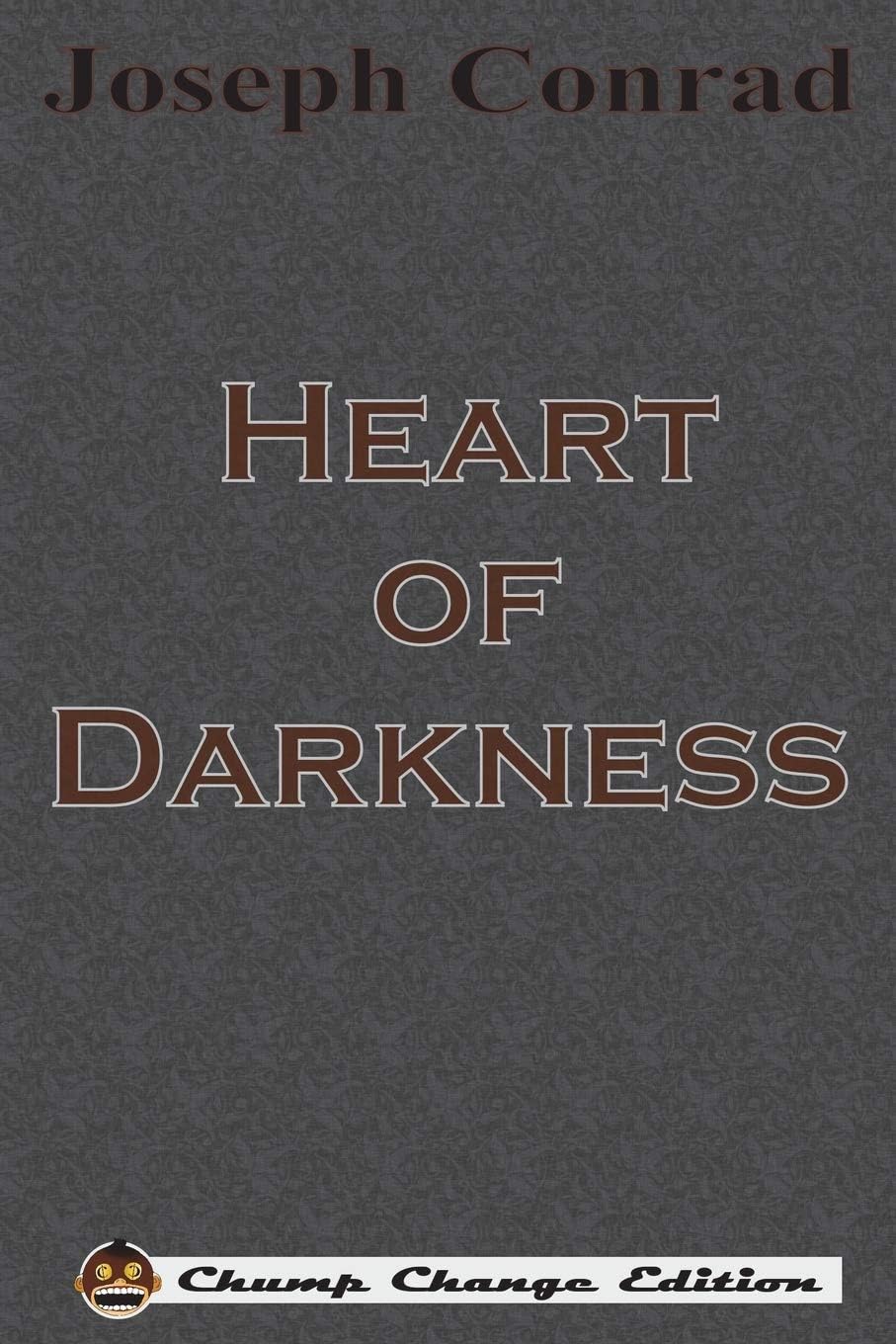

Heart of Darkness (Chump Change Edition)
Product ID: 200327295
Buy anything from 5,000+ international stores. One checkout price. No surprise fees. Join 2M+ shoppers on Desertcart.
Desertcart purchases this item on your behalf and handles shipping, customs, and support to Vanuatu.
Heart of Darkness (Chump Change Edition) [Conrad, Joseph] on desertcart.com. *FREE* shipping on qualifying offers. Heart of Darkness (Chump Change Edition) Review: ... is a definite read for college students studying literature like myself. I also see it capturing the attention ... - Heart of Darkness is a definite read for college students studying literature like myself. I also see it capturing the attention of those studying history, but I only see minds matured over the easily-distracted age of fifteen making the most of this experience. Published in 1899 by Joseph Conrad, who was already known for his seafaring career which included travels to Africa, this realistic novel makes for an interesting conversation starter when peeking out of my satchel and therefore well-deserving of 4.9 stars! Conrad employs imagery and dialogue to convey the harsh reality of the times. He describes the death of a humanity corrupted by a deadly one, resulting in an elegiac reflection of his travels. In this novella, Charles Marlow sets sail on the Congo and finds himself searching for the mysterious Kurtz. During his travels, Marlow sees the brutal treatment of starved natives and encounters obstacles like a ship in need of fixing, an attack, and illness. Once Marlow finds Kurtz, Marlow finds himself holding more power and responsibility than the man he sought, much like the power of knowledge peeking out of my satchel and intimidating many. I enjoyed reading this book, despite the verbose descriptions interrupting the plot, a challenge I assume may hinder other readers. I also found myself often relating to Conrad’s strong curiosity. Conrad focuses on action as the key tool to develop his characters. Marlow is an authentic character, and the reader experiences all of his conflicting thoughts as he does. We are also given a mental image through Conrad’s characterization of a tired captain giving into his curiosity. Kurtz is also well described by other characters, thus revealing his extensive education and powerful nature, as well as his talents of painting and music. I can also easily relate to his multitalented nature, proven by the vast array of tools in my satchel. The plot is built on a predictable foundation with the details of mistreated natives learned from the average reader’s advanced history classes, but this novel adds a new dimension to the textbook pages with intense and realistic imagery. The journey down the Congo sets the dangerous setting for interactions with natives and other workers, leading to an easily predictable ending of Marlow meeting Kurtz. However, Kurtz’s untimely death and Marlow’s untruthful delivery of his last words are unforeseen by readers other than myself. This novel is a heavy read and difficult to grasp because of the lack of humanity of all characterized. The native people are portrayed in a heavily critical manner in need of filtering by today’s standards, but like in Charlotte Perkins Gilman’s Herland, those who invade truly opt to make an area their own instead of integrating, also seen by the mistreatment of Native American tribes during the colonization of America. With all this in mind, I reiterate my strong recommendation of reading this timeless novel. Not only is it praiseworthy in the sense of capturing history in its true and brutal form, but it also has great literary merit, a reason why I will forever keep it peeking out from my satchel. Review: Dated in some aspects but a lot of the themes are still relevant - I had seen this title and Conrad's name coined constantly through other mediums before I actually decided to read this. I wasn't really pressed on until I came across a lecture by Chinua Achebe, an African author, who claimed that Heart of Darkness and Conrad were racist. Nothing like some controversy to inadvertently give attention to what your actually protesting eh? His views on Conrad though reminded me of my own on Mark Twain though. I don't like Twain, I think he was a racist despite being hailed constantly by English teachers I've known. I would have thought the same if I hadn't come across his views on American Indians. He called us "scum of the earth" and other things. Statements he never retracted apparently. It didn't stop me from reading Twain which I have done but It didn't impress me. So I can actually somewhat understand Achebe's qualms but there turned out to be more to the Heart of Darkness than he would have some believe. From what I understand this short work is heavily based on Conrad's own experiences from what he saw in the Congo Free State, something that would go on to effect his health and stability as it does for the character of the book Marlow. Marlow is a young man from England. Hungry for adventure on a steam boat in the dark continent. He manages to land a job with a company that is based on the Congo. So now the captain of his own tug boat he goes into Africa only to bare witness to the acts of the corporation he works for. Lines of naked bony natives in chains are led into mine shafts by uniformed men, massive tracts of the jungle are slashed and burned for bits of ivory, while starving slaves are left to die on the banks of the river. If this is progress then humanity is doomed it seems. But Marlow isn't there to gawk instead he's sent down river to track down and find a company agent, Mr Kurtz. Kurtz seems to be a golden boy of the company. His superiors praise him, so does his family and friends. He is like the embodiment of European ideals, superior in every way to the savages but as Marlowe goes down the river and further into the dark jungles he learns more about this man and his troubling nature. Despite his superior stock and civilized morals Kurtz had quite literally "gone native". It can be looked at in various ways. A disturbing indictment of greed and imperialism. A look at the self destructive nature of humanity or civilization in general. While the book was good in the respects of allegory its still very archaic. His writing can drag in certain parts and feels pretty dated. But it's Conrad's depictions of the natives stands out above all of them. They have almost no actual culture, they prance around fires with grass skirts and bones in their noses; and the description of the witch woman feels like it was torn right out of a pulp magazine. Still though I think the themes of the book and overall message trump these bits but some may just find them distasteful. In the end I actually liked Heart of Darkness but it definitely is racist in some parts. Conrad may have been disgusted with the Congo Free State, he may have been against imperialism, but he still saw the Africans as a lesser people. Still one can't really indict a man on views that were otherwise very common in his time. Compared to others from the same period Conrad was definitely a progressive. The book is pretty powerful and it had a strong message of anti-imperialism before it was beaten to death later on. In the end it's all a matter of taste. I liked it, its well written, not long, and it may dwell in the back of your head for a while. It left me wondering whether or not Kurtz's final message "exterminate the brutes" was meant for the natives or mankind in general.
| Best Sellers Rank | #12,000,429 in Books ( See Top 100 in Books ) #337 in Classic Literature & Fiction |
| Customer Reviews | 4.1 4.1 out of 5 stars (9,517) |
| Dimensions | 6.14 x 0.11 x 9.21 inches |
| ISBN-10 | 1640320369 |
| ISBN-13 | 978-1640320369 |
| Item Weight | 2.89 ounces |
| Language | English |
| Print length | 44 pages |
| Publication date | April 4, 1899 |
| Publisher | Chump Change |
K**N
... is a definite read for college students studying literature like myself. I also see it capturing the attention ...
Heart of Darkness is a definite read for college students studying literature like myself. I also see it capturing the attention of those studying history, but I only see minds matured over the easily-distracted age of fifteen making the most of this experience. Published in 1899 by Joseph Conrad, who was already known for his seafaring career which included travels to Africa, this realistic novel makes for an interesting conversation starter when peeking out of my satchel and therefore well-deserving of 4.9 stars! Conrad employs imagery and dialogue to convey the harsh reality of the times. He describes the death of a humanity corrupted by a deadly one, resulting in an elegiac reflection of his travels. In this novella, Charles Marlow sets sail on the Congo and finds himself searching for the mysterious Kurtz. During his travels, Marlow sees the brutal treatment of starved natives and encounters obstacles like a ship in need of fixing, an attack, and illness. Once Marlow finds Kurtz, Marlow finds himself holding more power and responsibility than the man he sought, much like the power of knowledge peeking out of my satchel and intimidating many. I enjoyed reading this book, despite the verbose descriptions interrupting the plot, a challenge I assume may hinder other readers. I also found myself often relating to Conrad’s strong curiosity. Conrad focuses on action as the key tool to develop his characters. Marlow is an authentic character, and the reader experiences all of his conflicting thoughts as he does. We are also given a mental image through Conrad’s characterization of a tired captain giving into his curiosity. Kurtz is also well described by other characters, thus revealing his extensive education and powerful nature, as well as his talents of painting and music. I can also easily relate to his multitalented nature, proven by the vast array of tools in my satchel. The plot is built on a predictable foundation with the details of mistreated natives learned from the average reader’s advanced history classes, but this novel adds a new dimension to the textbook pages with intense and realistic imagery. The journey down the Congo sets the dangerous setting for interactions with natives and other workers, leading to an easily predictable ending of Marlow meeting Kurtz. However, Kurtz’s untimely death and Marlow’s untruthful delivery of his last words are unforeseen by readers other than myself. This novel is a heavy read and difficult to grasp because of the lack of humanity of all characterized. The native people are portrayed in a heavily critical manner in need of filtering by today’s standards, but like in Charlotte Perkins Gilman’s Herland, those who invade truly opt to make an area their own instead of integrating, also seen by the mistreatment of Native American tribes during the colonization of America. With all this in mind, I reiterate my strong recommendation of reading this timeless novel. Not only is it praiseworthy in the sense of capturing history in its true and brutal form, but it also has great literary merit, a reason why I will forever keep it peeking out from my satchel.
D**R
Dated in some aspects but a lot of the themes are still relevant
I had seen this title and Conrad's name coined constantly through other mediums before I actually decided to read this. I wasn't really pressed on until I came across a lecture by Chinua Achebe, an African author, who claimed that Heart of Darkness and Conrad were racist. Nothing like some controversy to inadvertently give attention to what your actually protesting eh? His views on Conrad though reminded me of my own on Mark Twain though. I don't like Twain, I think he was a racist despite being hailed constantly by English teachers I've known. I would have thought the same if I hadn't come across his views on American Indians. He called us "scum of the earth" and other things. Statements he never retracted apparently. It didn't stop me from reading Twain which I have done but It didn't impress me. So I can actually somewhat understand Achebe's qualms but there turned out to be more to the Heart of Darkness than he would have some believe. From what I understand this short work is heavily based on Conrad's own experiences from what he saw in the Congo Free State, something that would go on to effect his health and stability as it does for the character of the book Marlow. Marlow is a young man from England. Hungry for adventure on a steam boat in the dark continent. He manages to land a job with a company that is based on the Congo. So now the captain of his own tug boat he goes into Africa only to bare witness to the acts of the corporation he works for. Lines of naked bony natives in chains are led into mine shafts by uniformed men, massive tracts of the jungle are slashed and burned for bits of ivory, while starving slaves are left to die on the banks of the river. If this is progress then humanity is doomed it seems. But Marlow isn't there to gawk instead he's sent down river to track down and find a company agent, Mr Kurtz. Kurtz seems to be a golden boy of the company. His superiors praise him, so does his family and friends. He is like the embodiment of European ideals, superior in every way to the savages but as Marlowe goes down the river and further into the dark jungles he learns more about this man and his troubling nature. Despite his superior stock and civilized morals Kurtz had quite literally "gone native". It can be looked at in various ways. A disturbing indictment of greed and imperialism. A look at the self destructive nature of humanity or civilization in general. While the book was good in the respects of allegory its still very archaic. His writing can drag in certain parts and feels pretty dated. But it's Conrad's depictions of the natives stands out above all of them. They have almost no actual culture, they prance around fires with grass skirts and bones in their noses; and the description of the witch woman feels like it was torn right out of a pulp magazine. Still though I think the themes of the book and overall message trump these bits but some may just find them distasteful. In the end I actually liked Heart of Darkness but it definitely is racist in some parts. Conrad may have been disgusted with the Congo Free State, he may have been against imperialism, but he still saw the Africans as a lesser people. Still one can't really indict a man on views that were otherwise very common in his time. Compared to others from the same period Conrad was definitely a progressive. The book is pretty powerful and it had a strong message of anti-imperialism before it was beaten to death later on. In the end it's all a matter of taste. I liked it, its well written, not long, and it may dwell in the back of your head for a while. It left me wondering whether or not Kurtz's final message "exterminate the brutes" was meant for the natives or mankind in general.
A**R
El corte de las páginas está pésimo
J**O
by Joseph Conrad 29877058 James McCormick's review Apr 19, 16 · edit it was amazing bookshelves: currently-reading This one had been very high on my to- read- list for a long time. I’ve read several of Conrad’s books previously and also saw an interview where Coppola talked about how it inspired Apocalypse Now. It’s quite a small work, more of a novella than a novel, and when I did finally get down to it - I read it in a single sitting. The story’s premise is quite simple. Marlow (the first person narrator of the story) travels up the Congo river on his employer’s orders to find and bring back an ivory trader by the name of Kurtz who is for much of the story a mysterious, almost mythical figure, “a prodigy… an emissary of pity and science and progress," who inspires awe and devotion in many of those he encounters. By the time Marlow does meet the physically ailing but still impressive, charismatic and eloquent Kurtz, we are eager to learn as much as we can about this human enigma through the more dispassionate and perspicuous eyes of our narrator. Like all Conrad’s works, the prose reads like dark, brooding blank verse which is utterly compelling. What struck me was the issue of free will. Marlow seems fated to meet the mysterious Kurtz and his journey toward the interior seems inevitable as Marlow is drawn nearer and nearer to the heart of darkness. All the while we have an overpowering sense of paranoia. Nature, represented by the African jungle, is dark, pitiless and terrifyingly savage, full of strange sounds and cannibalistic inhabitants. Yet as we learn about the European traders and their dubious and exploitive methods we find ourselves contrasting so called modern “civilisation” and asking if it is any better. If there is a moral centre to the work I couldn’t find one. Marlow is more of an observer rather than an active protagonist whilst Kurtz seems almost to stand outside of any framework, natural or societal. As with other Conrad novels, Heart of Darkness has you thinking about the story well after you finish reading. I was so intrigued by Kurtz’s final exclamation that I did some secondary reading. I initially viewed the work as an elaborate allegory, a descending, (increasingly nihilistic) journey but was surprised to learn (as Conrad claims) the story was to a large degree biographical, with "experience… pushed a little (and only very little) beyond the actual facts of the case.” Whatever the case, this is a very powerful, visceral work with prose that rightly places it amongst the literary canon.
C**R
Wanted to reread this classic. It’s just as I remembered it.
B**I
bello
A**R
as described
Trustpilot
1 week ago
1 month ago