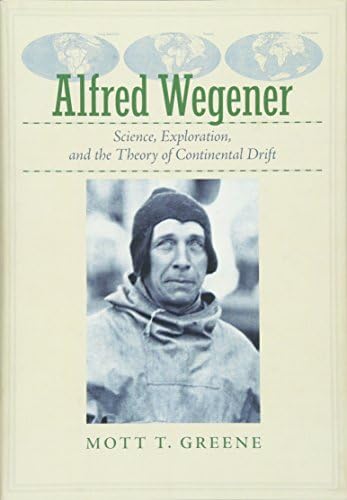

Alfred Wegener: Science, Exploration, and the Theory of Continental Drift Hardcover – October 30, 2015
Product ID: 207263192
Full description not available
G**M
A must-read for those interested in the background of major scientific discoveries...and in learning about how science works....
Excellent book! In my geology classes, I learned that one day Alfred Wegener decided that the continents had drifted to their current positions, published this theory, and was laughed out of the scientific community because he did not have a mechanism for the process. There was a LOT more to the story than that, and this definitive volume explores that "more". The book traces his education, professional work and credentials, and explores his approach to scientific investigations not only in geography but also in meteorology and climatology, as well has his integration of data through his research to support continental drift. This book is NOT light reading, but for those who are interested in intellectual explorers who have made major discoveries in science, this is a very important work. The greatest value to me is how it shows the scientific process - compiling evidence, finding a theory which unites the evidence, obtaining more evidence, refining the theory....Highly recommended.
B**3
Review of the Biography of Alfred Wegener
Outstanding and detailed work by Dr. Greene. Absolutely intrigued by the amount of work on varied subjects almost simultaneously that Alfred Wegener could achieve. Though not his primary field, Dr. Greene captured the meteorology very well which is my field. I definitely recommend this biography to any student of historical science and especially meteorologists.
A**R
Its broad sweep in detail of the surroundings and events in Alfred Wegener's life serves as a wonderful review of Wegener's life
This is an impressive book. Its broad sweep in detail of the surroundings and events in Alfred Wegener's life serves as a wonderful review of Wegener's life as well as the general history of Berlin and Germany. The review of this book by Ted Nield in Nature 526: 192-193 (8 October 2015) is what decided me to buy this book. The last two sentences of that review are: "The labour has taken more than 20 years. The result is a magnificent, definitive and indefatigable tribute to an indefatigable man." I agree completely.
S**K
This book makes me smarter
Fascinating history. Great for science teachers and all science groupies. I do like non-fiction oftentimes - I don't know if others would consider it challenging, but like biographies and travelogues in general, sometimes this book is a bit slow - and I like that, especially when reading at bedtime! If let's me know I am too tired to read and I go to sleep. Subject wise, if you are interested in our evolving understanding of Earth, this book is a knockout. Wegener should be much more famous, and I hope this book helps.
N**I
Probably Alfred Wegener is least appreciated as the scientist while ...
Probably Alfred Wegener is least appreciated as the scientist while his data clearly indicates the recent geological history of the Earth. His theory should won the Nobel Prize while I doubt Swedish Academy has enough experts to fairly asses his achievement.
D**E
Great book, but too long
Great book. Only one problem, its much too long. The book could be greatly improved if it was shortened by about 30%, this could easily be accomplished by shortening the life history of other scientists that Wegener interacted with, and also shorten the detailed scientific discussions, which are really not necessary.
G**D
Scholarly
This is a very, very scholarly work along the lines of a European Ph.D. thesis; no, 2 or 3 theses with the addition of the biographical information as well.
B**R
Outstanding biography... and a tragic story
Ideally, biographies of important scientists should explain their subject's formative background, their varied life experiences, and especially the distinctive habits of mind that led to their pioneering discoveries. In this lengthy but immensely satisfying book, Mott Greene locates Wegener culturally within a generation that embraced the "philosophy of life" (Lebensphilosphie), which placed humanity within nature, embraced change, and emphasized vitality, dynamism, and intense experiences. An avid mountaineer, sailor, and explorer, Wegener pursued his atmospheric studies fearlessly, employing record-setting balloon voyages and incredibly risky expeditions in Greenland in order to acquire new data. With equal effectiveness, Greene identifies Wegener's distinctive approach to science: What excited him most was his ability to discover, after a relentless search of a given literature, an underlying connection that solved numerous problems. But Wegener's eagerness to range far beyond disciplinary boundaries exposed him to risk -- namely, that he would be perceived as a synthesizer rather than a specialist, thus impeding his scientific career and weakening his credibility among scientists specializing in the fields he invaded. In face of virulent opposition and ridicule, Wegener nevertheless persisted in his advocacy of the drift idea, winning (as Greene shows) some significant support along the way. Still, this support fell short of scientific acceptance, largely due to Wegener's failure to provide a credible theory of drift and some evidence, at least, that drift had incontestably occurred. Greene emphasizes these points to explain why Wegener's legacy falls far short of Darwin's: nobody refers to plate tectonics as "Wegnerian" in the way they refer to evolutionary biology as "Darwinian." But as Greene acknowledges, Wegener's tragic death in 1930, at age 50, shut down his advocacy; had he lived longer, he might have further refined his theory -- and he might have lived long enough to see the first paleomagnetic evidence that drift had indeed occurred. I closed the book with a feeling of sadness that Wegener's contribution remains unappreciated by today's practitioners, countered by the happier thought that we have, at least, Greene's beautiful biography to keep Wegener's legacy alive.
C**R
Far too academic for general consumption
It wouldn't be an understatement to say that this book was a massive disappointment.I am a geologist and was dying to learn more about Wegener, who's been my hero for decades. His thinking literally changed the way that we think of the Earth as a dynamic mechanism, and his ability to bridge different scientific disciplines to come up with the theory that underpins modern plate tectonics was revolutionary.But this book is a terminally dry offering, that's simply too academic to be readable for the general public.I might be scientifically qualified, but I can't debate the validity of the scientific arguments presented, as I simply couldn't make it that far into the book to pass informed comment. The writing style is just awful and my sense is that even this author's scientific publications would be as dull as ditchwater to read.Someone needs to write a more accessible biography of Wegener - or direct me to one that's already been written, because this sure isn't it.
M**E
Setting the standard for science biographies
The work is clearly a labour of love - 25 years in the making and merticulous in its research. At almost 600 pages this looks like a dauting read but has a easy engaging style that makes reading it a joy. Wegener is fully deserving of such a biography - a brillant meterologist and climatologist he is perhaps best known for promoting the idea of continental drift, the forerunner of modern plate tectonics. This was arguably the greatest revolution in Earth Sciences in the 20th century. Wegener faced fierce opposition to his theory and never saw acceptance in his lifetime - all the trials and tribulations of a heretic genius are captured here. Recommended to anyone with an interest in how science progresses.
F**N
An exceptional account
‘Alfred Wegener’ covers much more than the life of this extraordinary scientist and his development of the ‘Continental Drift’ hypothesis: Greene brings to life the early 20th century environment of natural sciences and scientists in Germany and the repercussions of WWI on the science community. Wegener’s academic development, his many and varied scientific interests and his prolific publications are explored and analysed in great detail. In some chapters, the detail will appear excessive to the average reader.The book also reminds us of the hardships explorers were exposed to and the risks inherent in exploring remote areas like Greenland at the time. One is awed by what was achieved with minimum support, no communication and primitive means of transport such as dog and pony sleds.In the course of over 20 years, Greene has created an admirably exhaustive and yet entertaining account of Alfred Wegener’s remarkable life and personality.
R**Y
Five Stars
Detailed & broad coverage of Alfred Wegener - a big book
A**A
Must read adventure classic
One of the best books, I have had an opportunity to read. Alfred Wegener turned topsy-turvy the whole concept of Geology. I am a professional Geologist, with a M.Sc degree in Geology, but was not aware that Alfred Wegener was NOT a Geologist. He went to Greenland thrice, on very arduous expeditions; the last one being a fatal trip. He discovered continental drift leading to the present 'Plate Tectonics' working at -25 degrees C, in almost total darkness through 'day' and night. Most amazing was the author, Mott T.Greene who travelled all over the same route, before writing this amazing book. In the beginning, I thought the prize is a bit too high, but it is worth every Re paid, and it is value added adventure literature, and I am indeed grateful that Amazon could make this book available.
Trustpilot
3 weeks ago
2 months ago