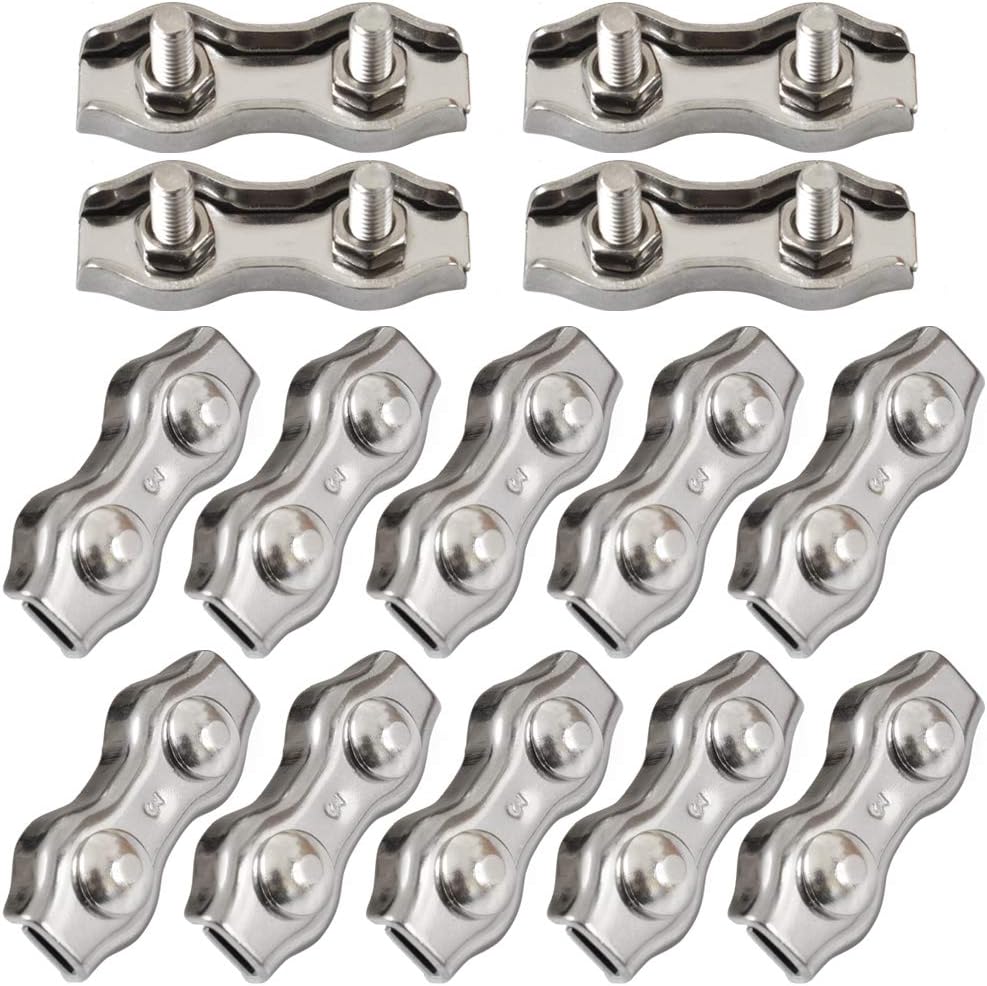


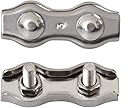


Cozihom 1/8 Inch M3 Stainless Steel Duplex 2-Post Cable Clamp, Wire Rope Clip Cable Clamp, Pack of 14
Product ID: 213238677
📏Precise Dimensions
🔩304 Stainless Steel
🛠️Durable & Corrosion-Resistant
Buy anything from 5,000+ international stores. One checkout price. No surprise fees. Join 2M+ shoppers on Desertcart.
Desertcart purchases this item on your behalf and handles shipping, customs, and support to Vanuatu.
🔧 Tighten Up Your Game with Style!
This pack of 14 Duplex 2-Post Cable Clamps is made from high-quality 304 stainless steel, ensuring durability and corrosion resistance. Ideal for a variety of applications, these clamps provide a tidy and efficient solution for tightening steel ropes in both industrial and home settings.
| Customer Reviews | 4.5 out of 5 stars 403 Reviews |
A**A
Strong mini-clamps - but they need instructions...
First off - the good news: These clamps are really strong, when used properly, and the screws are torqued down to a good measure. With the 1/8" cable I was using, one could probably support my weight easily (I'm a big guy); using two would work even better. But for my needs, one clamp was more than enough (in fact, I ended up using one after I had broken one of the fasteners; the single fastener held up fine - and I'll explain in a bit what happened). The bad news is the reason for the "easy to use" 3-star rating - they are anything but, and that's not the fault of the clamp, manufacturer, or seller - I just didn't realize how difficult to install on 1/8" cable it was going to be. It seemed simple, make a loop, unscrew the clamp, fit it in, screw it down tight. Seems reasonable, right? Well - no. So I'm going to give you all some tips, to hopefully make things easier. It would be nice if the seller included a video showing what to do; maybe I should make one myself... First off - tools - you'll want: 1. A pair of gloves 2. A 7mm socket for a 1/4" handle 3. A 1/4" nut driver (w/ a T-handle would be ideal) 4. A 1/4" socket wrench (if the nut driver doesn't have a T-handle) 5. A pair of channel locks and a standard pair of pliers 6. Alternatively, a pair of so-called "pliers-wrench" may work better in place of the above. 7. Gloves? Use 'em if you want too! Do not substitute needle-nose pliers - they will not work in this application. In fact, you may injure yourself trying. First - if you have a "loose" coil of cable like I did (I bought 100 feet - it came coiled, and held together with zip ties and plastic wrap), be careful with unwrapping it. Keep a good grip on the coil, so it doesn't "unspool" and "bird nest". I found the best way to start was to cut 2 of the 3 zip ties, remove the plastic wrap, and then take a velcro "zip tie" and bundle it with that - then cut the last zip tie. That way, you can keep it from uncoiling, but still remove and let out the amount of cable you need. If you have a large enough space, you could just uncoil the whole thing in a straight-ish line. Whatever you do, don't let it uncoil itself - it's not near as bad as welding wire, but it still can want to get out of hand... 1. The bolts aren't bolts - they are pressed-in threaded studs - and that's a good thing - I can't imagine how hard this would have been using loose bolts... 2. Disassemble the clamp before starting, and put the 3 pieces (2 hex nuts, clamp backing piece) somewhere close by (don't lose 'em!) 3. Cut the cable to length, or leave it on the coil and cut it afterward - whatever you feel is best. Note - you might want to get the proper cable cutters. I didn't, and instead had to use a pair of metal snips, and had to do two attempts to cut the cable - the stuff is tough! Also - you may want to wear some gloves, as the cut end will be sharp (the individual wires that make up the cable are like needles). 4. Form your coil - this takes some trial and error, especially if you want to use a "thimble" on the loop. You need to make the loop big enough to wedge the thimble in place (but still "spring" into place), with enough length to be able to clamp the free end and the other side; when in doubt, use more cable length for the free end, and trim or tape the excess later. 5. Now the tough part - mounting the clamp. I found it was best to mount the clamp on the non-free end side, then bend and mount the other side in place. You want both pieces of cable - the non-free and the free end - to fit completely inside the inner edge of the clamp body. But you'll find the cable won't easily cooperate. 6. Instead, fit the non-free side such that the raised edge ends of the clamp hold on to the cable by friction between the stud and the raised edge of the clamp. 7. Use the pliers to "roll" and fit the cable around the bends of the clamp body "channel". The ends might raise up, so just use the pliers to force 'em down (crimp). You'll need to do this multiple times, but eventually you'll get the cable in place (remember to cuss - cussing always helps motivate the tools and parts). 8. Bend the free end of the cable around to form the loop, and again, fit the cable into the ends of the clamp; basically repeat steps 6 and 7. 9. Remember that the ends may creep up - so be sure to keep 'em forced down using the pliers. 10. The cable at this point should be "flat" inside the clamp, and just below the edge of the clamp, following its contours. You may notice the loop end having (or wanting) to twist 90 degrees perpendicular to the clamp - this is OK, let it happen - just a regular thing when using twisted rope-like stuff (there's a term for this "auto-twisting" but I forget what it is). 11. At this point, there's a lot of pressure on the clamp from the wire wanting to "spring free" of the clamp - so work these steps carefully, but quickly. But if the clamp/cable should pop free, just re-fit things and cuss some more. 12. If you're bare handed, you may be bleeding - a project isn't complete unless you make a blood sacrifice, of course. Cuss some more if you need to. 13. Once the cable is in place inside the clamp, take the "backside" of the clamp, and fit it over the studs, then put on the nuts, finger tight. 14. Put your 7mm socket on to the nut-driver or socket wrench handle. Use the channel locks to hold the clamp by the middle (you should have enough room still to fit the socket on to the nuts and still turn it). 15. Tighten the nuts. With 1/8" cable, you should be able to clamp things down enough that only 1-2mm of thread from the end of the stud to the side of the nut is visible. Use care here; if you really torque things down, you'll break the stud off (like I did - still, the single stud held it all together anyway, for my purposes that was fine). 16. Install a second clamp if needed. 17. Install the thimble if wanted. 18. You might want to cuss some more at this step - otherwise, grab a beer, and drink to a job well done (and then realize you have several more of these to do - sigh). That's basically it. The trick is using the pliers and rolling the cable in place, to make it follow the contours of the clamp body, and doing both sides carefully, so you can put the remainder together and emerge with a strong mechanical engagement. I don't know if I would do this for anything safety critical or such (ie - lifting loads), but for basic usage, it should work fine. Good luck everyone with your projects - and again, remember to cuss and make a blood sacrifice - that's how you'll know you're doing things right!
K**S
Wire clamps
These were wonderful, did not expect them to hold up to what I used them for but I'd get them again and again. Arrived quickly, easy to use, works perfect
J**R
A must have for wire antennas.
I use these with all of my wire antennas and they are incredibly useful. These stainless steel ones hold up very well too, I have had one set outside for almost two years and it shows nearly no tarnish. The nuts can work loose with a lot of movement over time, so a small dab of thread locker is a good idea for long-term installations.
K**R
Not bolted - Uses studs with nuts
A word of advice: These clamps fasten with hex nuts that mount on the studs you see in the picture. There are no screws; you cannot tighten these clamps with a screwdriver. You need to have a socket wrench / nut driver. The nuts furnished measure 6.9mm and presumably are meant to be tightened with a 7mm socket wrench... but a 9/32 socket is close enough to work.
A**R
Excellent value, product.
Good quality. You can't get these clamps locally, at any price.
F**G
Great cable claps.
Great parts to connect wire SS cables outdoors. I used them to hang outdoor lights across the back yard.
A**Y
Worked great for hanging lights outside!
I used these clamps with wires I had to hang lights outside from trees. They are very strong & worked great. I had a tool that came with the wire hanging kit that worked well with these as well. This was very helpful when tightening.
N**U
It’s a little tight for a 1/8” coated wire
This product works, you just have to shove the coated wire into the grooves. It won’t slide too nicely if you are trying to adjust the wire.
M**E
Recommended
Great bits of kit and work really well.
C**N
très bien
parfait pour les cordon à linge solides et détachables
C**E
Muy facil de instalar
Muy facil de instalar
J**.
Conforme
Description conforme, livraison à temps
M**F
Verbinder
Für schnelle Reparaturen super
Trustpilot
3 weeks ago
2 months ago