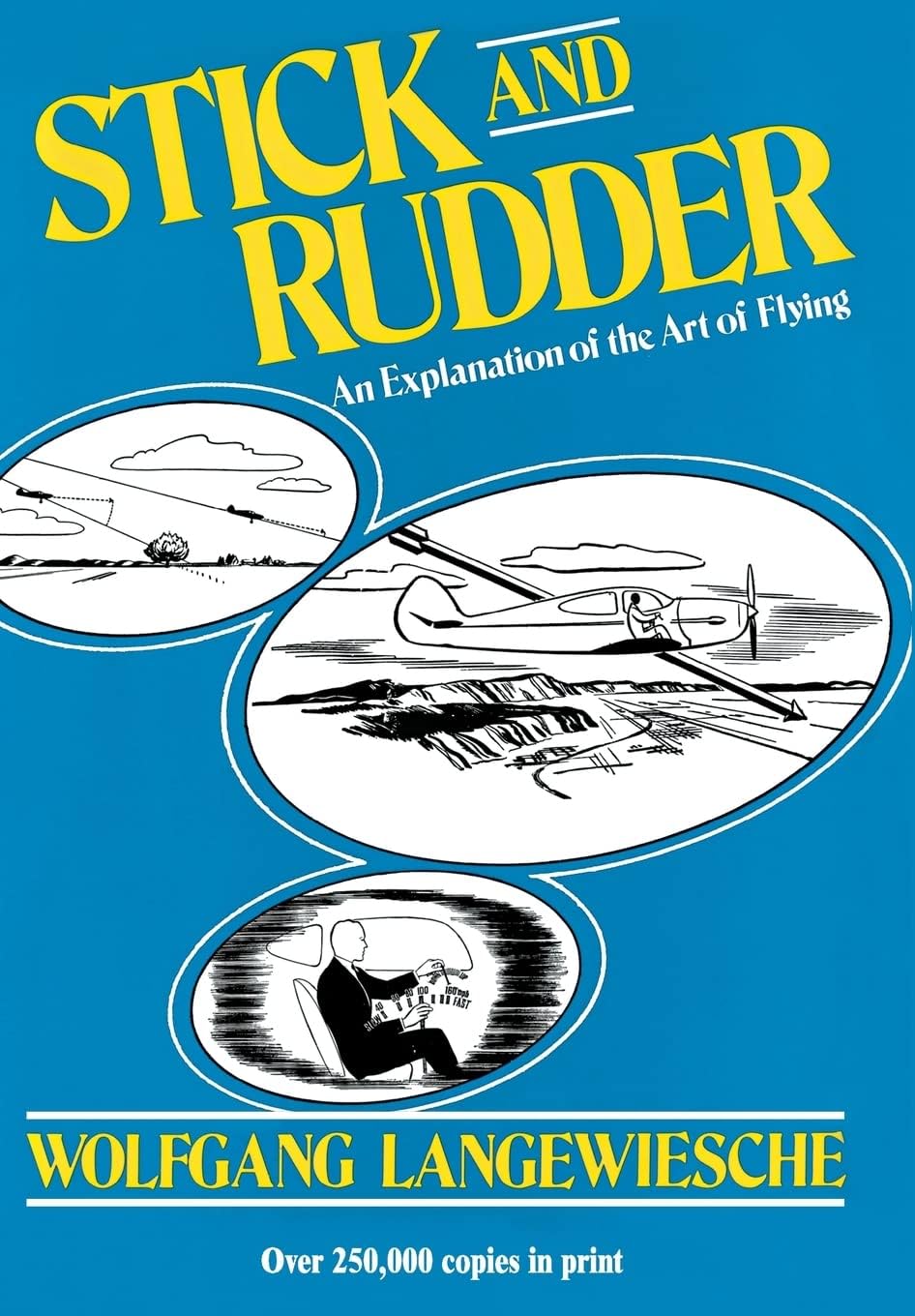
Stick and Rudder: An Explanation of the Art of Flying
Product ID: 221182
Buy anything from 5,000+ international stores. One checkout price. No surprise fees. Join 2M+ shoppers on Desertcart.
Desertcart purchases this item on your behalf and handles shipping, customs, and support to Vanuatu.
Publisher's Note: Products purchased from Third Party sellers are not guaranteed by the publisher for quality, authenticity, or access to any online entitlements included with the product. WHAT'S IN STICK AND RUDDER: The invisible secret of all heavier-than-air flight: the Angle of Attack. What it is, and why it can't be seen. How lift is made, and what the pilot has to do with it. Why airplanes stall How do you know you're about to stall? The landing approach. How the pilot's eye functions in judging the approach. The visual clues by which an experienced pilot unconsciously judges: how you can quickly learn to use them. "The Spot that does not move." This is the first statement of this phenomenon. A foolproof method of making a landing approach across pole lines and trees. The elevator and the throttle. One controls the speed, the other controls climb and descent. Which is which? The paradox of the glide. By pointing the nose down less steeply, you descend more steeply. By pointing the nose down more steeply, you can glide further. What's the rudder for? The rudder does NOT turn the airplane the way a boat's rudder turns the boat. Then what does it do? How a turn is flown. The role of ailerons, rudder, and elevator in making a turn. The landing--how it's made. The visual clues that tell you where the ground is. The "tail-dragger" landing gear and what's tricky about it. This is probably the only analysis of tail-draggers now available to those who want to fly one. The tricycle landing gear and what's so good about it. A strong advocacy of the tricycle gear written at a time when almost all civil airplanes were taildraggers. Why the airplane doesn't feel the wind. Why the airplane usually flies a little sidewise. Plus: a chapter on Air Accidents by Leighton Collins, founder and editor of AIR FACTS. His analyses of aviation's safety problems have deeply influenced pilots and aeronautical engineers and have contributed to the benign characteristics of today's airplane. Stick and Rudder is the first exact analysis of the art of flying ever attempted. It has been continously in print for thirty-three years. It shows precisely what the pilot does when he flies, just how he does it, and why. Because the basics are largely unchanging, the book therefore is applicable to large airplanes and small, old airplanes and new, and is of interest not only to the learner but also to the accomplished pilot and to the instructor himself. When Stick and Rudder first came out, some of its contents were considered highly controversial. In recent years its formulations have become widely accepted. Pilots and flight instructors have found that the book works. Today several excellent manuals offer the pilot accurate and valuable technical information. But Stick and Rudder remains the leading think-book on the art of flying. One thorough reading of it is the equivalent of many hours of practice. Review: . - Another great read. Review: Great book about the art of flying - I'm pursuing a PPL under part 61 so I'm basically building my own ground school curriculum from books here at desertcart. The various FAA books are good, and cover the basics, but in terms of describing how an airplane is flown, how it's maneuvered, and how to avoid digging a big hole in the ground, this is the book. Just buy it already... I don't care how long you've been flying I'm convinced you'll find this a good read. I read through it the first time right after reading the FAA Airplane Flying Handbook, and even though it was written in the 40's (and has a few dated ideas... like how rudders will be gone from airplanes in "a few years") it still does a much better job of describing the basics. The book is well-written, well-illustrated, and comprehensive. The single most important thing I learned from reading this, and what is missing from every other book I've read, is how to avoid killing yourself in an airplane. The author talks about how accidents actually happen, and most importantly how to avoid them. It's simple, to-the-point, and not necessarily what you'd think (although it is completely logical). Those chapters alone should make it mandatory reading for any pilot, and that's only about 20% of the book. Consider the rest a bonus.


| Best Sellers Rank | #15,109 in Books ( See Top 100 in Books ) #2 in Aviation History (Books) #8 in Aeronautics & Astronautics (Books) #11 in Piloting & Flight Instruction |
| Customer Reviews | 4.8 out of 5 stars 1,577 Reviews |
M**W
.
Another great read.
D**D
Great book about the art of flying
I'm pursuing a PPL under part 61 so I'm basically building my own ground school curriculum from books here at Amazon. The various FAA books are good, and cover the basics, but in terms of describing how an airplane is flown, how it's maneuvered, and how to avoid digging a big hole in the ground, this is the book. Just buy it already... I don't care how long you've been flying I'm convinced you'll find this a good read. I read through it the first time right after reading the FAA Airplane Flying Handbook, and even though it was written in the 40's (and has a few dated ideas... like how rudders will be gone from airplanes in "a few years") it still does a much better job of describing the basics. The book is well-written, well-illustrated, and comprehensive. The single most important thing I learned from reading this, and what is missing from every other book I've read, is how to avoid killing yourself in an airplane. The author talks about how accidents actually happen, and most importantly how to avoid them. It's simple, to-the-point, and not necessarily what you'd think (although it is completely logical). Those chapters alone should make it mandatory reading for any pilot, and that's only about 20% of the book. Consider the rest a bonus.
K**V
One of the books that has been used by generations of pilot trainees.
Very good condition.
J**I
If you fly or know someone who does, buy this book! -- USAF Pilot
If you fly or know someone who does -- buy this book! You may literally save their lives some day. It's a steal for a hard cover volume and it's one of the best texts on stick & rudder flying I've ever read. I'm an Air Force Academy grad with a degree in Astronautical Engineering. I know all the equations of flight and have tested wings in a lab. I was also a Jet Instructor Pilot for several years and also have a small out of Cessna 172 time (I just didn't enjoy props). Been out of flying for 30 years. I then took a ride in a glider and fell in love with soaring! You hardly use the rudder in normal jet flying so I had a lot to "re-learn" about how important it is in light aircraft. One of my glider instructor's recommended this book. I was skeptical, but quickly fell in love with it. It was written many years ago and the old wording and line drawings just added to my interest. You won't find any equations or graphs -- but sound words from a pilot who knows how to fly.
J**E
Believe the 5 star reviews!
At VAF (Van’s Air Force), this book kept getting mentioned as one of their favorites. I couldn’t imagine what would be so great about it, especially when the content in it was so old. But, like many others, it’s probably one of my favorite aviation books now, and is loaded with good information that I’m convinced will make you a safer pilot. I know it has made me more self aware, and flying experimental planes, we need to do more to improve our safety record. Understanding the concepts more clearly in this book, is as good a start as any. I can’t really add anything that others haven’t already done, but do want to stress one point. Wolfgang says that pilots are quite apt at recovering from stalls, when they expect them. But the real problem, is, pilots when not practicing it, most don’t realize they have got themselves in a stall when in the pattern, so instead of pushing down on the stick (or yoke) to regain airspeed back, they are pulling back, not ever knowing they were in a stall before it is too late. That still seems like the major problem today too; particularly when turning left base and left downwind. Steeper turns while turning don’t help the situation since it increases the stall speed as well, and worst case scenario you’ve fooled around and got yourself into a spin. I can't imagine no one benefiting from this book.
G**R
Rudder? I Don't Need No Lousy Rudder!
Funny, the title is Stick and Rudder and yet the author spends half the book complaining that the stick should be restricted to prevent dangerous excessive elevator and rudders shouldn't exist because they are the major cause of crashes. The book was written in the 30's and focuses on tail draggers. It is interesting to hear the author's predictions on how "future" aircraft will be designed. For example, he predicts safety improvements in aircraft design will eliminate fatalities due to stalls. He praises safety aircraft that do not allow the angle of attack to approach a stall - protecting pilots from themselves (but unsafely limiting aircraft maneuverability, in my opinion). He also suggests rudders will be unnecessary in the future, e.g., with the "new" tricycle landing gear allowing cross-wind landings while "crabing" (without the aircraft aligned to the runway). Somewhat amusing. Mr. Langewiesche rants too loud and often on the angle of attack and the big engineering mistake of rudders. Still, in reading through the book, I did get some new insights on glide control, landing technique and emergency aircraft maneuvers. Overall, I (250 hour private pilot) found useful conceptual models in the book actually helped me solve some control problems I was having. With the publication date in mind, it is definitely worth reading for a flight student or for an experienced pilot.
P**R
All Student Pilots Should Buy This Book
When I was taking my primary training I was pinching every penny to buy flight time and this book seemed out dated and expensive. I finally bought it and read it. If I had spent the few bucks back then I would have saved the price of its purchase many times over in wasted flight instruction hours. Often what Langewiesch describes is preambled with ( I'm paraphrasing here ) "A well behaved airplane should not do this but..." Present day trainers are much better behaved than when he wrote this book so the characteristics he goes on to explain are minimized, and as a result often misunderstood or simply ignored. They shouldn't be. Sooner or later all airplanes exhibit some or all of those traits and knowing what they are, why they occur, and how to react to them will greatly improve your skills. Often the "theory" as inadequately explained in a noisy cockpit by your CFI as you strive to perfect your skills is only part of the puzzle. At some point theory is overcome in the real world by practical application and the limitations of aircraft design. For a simple example: you have probably been taught that you do not need to hold any rudder once you have established in a steady turn, but no doubt you have also discovered that it is sometimes necessary to hold some rudder in some turns. What gives? This book will help you identify why and when these sorts of things should or should not happen, what to do about them, and especially important, what NOT to do about them.
S**H
Probably the best book ever written on WHY an airplane flies
The book is excellent once you get past the archaic language ie ailerons/elevators being called flippers etc. it describes why things happen as they do and is probably the best description of how the rudder functions during a turn. Also remember that this book is written primarily from a ‘taildragger’ perspective as when this book was written the tricycle gear was a novel theory and taildraggers were called ‘conventional landing gear’ planes. All in all a great book on WHY airplanes fly as opposed to the much more common approach of ‘how to fly an airplane’
F**S
Un classico
Cosa dire di nuovo su questo libro? Un testo che, per quanto datato, continua a fornire delle informazioni che devono fare parte del bagaglio culturale di chi vuole capire COME vola un aereo e non solo quali comandi muovere per farlo volare in sicurezza. Se si sa perché succedono le cose a bordo di un velivolo, si può anche reagire meglio ai suoi comportamenti e alle situazioni difficili. Lettura istruttiva e piacevolissima.
F**Q
Great book
An interesting book that gives the lay man an in depth understanding of what flying really is..
M**G
Der Beweis, dass Didaktik keine Erfindung der letzten 20 Jahre ist
Ich habe mir das Buch geholt, weil ich noch ziemlich am Anfang der Flugausbildung stehe. M.E. ist das eine ideale Ergänzung zum Theoriekurs und den deutschen Theoriebüchern (kein Ersatz, will es auch gar nicht sein). Während sich die Theorie und auch die Theorieprüfung mit allen das reine Fliegen umgehenden Faktoren beschäftigen (Metereologie, Aerodynamik, Menschliches Leistungsvermögen, Navigation, Sprechfunk, Flugplanung u.a.), die alle unerlässlich und wichtig für den sicheren Flugbetrieb sind, aber eben eher das Gesamtbild vermitteln, konzentriert sich dieses Buch einzig und allein auf das praktische Fliegen an sich. Das Buch beschäftigt sich damit, wie man zu fliegen hat, warum man im Anflug die Höhe mit dem Gas und die Geschwindigkeit mit dem Höhenruder steuert (und nicht anders herum), warum man den Anstellwinkel immer beachten muss, wie man landet, und wie der Wind relativ zum Flugzeug zu verstehen ist. Also eine theoretische Anleitung zum praktischen fliegen, nicht mehr, und nicht weniger. Die essentiellen Basics werden dabei dauernd wiederholt, bis man sie verinnerlicht hat. Sprachlich trotz des hohen Alters gut verständlich und ohne moralischen Zeigefinger, hebt sich dadurch auch wohltuend ab von den manchmal arg verwissenschaftlichten deutschen Büchern, bei denen man dazu neigt, diverse Fachbegriffe einfach um ihrer selbst willen zu verwenden (ich sage nur feuchtadiabatischer Hebungsgradient). Erstaunlich auch, dass das Buch noch nicht veraltet ist, obwohl es schon fast 80 Jahre alt ist. An einigen Stellen merkt man das Alter zwar (so wird an einer Stelle an die Gewichtsabnahme eines Flugzeugs nach dem Abwerfen von Bomben erinnert, was der Zeit 1944 geschuldet ist), auch die Illustrationen sind etwas Retro, aber das hat keinerlei Auswirkungen auf die praktische Relevanz des Buchs. Englisch muss man allerdings schon können, wenn man das Buch liest. Es ist zwar bewusst einfach geschrieben, aber trotzdem nicht ganz einfach zu verstehen.
D**D
Everything I hoped it would be....
I had been promising myself this book for a long time. One of those aviation classics you feel you should read but perhaps never get around to. Well this time I did get around to it when I saw it on Amazon for a sensible price, so many times it has come up at silly money I just couldn't entertain the idea of buying it but finally a sensibly priced copy appeared from a seller in the States and even with postage it was the chance to get the book I had promised myself. It is packed full of excellent information for the pilot, whether starting out or experienced. It is written in a style which explains the concepts being discussed in a very informative way without using jargon and thus paints the images in the minds eye with clarity. A book I would thoroughly recommend. Furthermore my copy arrived very quickly from America and so purchasing internationally was as easy as buying fro a UK supplier.
T**S
Re: A well known classic
A must-read for an aspiring pilot, Stick & Rudder gives a hands on 'how to' guide to flying light (and not so light) aircraft. A remarkably contemporary book given that it was written at the beginning of last century.
Trustpilot
2 months ago
1 week ago