Buy anything from 5,000+ international stores. One checkout price. No surprise fees. Join 2M+ shoppers on Desertcart.
Desertcart purchases this item on your behalf and handles shipping, customs, and support to Vanuatu.
🦅 Capture the wild like a pro — reach farther, shoot steadier, and never miss the moment!
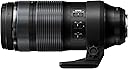
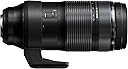
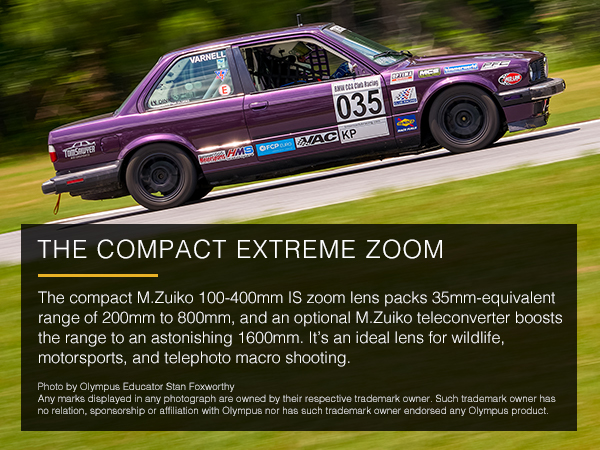
The OM SYSTEM Olympus M.Zuiko Digital 100-400mm F5.0-6.3 is a compact, lightweight super telephoto zoom lens designed for Micro Four Thirds cameras. Offering a 200-800mm equivalent focal range with optical image stabilization and weather-sealed construction, it excels in outdoor wildlife and bird photography. Compatible with 1.4x and 2.0x teleconverters, it delivers versatile reach and sharp images, making it an ideal choice for adventurous professionals seeking high-quality telephoto performance without the bulk.


| ASIN | B089YY76YK |
| Aspect Ratio | 4:3 |
| Audio Recording | No |
| Best Sellers Rank | #718 in SLR Camera Lenses |
| Brand | Olympus |
| Built-In Media | Lens Cap, Lens Hood, Rear Cap |
| Camera Lens | 100-400mm F5.0-6.3 IS Lens |
| Camera Lens Description | 100-400mm F5.0-6.3 IS Lens |
| Color | Black |
| Compatible Camera Models | Olympus (micro four thirds mount) |
| Compatible Camera Mount | Micro Four Thirds |
| Compatible Devices | Olympus OM-D, Olympus PEN |
| Compatible Mountings | Micro Four Thirds |
| Customer Reviews | 4.4 out of 5 stars 406 Reviews |
| Exposure Control Type | Automatic |
| File Format | JPEG |
| Focal Length Description | Super Telephoto Zoom 100 - 400mm |
| Focus Type | Auto/Manual |
| Global Trade Identification Number | 04545350053055 |
| Image stabilization | Optical |
| Iso Range | 100-???? |
| Item Type Name | Super telephoto lens. |
| Item Weight | 1325 Grams |
| Lens | Telephoto |
| Lens Coating Description | ZERO Coating |
| Lens Design | Zoom |
| Lens Fixed Focal Length | 400 Millimeters |
| Lens Mount | Micro Four Thirds |
| Lens Type | Telephoto |
| Light Sensitivity | ISO 100 - ISO 6400 |
| Manufacturer | Olympus |
| Manufacturer Part Number | V315070BU000 |
| Maximum Aperture | 5 Millimeters |
| Maximum Focal Length | 400 Millimeters |
| Maximum Shutter Speed | 1/4000 seconds |
| Media Type | stills_and_video |
| Minimum Aperture | 6.3 |
| Minimum Focal Length | 100 Millimeters |
| Minimum Shutter Speed | 1/4000 Seconds |
| Model Name | M.Zuiko Digital ED 100-400mm F5.0-6.3 IS Lens |
| Model Number | V315070BU000 |
| Number of Diaphragm Blades | 9 |
| Photo Filter Size | 72 Millimeters |
| Real Angle Of View | 3.1 Degrees |
| Shooting Modes | Landscape |
| UPC | 050332193208 |
| Unit Count | 1.0 Count |
| Video Capture Format | MP4 |
| Video Capture Resolution | 1080p |
| Viewfinder Type | Electronic, Optical |
| Warranty Description | 1 Year Manufacturer |
| Water Resistance Level | Water Resistant |
| Zoom Ratio | 4:1 |
D**N
Great Wildlife Lens that doesn't break the bank
I think this is a great lens for the price. This would be the next logical step up from a 45-150 kit lens for your micro 4/3 camera if you're into wildlife photography, or maybe you want to get some closeup portraits of animals. The pictures are sharp, it's not too bulky or heavy, and it has incredible reach. I typically use the MC-14 1.4x teleconvertor giving me 1120mm full frame equivalent focal length. The light weight coupled with the image stabilization means I have no problem shooting by hand at max zoom. Just mind your shutter speed. Image quality is very good. Better than I expected to be able to achieve, especially with the teleconvertor. It's not the sharpest lens in the world, but it's less than $1000 and plenty good enough for professional quality pictures. You just won't be making insane crops with this lens. You'll still want to get close even with the long reach. Light can be a problem. It is a very slow lens, so cloud cover will have you shooting high ISO. You won't be shooting owls at dusk. Luckily, I live in Arizona so light is very abundant. I think Micro 4/3 has a ton of advantages for wild life photographers looking to be more adventurous. The cameras are small and the crop factor gets you a ton of reach. I frequently hike with this lens. You don't need to haul around a giant tripod and gimbal. Some people are into finding a spot, setting up camp, and waiting for the action, but I much prefer to hike around and snap what I encounter. This is the lens for that. If you couple this lens with a used camera, you can really get into wildlife portrait photography for under two grand, which I don't think is that bad. Quality-wise, the lens feels durable and well made. It just feels like an expensive product in your hand. The zoom ring feels smooth, the switches feel high quality, and everything about it is functional. Weather sealing seems to have held up. I took it out in the rain on one trip and got caught in a downpour. I haven't had any issues. Overall, I'll highly recommend this lens to anyone looking to get into bird or wildlife photography.
S**G
it's all about the reach, works fine on a G9, comparison to Panasonic 100-400 (with 2nd gen notes)
I had been considering getting a 100-400 lens for a while, but it was hard to justify. I already have the first generation 100-300, and picture quality aside, how much of a difference would it be to go to 400? Factor in the teleconverter options for the Olympus lens and it becomes easier to justify going to 560 (1.4x400) or 800 (2x400). I bought this lens and the 1.4 teleconverter, figuring it would be easier to use and less detrimental to picture quality than the 2x teleconverter. Owning a Panasonic G9, the first concern is how well the Olympus would work with it. Some reviewers say it's fine, others say the Panasonic 100-400 works so much better. With the Olympus 100-400 on its own the G9 seemed to perform just fine. I didn't notice any slow focusing or missed shots due to camera shake, even on an overcast day without much light. On this same overcast day I then added the 1.4 teleconverter and didn't find the lens any more difficult to use, other than finding a shot when fully zoomed. To know for sure, I also tried a Panasonic 100-400, and didn't notice any obvious advantages. I am sure shooting style can make a big difference in noticing how well a camera pairs to a particular lens, but for my amateur, handheld bird shots, I didn't have problems with either lens. It's hard to make comparisons with fast moving birds, but I did a test with the more stable moon. For this test not only did the 560 mm equivalent focal length better fill the sensor than the 300 mm lens, but it looked so much better. After seeing the difference in picture quality the cost was easy to justify, even without the reach of the teleconverters. The Olympus with and without the teleconverter and the Panasonic 100-400 were all clearly superior to the 100-300. I also found that the Olympus with and without the teleconverter looked better than the Panasonic. There are many reviews and posts comparing these lenses, with conclusions supporting one or the other, so pick either lens and there is ample documentation to show you made the right choice. Between lens copy variation, camera type and settings, and shooting style, there are plenty of reasons why one may work better for one person than another. For me, my simple moon test (which is repeated regularly looking for eclipses and such) showed the Olympus worked better, and in other testing the Panasonic did not show an advantage, other than size and weight, so I went with the long reach of the Olympus. In full disclosure, I wanted justification for the Olympus because of the teleconverter option, and in my case it did appear to look better. I experimented with the electronic teleconverter built into the G9 and cropping from both brands of 100-400 and the 100-300, but found that the 1.4x teleconverter pictures of the moon looked slightly better than the resized versions without the teleconverter. An undeniable advantage of the Panasonic lens is the size and weight, but it's not as much as specifications initially show. Sure, it's lighter, and that doesn't change, but its length does. The Panasonic is shorter than the Olympus when it is retracted and extended, but it is shorter by 1.5" retracted, and only a little over a half inch when extended. In other words, when at full zoom, the Panasonic is almost the same length as the Olympus. This is an aspect of the size that needs to be considered, though there is no doubt that retracted it more easily fits into a bag. The zoom length may also be related to the oft reported stiffness of the Panasonic zoom ring. The Olympus extends about 2 3/8", while the Panasonic extends about 2 7/8". That greater extension while zooming the Panasonic may account for the greater effort to twist its zoom ring compared to the Olympus. The handle is easily removed from the Olympus by loosening the finger screw and rotating the handle until it can slide off. This makes the lens feel much smaller, but it should still be held firmly with your hand, and not be support only by the camera's lens mount. length retracted; length extended; lens extension Panasonic 6 5/8", 17 cm; 9 5/8", 24.5 cm; 3", 7.5 cm Olympus 8", 20.5 cm; 10 3/8", 26.5 cm; 2 3/8", 6 cm I also found the Olympus focus ring to be easier to turn. This may seem trivial, but these large lenses require extra support, so it can be awkward to have a firm hold on the lens with a light touch on the focus ring. The Olympus focus ring is light enough that a free finger can easily focus on the bird among the leaves without shaking the camera, unlike the Panasonic which requires greater effort. The build quality of the Olympus feels great, and of course the all metal construction of the Panasonic lens does, too. I have read a few complaints about the durability of the Panasonic lens, but the one I tried was used, graded as "acceptable", and well worn, but still seemed to work as designed without any noticeable degradation to the lens mount or focus speed. Based on my short experience with the Panasonic, testing a copy that appears to have been used for a few years, I wouldn't hesitate to buy one if it were my choice. Several people with Panasonic cameras have also commented on the tightness of the lens mount. Yes, the Panasonic 100-400 feels a little more snug on the G9 than the Olympus 100-400, but I have other Panasonic lenses that are looser than this Olympus, and my tightest mounting lens is an Olympus 60 mm, so in my experience one brand isn't clearly better in this regard. The copy of the 1.4 teleconverter I have fits tighter to the camera than the Olympus lens does, so lens fit is even less of an issue, but for me it isn't an issue at all, either way. I was attentive to this when trying out the lens, and did notice some very (very) light clunking, but found most often it was related to the extended part of the zoom making a slight movement as I walked. The end of the Panasonic lens, though its extension is longer as previously noted, feels a little tighter in this regard. I thought when I tried these lenses that they would feel absolutely huge, but after acquiring the Panasonic 10-25, which was larger than all of my other lenses, and so good that it rarely leaves my camera, I didn't find them to be ridiculously large, at least when retracted. Fully zoomed, yes, they start to look pretty big, and all of these lenses, including the aforementioned 10-25, may make you wonder why you are using a micro four thirds camera (of course, you know that full frame lenses with comparable zoom would weigh even more). The Panasonic does come closer to the size that you might think a super zoom would be on a micro four thirds, and might tempt you into thinking it's a lens attached to your camera, but with the Olympus there is not doubt, it's a camera attached to your lens. This review should have been posted nearly a year ago, and now that I am finally getting around to it, I see there is a newer version of the Panasonic 100-400, which of course brings on another bout of "did I get the right lens?" With my initial investigation, I think I still would have bought the Olympus. The new Panasonic is shorter than the first generation when extended, which of course provides a size advantage, and also may address the zoom ring stiffness as I described above. A huge benefit of the 2nd generation is the ability to use teleconverters, but on the video I saw, the zoom range is limited with the teleconverters attached to prevent the lens elements from bumping into the teleconverter! This means the new Panasonic lens is not fully compatible with the teleconverters, and uses a switch to limit range to avoid mechanical interference. The Olympus can be fully zoomed in and out with the teleconverter. I like to leave the teleconverter on, and certainly wouldn't want to remove my lens to remove the teleconverter if the subject was filling the frame too much and I couldn't move. So, based on a couple of press releases, I still choose the Olympus.
J**S
Light and Great Value
I bought this telephoto for my LUMIX G9, so I could have a lighter telephoto for my micro 4/3rds. And it doesn’t disappoint at all! The zoom on it and focus is pretty great in capturing amazing shots, as long as they aren’t moving. However, the focus speed with this lens and the camera I use is pretty slow, so you can’t capture that bird flying in the air. I’ve attached some images to show image quality, and for my purposes it does outstanding work! Overall, I think this is a great addition to your camera kit if you are looking for something to zoom in at 400 mm range using a micro 4/3rds.
B**L
Great lens
I had a Lumix G9 and the Panasonic Leica 100-400 lens, but wanted a newer body, so I sold the camera to a friend. For a while I used the Leica 100-400 with my new OM-1, then decided to sell the lens(same friend) and get this Olympus/OM System 100-400 and both the MC-14 and MC-20 teleconverters. The lens by itself is very sharp, and I'm 100% happy with the results. With the MC-14 you lose a stop of light, but I find that the sharpness is still really good, nearly the same as the bare lens. The MC-20 takes another stop of light, and also causes a visible loss of sharpness. I'm still happy with the images, but when you compare them to the other configurations you can see the difference. Attached pics: The Cooper's Hawk(90% sure that's the species) is shot with the MC-14, the Moon is shot with the MC-20
J**C
Very pleasantly surprised
This is not an Olympus PRO lens but the build quality is very good. I am extremely pleased with the picture quality, in particular with the excellent image sharpness. I have also used the lens with the Olympus 2X converter and, again, I am getting pictures of a quality I would not think possible with this combination. Another surprise: the image stabilization works well. I was taking pictures at 800mm (with the 2X converter) - which is difficult to do hand held at a relatively low shutter speed - and most of the images came out quite nice! On the downside, the maximum aperture of this lens is a somewhat limited f/5.0-6.3 (worse when you add the 2x converter) and, given that, an ISO in the 6400 range may often be required. Even at this higher ISO, though, I am very pleased with the quality of the images I am getting from the combination of this lens and my Olympus OM-D E-M1 Mark II camera. For me, this is a pricy lens and I thought long and hard before purchasing it, but I'm glad I did.
T**Z
Great super telephoto lens for the price
Not too heavy or large for telephoto range, great for bird photography, sharp and clean when there is enough light, focuses fast and reliably, well made and sturdy. Limitations become apparent on a cloudy or dark day when higher ISOs are required leading to increased image noise. There are brighter super telephoto lenses out there but are much much more expensive, much bigger and much heavier. The Olympus 100-400 is the best choice for advanced amateurs but professionals may need to put up with the weight, bulk and expense of brighter super telephoto lenses.
A**E
A lens like this is keeping MFT alive
It’s now mid 2024 and camera competition has been tough on MFT (Micro Four Thirds). Lots of people are saying MFT is dead but I beg to differ thanks to lenses like this one. Pair this lens with the Olympus/OM Systems OM-1 (Mark 1 or Mark II) or Panasonic G9II and you’ll have a great lightweight wildlife setup. Some of the cons of this lens is it’s slightly bigger and heavier than the Panasonic 100-400mm lens. Also this lens does not have Sync-IS with Olympus cameras. I feel the cons can be forgiven given the performance of this lens. I was using an Olympus 75-300mm lens and Panasonic 100-300mm II lens prior and this lens is a major step-up to those lenses. I’m currently using this lens with an Olympus OM-1 camera and I'm extremely happy with the images I’m getting with this combo. All attached photos are taken by me with the Olympus combo. My primary wildlife setup has been my Sony A7III paired with the Sony 200-600mm but I’ll be honest, I have been grabbing this combo over that Sony combo due to the light weight and excellent image quality. The Olympus combo balances well and doesn’t feel front heavy like my Sony combo. Yes, I can get better image quality with the Sony combo but I get less fatigue with the Olympus combo and I enjoy using the Olympus combo more than the Sony combo. Now keep in mind this is a 200-800mm full frame equivalent lens so at 400mm (800mm full frame equivalent) you must use proper technique to get the best image quality. Trust me, I’m still learning as I’m no pro. Practice, practice, and practice some more. I honestly feel wildlife photography is MFT strong suit. And thanks to lenses like this 100-400mm, I feel MFT will continue to live on.
C**S
Awful lense
I couldn't get the lense to focus at all. The image quality was awful. In my opinion for the price ot should have performed better
K**ー
商品レビュー
説明どおりの品物でした。信頼がおける業者様です
D**I
Captura Cada Detalle con el Teleobjetivo M.Zuiko Digital ED 100-400mm
¡El M.Zuiko Digital ED 100-400mm F5.0-6.3 IS es tu pasaporte a la fotografía de largo alcance! Zoom Extremo 100-400mm: Amplía tu visión desde un ángulo amplio hasta un increíble teleobjetivo, ideal para sujetos distantes. Estabilización de Imagen (IS): Mantén tus fotos nítidas y estables, incluso cuando estés disparando a distancias largas o con poca luz. Apertura Variable F5.0-6.3: Ofrece flexibilidad en diferentes condiciones de iluminación, perfecto para una variedad de situaciones fotográficas. Diseño Compacto y Ligero: Aunque tiene un impresionante rango de zoom, sigue siendo manejable y fácil de llevar en tus aventuras fotográficas.
T**L
beeindruckende optische und technische Leistung
Ich konnte trotz des relativ hohen Preises nicht widerstehen und habe mir dieses Objektiv geleistet obwohl die Fotografie nur eines meiner Hobbys ist. Zu meiner OMD EM10 Mark 2 passt es vom handling eigentlich gar nicht. Trotzdem sind mir auf Anhieb mit dieser Kombination immer scharfe Aufnahmen gelungen. Ich habe einige Beispielfotos mit angehängt. Alle Aufnahmen sind frei Hand mit 400mm (800mm Kleinbild) gemacht und sind JPG`s direkt aus der OMD EM10 M2 unbearbeitet. Der Mond darf natürlich nicht fehlen :-) Was ich als großen Vorteil gegenüber anderen Systemen mit dieser Brennweite sehe, ist ganz klar die Kompaktheit. Klar ist auch das M.Zuiko100-400 schon recht groß und schwer aber ich habe es zusammen mit der EM10 und 3 weiteren Objektiven und einem guten Fernglas in einem wirklich kleinen Fotorucksack (siehe Foto). Den schnappe ich mir nach der Arbeit, schwinge mich aufs Rad und suche nach Motiven. Die Ausrüstung stört mich dabei vom Gewicht oder Volumen überhaupt nicht. Entdecke ich etwas interessantes steige ich vom Rad, nehme die Kamera in die Hand und dank des hervorragenden Bildstabilisators schieße ich auch bei langer Brennweite frei Hand tolle Fotos. Wenn ich erst einmal die M1 Mark... habe ist da sicher noch mehr rauszuholen. Dafür muss ich aber noch ein wenig sparen :-(
R**O
Obbiettivo fantastico
Praticamente perfetto, nitido a sufficienza (qualche decadimento assolutamente minino agli estremi) per foto di alta qualità, compatto e resistente, anche se non classificato come pro un obbiettivo con caratteristiche di alto livello, stabilizzato e tropicalizzato. In più può montare i moltiplicatori Olympus (1,4x e 2x) che aumentano il range fino alla incredibile focale di 1600mm (FF equivalenti), cosa che il suo "parente stretto" Panasonic (anche se di altrettanta qualità) non può fare.
M**N
Best zoom lens for OM-1
This 100-400mm f/5-6.3 meets exactly what I needed shooting from my patio, my photo walks and best of all, my bird photography in pro capture, BIF with dual eye and tracking. Such an amazing small zoom lens with big features.
Trustpilot
1 month ago
1 month ago