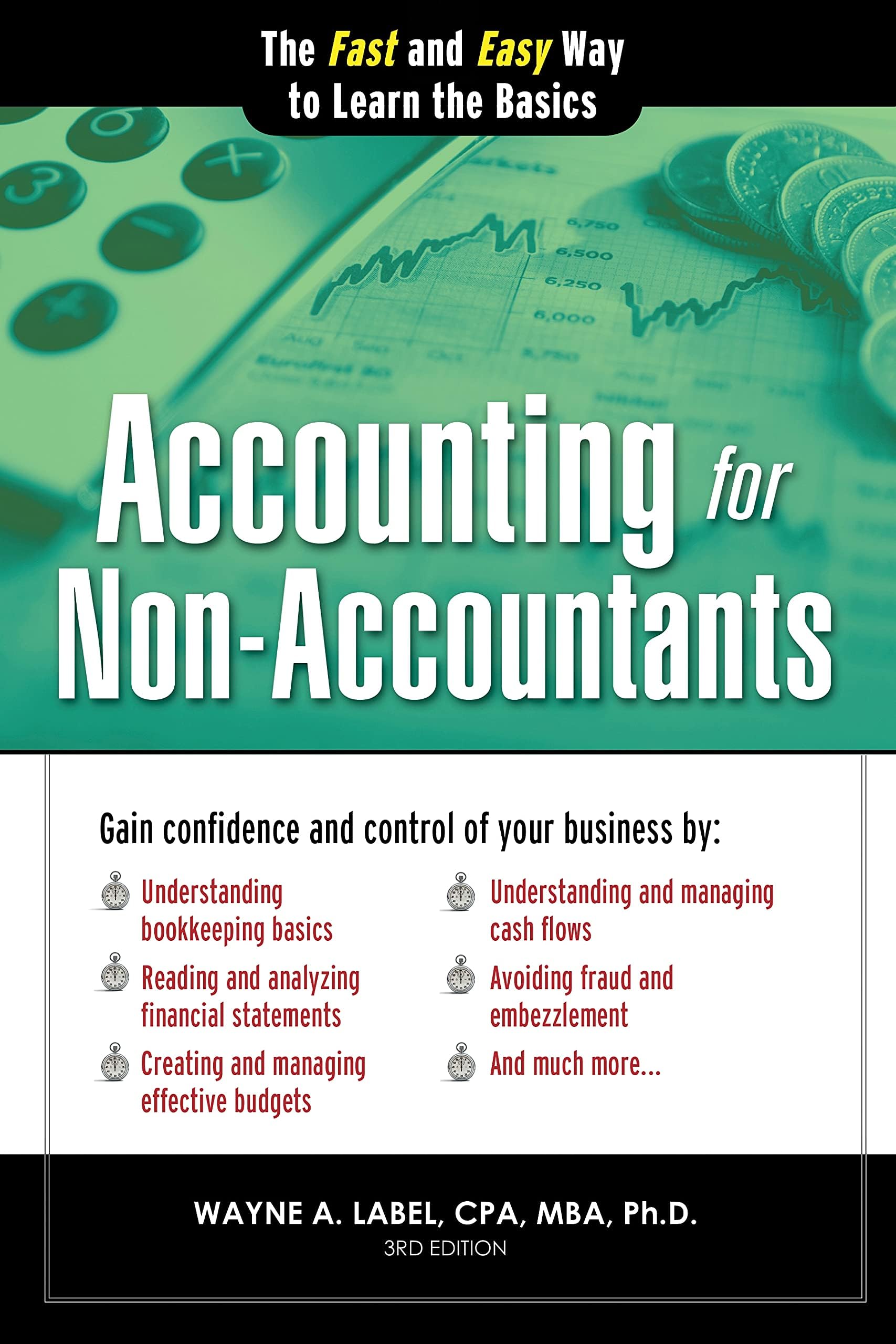
Accounting for Non-Accountants: Financial Accounting Made Simple for Beginners (Basics for Entrepreneurs and Small Business Owners) (Quick Start Your Business)
Product ID: 22233999
Buy anything from 5,000+ international stores. One checkout price. No surprise fees. Join 2M+ shoppers on Desertcart.
Desertcart purchases this item on your behalf and handles shipping, customs, and support to Vanuatu.
A Quick, Compact, and Easy-to-Understand Resource for Non-Accountants! The perfect financial accounting guide for beginners! Accounting for Non-Accountants is the must-have guide for all of us who have never taken an accounting class, are mystified by accounting jargon, and have no clue about balance sheets, income statements, payroll management, corporate taxes, or statements of cash flows. This simple to use accounting book is bookmaking made simple. Whether you're a small business owner, aspiring entrepreneur, or simply seeking to understand the financial aspects of your personal and professional life, Accounting for Non-Accountants provides a comprehensive introduction to accounting principles in a clear and accessible manner. This must-have guide includes information such as: How to prepare and use financial statements How to control cash flows How to manage budgets How to use accounting ratios How to deal with audits and auditors interpret financial statements Empower yourself with financial knowledge and gain confidence in managing your finances with Accounting for Non-Accountants . This book serves as a valuable resource for anyone seeking to grasp the essential concepts of accounting, from small business owners to individuals looking to enhance their financial literacy. Discover the power of financial understanding and unlock new opportunities for success. Let this book help you like it helped these readers: "Dr. Labels explanations are simple and straightforward. " "This will help me a lot as I set up my own business. " "I have worked in accounting for over twenty-five years, and this is the best book I have seen to help people with the basics of accounting." For entrepreneurs or anyone who needs to brush up on accounting fast, this book will have you up and running in no time. Review: straightforward and sequential layout of accounting transactions - Accounting for Non-Accountants by Wayne A. Label is a marvelous little book for getting acquainted with basic financial statements such as, primarily, the Balance Sheet and the Income Statement, in addition to the Statement of Cash Flows and the Statement of Retained Earnings. The book is geared for people new to accounting principles, as it lays out, for instance, different sequential snapshots of the balance sheet to demonstrate how individual adjustments are treated. This is probably the highlight feature of the book for newcomers--its straightforward and sequential layout of accounting transactions. With that said, let it be clear that Label has personality, demonstrated by his occasional use of humor and his engaging writing style. Furthermore, Label covers a large scope of interesting material--not just information on financial statements-- to give beginners a broad overview of the industry. To explain, about half of the book is dedicated to the financial statements, journal, and ledger, while the other half is dedicated to concepts such as fraud prevention, audits, GAAP, and--perhaps most interestingly--ratios (including rate of return on investment, current ration, sales ratios, and many others) for reporting short-term or long-term analysis of financial data. As a specific example of what the book offers, Label expounds on Generally Accepted Accounting Principles (GAAP), which apply to the United States (and Canada, too, so I am told). These principles outline the requirements for accounting, such as both the requirement that financial statements be relayed in monetary terms and the requirement that the depreciation estimates be sufficiently verifiable. As another example, the book provides a somewhat cursory albeit introductory discussion on both the journal and the ledger, while providing a clear definition of the double accounting system, including an accessible definition of the somewhat arbitrary meaning of both credits and debits. Perhaps unique to Label's book is the emphasis on corporations, where he outlines concepts such as preferred versus common stock, cash dividends, stock dividends, and stock splits. This section is more advanced than the rest of the book, but will be especially of interest if the reader either plans to incorporate, of course, or has had prior experience with the stock market. While Label's book is an excellent introduction to accounting principles (with overviews of some advanced concepts such as stocks, corporations, and audits), it is only the first stop for acquiring a solid footing in accounting concepts. A good follow-up (and relatively more advanced and academic) book to Label's that I've started reading is Barron's Accounting by Peter J. Eisen. Eisen's book does not ease the newcomer into accounting principles like Label's does, but it offers a lot more in-depth practice and insight into financial statements. Eisen's book also emphasizes proprietorship, unlike Label's which focuses a great deal on the corporation. Another book recommendation to read in tandem with Label's is Accounting Made Simple: Accounting Explained in 100 Pages or Less by Mike Piper. All in all, I'd recommend starting with Label's book if (1) you have little to no background in accounting, (2) you would like an overview of the industry, or (3) your long-term agenda includes setting up a corporation. Review: It cover everything you needed to know about introduction to accounting - This book cover introduction to accounting. It gives vocabulary words and the meanings.


| Best Sellers Rank | #104,876 in Books ( See Top 100 in Books ) #28 in Financial Accounting (Books) #132 in Small Business (Books) #1,069 in Personal Finance (Books) |
| Customer Reviews | 4.5 out of 5 stars 922 Reviews |
S**C
straightforward and sequential layout of accounting transactions
Accounting for Non-Accountants by Wayne A. Label is a marvelous little book for getting acquainted with basic financial statements such as, primarily, the Balance Sheet and the Income Statement, in addition to the Statement of Cash Flows and the Statement of Retained Earnings. The book is geared for people new to accounting principles, as it lays out, for instance, different sequential snapshots of the balance sheet to demonstrate how individual adjustments are treated. This is probably the highlight feature of the book for newcomers--its straightforward and sequential layout of accounting transactions. With that said, let it be clear that Label has personality, demonstrated by his occasional use of humor and his engaging writing style. Furthermore, Label covers a large scope of interesting material--not just information on financial statements-- to give beginners a broad overview of the industry. To explain, about half of the book is dedicated to the financial statements, journal, and ledger, while the other half is dedicated to concepts such as fraud prevention, audits, GAAP, and--perhaps most interestingly--ratios (including rate of return on investment, current ration, sales ratios, and many others) for reporting short-term or long-term analysis of financial data. As a specific example of what the book offers, Label expounds on Generally Accepted Accounting Principles (GAAP), which apply to the United States (and Canada, too, so I am told). These principles outline the requirements for accounting, such as both the requirement that financial statements be relayed in monetary terms and the requirement that the depreciation estimates be sufficiently verifiable. As another example, the book provides a somewhat cursory albeit introductory discussion on both the journal and the ledger, while providing a clear definition of the double accounting system, including an accessible definition of the somewhat arbitrary meaning of both credits and debits. Perhaps unique to Label's book is the emphasis on corporations, where he outlines concepts such as preferred versus common stock, cash dividends, stock dividends, and stock splits. This section is more advanced than the rest of the book, but will be especially of interest if the reader either plans to incorporate, of course, or has had prior experience with the stock market. While Label's book is an excellent introduction to accounting principles (with overviews of some advanced concepts such as stocks, corporations, and audits), it is only the first stop for acquiring a solid footing in accounting concepts. A good follow-up (and relatively more advanced and academic) book to Label's that I've started reading is Barron's Accounting by Peter J. Eisen. Eisen's book does not ease the newcomer into accounting principles like Label's does, but it offers a lot more in-depth practice and insight into financial statements. Eisen's book also emphasizes proprietorship, unlike Label's which focuses a great deal on the corporation. Another book recommendation to read in tandem with Label's is Accounting Made Simple: Accounting Explained in 100 Pages or Less by Mike Piper. All in all, I'd recommend starting with Label's book if (1) you have little to no background in accounting, (2) you would like an overview of the industry, or (3) your long-term agenda includes setting up a corporation.
S**S
It cover everything you needed to know about introduction to accounting
This book cover introduction to accounting. It gives vocabulary words and the meanings.
R**A
NICE BUT TOO LONG
Nice book with lots of information for a non-accountant, which is what the title of the book is. However, it is too long and i quickly lost interest in reading it. I did, however, go thru looking for tips and tricks. Thank you. Lot it makes sense.
A**A
Perfect for the Non Accountant
If you are one of those people who can't keep up with your money the way you are supposed to, this book is for you. If you need to learn accounting but shudder at the thought, this book is for you. The author has taken dry, boring, but necessary to learn concepts and made them easy to understand and probably as interesting as it can get (if that's possible). If the title "Accounting for Dummies" wasn't already taken, he could have used the title for this book.
M**U
Worth a read to any small business owner
This is clearly written, and builds on itself in a logical manner. I was humbled to find stuff I didn't know, considering I have had my small business for 10 years. IMHO, I wish I read this about 20 years ago. I plan to gradually teach my kids off these principles as they get older.
C**.
Not so easy or simple
The book purports to teach you what you'd need in terms of accounting to run a small business enterprise. The description of accounting principles is sometimes not as clear as it could be. It does use some reasonably simple examples, mostly based around a fictitious bicycle shop.
C**A
Clear, concise and easy to understand!!
I thought this was a pretty good book. I am not an accountant, however the information was clear, concise and easy to understand. The author did a very good job explaining the basic concepts using examples and definitions. I would recommend this book to any beginner that is interested in accounting or bookkeeping.
D**S
Very helpful for small business owners without a financial background
If you're a small or micro business owner, but A) aren't clear on what kind of records you should be keeping, or B) don't know a balance sheet from an income statement, or an expense from a liability, then this book would be an excellent investment of your time. He gives it to you straight and at the right level of complexity. Only one chapter didn't seem immediately relevant to me -- the one on corporations -- but it helped that all that info was contained in one chapter that I could basically skip, AND, I saw that even though it wasn't immediately relevant, it also contained info that I should probably learn. Highly recommended.
K**D
Such a Great Book for non accountants
I've had my business for 11 years and have good basic knowledge of accountancy, however your account won't give you the time usually to sit there and go over things. This book (although doesn't make sense from an accounts point of view to me as an owner) puts everything into perspective and is actually a good read for a boring subject. Would recommend this book. I'm on page 120 after less than one week. Will probably finish it next week. I'm in the UK but this is from the US but still highly relevant.
R**A
Balancesheet
Very use for non accountant professionals.
E**S
Great help
This book has lots of information and it’s easy to understand it has been a great learning tool
福**香
会計学基礎
誤字脱字が目立つが、易しく分かりやすいと感じた。初心者向きだと思う
A**D
Great book for non accountants
Comprehensive and straight to the point
Trustpilot
5 days ago
1 week ago