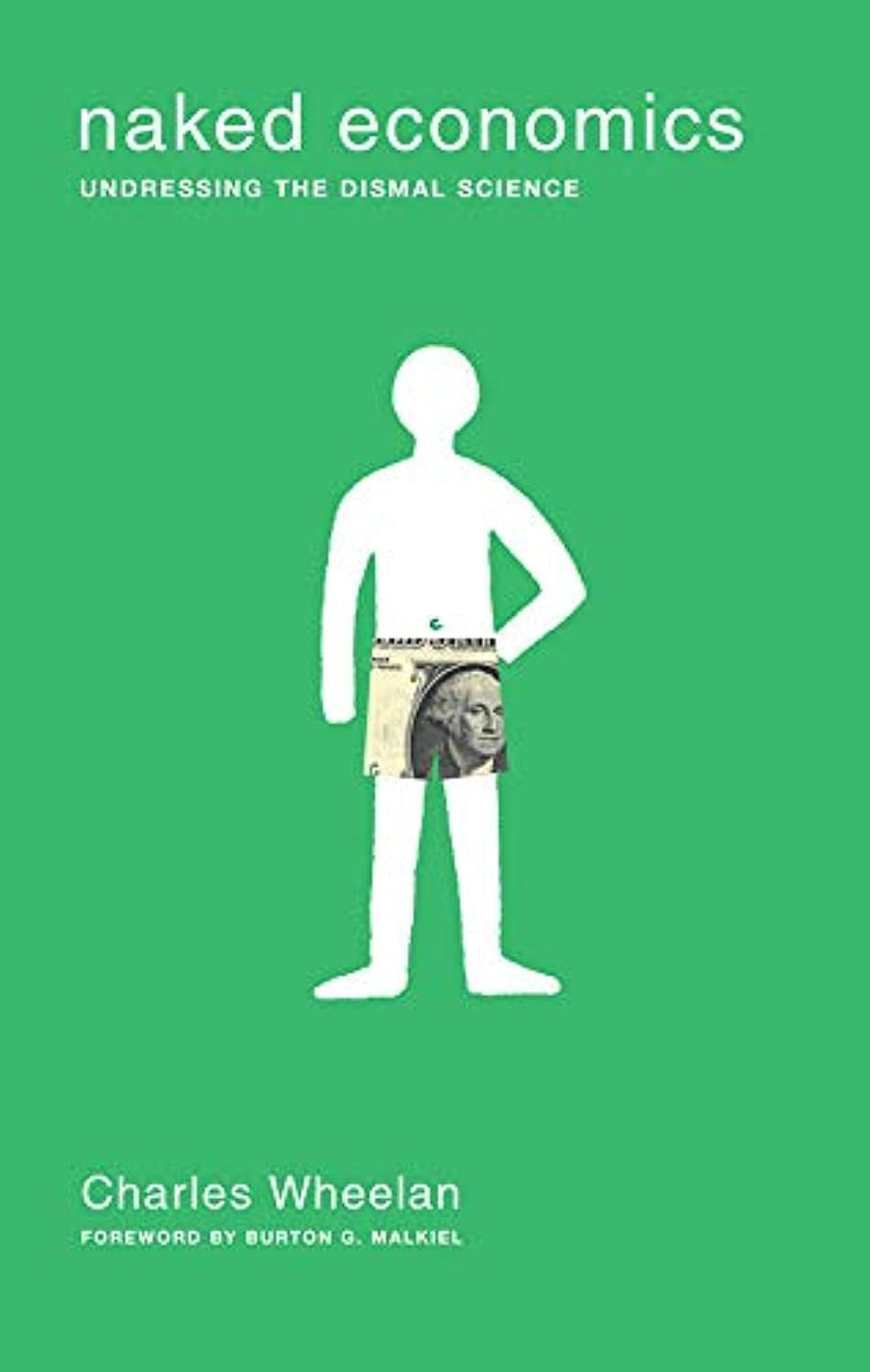
W. W. Norton & Company Naked Economics: Undressing the Dismal Science
Product ID: 253579292
Buy anything from 5,000+ international stores. One checkout price. No surprise fees. Join 2M+ shoppers on Desertcart.
Desertcart purchases this item on your behalf and handles shipping, customs, and support to Vanuatu.
W. W. Norton & Company Naked Economics: Undressing the Dismal Science : Wheelan, Charles: desertcart.ae: Books Review: As Wheelan writes himself in the introduction to the book, “This book is not economics for dummies; it is economics for smart people who never studied economics (or have only a vague recollection of doing so).” By referencing work done by many Nobel-prize winning economists, Wheelan gives an intuitive yet detailed perspective on microeconomics, macroeconomics, international economics, and describes how they are all interconnected. He thoroughly explains the role that firms and consumers play in markets, the importance of incentives, and the role of the government as a “necessary evil”. He talks about human capital and how it potentially creates large gaps between the rich and the poor. He breaks down the measures used to determine a country’s economic success, and how policy makers can most effectively minimize the negative effects of recessions and capitalize on the positive effects of growth. He also acknowledges that this theory has practical limitations. “Policy is not made in theory, it is made in Congress,” (159). Finally, he insists, with evidence, that trade among nations is essential for poor and developed nations alike. Most importantly, this 2002 book makes predictions that are eerily similar to the economy today. These include the role of technology in consumer data collection for price discrimination, and the growing government objective of environmental protection. If nothing else, Wheelan’s writing is simple, funny, and light-hearted. You will not struggle through the pages of this book. On the contrary, you will derive a great deal of utility. Review: I thought this was a very good introduction to economics for the layman. Wheelan purports to explain the subject without all the mind-numbing charts and economics jargon and he succeeds in doing just that. My initial reaction to the book was that Wheelan was merely an apologist for unfettered capitalism but it turned out to be a relatively objective work. He gives both sides of the story so to speak, and concludes that government is important to a healthy economy, as long as it is used judiciously. For instance, on page 51 he flatly states; "Anyone who tells you that markets left to their own devices will always lead to socially beneficial outcomes is talking utter nonsense." He points out how most developing countries would love to have the bureaucracy that we have, and this lack of effective government is what keeps many nations from prospering. Of course, this goes both ways as he also describes the damage done by excessive government regulation, as witnessed by states like North Korea. He argues against the allures of protectionism and emphasizes the importance of international trade, for rich and poor countries alike. Besides the relationship between government and economies, the author tackles all the major aspects of economics such as how the financial markets work, the difference between monetary and fiscal policy, the Federal Reserve, inflation, human capital, currency, externalities and so on. His analysis of "creative destruction" can be summed up by the following; "It would have been one thing to help displaced Pony Express workers by retraining them as telegraph operators; it would have been quite another to help them by banning the telegraph." He's actually quite humorous at times also; "Any thoughtful policy analyst knows that some individuals who wear spandex in public should be taxed, if not jailed." Wheelan makes no secret that capitalism is an amoral system that often leaves short-term damage in its wake. He insists though, that in the long-term it is the best system around, hands down. He makes some interesting points about international trade and globalization, pointing out that those who oppose it, often do more harm to the very people they intend to protect. For instance, he claims that Third World sweatshops, while deplorable by Western standards, are often the best option that some people have, and that they are a necessary step in the process toward industrialization. He claims that any attempt to boycott or otherwise oppose these conditions would simply force these places to shut down, condemning the workers to even worse prospects. My only criticism of this argument, and maybe I'm naïve, is that this seems a bit too "all or nothing." It seems hard for me to believe that any effort to enforce better working conditions would automatically put these places out of business. Isn't there a middle road here? One thing I did notice was that Wheelan states early on that capitalism is not a zero-sum game, meaning that my wealth does not depend on someone else's poverty. Then, later in the book he says that there is a finite amount of capital in the world and the more in the hands of government, the less for the rest of us. Either I'm missing something or this is a contradiction. Other than that, I enjoyed the book greatly and actually feel more knowledgeable on the subject than before I started. Economics has always frustrated me but the author explained it in a way that even a meathead like myself could understand. Wheelan also accomplished something I heretofore thought impossible; he actually made economics interesting! 4.5 stars.
| Best Sellers Rank | #8,884 in Business & Economics #45,163 in Textbooks & Study Guides |
| Customer reviews | 4.4 4.4 out of 5 stars (164) |
| Dimensions | 16.51 x 2.79 x 24.38 cm |
| Edition | First Edition |
| ISBN-10 | 0393049825 |
| ISBN-13 | 978-0393049824 |
| Item weight | 567 g |
| Language | English |
| Print length | 288 pages |
| Publication date | 17 September 2002 |
| Publisher | W. W. Norton & Company |
N**N
As Wheelan writes himself in the introduction to the book, “This book is not economics for dummies; it is economics for smart people who never studied economics (or have only a vague recollection of doing so).” By referencing work done by many Nobel-prize winning economists, Wheelan gives an intuitive yet detailed perspective on microeconomics, macroeconomics, international economics, and describes how they are all interconnected. He thoroughly explains the role that firms and consumers play in markets, the importance of incentives, and the role of the government as a “necessary evil”. He talks about human capital and how it potentially creates large gaps between the rich and the poor. He breaks down the measures used to determine a country’s economic success, and how policy makers can most effectively minimize the negative effects of recessions and capitalize on the positive effects of growth. He also acknowledges that this theory has practical limitations. “Policy is not made in theory, it is made in Congress,” (159). Finally, he insists, with evidence, that trade among nations is essential for poor and developed nations alike. Most importantly, this 2002 book makes predictions that are eerily similar to the economy today. These include the role of technology in consumer data collection for price discrimination, and the growing government objective of environmental protection. If nothing else, Wheelan’s writing is simple, funny, and light-hearted. You will not struggle through the pages of this book. On the contrary, you will derive a great deal of utility.
P**N
I thought this was a very good introduction to economics for the layman. Wheelan purports to explain the subject without all the mind-numbing charts and economics jargon and he succeeds in doing just that. My initial reaction to the book was that Wheelan was merely an apologist for unfettered capitalism but it turned out to be a relatively objective work. He gives both sides of the story so to speak, and concludes that government is important to a healthy economy, as long as it is used judiciously. For instance, on page 51 he flatly states; "Anyone who tells you that markets left to their own devices will always lead to socially beneficial outcomes is talking utter nonsense." He points out how most developing countries would love to have the bureaucracy that we have, and this lack of effective government is what keeps many nations from prospering. Of course, this goes both ways as he also describes the damage done by excessive government regulation, as witnessed by states like North Korea. He argues against the allures of protectionism and emphasizes the importance of international trade, for rich and poor countries alike. Besides the relationship between government and economies, the author tackles all the major aspects of economics such as how the financial markets work, the difference between monetary and fiscal policy, the Federal Reserve, inflation, human capital, currency, externalities and so on. His analysis of "creative destruction" can be summed up by the following; "It would have been one thing to help displaced Pony Express workers by retraining them as telegraph operators; it would have been quite another to help them by banning the telegraph." He's actually quite humorous at times also; "Any thoughtful policy analyst knows that some individuals who wear spandex in public should be taxed, if not jailed." Wheelan makes no secret that capitalism is an amoral system that often leaves short-term damage in its wake. He insists though, that in the long-term it is the best system around, hands down. He makes some interesting points about international trade and globalization, pointing out that those who oppose it, often do more harm to the very people they intend to protect. For instance, he claims that Third World sweatshops, while deplorable by Western standards, are often the best option that some people have, and that they are a necessary step in the process toward industrialization. He claims that any attempt to boycott or otherwise oppose these conditions would simply force these places to shut down, condemning the workers to even worse prospects. My only criticism of this argument, and maybe I'm naïve, is that this seems a bit too "all or nothing." It seems hard for me to believe that any effort to enforce better working conditions would automatically put these places out of business. Isn't there a middle road here? One thing I did notice was that Wheelan states early on that capitalism is not a zero-sum game, meaning that my wealth does not depend on someone else's poverty. Then, later in the book he says that there is a finite amount of capital in the world and the more in the hands of government, the less for the rest of us. Either I'm missing something or this is a contradiction. Other than that, I enjoyed the book greatly and actually feel more knowledgeable on the subject than before I started. Economics has always frustrated me but the author explained it in a way that even a meathead like myself could understand. Wheelan also accomplished something I heretofore thought impossible; he actually made economics interesting! 4.5 stars.
M**.
A diferencia de muchos otros libros que hablan sobre economía, Naked Economics tiene una visión mucho más neutral que no invita al lector a mezclarse con un sector determinado del espectro político (izquierda o derecha). Dado que Charles Wheelan aparte de escritor, periodista y orador, es un político de centro, este libro es perfecto para comprender las nociones básicas de la economía, con una pizca del contexto estadounidense que es perfecta para entender cómo el comportamiento del gobierno y la sociedad interactuan de diferentes formas con la misma. Muy recomendado para cualquiera que busque introducirse en este tema.
S**L
Excellent read
A**S
Highly recommended!!!
Trustpilot
1 week ago
2 days ago