
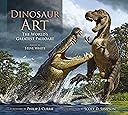
Dinosaur Art: The World's Greatest Paleoart
Product ID: 2711272
🌍Global paleoart perspectives
🎨Diverse artistic media
📚High-quality art book
Buy anything from 5,000+ international stores. One checkout price. No surprise fees. Join 2M+ shoppers on Desertcart.
Desertcart purchases this item on your behalf and handles shipping, customs, and support to Vanuatu.
🎨 Unlock the prehistoric art revolution—where science meets stunning creativity!
Dinosaur Art: The World's Greatest Paleoart is a premium-quality art book featuring a curated collection of modern dinosaur illustrations by nine influential paleoartists. Celebrated for its vibrant, full-color images printed on high-grade paper, the book combines cutting-edge scientific insights with diverse artistic styles, from digital photorealism to traditional brushwork. Enhanced by exclusive interviews, it offers a unique glimpse into the creative process behind the paleoart renaissance inspired by Dr. Robert Bakker’s groundbreaking work. Perfect for art lovers, dinosaur enthusiasts, and millennial professionals seeking a sophisticated, conversation-starting addition to their collection.
| Best Sellers Rank | #216,614 in Books ( See Top 100 in Books ) #57 in Biology of Dinosaurs #333 in Plant & Animal Art (Books) #1,146 in Other Art Media (Books) |
| Customer Reviews | 4.7 out of 5 stars 457 Reviews |
H**E
The Newest and Bestest Picture Book of Dinosaurs and Other Extinct Animals
Charles Knight died while I was still a young boy, leaving behind a series of paintings of dinosaurs and other extinct creatures which sustained me through my childhood (even my "dino-toys" aped Knight's reconstructions), but then something terrible happened. For almost 30 years, dinosaur art stagnated, with endless recyclings and reworkings of Knight's depictions, getting ever cruder and falling ever further behind the evolving dinosaur science. Then, in 1986, Dr. Robert Bakker, in "The Dinosaur Heresies", brought modern dinosaur science into the mainstream and, with it, he inspired a whole new generation of "paleo-artists" to pick up the cudgel (or brush or pen or computer stylus) and to start illustrating these new ideas, new interpretations, and the multitudinous new finds coming out of such previously ignored places as South America and China. This book reflects a compendium of select works from 9 of the "second generation" of the artists thus inspired, plus the work of Gregory Paul, who, if he is the least "artistic" of the group, is probably one of the most influential of this new wave of "dino-drawers". Almost all of the artists showcased acknowledge Bakker as their inspiration and Paul as their mentor, tho' their work differs extraordinarily in both technique and result, from the utterly "photo-realistic" (such as the works of Julius Csotonyi and Luis Rey) to the almost Japanese brushwork illustrations of artists such as John Conway. None of the artist's works are a disappointment and all are utterly compelling and intriguing, with an excellent (if necessarily limited) selection of works from each of the featured artists, all beautifully presented on high quality paper stock and in full color. Be aware, however, that this is NOT a book about ancient animals. It is a book about art, with the text, in each case, consisting of an interview with the featured artist, which only tangentially touches on the subject matter. As an art book, however, it succeeds brilliantly. Seeing the utter revolution in the depiction of extinct animals which has followed in the wake of Bakker's book (helped, in many cases, by evolving technology, including, particularly, the various means of creating "digital art"), one almost feels like Cosimo de Medici, watching as the new thinking and new techniques of the Renaissance displace the tired conventions of Medieval artwork and its increasingly degraded reiteration of Byzantine artistic conventions. If I have any bone to pick with the book (aside from the short shrift given to the animals depicted and the lack of much discussion of them) it is the exclusion of what really was the "first wave" of this paleo-art revival in favor of the "enfant terribles" who followed them. Where are the Czerkas brothers? Where is John Gurche (whose work provided the cover art for Bakker's book)? Where are David Peters and Mark Hallet? Leaving those artists out (esp. Gurche and the Czerkas) is like writing a book about the Renaissance without discussing Fra Angelico and Giotto or the Dutch oil painters, such as Van Eyck. All the artists featured deserved to be featured, but one wishes that, perhaps, a few more might have been tapped for inclusion. It is a relatively piddling gripe, however, and the book is a delight whether the interest is art or dinosaurs, the type of book one can visit and revisit over and over again without satiation. Well worth the price.
T**S
Stunning--an Absolutely Incredible Book!
I can't think of enough superlatives to use to describe my opinion of "Dinosaur Art: The World's Greatest Paleoart." This is, quite simply, one of the most incredible books I've seen in many years. I first came across it, securely shrink-wrapped in plastic, in a bricks-and-mortar bookstore. The vibrant artwork on the cover attracted me from across the store, and when I felt the heft of the slim but heavy volume, I knew it was something special. What a book it is! The quality of the artwork between its sturdy covers just blew me away. The production values are absolutely first-rate. The images, including several multiple-page foldout panoramas, are razor-sharp and breathtaking. I found myself staring at each of them for literally minutes, trying to extract the maximum amount of information and marveling at the amount of work the artist put into creating each one. The colors are phenomenal--and, naturally, mostly speculative, since no one knows how dinosaurs were patterned and marked (with one exception that the book illustrates and explains). While the focus of "Dinosaur Art" is on the artwork, of course, the interviews with the artists are also fascinating. Some of them reveal exactly how certain works came to be, and how our understandings of the dinosaurs they illustrated evolved over the years. All are interesting and inspirational. Artistic media represented in "Dinosaur Art" include pencils, pen-and-ink, gouache, oils, acrylics and digital. Styles range from relatively loose to stunningly photo-realistic. And the subjects run the gamut from small bird-like dinosaurs to the biggest of the big sauropods. I had never heard of most of the creatures, but that didn't stop me from enjoying these remarkable images of them in the environments they inhabited. "Dinosaur Art" is an amazing book. Anyone who has ever wondered what the earth might have looked like in the days before a six-mile-in-diameter asteroid slammed into the Gulf of Mexico 65 million years ago and wiped out most life on the planet, should find it of immense interest. If you have the slightest curiosity about dinosaurs, paleontology or gorgeous, cutting-edge speculative art, it should occupy a place of honor on your bookshelves. In my opinion, "Dinosaur Art" is the book of the century (so far).
J**P
Just as described
I don't have any complaints about this, its exactly what it is supposed to be which is a book of paleo art. However, I do have 'regrets', lol. First, its a disappointingly short book for the money spent. Granted of course good art doesn't come cheap. Secondly.... it wasn't really what I was looking for myself, which was a book about dinosaurs with some great illustrations. This book stages the art and talks about the artists, not the dinos so much. It is however a good way for you to discover which paleo illustrators whose style you like. Just for the heck of it, I rated the top artists in the book according to my own taste. Granted of course when it comes to art, there is no "better" or "worse", its entirely up to what appeals to you personally. 5 being best. - Julius Csotonyi (5, probably my #1 pick) - Mauricio Anton (4) - Doug Henderson (4, great nature scenes) - Todd Marshall (5, but a bit surreal. The most 'wow' pics were these) - John Sibbick (4) - Luis Rey (5, great use of colors) - Raul Martin (4, nice detail but a little two dimensional) If you're going to collect dino books, this is probably a must have. Also its a dinosaur book geared specifically to adults, which seems a rarity although I have no idea why. I suppose it goes with the general assumption by mass marketing that as people 'grow up' they lose interest in just about everything except perhaps things like tools, staying young and complaining about politics, lol.
S**R
Stunning collection of paleoart from ten viewpoints
Another fabulous collection which includes good interviews with the ten top paleoartists with surprisingly different approaches to the discipline. And of course, there is the fabulous artwork. Each interview brings out the different voices of the artist. This is a full paleo-meal which includes art of every flavor along the spectrum from pencil drawing, through traditional watercolor and oils, to art created on the computer---and every combination between. There is also a great amount of detail about paleontology, with commentary from standout paleontologists. I would have appreciated bigger print so that I didn't have to use a lighted magnifying glass to read the text, but it is a small inconvenience for the amount of dino detail I gleaned. Also, I would have liked a picture of each artist as well as the paleontologists offering the commentary so I didn't have to look them up on the Internet to get a visual notion of the kind of person behind the interview.
E**S
If you like paleoart, you should like this.
There are many books out there that feature the work of a particular paleoartist. There are also many books that include the work of many artists, but are primarily "encyclopedias" or have significant scientific content. More rare are anthologies of paleoart that exist solely for the purpose of showing the art itself. The last example I remember was "Dinosaur Imagery" from 2000. This year we have a new one "Dinosaur Art. The World's Greatest Paleoart," edited by Steve White. (I am not sure if the title is implying the art is great because it depicts dinosaurs, or that the book contains the greatest dinosaur art.) Steve White is a British comic book writer and editor, but also an illustrator of dinosaurs. DATWGP deals with ten currently practicing artists (in alphabetical order): Mauricio Anton, John Conway, Julius Csotonyi, Doug Henderson, Todd Marshall, Raul Martin, Robert Nicholls, Gregory S. Paul, Luis Rey, and John Sibbick. The Foreword and Introduction are provided by Dr. Philip Currie and Dr. Scott Sampson, respectively. I am not sure why these artists are included and not some of my other favorites like, say, William Stout or James Gurney. About 15 pages is devoted to each artist. The text of the book is in the form of a short bio followed by an informal interview of each artist, much as we have seen in the paleoart magazine "Prehistoric Times." The text comprises only 15-20% of the space of the book, with the rest being whitespace and the art itself. There are also separate sections or "boxes" that tell about a particular animal (some of which I have not heard of before). Another reviewer has noted that the boxes are in the same font as the main text and the boxes are not otherwise set off with borders or different background color, so sometimes you lose the thread of the text. I have to agree. The art itself is spectacular, of course, and that alone is enough to buy the book. There are a number of styles. Doug Henderson, for instance, is mostly a landscape artist (who happens to include prehistoric animals); he works in a soft almost impressionistic style. Raul Martin's dinosaurs, on the other hand, are pin sharp with lots of detail. Luis Rey's work is noted for being especially colorful, with the dinosaurs garbed in almost neon hues. Not all the art is of dinosaurs. Mauricio Anton, for instance, specializes in mammals. There are many crocodilians, pterosaurs, and marine reptiles. The worst thing you can say is that you probably have seen a lot of these paintings before, especially for the artists that have been around a long time. All the artists are pretty obsessed with getting the science right and are pretty disparaging of artists that don't try. Most were inspired by Bob Baaker and the Dinosaur Renaissance in the 1980's. It is interesting that within the scientific uncertainty some have the philosophy of "don't show feathers on theropods unless there is direct evidence", and some work by "feathers make everything look cool." You can see that modern paleoart has gone at least partly digital. A few of the artists, for instance Julius Csontonyi, show digitally painted animals photoshopped over a photographed landscape. A few still work in physical media (pencils and paint). Some of those still use the classical technique of making small dinosaur sculptures to use as models before beginning the painting. I give this book a high recommendation.
A**.
Great Art, Many Styles
As noted by other reviewers, this artwork is both beautiful and diverse. Some of it is so realistic it almost appears photographic. Some is a little stiff, almost like a still life with dinosaurs. Other art included here verges on fantasy art with dinosaurs portrayed in deeply intense colors. There are also some terrific fold-out landscapes of prehistoric life. No one is going to like all of these styles equally, but anyone who enjoys the portrayal of dinosaurs and other prehistoric life should enjoy most of them. If you read a lot about dinosaurs, some of the images will be familiar, but I also realized that pictures I had seen in other books had often been truncated and I was now looking at the complete artwork. I am also delighted to see paleo-artists get some solid recognition. Most of the best modern artists of prehistoric life are represented here, and many of these people know as much about dinosaur anatomy as hard scientists. At least one of the artists has a sense of humor in naming his work (T-Rex Enjoying Seafood). I was also surprised at the very reasonable price for such a beautiful book. This belongs on the same shelf as Richard Milner's stunningly beautiful recent book on pioneering artist Charles R. Knight. [ASIN:0810984792 Charles R. Knight: The Artist Who Saw Through Time]]
M**S
A Beauty and a Treasure
This is quite simply a stunning book, full of gorgeous pictures. I liked that the emphasis of this book was not so much on the dinosaurs as it was on the people bringing them to life. We already have so many books out there telling us anything we could want to know about the animals themselves; it's always nice to get a feel for other aspects of paleontology (in this case, the people and processes involved in artistic reconstructions). I deeply admire all the artists presented, and think they are all excellent at what they do: my one criticism of the book is that I think it has a very poor representation of Luis V. Rey's work. I think he is an excellent artist, but the pieces here don't quite do him justice. I much prefer his pre-digital paintings, and a few of his pieces presented in the book actually look a little sloppy (a particular offender being the T-rex vs. Triceratops, where you can clearly differentiate some of the Photoshop layers, making it look like a cheap green-screen SFX). Overall though, I cannot sing enough praises of everyone involved in the making of this volume. Hopefully we get a second collection sometime in the near future that includes all the artist's who weren't able to fit this time around!
S**Y
Beautifully illustrated
The cover image is on display at Big Bend National Park in the outdoor paleontologic exhibit. I purchased it to complement the series of Princeton Field Guides to Dinosaurs, Field Guide to Mesozoic Sea Reptiles and Field Guide to Pterosaurs. It is interesting to see how the knowledge and art of dinosaurs has evolved over the 150 years since their discovery and description.
Trustpilot
3 weeks ago
3 weeks ago