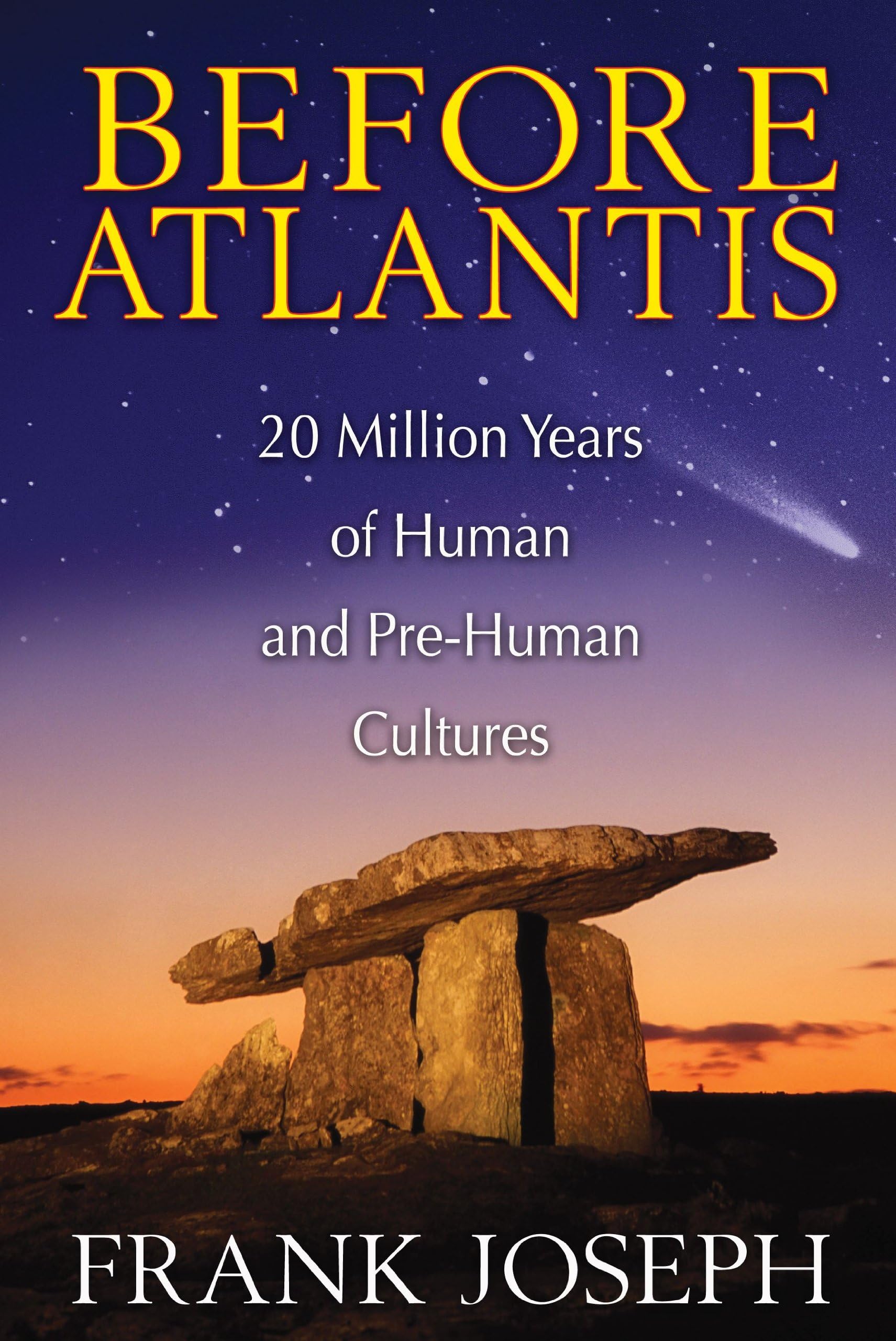
Before Atlantis: 20 Million Years of Human and Pre-Human Cultures
Product ID: 2743693
Buy anything from 5,000+ international stores. One checkout price. No surprise fees. Join 2M+ shoppers on Desertcart.
Desertcart purchases this item on your behalf and handles shipping, customs, and support to Vanuatu.
Before Atlantis: 20 Million Years of Human and Pre-Human Cultures [Joseph, Frank] on desertcart.com. *FREE* shipping on qualifying offers. Before Atlantis: 20 Million Years of Human and Pre-Human Cultures Review: Not Perfect but a Serious Effort! - I really enjoyed the author's efforts to look at a wide body of evidence from global sites, group these findings by era, and propose possibilities that remain clearly earth (and ocean) bound. There may be errors in dating or grouping, but it is a joy to see a presentation which accepts that hominids throughout time may have been ingenious, resourceful, thinking and thoughtful. The author is neither so full of hubris nor so wildly speculative as to propose anything done with technologies WE have not discovered or understood `must be attributed to extraterrestrials!' REALLY??? If Joseph makes leaps of logic (and he does) at least they are (earth)bounded. He suggests that homo sapiens sapiens might not have been the sole intelligent branch of hominid. Other branches may have evolved to highly advanced forms and developed civilized societies before meeting catastrophic ends, which thereby directed, contributed to or limited us along our singular route. Since the writing of this text, new discoveries contribute evidences to Joseph's catalogue. For example, studies suggest that Neanderthals may have been more intellectually and aesthetically inclined than previously thought. There may have been more interbreeding of Neanderthals with Homo sapiens sapiens than previously assumed. Additional sites of stone spheres in desertcartia propose astro-calender purposes for these spheres, and tests done in Europe support that some might have served as `ball bearings' useful in moving large stones. A `stonehenge' formation has recently been `found' beneath the waters of the Sea of Galilee. Evidence of an alleged 'Bosnia pyramid complex' contributes weight to Joseph's outline of historic civilizations. These findings and others continue to fill holes in the webs of data Joseph outlines. Now, I would like to see more cross-disciplinary grids laid atop this web. How might further and more in-depth evolutionary cataloguing of languages, examinations of world myths, geological evidences, and biological (DNA) data contribute to the reordering, affirmation, extension, or refutation of historic intellectual and cultural evolution laid out by Joseph. His proposals are not perfect - but a credible effort has been made to make sense of ancient artifacts without resorting to annoyingly illogical "alien theories' or pseudoscientific fads. A truly enjoyable summer read. Thanks! Review: well written but controversial - Let me begin by saying that this book is well organized and well written. It covers a great many topics, some more interesting than others. I found the chapters on the "aquatic ape theory" to be fascinating and, perhaps, useful in understanding diet and nutrition from a different perspective. Perhaps the people of Japan and Okinawa (for example) live healthier lives than Europeans and Americans because of their seafood and seaweed consumption. The discussion of the Mount Toba eruption of ca. 75,000 years ago is informative, suggesting that we humans benefitted as mammals due to the eruption. Joseph's theories of what happened after the eruption, such as the emergence of Mu and Lemuria are, however, pure speculation and a bit hard to follow. I am not sure that Joseph has his dates correct in tracing human evolution from Homo erectus onward, as I have seen different dates in other writings. Three of the major themes of this book are: (1) members of the Solutrean culture of Europe made their way to both North America and to the proposed island of Atlantis around 20,000 BC or later; (2) the island of Atlantis was settled by mariners from Western Europe (builders of megalithic monuments) around 3814 BC, but Atlantis was destroyed in 1198 BC; and, (3) some meglalithic peoples of northern Europe made their way to North America, as the Beothuk people ("red paint people"), and these people (or related ones?) were responsible for all the megalithic structures (including stone circles) that have been found throughout the Americas and the Pacific. I do not find the Solutrean theory (as it applies to North America) to be terribly controversial or unreasonable. However, there are problems with Joseph's treatment of the second and third themes listed above. The whole chronology that Joseph ascribes to Atlantis is problematic, because the Plato story of Atlantis was supposed to have taken place about 10,000 years before Plato's time. IF Atlantis existed as an island in the Atlantic (after being connected, originally, to Africa by a landbridge), then it is difficult to understand how this island could have been destroyed (sunk) around 1198 BC. If one looks at a chart showing the sea level from ca. 6000 BC onward (such as in Oppenheimer's "Eden in the East"--a book which Joseph refers to on several occasions), it appears that the ocean was HIGHER in 3814 BC than it was in 1198 BC. This means that Atlantis would have grown larger during this period; and there would not have been any rise in sea level around 1198 to cause the island to "sink" naturally. Surely, the island and its remains would still be around for modern man to discover. Joseph's explanation for why he chose 1198 BC as the date of Atlantis' demise is rather bizarre. He claims that the Egyptian priests who translated the Atlantean story for Solon used a LUNAR calendar, and that the resulting date for the destruction of Atlantis was around 1200 BC. This seems difficult to accept. (I, for one, view the Atlantis story as nothing more than an allegory, so do not worry about putting it into a specific time period, despite Plato's dating.) The whole idea of a SINGLE megalithic culture propogating around the world and coming to an end around 1198 BC (with the destruction of Atlantis), is too difficult for me to accept. Historians and archaeologists have dated most of the megalithic sites of the Americas (such as New England, San Agustin [Colombia], the Incan structures, etc.), of the Pacific (eg., Easter Island, the Marquesas Islands, Tahiti, Micronesia, Vanuatu, etc.), and of Indonesia, Malaysia, and Madagascar to the AD period. Of course, it is difficult to date stone structures, but at least one of the American sites--San Agustin--has been dated to after 400 AD because the megalithic structures were built on top of datable middens. I am confident that most of the American, Pacific, Indonesian, and African megaliths date to a time well after 1198 BC. Having said enough, I will let the reader form his/her own opinions on the merits and problems of this interesting book.
| Best Sellers Rank | #533,326 in Books ( See Top 100 in Books ) #112 in Prehistory #724 in Mysticism (Books) #1,081 in Unexplained Mysteries (Books) |
| Customer Reviews | 4.4 4.4 out of 5 stars (249) |
| Dimensions | 6 x 0.9 x 9 inches |
| Edition | Illustrated |
| ISBN-10 | 1591431573 |
| ISBN-13 | 978-1591431572 |
| Item Weight | 1.18 pounds |
| Language | English |
| Print length | 336 pages |
| Publication date | March 24, 2013 |
| Publisher | Bear & Company |
A**R
Not Perfect but a Serious Effort!
I really enjoyed the author's efforts to look at a wide body of evidence from global sites, group these findings by era, and propose possibilities that remain clearly earth (and ocean) bound. There may be errors in dating or grouping, but it is a joy to see a presentation which accepts that hominids throughout time may have been ingenious, resourceful, thinking and thoughtful. The author is neither so full of hubris nor so wildly speculative as to propose anything done with technologies WE have not discovered or understood `must be attributed to extraterrestrials!' REALLY??? If Joseph makes leaps of logic (and he does) at least they are (earth)bounded. He suggests that homo sapiens sapiens might not have been the sole intelligent branch of hominid. Other branches may have evolved to highly advanced forms and developed civilized societies before meeting catastrophic ends, which thereby directed, contributed to or limited us along our singular route. Since the writing of this text, new discoveries contribute evidences to Joseph's catalogue. For example, studies suggest that Neanderthals may have been more intellectually and aesthetically inclined than previously thought. There may have been more interbreeding of Neanderthals with Homo sapiens sapiens than previously assumed. Additional sites of stone spheres in Amazonia propose astro-calender purposes for these spheres, and tests done in Europe support that some might have served as `ball bearings' useful in moving large stones. A `stonehenge' formation has recently been `found' beneath the waters of the Sea of Galilee. Evidence of an alleged 'Bosnia pyramid complex' contributes weight to Joseph's outline of historic civilizations. These findings and others continue to fill holes in the webs of data Joseph outlines. Now, I would like to see more cross-disciplinary grids laid atop this web. How might further and more in-depth evolutionary cataloguing of languages, examinations of world myths, geological evidences, and biological (DNA) data contribute to the reordering, affirmation, extension, or refutation of historic intellectual and cultural evolution laid out by Joseph. His proposals are not perfect - but a credible effort has been made to make sense of ancient artifacts without resorting to annoyingly illogical "alien theories' or pseudoscientific fads. A truly enjoyable summer read. Thanks!
M**K
well written but controversial
Let me begin by saying that this book is well organized and well written. It covers a great many topics, some more interesting than others. I found the chapters on the "aquatic ape theory" to be fascinating and, perhaps, useful in understanding diet and nutrition from a different perspective. Perhaps the people of Japan and Okinawa (for example) live healthier lives than Europeans and Americans because of their seafood and seaweed consumption. The discussion of the Mount Toba eruption of ca. 75,000 years ago is informative, suggesting that we humans benefitted as mammals due to the eruption. Joseph's theories of what happened after the eruption, such as the emergence of Mu and Lemuria are, however, pure speculation and a bit hard to follow. I am not sure that Joseph has his dates correct in tracing human evolution from Homo erectus onward, as I have seen different dates in other writings. Three of the major themes of this book are: (1) members of the Solutrean culture of Europe made their way to both North America and to the proposed island of Atlantis around 20,000 BC or later; (2) the island of Atlantis was settled by mariners from Western Europe (builders of megalithic monuments) around 3814 BC, but Atlantis was destroyed in 1198 BC; and, (3) some meglalithic peoples of northern Europe made their way to North America, as the Beothuk people ("red paint people"), and these people (or related ones?) were responsible for all the megalithic structures (including stone circles) that have been found throughout the Americas and the Pacific. I do not find the Solutrean theory (as it applies to North America) to be terribly controversial or unreasonable. However, there are problems with Joseph's treatment of the second and third themes listed above. The whole chronology that Joseph ascribes to Atlantis is problematic, because the Plato story of Atlantis was supposed to have taken place about 10,000 years before Plato's time. IF Atlantis existed as an island in the Atlantic (after being connected, originally, to Africa by a landbridge), then it is difficult to understand how this island could have been destroyed (sunk) around 1198 BC. If one looks at a chart showing the sea level from ca. 6000 BC onward (such as in Oppenheimer's "Eden in the East"--a book which Joseph refers to on several occasions), it appears that the ocean was HIGHER in 3814 BC than it was in 1198 BC. This means that Atlantis would have grown larger during this period; and there would not have been any rise in sea level around 1198 to cause the island to "sink" naturally. Surely, the island and its remains would still be around for modern man to discover. Joseph's explanation for why he chose 1198 BC as the date of Atlantis' demise is rather bizarre. He claims that the Egyptian priests who translated the Atlantean story for Solon used a LUNAR calendar, and that the resulting date for the destruction of Atlantis was around 1200 BC. This seems difficult to accept. (I, for one, view the Atlantis story as nothing more than an allegory, so do not worry about putting it into a specific time period, despite Plato's dating.) The whole idea of a SINGLE megalithic culture propogating around the world and coming to an end around 1198 BC (with the destruction of Atlantis), is too difficult for me to accept. Historians and archaeologists have dated most of the megalithic sites of the Americas (such as New England, San Agustin [Colombia], the Incan structures, etc.), of the Pacific (eg., Easter Island, the Marquesas Islands, Tahiti, Micronesia, Vanuatu, etc.), and of Indonesia, Malaysia, and Madagascar to the AD period. Of course, it is difficult to date stone structures, but at least one of the American sites--San Agustin--has been dated to after 400 AD because the megalithic structures were built on top of datable middens. I am confident that most of the American, Pacific, Indonesian, and African megaliths date to a time well after 1198 BC. Having said enough, I will let the reader form his/her own opinions on the merits and problems of this interesting book.
M**N
EYE OPENING AND REVEALING
A very well-researched and profoundly interesting work by an eminent alternative researcher and open-minded thinker on our ancient past. One of this books most interesting sections concerns the Aquatic Ape Hypothesis. Frank succinctly summarizes the thesis and how it makes more sense of our ancestry than official dogmas such as Darwinism. Another fascinating section concerns the true purpose of Europe's many fascinating megalithic structures - menhirs, dolmens, stone circles and other cyclopean ruins. Frank summarizes the findings of geologist Paul McCartney which casts new light on this subject, verifying the sophistication of our predecessors, and devastating the narrow beliefs of modern dogmatic academics arrogantly dismissive of the ancient past. Having studied megalithic sites in the field myself, this information was new to me, and very eye-opening. There are many other interesting sections of this brilliant book distinguished by offering a great many proofs for scientifically minded logical readers interested in alternative subjects. I recommend all of Frank's works.
F**N
Muy buen libro para conocer las civilizaciones antiguas y que desaparecieron. Muy interesante
S**1
T.E. LEE, WARREN KING MOOREHEAD, MARCELINO SANZ DE SAUTUOLA, VIRGINIA STEEN-McINTYRE, and all those martyrs of discovery whose professional careers were destroyed by their mainstream colleagues for daring to challenge prevailing academic dogma with facts later proved correct. I have just finished reading this book so every thing is still fresh in my mind, I have never read a book like it or the topics it covers, this has to be the best book I have ever read in my life, it covers topics on aquatic phases, stone age sophistication, older than Sphinx or Pyramid, stone age Astronomers in America, 17 chapters in all, get this book before it goes out of print with P&P I paid less than £10 for a brand new book
B**L
Joseph did a brilliant job by including information here because he included countries that never get a mention in this context. I loved the bits on New Guinea. I have read all the well known authors on the subject of alternative views on ancient civilisations and Joseph really is the one and only author that has taken the extra steps to explore the far off places. Thanks Frank. I grew up in New Guinea and now I finally have something to go and explore one day.
F**N
Excellent book revealing how ignorant our historians are. Well the world was thought to be flat so I suppose this is the process to spread the truth about our reality. He argues how we have adapted originally from the sea. He shows how there are thousands of stone circles and the like al over the world which is not a common knowledge yet! Well truthers have tried spreading the truth in the past and they have been vilified by their ignorant peers. Probably all related to the secret societies that have caused and benefitted from imperialism and major wars in the last hundred years or so. Probably leads to the watchers, see Gary Wayne, another truther.
A**R
very interesting, it does explain many things not tell in school or otherwise.
Trustpilot
2 months ago
5 days ago