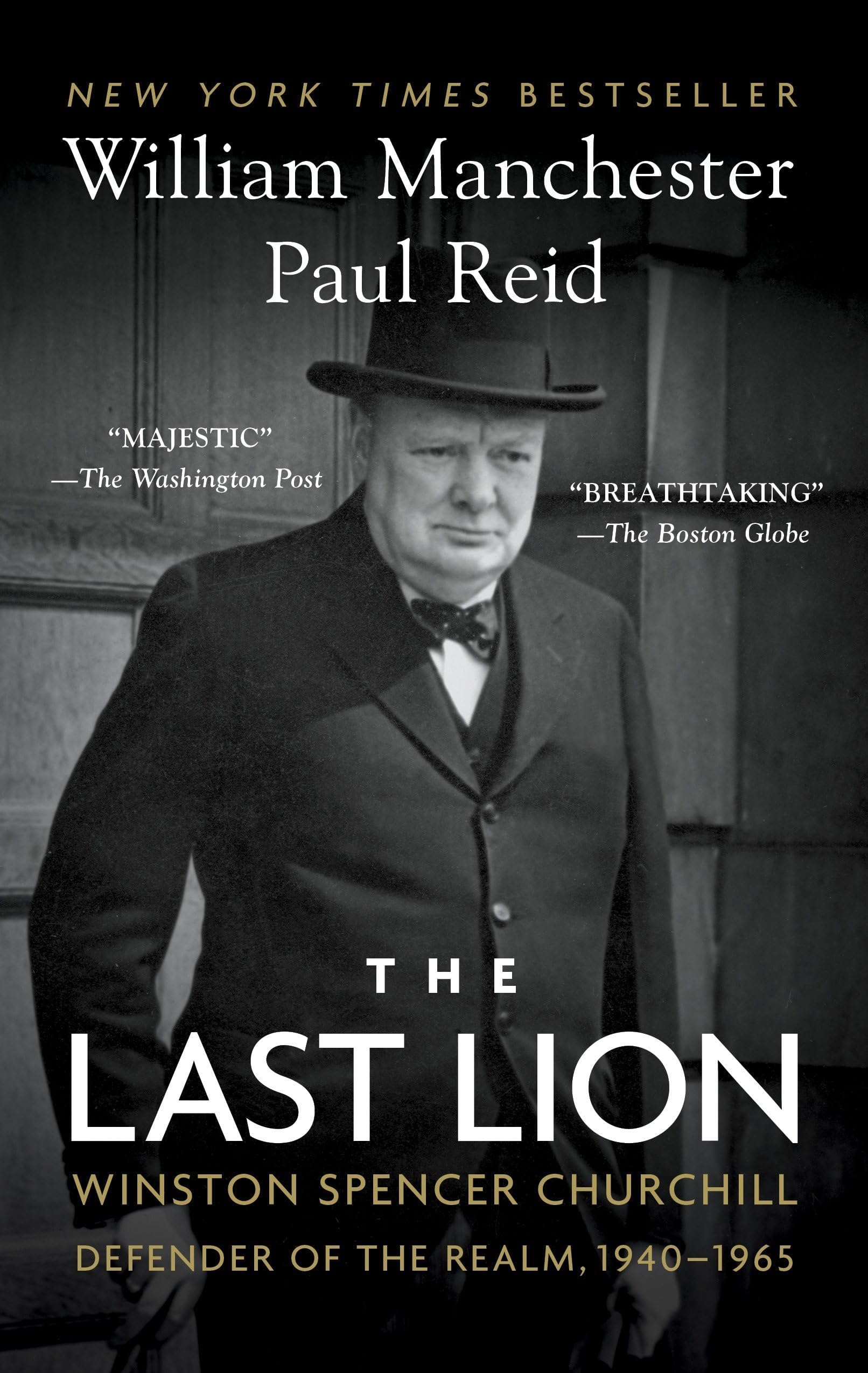
The Last Lion: Winston Spencer Churchill: Defender of the Realm, 1940-1965
Product ID: 316005
Buy anything from 5,000+ international stores. One checkout price. No surprise fees. Join 2M+ shoppers on Desertcart.
Desertcart purchases this item on your behalf and handles shipping, customs, and support to Vanuatu.
Spanning the years 1940 to 1965, The Last Lion: Defender of the Realm begins shortly after Winston Churchill became prime minister—when Great Britain stood alone against the overwhelming might of Nazi Germany. In brilliant prose and informed by decades of research, William Manchester and Paul Reid recount how Churchill organized his nation’s military response and defense, convinced FDR to support the cause, and personified the “never surrender” ethos that helped win the war. We witness Churchill, driven from office, warning the world of the coming Soviet menace. And after his triumphant return to 10 Downing Street, we follow him as he pursues his final policy goal: a summit with President Dwight Eisenhower and Soviet leaders. And in the end, we experience Churchill’s last years, when he faces the end of his life with the same courage he brought to every battle he ever fought. NAMED ONE OF THE BEST BOOKS OF THE YEAR BY The Wall Street Journal • The Daily Beast • St. Louis Post-Dispatch • The Daytona Beach News-Journal • Kirkus Reviews • Booklist “Majestic . . . This book is superb. It has tremendous pace, rich detail and immense drama.” — The Washington Post “Masterful . . . The collaboration completes the Churchill portrait in a seamless manner, combining the detailed research, sharp analysis and sparkling prose that readers of the first two volumes have come to expect.” —Associated Press “Matches the outstanding quality of biographers such as Robert Caro and Edmund Morris, joining this elite bank of writers who devote their lives to one subject.” —Publishers Weekly (starred review) “Breathtaking . . . brilliant and beautiful, evocative.” —The Boston Globe “A must-read finale for those who loved Manchester’s first two books.” —USA Today “The final volume is . . . majestic and inspiring.” — People “One of the most thorough treatments of Churchill so far produced.” — Library Journal (starred review) Review: A Thorough Conclusion to a Great Biography - William Manchester, and his appointed successor Paul Reid, have successfully and thoroughly concluded the life story of the greatest British statesman of the 20th century, and one of, if not the foremost statesman of the Second World War. In spite of several reviews that diminish the work because Paul Reid took over from William Manchester, and the contention was that Reid was not as good a writer, I have to take exception to the charge. I could not tell where Manchester left off and Reid began. The writing is excellent, and yes, there is a world of information, especially about the war, but in all fairness to Reid, he had to cover this ground thoroughly because it was such an important part of the long and productive life of Churchill. Having read a good deal of the war and Churchill, I still found many things of interest in this book. One good example is the excellent information on the Battle of Britain, when England stood alone in the face of the Nazi menace. We all know of the long odds against the British and their bravery in fighting off the Luftwaffe during this critical time, but the book introduces us to the British Air Chief Marshall Sir Hugh Dowding. Mostly disliked by the people around him, and essentric in his own British way, it was Dowding that was the champion of radar as far back as 1937 when he ordered work to begin along the eastern and southern coasts with a chain of stations, some of which were low-level with ranges of 50 miles and the others, high-level with a range of 120 miles. This enabled the British to detect German squadrons in many cases before they entered the English Channel. It was this radar that helped them to scramble fighters to meet the menace as it approached the island. COnsidering that Dowding in July, 1940 had eight hundred single engine aircraft to hold off a much larger force, it was in a sense, a miracle for Britain. The German Second and Third Air Fleets were comprised of 750 bombers, 250 Stuka dive bombers, 600 Bf109 fighters and 250 twin Bf110 fighters, but Dowding placed the emphasis on knocking out the bombers and not getting into dog fights with the fighter escort. Goring tried to keep up appearances and lied about the results, but the German strategy was changing. And, even though they knew the location of the two factories that Rolls Royce used to build the Merlin engines, they never bombed these facilities. By September, Hitler elected to concentrate on London and bomb the British to the peace tables. That did not work out well for Adolph. Another important person in all of this was Lord Beaverbrook, who worked in producing the aircraft needed to fight this air battle. In July, 1940, British workers produced 496 fighter planes, which was an astounding accomplishment. In addition, Beaverbrook's Civilian Repair Organization was busy salvaging parts from fighters shot down over England and in some instances, were able to resurrect German planes that would next fly as a RAF craft. It is without a doubt that 1940 was Winston's best year, although in many ways the darkest for England. They stood alone. France had fallen, Europe was a Nazi land mass, Hitler and Stalin were beginning their workings toward an alliance, and America stood away from the fight largely because of the isolationist movement and FDR's firm decision not to let his political foes take him down for getting America involved in the war. And while the RAF had performed splendidly in the air, the evacuations from Dunkirk were still fresh in everyone's mind and England was in a sense, a nation with a moat around it awaiting landing barges to finish them off. In a large sense, it was Churchill's determination that led England during this dark time, and yet, Churchill's big problem was that he knew he could not challenge Hitler on the continent, and thus tried to snipe at him in other areas, which largely centered throughout the Mediterranean Sea. For a time, North Africa enjoyed some success, and then Rommel appeared and the British were once more in flight, and add to this the humiliating surrender of Sinapore in the Pacific, and greatly in need of a victory. Churchill began to draw criticism because of the lack of victory, and then Montgomery gave him a sound victory over Rommel at El Alamein and this got the monkey off of Churchill's back. Finally, by the end of 1941, America was in the mix and the English were no longer alone. By June of 1942, Hitler had invaded Russia and the Allied effort, while still recoiling from defeats, at least had the potential to break the enemy's back. There is a great deal of information about the war and especially the workings between American and England. Both Eisenhower and Marshall favored an invasion in France, while Churchill looked to menace the Germans along the periphery, thus the invasion into North Africa (Torch) and the later invasion on the south of France (Anvil, later renamed Dragoon). As during the first war, Churchill's designs as in the Dardanelles, was to go around instead of directly at. The American logic was simple: cut to the chase, go the shortest route and kill the beast. The American version won the day, certainly at the urging of Stalin, who was losing in civilian and military casualities, 10,000 people per day (YES PER DAY), and had no sympathy for what might turn into a high kill rate. England was very deadly in their night bombings of German cities (especially Hamburg and Berlin)but that was not impressing Stalin, who continued to demand more, and quite rudely. Churchill had to contend not only with Uncle Joe's bad manners but also FDR's vision of a world after the war where Britain played a lesser part. Much of this story shows, as it should, how events unfolded during the war, and how Britain and Churchill began to be overruled by Stalin and Russia. In effect, this war broke England and WSC was faced with the grim knowledge that after the killing was over, England would no longer be a first rate world power. It was certainly not the role that Winston wanted to play, but the inevitability of losing most of the empire was there, and FDR was probably the most heartless in his desire to see that England was no longer a colonial power. The books shows us a large support cast. Of interest was Winston's only son, Randolph. Randolph was just not a happy man, and while his father loved him, he was a contrary person. His sister Mary later wrote that he could pick a quarrel with a chair. He married the beautiful Pamela Digby who ditched him for Averill Harriman. I hate to be ugly, but he looks like Clementine in drag to me. Overall, I think this is a fine conclusion to the story of one of the most interesting people in the history of our modern world. As the author/s points out, you would likely have to go back 400 hundred years to the reign of Elizabeth I to find the strength of character of such a leader of the British people. I very much recommend this book to anyone interested in Churchill. Review: Defender of the Realm - Highest Recommendation ! - William Manchester's third volume biography of Winston Spencer Churchill (WSC) Defender of the Realm 1940-1965 is based on his notes and assisted by journalist Paul Reid is a worthy addition and completes the 3 volume epic story of the life and history of WSC who along with FDR and Stalin led the Allies to victory against the Axis in WW II. It is an amazing story. This is a continuation of Manchester's earlier works The Last Lion: Vision of Glory 1874-1932 and The Last Lion: Alone, 1932-1940 and completes the story. William Manchester met WSC on a cruise from Britain to America in the 1950's and dedicated his life to capturing all the most salient aspects of the man many consider the person who saved Britain and for that matter Western Christian Civilization when it was at its most dire crisis in the 1939 - 1942 period. This is monumental work, well crafted and reads well. There appears to be no break in the prose style from Volume I thru Volume III which suggests that Mr. Reid studied Manchester's style and rythm to capture his writing method flawlessly. Not easy to do. Manchester had wrote another great biography on General Douglas MacAuthur, American Ceasar published in 1976 which is widely accepted as the definitive work of this 5 star American general who saved South Korea from conquest and slavery by the communist forces of Kim Il Sung in 1950 when he proposed and persuaded the General Staff to accept the plan of the Inchon landing instead of abandoning the mainland as most American generals and policy makers thought was the best and only course of action. This roughly 3000 page work of Vol I thru III will be seen as the same for WSC in the decades to come. There are no similar works that read as well as this. None that even come close to this quality reading and I have read quite a few WSC biographies and his books (he wrote roughly 50). I first became a Churchill fan when I was working in Lagos, Nigeria as an oil field expatriate in 1980 and there in the airport book store was Winston's autobiography "My Early Life". Nigeria being a former British Colony had a fair amount of symbols and artifacts of the British Empire even then. He wrote it in the 1920's when he was in his early fifties. If you really want to understand WSC you need to read this work because it shows how incredible lucky he was and how he had one heck of a guardian angel who spared him time and again for greater glory later in life. He was in four wars by the time he was 25 including the last calvary charge of the British Empire in the Sudan in 1898. However I digress........back to the last volume of Manchester's work which after decades of being discussed and was thought dead because Manchester had a stroke was thought not able to finish it has now been published finally in the Year of our Lord 2012. This volume begins with the invasion of France by the Germans in May of 1940. The Western allies of Belgium, France and Britain are in a defensive mode and seemingly in a strong position behind the Maginot Line. The allies are confident they are ready mainly; well, because they have more of everything except perhaps aircraft than Germany. They are thinking in WW I terms and this will cost them the Battle of France. Winston has just been appointed Prime Minister on May 10 which is the position he has assiduously sought most of his adult life and when he finally gets hold of the reigns of power it is a complete nightmare. As the Battle of France begins all seems well; but the Germans have a suprise in store for them. It is Manstein's and Guderian's plan (Case Yellow) to fake the main thrust thru Holland in a flanking attack thru the low lands. This is what Ally intelligence predicts Germany will do. Instead the Germans put their strongest attack force with most of the panzers in the Ardennes which is deemed nearly impenetrable. Besides the massive thick woods there is the barrier of the large fast-flowing Meuse river to stop any breakthrough. Everything looks well thru the eyes of the Allies that they are ready for any sort of attack. The Germans though have seen the future and realize that if they can catch the allies unawares and use a secret weapon and better tactics they can break the allies in two. So they fake with a strong attack thru Holland (Army Group B) making it appear to be the main thrust and while the allies surge there they cut thru the Ardennes (Army Group A) to reach the Meuse River which appears to be strongly defended. It is not. The secret weapon is the 88MM gun - a high velocity gun that can penetrate thick concrete gun houses and the defending tanks situated on the opposite side of the river. The Germans use their engineers to quickly build pontoon bridges. Stuka dive bombers are also used to destroy French tanks surging to stop the crossing. The Wermarcht know to mass their panzers while the ally tanks are mostly scattered - another big Ally mistake. The allies are pushed back and scattered from the Meuse, the Wermarcht pours through and panic ensues as the panzers speed towards the Atlantic coast. Fuel needed for the panzers is obtained from French petrol stations. For perhaps 48 hours the Allies have no idea what has happened as they are still focused on Army Group B where they are convinced the main fighting is taking place such is the confusion at the top levels. This is the dire situation that greets WSC in his beginning weeks as the PM in this Vol III. All hell has broken lose and his formidable ally - France has just received a mortal wound and the ally Belgium capitulates. According to WSC later in life he says that one of the biggest shocks of his life was after learning of the German breakthrough thru the Ardennes and the subsequent race to the channel by the same - He asked the French Military Leaders where their major reserves were to counter this breakthough. He was told that there was no such reserve forces to stop the panzers. All of this and more are covered in this wonderful book that has finally been released which covers the years 1940-1965 of the The Last Lion. Highest recommendation; you will not be disappointed. Strongly suggest you buy all three volumes of Manchester's epic historical work and also buy WSC's History of the English Speaking Peoples which won the Pulitzer prize in 1956 and which took WSC 20 years to write when he wasn't leading the British Commonwealth forces against the Axis forces. If there is something that WSC provides as a gift to future generations is that people should study history. Like historian Will Durant, WSC being the prolific student of history came to realize that history keeps repeating itself and that the more he studied history and the further he saw in the past; the further into the future he could see. This is most profound and is something that most people don't understand; WSC came to realize this gradually thru his study of history. That was WSC's special gift - the ability to see the future based on what he knew from the past because he studied it. He wasn't always right and he made many errors but he kept coming back into the arena and he was right on the major issues in defense of his people.

| Best Sellers Rank | #66,975 in Books ( See Top 100 in Books ) #2 in U.K. Prime Minister Biographies #190 in Political Leader Biographies #225 in World War II History (Books) |
| Customer Reviews | 4.7 out of 5 stars 2,563 Reviews |
P**L
A Thorough Conclusion to a Great Biography
William Manchester, and his appointed successor Paul Reid, have successfully and thoroughly concluded the life story of the greatest British statesman of the 20th century, and one of, if not the foremost statesman of the Second World War. In spite of several reviews that diminish the work because Paul Reid took over from William Manchester, and the contention was that Reid was not as good a writer, I have to take exception to the charge. I could not tell where Manchester left off and Reid began. The writing is excellent, and yes, there is a world of information, especially about the war, but in all fairness to Reid, he had to cover this ground thoroughly because it was such an important part of the long and productive life of Churchill. Having read a good deal of the war and Churchill, I still found many things of interest in this book. One good example is the excellent information on the Battle of Britain, when England stood alone in the face of the Nazi menace. We all know of the long odds against the British and their bravery in fighting off the Luftwaffe during this critical time, but the book introduces us to the British Air Chief Marshall Sir Hugh Dowding. Mostly disliked by the people around him, and essentric in his own British way, it was Dowding that was the champion of radar as far back as 1937 when he ordered work to begin along the eastern and southern coasts with a chain of stations, some of which were low-level with ranges of 50 miles and the others, high-level with a range of 120 miles. This enabled the British to detect German squadrons in many cases before they entered the English Channel. It was this radar that helped them to scramble fighters to meet the menace as it approached the island. COnsidering that Dowding in July, 1940 had eight hundred single engine aircraft to hold off a much larger force, it was in a sense, a miracle for Britain. The German Second and Third Air Fleets were comprised of 750 bombers, 250 Stuka dive bombers, 600 Bf109 fighters and 250 twin Bf110 fighters, but Dowding placed the emphasis on knocking out the bombers and not getting into dog fights with the fighter escort. Goring tried to keep up appearances and lied about the results, but the German strategy was changing. And, even though they knew the location of the two factories that Rolls Royce used to build the Merlin engines, they never bombed these facilities. By September, Hitler elected to concentrate on London and bomb the British to the peace tables. That did not work out well for Adolph. Another important person in all of this was Lord Beaverbrook, who worked in producing the aircraft needed to fight this air battle. In July, 1940, British workers produced 496 fighter planes, which was an astounding accomplishment. In addition, Beaverbrook's Civilian Repair Organization was busy salvaging parts from fighters shot down over England and in some instances, were able to resurrect German planes that would next fly as a RAF craft. It is without a doubt that 1940 was Winston's best year, although in many ways the darkest for England. They stood alone. France had fallen, Europe was a Nazi land mass, Hitler and Stalin were beginning their workings toward an alliance, and America stood away from the fight largely because of the isolationist movement and FDR's firm decision not to let his political foes take him down for getting America involved in the war. And while the RAF had performed splendidly in the air, the evacuations from Dunkirk were still fresh in everyone's mind and England was in a sense, a nation with a moat around it awaiting landing barges to finish them off. In a large sense, it was Churchill's determination that led England during this dark time, and yet, Churchill's big problem was that he knew he could not challenge Hitler on the continent, and thus tried to snipe at him in other areas, which largely centered throughout the Mediterranean Sea. For a time, North Africa enjoyed some success, and then Rommel appeared and the British were once more in flight, and add to this the humiliating surrender of Sinapore in the Pacific, and greatly in need of a victory. Churchill began to draw criticism because of the lack of victory, and then Montgomery gave him a sound victory over Rommel at El Alamein and this got the monkey off of Churchill's back. Finally, by the end of 1941, America was in the mix and the English were no longer alone. By June of 1942, Hitler had invaded Russia and the Allied effort, while still recoiling from defeats, at least had the potential to break the enemy's back. There is a great deal of information about the war and especially the workings between American and England. Both Eisenhower and Marshall favored an invasion in France, while Churchill looked to menace the Germans along the periphery, thus the invasion into North Africa (Torch) and the later invasion on the south of France (Anvil, later renamed Dragoon). As during the first war, Churchill's designs as in the Dardanelles, was to go around instead of directly at. The American logic was simple: cut to the chase, go the shortest route and kill the beast. The American version won the day, certainly at the urging of Stalin, who was losing in civilian and military casualities, 10,000 people per day (YES PER DAY), and had no sympathy for what might turn into a high kill rate. England was very deadly in their night bombings of German cities (especially Hamburg and Berlin)but that was not impressing Stalin, who continued to demand more, and quite rudely. Churchill had to contend not only with Uncle Joe's bad manners but also FDR's vision of a world after the war where Britain played a lesser part. Much of this story shows, as it should, how events unfolded during the war, and how Britain and Churchill began to be overruled by Stalin and Russia. In effect, this war broke England and WSC was faced with the grim knowledge that after the killing was over, England would no longer be a first rate world power. It was certainly not the role that Winston wanted to play, but the inevitability of losing most of the empire was there, and FDR was probably the most heartless in his desire to see that England was no longer a colonial power. The books shows us a large support cast. Of interest was Winston's only son, Randolph. Randolph was just not a happy man, and while his father loved him, he was a contrary person. His sister Mary later wrote that he could pick a quarrel with a chair. He married the beautiful Pamela Digby who ditched him for Averill Harriman. I hate to be ugly, but he looks like Clementine in drag to me. Overall, I think this is a fine conclusion to the story of one of the most interesting people in the history of our modern world. As the author/s points out, you would likely have to go back 400 hundred years to the reign of Elizabeth I to find the strength of character of such a leader of the British people. I very much recommend this book to anyone interested in Churchill.
E**H
Defender of the Realm - Highest Recommendation !
William Manchester's third volume biography of Winston Spencer Churchill (WSC) Defender of the Realm 1940-1965 is based on his notes and assisted by journalist Paul Reid is a worthy addition and completes the 3 volume epic story of the life and history of WSC who along with FDR and Stalin led the Allies to victory against the Axis in WW II. It is an amazing story. This is a continuation of Manchester's earlier works The Last Lion: Vision of Glory 1874-1932 and The Last Lion: Alone, 1932-1940 and completes the story. William Manchester met WSC on a cruise from Britain to America in the 1950's and dedicated his life to capturing all the most salient aspects of the man many consider the person who saved Britain and for that matter Western Christian Civilization when it was at its most dire crisis in the 1939 - 1942 period. This is monumental work, well crafted and reads well. There appears to be no break in the prose style from Volume I thru Volume III which suggests that Mr. Reid studied Manchester's style and rythm to capture his writing method flawlessly. Not easy to do. Manchester had wrote another great biography on General Douglas MacAuthur, American Ceasar published in 1976 which is widely accepted as the definitive work of this 5 star American general who saved South Korea from conquest and slavery by the communist forces of Kim Il Sung in 1950 when he proposed and persuaded the General Staff to accept the plan of the Inchon landing instead of abandoning the mainland as most American generals and policy makers thought was the best and only course of action. This roughly 3000 page work of Vol I thru III will be seen as the same for WSC in the decades to come. There are no similar works that read as well as this. None that even come close to this quality reading and I have read quite a few WSC biographies and his books (he wrote roughly 50). I first became a Churchill fan when I was working in Lagos, Nigeria as an oil field expatriate in 1980 and there in the airport book store was Winston's autobiography "My Early Life". Nigeria being a former British Colony had a fair amount of symbols and artifacts of the British Empire even then. He wrote it in the 1920's when he was in his early fifties. If you really want to understand WSC you need to read this work because it shows how incredible lucky he was and how he had one heck of a guardian angel who spared him time and again for greater glory later in life. He was in four wars by the time he was 25 including the last calvary charge of the British Empire in the Sudan in 1898. However I digress........back to the last volume of Manchester's work which after decades of being discussed and was thought dead because Manchester had a stroke was thought not able to finish it has now been published finally in the Year of our Lord 2012. This volume begins with the invasion of France by the Germans in May of 1940. The Western allies of Belgium, France and Britain are in a defensive mode and seemingly in a strong position behind the Maginot Line. The allies are confident they are ready mainly; well, because they have more of everything except perhaps aircraft than Germany. They are thinking in WW I terms and this will cost them the Battle of France. Winston has just been appointed Prime Minister on May 10 which is the position he has assiduously sought most of his adult life and when he finally gets hold of the reigns of power it is a complete nightmare. As the Battle of France begins all seems well; but the Germans have a suprise in store for them. It is Manstein's and Guderian's plan (Case Yellow) to fake the main thrust thru Holland in a flanking attack thru the low lands. This is what Ally intelligence predicts Germany will do. Instead the Germans put their strongest attack force with most of the panzers in the Ardennes which is deemed nearly impenetrable. Besides the massive thick woods there is the barrier of the large fast-flowing Meuse river to stop any breakthrough. Everything looks well thru the eyes of the Allies that they are ready for any sort of attack. The Germans though have seen the future and realize that if they can catch the allies unawares and use a secret weapon and better tactics they can break the allies in two. So they fake with a strong attack thru Holland (Army Group B) making it appear to be the main thrust and while the allies surge there they cut thru the Ardennes (Army Group A) to reach the Meuse River which appears to be strongly defended. It is not. The secret weapon is the 88MM gun - a high velocity gun that can penetrate thick concrete gun houses and the defending tanks situated on the opposite side of the river. The Germans use their engineers to quickly build pontoon bridges. Stuka dive bombers are also used to destroy French tanks surging to stop the crossing. The Wermarcht know to mass their panzers while the ally tanks are mostly scattered - another big Ally mistake. The allies are pushed back and scattered from the Meuse, the Wermarcht pours through and panic ensues as the panzers speed towards the Atlantic coast. Fuel needed for the panzers is obtained from French petrol stations. For perhaps 48 hours the Allies have no idea what has happened as they are still focused on Army Group B where they are convinced the main fighting is taking place such is the confusion at the top levels. This is the dire situation that greets WSC in his beginning weeks as the PM in this Vol III. All hell has broken lose and his formidable ally - France has just received a mortal wound and the ally Belgium capitulates. According to WSC later in life he says that one of the biggest shocks of his life was after learning of the German breakthrough thru the Ardennes and the subsequent race to the channel by the same - He asked the French Military Leaders where their major reserves were to counter this breakthough. He was told that there was no such reserve forces to stop the panzers. All of this and more are covered in this wonderful book that has finally been released which covers the years 1940-1965 of the The Last Lion. Highest recommendation; you will not be disappointed. Strongly suggest you buy all three volumes of Manchester's epic historical work and also buy WSC's History of the English Speaking Peoples which won the Pulitzer prize in 1956 and which took WSC 20 years to write when he wasn't leading the British Commonwealth forces against the Axis forces. If there is something that WSC provides as a gift to future generations is that people should study history. Like historian Will Durant, WSC being the prolific student of history came to realize that history keeps repeating itself and that the more he studied history and the further he saw in the past; the further into the future he could see. This is most profound and is something that most people don't understand; WSC came to realize this gradually thru his study of history. That was WSC's special gift - the ability to see the future based on what he knew from the past because he studied it. He wasn't always right and he made many errors but he kept coming back into the arena and he was right on the major issues in defense of his people.
V**N
His Finest Hour (and Day, Week, Month and Year)
The late Mr. Manchester and his corroborator Mr. Reid have written an exquisitely orthogonal volume: ‘The Last Lion’ encompasses an American perspective on the most British of leaders, a riveting read stretching well past 1000 pages, and not least a treasure trove of fresh scholarship to contribute on perhaps the most important 20th century statesman, not to mention World War II (which comprises nearly all of the work). Simply put, if you think you know everything about the war – much less Mr. Churchill – I implore you to dive in; this is a doorstop, to be sure, but also probably the best non-fiction one I’ve ever tackled. The interweaving of war history with Churchill’s life – to be sure, from 1940 to 1945 they were impossible to separate – illuminates and magnifies both stories and ends up as perhaps the best testament to the subject imaginable: since he was so intimately involved in every aspect of the fight we see perspectives large and small – not to mention all their exhilarating and terrifying consequences. To match this intimacy Churchill’s obvious wartime strengths – boldness, fortitude, even stubbornness – receive full emphasis by the authors while their astounding scholarship matches these traits to (usually) admirable outcomes. Having access to just about anything Churchill ever wrote – not to mention “over 50 exclusive interviews with his friends, family and colleagues in the early ’80s” – Mssrs Manchester and Reid bring plenty of new material to the fore, not all of it complimentary (e.g., Churchill’s family relations, Stalin’s notorious scheming, FDR’s measuring war aims to political advantage). The crispness of these new insights only stands out more starkly against such a familiar backdrop. And even with obvious knowledge of the outcome, I found myself so immersed in the narrative that I truly wondered how in the dark early days of the war (e.g., fall of France, the Blitz) Churchill would rally his holdout nation against the seemingly invincible might of the Nazis. But rally he certainly does – and for a man in his mid-sixties at the war’s outbreak, Mr. Churchill’s uncanny energy and foresight are almost continually in evidence; obvious examples include his (largely ignored) warnings about Stalin’s ambitions in Eastern Europe (climaxed in his “Iron Curtain” speech, in Westminster, Missouri of all places), but lesser known ones (e.g., wholeheartedly pushing an *offensive* strategy in the eastern Mediterranean while Dunkirk was still in the headlines) arise at tantalizing intervals. Even the authors seem to betray some surprise at what they found, though in the context of the overall narrative it all makes perfect sense. The only demerit I could find other commenters have probably covered: the advantages listed above obscure the simple fact that this is more war history than biography; no doubt a few wanting more dirt on Mr. Churchill (not to mention his eccentric clan) and details on his postwar years will be disappointed. But no matter: this is the final word on a great leader, with the scope and detail to match his outsized accomplishments. Anyone with even a passing interest in the war, Churchill, British/European history, or even individual battles and military tactics I expect will come away uniquely satisfied.
G**R
Mr. England: Genius, Oratory, Warts and All
By noted author and historian, William Manchester, and finished, upon his death, by Paul Reid, this is the third book in the Churchill trilogy and covers the period beginning with World War II and finishes with Churchill’s death in 1965. It’s an exhaustive work, filling 1200 pages in the paperback version, with more detail about the war than you can possibly digest, much less remember. As it is a book about the man, however, Churchill is described and analyzed in the context of each event. But how much can anyone say about one man, even one as complex and bigger than life as Winston Churchill? As a result, the character analysis, as such, does tend to become redundant over so many events. We get it: He was a cantankerous man with boundless energy who loved his country, his drink, and his cigars, and who, at times, displayed true love and wit and who always spoke with a flourish that few politicians before or since could duplicate. He was, in a few words, a truly brilliant eccentric brimming with emotion of every stripe who had incredible vision and unwavering persistence. Regarding the war, a friend who had fought in the jungles of Vietnam in the mid-60s once told me that no author or director had ever captured the one defining attribute of every battlefield – chaos. The same is apparently true in the map rooms, offices, and bunkers where war is strategized and planned. The reader gets the sense that we didn’t so much fight the war as we stumbled through it. I mean no disrespect in that observation. Such is the nature of the beast. But it is quite amazing, distressing, perhaps, how the war could have come out so differently at a thousand points along the way. And that, I suppose, is the one undeniable reason to avoid war at all costs. You never really know how it’s going to turn out. Hitler had to be stopped. Churchill, Roosevelt, and Stalin, the latter once having once been Hitler’s ally, all understood that. Violence was unavoidable. The exception, however, never fully negates the rule. And perhaps it was unavoidable, given the authors’ desire to draw sharp edges around the focus of their efforts (i.e. Churchill) that Roosevelt is defined in far less favorable shades than he is in Doris Kearns Goodwin’s outstanding book, “No Ordinary Time,” a biography of the Roosevelts. In the end, however, I didn’t feel they quite made their case regarding Roosevelt, nor, perhaps, did they want to, given that this was a book about Churchill, so I’m sticking with DKG’s more flattering portrayal. In the end, Churchill, largely through soaring rhetoric, brave example, and inexhaustible energy, kept his “small island”, as he refered to it, in the war. It was Russia, however, which paid the biggest price, having lost up to 30 million soldiers and civilians in the end, and the US industrial machine that actually made winning possible. American factories, and the ingenious lend-lease program, outfitted the US, British, and Russian armies almost single-handedly, all while fighting battles of survival in both Europe and the Pacific. The book is well written, but unless you are a history buff, you are bound to find it a bit long in length and on detail. In the end I was glad I read it but whenever I read a book about war I am left with the same question: Why are we still fighting them? They are savage affairs that bring out the worst in everyone. People on all sides end up doing things they would never condone in peacetime (the good guys included). There are no real winners and none of the characters emerges truly heroic or morally pristine. (Such honesty is a credit to the authors, to be sure.) Nonetheless, Churchill came along at a time when his country and the world truly needed him. He is an unparalleled historic figure who left nothing on the field of play. He was truly an extraordinary figure I am not sure could ever be duplicated. The world would be a very different place if he hadn’t been a part of it all.
J**N
Tour de force
Imagine writing over 1,000 pages in someone else's style. Paul Reid does just that. He has Manchester's penchant for complex and appositional sentences down cold, and their rhythms, too. The result is a seamless extension of Manchester's previous two volumes and a tour de force. But Reid appears to have read little about WWII published after 2003, unless related to Churchill directly. This is understandable; he had the equivalent of four novels to write, with contractual timelines, one suspects. Manchester would have read these sources and made more use of existing ones. So Reid misses tidbits that make history sizzle and that Manchester loved. He doesn't note that Hitler's doctor was feeding the dictator amphetamines (for a heart ailment!) and that Hitler was addicted, a fact that explains increasingly erratic behavior--or that churchill was taking uppers and downers, too, distributed by Lord Moran, his physician. Or that food supplies in Britain, at their nadir, were down to less than a week, as a result of U-boat activity. (Donitz, after the war, said that, if he had started with 1,000 submarines, Germany would have won.) Or that communications between Churchill and Roosevelt were signed or addressed to "Former Naval Person." He doesn't mention Churchill's sexual dalliances in the south of France or his wife's one affair. He doesn't include the text of Darland's letter to Churchill, after Churchill destroyed the French fleet--a major omission, because it speaks to the issue Reid raises, character and whether Darland would have kept his word to never allow the fleet to fall into German hands. Concerning invasion of Japan, he writes, "All within the U.S. military expected American casualties to exceed one million" (p. 885), although there was a range of estimates, the lowest being 300,000. More seriously, he doesn't link concern for war needs in the Pacific with Eisenhower's refusal to take Berlin and the 1,000,000 casualties the Soviets suffered to get there. There was still a war in the Pacific. Cooks and clerks were taking up rifles; there were no divisions in reserve in the United States. Finally, if Ike had taken Berlin, he would have had to give it back; Berlin was in the Russian sector. Ike had good reasons for "letting the Russians take Berlin." Rather than state them, Reid's portrayal of Ike reflects Churchill's, who called Ike a "ventriloquist's dummy." This overlooks military and political talents, needed by a supreme commander to manage troops with diverse nationality and politicians with diverse interests, and Churchill's commitment, throughout WWII and before, to garner glory wherever it lay. Reid's view of Lord Moran reflects that of Churchill's family, who faulted the doctor's books about Churchill, though Moran was Churchill's Boswell, closest intimate outside of family and most readable commentator, with insights not available elsewhere. These suggest that Reid, like many biographers, fell under the spell of his subject, easy to do with Churchill. This view is supportable up to a point only, because Reid's portrait of Churchill is not always rosy: a hyperactive man of action with creative intellect forever on duty and locating hidden connections well in advance of others, but vainglorious, overbearing to those around him, close to a nudist or flasher, and unwilling to get off stage, his life captured by his role. Reid makes up his own mind about Churchill, and that is his greatest achievement: He does justice to the Man of the Century, without prejudice, though some of the warts are missing. This book is up to Manchester's writing standards, and a testament to Reid's friendship with Manchester; but not quite up to Manchester's research standards. Reid will agree to this, I believe. And I suspect that Reid wearied of his task, as his final chapters and post-script show diffidence and haste. But he completes Manchester's original design and gives us a great read, about a war that was a coin flip. It's well worth your time, if you have a week off to read it; it's close to definitive, though no substitute for Churchill's own books and histories, where all appreciations begin and end. One caveat: My copy, purchased from Amazon, had all odd-numbered pages printed slightly off center. My copy is a second, but not marked as such. Amazon may not know this. If you get one, you have the option of sending it back.
R**E
Remember Winston Churchill
All Churchillians know that Winston was a painter. In the last 67 years historians have been painting the portrait of Winston S. Churchill. Such esteemed writers as Martin Gilbert and Roy Jenkins have accurately and scholarly depicted the life of this great man. In these portraits we have an accounted reprisal of a great man which would be accurate and true. However with William Manchester we also have an artist's rendering which is more than a mere portrait, it is in fact a broad painting with the main portrait in the middle and the related detailed scenery in the background. Hence the difference of Manchester and his final collaborator of Paul Reid have finally brought closure to the historical trilogy of Winston Spencer Leonard Churchill. Gilbert and Jenkins would bring forth the facts and actions of what Churchill said and did and what the reactions were. We would learn a great deal from these scholars of history. However what Manchester and later Paul Reid did was to interweave the background and scenery of the times of what was happening during these tumultuous times. For instance Churchill's visiting of bombed out London areas shows to one and all the personal and human effects of what War is all about. Reid shows to one and all Churchill in his element from his grooming habits to his drinking habits to his relationships with family and subordinates. All his warts are shown, along with all his probing and incisive actions to motivate his subordinates and constituency to persevere during the most trying of times. Reid shows instances which conveys to us that Churchill, who was very hands on in directing military actions, would seem from time to time out of his element when directing actions of Naval operations. Such was the case when he directed the Prince of Wales and the Repulse into action in the Pacific. Sadly both these ships were sunk by the Japanese. Churchill neglected to respect the vastness of the Pacific. Warts were shown in this Naval Operation. One anecdote which I have never seen in any Churchill book was written by Reid which shows the quick wit of Winston. "On September 5, President Roosevelt invited Mrs. Ogden Reid to join himself and Churchill for lunch at the White House. She was a supporter of Indian Independence. She was known for speaking her mind, and Roosevelt had no doubt that she would speak it to Churchill. She did, asking Churchill, "What are you going to do about those wretched Indians?" He replied, "Before we proceed further let us get one thing clear. Are we talking about the brown Indians in India, who have multiplied alarmingly under British benevolent rule? Or are we talking about the Red Indians in America, who, I understand, are almost extinct?" After reading many books on Churchill, this book brings forth to one and all the time frame which made Winston the man of the 20th century. Reid continues Manchester's oeuvre that frames history in its actual context. You taste Winston's Scotch and smell his cigars and you dip into his morning baths. We just don't see his actions we actually seem to experience it. Churchill was not just a great writer and orator, he demanded action as Reid so apply implied. As a student of history he crammed over 100 years of life into 90 years. Very much like Teddy Roosevelt did in little over 60 years as described by Edmund Morris. Roosevelt and Churchill were not friends but in retrospect were so very much like each other. They were great writers, orators and men of action. I have thoroughly enjoyed this book and can put to ease all readers of this trilogy that the third book was really the best. I'm sure Mr. Manchester would concur!
D**R
Completion of a Masterpiece
Many readers of Paul Reid's The Last Lion: Defender of the Realm will have a single overriding question as they crack open this enormous (1,000+ pages) book: is it worthy to sit beside its two magnificent predecessors in this three volume life and times of Sir Winston Churchill? I am happy to report that it is. Those who have waited over 20 years to see this work finally completed will be well satisfied with Reid's volume, which is nearly as long as its predecessors combined. As it was with Manchester's volumes, Reid opens with a preamble on Churchill's personality, lifestyle, family, and work habits. Totaling nearly 50 pages, it serves as a magnificent reintroduction to Churchill and readies the reader to rejoin Churchill as he enters the most important phase of his life: preparing England to play her great role as the lonely guardian of the freedoms we too often take for granted from 1940 until Hitler invaded Russia. Reid carefully explains how Churchill accomplished this, making clear why, for all his pettiness, oddities and foibles, he is, undoubtedly one of the most remarkable people ever to have lived. For without Churchill, the English likely would not have stood against Hitler. Had the English not stood against Hitler, he may well have had the strength to conquer Russia or at least expel her from Europe. Accomplishing that would have left him and the Nazi party rulers of the continent, and perhaps more, for decades. One shudders to contemplate the consequence of such an epoch. Reid's volume is not only a fine biography, but an extremely detailed account of World War II from the British perspective as well. Also, he decided to reverse Manchester's decision to end his work with the termination of the War, extending his coverage to include Churchill's post war career and life. As a result, the three volumes stand as a complete life and times of the Great Man. Like Manchester, Reid does not stint the little details that bring the reader into the story, making them feel as if they are weekending at Ditchley with Churchill as he works his magic on visiting American visitors to convince them of England's will or in the front bench in the House of Commons while he is delivering one of his many famous orations. You can't write a history exceeding 1,000 pages without errors and Reid does not. For instance, Lyndon Johnson is identified as the "Majority Leader" of the House Armed Services Committee, playing a key role in Lend Lease. There is no such position nor was there any committee with that name until 1946. World War II buffs will likely raise other niggling errors that naturally arise when someone not steeped in its history attempts a retelling on this massive a scale. One also wishes for more than 100 or so pages on Churchill's 20 year post war career in a book than devotes 950 pages to 1940-1945. But to dwell on this is pettiness, and must be seen in the light of Reid's magnificent gift to those of us who love to study Churchill. It may lack the aura of authority of Gilbert's official biography or the succinctness of Addison's brilliant short study. At the end of the day, though, Manchester/Reid's 2500+ pages will allow us to come as close as possible to being in Churchill's presence throughout his incredible life as any book can do. Accordingly, it joins its predecessors as an indispensable volume for Churchillians.
C**H
Wonderful Biographical Work
I have just completed reading the three volumes of William Manchester’s biography of Winston Churchill, The Last Lion. Yes, it was a little over three thousand pages. But I was so sorry to see it end. Manchester’s biographical style is magnificent. It is so much more than a serial outline of events in Churchill’s life. Manchester provides sufficient context to the times such that the volumes can almost be read as a history of Britain from the late Victorian era to the beginning of the modern Elizabethan era. He wrote other works that have been very well received, notably The Death of a President, American Caesar, and Goodbye Darkness. I have read those works, but I believe that The Last Lion is without doubt the preeminent work of Manchester’s career. It should be noted here that he suffered two strokes and passed away prior to completion of the third volume. Just a year prior to his death in 2004, he asked Paul Reid, a Florida journalist, to complete the work. To Mr. Reid’s credit, there is little if any perceptible difference in its style when compared to that of the first two volumes. What is a life well lived? In my mind I never had a very good answer to that question until I read this work. But now I think I have found the gold standard against which others can be measured. Winston Churchill was a soldier and an officer, a war correspondent, an aviator, a painter, an author, an orator, a holder of virtually every important ministerial position in the British government, and a Member of Parliament for fifty-five years. He had a near photographic memory, reciting lengthy passages from memory fifty years after graduating from Harrow. He was a master of the English language, having written the five volume The World in Crisis, the four volume A History of the English Speaking Peoples, and the six volume The Second World War. And he had a wit to match. Entire books are dedicated to his quotations and epigrams. He seemed to never waste time. He never let grass grow beneath his feet. He was an unashamed, tireless champion and defender of Britain and the British way of life. He was in many people’s minds the greatest personage of the twentieth century. With all due respect to Roosevelt, Einstein, Gandhi, and others I would have to agree. Dedicate the time to read this biography. It will affect you in a way few other biographies can. Thank you William Manchester and Paul Reid for writing it and Winston Churchill for living it.
D**D
30 ans plus après mais jamais trop tard !
Ce 3ème & ultime volume finalise la somme -unique sur le sujet- qu'avait entreprise William Manchester aujourd'hui disparu ; ce grâce à Paul Reid que s'était choisi l'auteur lui-même pour terminer son travail. L'édition anglaise de cette biographie est donc désormais achevée. Elle est du reste disponible dans un beau coffret regroupant les 3 tomes. Et pour le peu que j'en ai déjà parcouru, on ne voit pas que cet ouvrage a été rédigé à 2 mains ; enfin presque... Ce n'est que refermant le livre, et connaissant bien la plume de Manchester, que l'on peut douter. Les archives sont les siennes mais le traitement et l'expression ne me paraissent pas de sa facture. Or vu le contexte, Reid a fait un excellent travail. Manchester se distinguait par un coup de main, un "knack", particulier qui fit tout son succès : aller au tréfonds de son sujet d'étude pour fusionner la personnalité étudiée avec le cours des évènements en révélant des aspects historiques inédits mais vérifiés. Dans ce livre, ce sont les mémoires de Brooke ou le "flow" d'autres sources - tels Ismay, Colville etc. - qui alimentent le gisement. Dans cet ouvrage, vous verrez donc un traitement original du conflit mondial, du débarquement comme de l'entrée en lice des USA. Mais à mon sens, la personnalité de Winston - si abondamment présente dans les 2 précédents volumes - n'a pas été traitée pareillement. Elle est ici en retrait et il y manque ce que "Bill" aurait lui-même développé. Par exemple, il est inimaginable que Manchester n'ait pas dit plus sur le lien Winston/Monty et que l'auteur d'un fabuleux Mc Arthur ai eu si peu à dire ici sur celui-ci. Pour conclure, ce Manchester "putatif" même écrit uniquement par son co-auteur est bien meilleur qu'un authentique Manchester comme par exemple son écrit sur Rockefeller... Reste à savoir désormais si les éditions R.L. assumeront la traduction car cela fait maintenant 30 ans que le premier volume paraissait. On peut en douter, notamment vu ce qui est dit sur le Général de Gaulle, la France et leur place... Le savoir est instructif car il est rare d'aborder ces aspects par l'optique étrangère. Cette édition originale est en anglais sous couverture rigide ; ce dont était dépourvue l'édition fexible rouge de R.L. Elle comprend deux cahiers de photos.
B**O
The Last Lion: Winston Spencer Churchill
Bellissimo, conoscevo i precedenti capitoli di William Manchester; lo standard è rimasto elevato. Peccato non esista ancora una versione in italiano Consigliabile.
M**R
The Western World's savior
Where to start? Simply speaking, "The Last Lion" is one of the five best book I've ever laid my eyes upon. Few man in history had the vision, courage, energy and will of Winston Churchill. Some would say that he was the savior of England during WW2, but make no mistake, he was the savior of the entire Western World. The thing I appreciate the most when I begin a book is to learn something. Well, I learned plenty. I won't disclose what's in it, but "The Last Lion" is a treasure of fascinating facts. In essence, through the authors pens, the reader is treated with Britain's version of the second world war; the fight to repel the German invaders, the struggle to stay alive, the numerous attempts to drag the US into the conflict and so on. The reader will learn through Churchill that WW2 evolved mainly from political concerns and not from military interest. In fact most military decisions were subject to political objectives and NOT with the goal of destroying the Axis army as fast as possible. With the war over, the Cold War started and another fascinating episode of Winston Churchill's life began... In a Century that saw Teddy Rosevelt, JFK, Gandhi, Ronald Reagan, Gorbatchev and Castro, Winston Churchill stands above all.
M**T
Outstanding piece of literature.
Outstanding piece of literature ! This book is exceptionally well written , detailed and highly and easily readable. In particular the first 50 pages or so, give the very best overview of Winston Churchill that I have have ever read, anywhere. These first introductory pages are superbly written, and give any reader a short, but highly comprehensive insight into this great man. The book thereafter is in chronological order, starting at his appointment as Prime Minister. As well covering all the many aspects of the progress of the war, the book contains intriguing accounts of the machinations of British politics throughout this hectic period. It regularly surprises the reader with additional "tit bits" about Churchill, his whims and fancies, as well as explaining his many controversial decisions. This really is a comprehensive book. It is part of a trilogy true, but frankly anyone interesed in discovering just what Churchill represented, how he conducted himself, how he dealt with so many controversial issues - and there were dozens and dozens of these during the 6 years of war - should at least read this single volume. It is never dry, never dull, never boring. It entertains, informs and draws admiration for this huge figure of British life, culture and above all, history. Apart from the occasional "Americanism " in the written word - eg.,"railroad" instead of "railway" etc. - this book is without fault. Excellent reading and VERY highly recommended
P**Y
as good as volumes 1 and 2
I read the first 2 volumes and was waiting very much the 3rd one. Now I know the story that it was not written by Manchester who died but Reid and it is in very similar style and very detailed and exciting to read.
Trustpilot
2 days ago
2 weeks ago