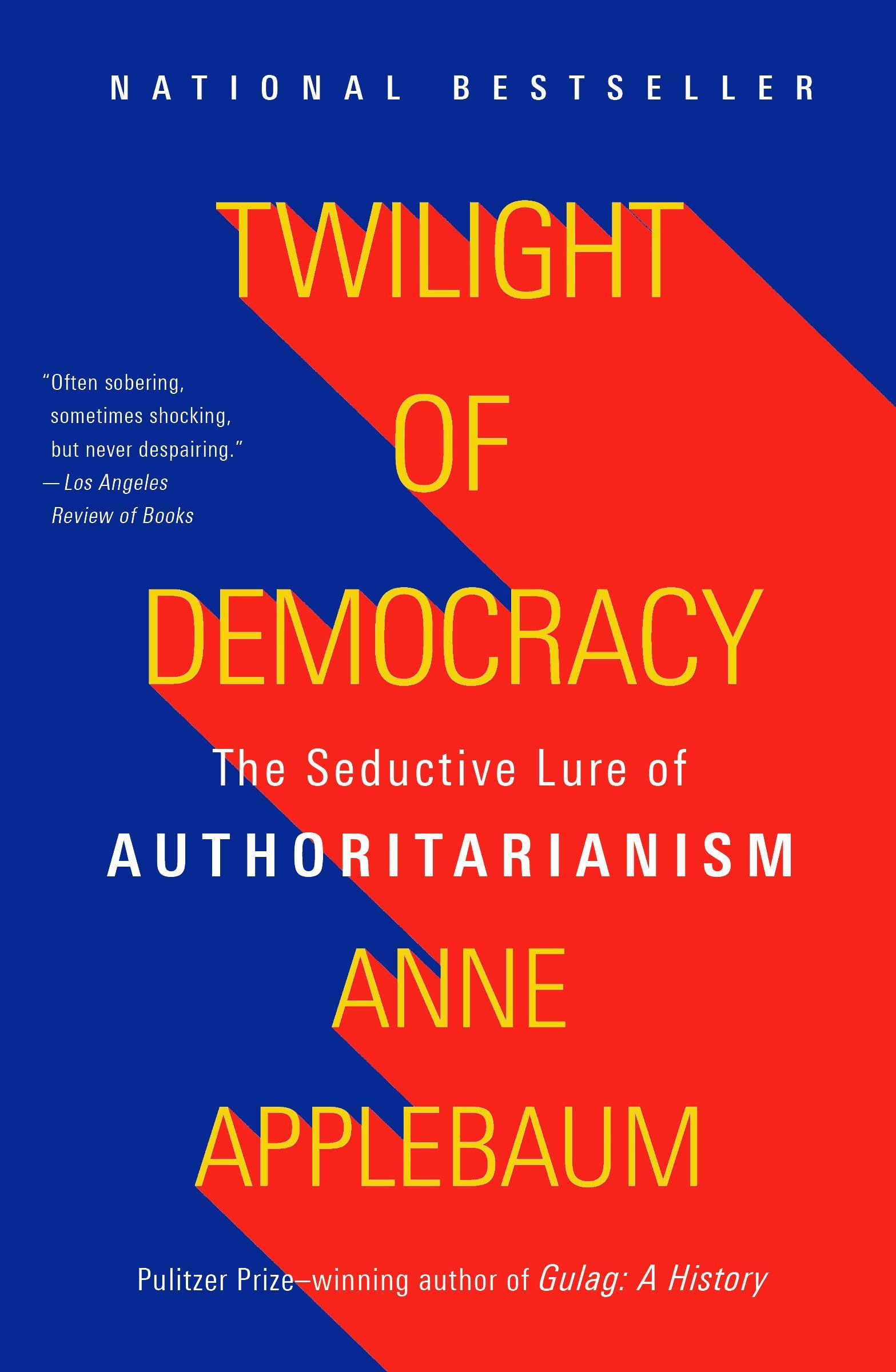

Twilight of Democracy: The Seductive Lure of Authoritarianism
Product ID: 331473621
Buy anything from 5,000+ international stores. One checkout price. No surprise fees. Join 2M+ shoppers on Desertcart.
Desertcart purchases this item on your behalf and handles shipping, customs, and support to Vanuatu.
Twilight of Democracy: The Seductive Lure of Authoritarianism [Applebaum, Anne] on desertcart.com. *FREE* shipping on qualifying offers. Twilight of Democracy: The Seductive Lure of Authoritarianism Review: Why does someone succumb to authoritarianism? - Why would someone succumb to the lure of authoritarianism? This question ran through my mind as I read Anne Applebaum’s Twilight of Democracy: The Seductive Lure of Authoritarianism. As I compiled a list of the contributing factors, a second thought appeared--we are all susceptible, no matter how educated we may be nor how much money we earn. Please note. Anne Applebaum reminds us that she refrained from providing a list of factors, as she urges us not to look for simple answers. It could be as little as one or it could be all of descriptors that pushed someone into the arms of totalitarianism. How would one ever know? Maybe this list should be seen as reasons rather than factors or descriptors. Regardless, please view what I have written as a gambit. Any mistakes are totally mine. Internal Factors (Reasons) • A person’s eccentricity leads him or her down the path of fanaticism and conspiracy (p. 9). • Inflammatory language is appealing (p. 9). • A political party that promotes opposing moral views of their current family situation is attractive (p. 10). • A scapegoat provides a simple answer to their country’s problems (p. 11). • Some are searching for a new identify that makes them feel special or superior (p. 12). • People can succumb to irrationality and their passions (p. 15). • Some people disdain complexity (p. 16). • Members of the intellectual elite become dissatisfied with the objective pursuit of truth to become promoters of extreme propaganda and conspiracy (p. 18). • Some believe that existing institutions are corrupt and need to be destroyed (p. 20). • Some are repulsed by the perceived weakness of the political center (p. 20). • Some are simply opportunists (p. 20). • Some who are deeply religious feel threatened by a secular society (p. 21). • Some are attracted to the idea of chaos (p. 21). • Many are looking to redefine their nations and rewrite social contracts (p. 21). • Some want to alter the rules of democracy so that they will never lose power (p. 21). • They believe that they will receive financial and social rewards for pledging loyalty (p.23). • They see it as an opportunity for upward mobility (p. 24). • They feel resentful because of their perceived lack of success in the current system (p. 24). • Some believe they deserve to rule (p. 29). • Some resent and are envious of others' success under the current system (p. 29). • Some are interested in a political career early on (p. 32). • Some are fascinated by authoritarian figures (p. 32). • Some hold anti-immigrant and anti-Semitic views (p. 46). • Some hold the perception that they feel patronized by the cultural elite (p. 50). • Some are a profound cynic (p. 52). • Some are searching to satisfy their desire for harmony and community (p. 59). • Some are nostalgic for a previous era in which they perceived their country made the rules (p. 62-63). • Some are searching for a leader of action (p. 64). • Some are looking for a party that can collaborate with other superpowers (p. 66). • Some are searching for ways to impress others (p. 71). • Some are looking to fill a vacuum in a political party (p. 73). • Some want to reconstruct a myth of a bygone era (p. 74). • Some see their country and society in decline (p. 80). • Some hold racial or racist views (p. 86). • Some believe that only a revolution can reform the system’s current corruption (p. 89). • Some believe hardship long-term is good for a country (p. 92). • Some believe that reports about a totalitarian country are fake (p. 99). • Some engage in moral equivalence to justify a government bad action (p. 100). • They believe a meritocratic system is unfair (p. 109). • They believe their values are not represented in society (p. 139). • People believe in the invincibility of democracy (p. 142). • People lose faith in progress and social mobility (p. 146). • Those on the extreme edges are also attracted to violence (p. 151). • People see no difference in political forms of government (p. 152). • People’s optimism disappears over time (p. 165). • People believe the ends justify the means if it restores the greatness of their country (p. 171). • A social controversy divides people into camps, leading to questions of national identity (p. 174). • People fear for their lives due to a crisis (p. 184). External Factors (Reasons) • An extremist political party deceives the public by running a moderate campaign (p. 4). • The right conditions can turn any society against democracy (p. 14). • Some had a negative experience with an opposing political/social group (p. 20). • A few can become very wealthy under an authoritarian system (p. 26). • They are promised protection from accusations of corruption or incompetence (p. 26). • History operates in a vicious cycle in a person’s country (p. 57). • People live in a society undergoing complex change (p. 106). • People view serious outbreaks of crime (p. 106) • Certain groups of people experience added competition for certain jobs as a result of recent migration (p. 107). • There is a cantankerous modern discourse (p. 109). • They are living during a period of severe economic inequality and wage decline (p. 109). • There has been a shift in advertising from newspapers to the Internet (p. 112). • People now hold different opinions as well as a different set of facts (p. 113). • The information sphere is perceived to have no trusted authorities and sources (p. 113). • Algorithms produce the information that you want to read and watch (p. 113). • The medium of debate has moved online (p. 115). • Fragmentation of the public sphere creates mistrust and instability (p. 115). • There is an absence of a center ground (p. 115). • There has been a rise in partisanship (p. 116). • There is waning respect of neutral institutions (p. 116). • There has been growth in angry rhetoric (p. 116). • Modern democratic institutions are based on outmoded information technology (p. 116). • Modern debate no longer builds consensus and promotes aggressive confrontation (p. 117). • Targeted political campaigns can be established instantaneously on the Internet (p. 117). • Mainstream parties do not address real issues of modern life (p. 123). • Upstart political parties have the ability to bundle together issues, repackage, and then market an identity to a targeted audience (p. 123). • There is international support for a political party or movement (p. 128). • There is more cooperation and coordination among extreme political movements (p. 132). • Extreme pessimism about a country is transmitted from generation to generation (p. 149). • The disease of nihilism wreaks havoc on a country (p. 187). Review: An Important Read for A Challenging Time - The irony is not lost on me that I finished this book just as the Jan 6 hearings were starting. Applebaum's thesis for this book is clear and terrifying, that "given the right conditions, any society can turn against democracy," which until 2016 I wouldn't have believed. She explains those conditions and reveals the playbook for authoritarianism, particularly orchestrated in Poland, Hungary, Britain, Spain, Italy, (other parts of the world) and yes, America. I find this book authoritative, compelling, and objective. Keep in mind that the author identifies as a Republican, which for me, a "card-carrying, bleeding-heart, tree-hugging" liberal, to even read her work is a big deal. She doesn't just give the overview for the "right conditions" in a far-right world, but for the far-left as well, who both have similar tactics, motivations, and methodologies in delivering authoritarianism. So Applebaum's conclusions drawn for either party extreme is insightful. She's a perceptive historian who has a gift for explaining these complex ideas, definitions, and trends clearly. Although this book feels objective throughout, meaning she views and explains multiple perspectives, she also acts as participant and gives firsthand knowledge of many of the individuals that she's discussing. She also has lived and worked in America, Britain, Poland, and other parts of the world, and she's both a journalist and academic, so she brings a mix of life lived and historical research, both theory and practice, to this work. She makes this topic and the evolution of authoritarianism not just something in the past but something real with much currency and relevance for right now, especially in her discussion of nostalgia, nationalism, and fake news and especially in her view of Ukraine, the United States, and the overview of the circular themes in Europe concerning the far right. Her detailed overview of the persuasive techniques used by "this club" is chilling. She discusses those conditions which she mentions in her thesis, and after reading this text, I feel as if I've attended a university history course on authoritarianism (with a dynamic, creative, and deep-diving professor). This is my first text by Anne Applebaum, and I hope to read Red Famine and Gulag next.


| Best Sellers Rank | #45,844 in Books ( See Top 100 in Books ) #14 in Civics & Citizenship (Books) #144 in History & Theory of Politics #945 in History (Books) |
| Customer Reviews | 4.5 4.5 out of 5 stars (5,081) |
| Dimensions | 5.19 x 0.51 x 8 inches |
| ISBN-10 | 1984899503 |
| ISBN-13 | 978-1984899507 |
| Item Weight | 2.31 pounds |
| Language | English |
| Print length | 224 pages |
| Publication date | June 22, 2021 |
| Publisher | Vintage |
L**N
Why does someone succumb to authoritarianism?
Why would someone succumb to the lure of authoritarianism? This question ran through my mind as I read Anne Applebaum’s Twilight of Democracy: The Seductive Lure of Authoritarianism. As I compiled a list of the contributing factors, a second thought appeared--we are all susceptible, no matter how educated we may be nor how much money we earn. Please note. Anne Applebaum reminds us that she refrained from providing a list of factors, as she urges us not to look for simple answers. It could be as little as one or it could be all of descriptors that pushed someone into the arms of totalitarianism. How would one ever know? Maybe this list should be seen as reasons rather than factors or descriptors. Regardless, please view what I have written as a gambit. Any mistakes are totally mine. Internal Factors (Reasons) • A person’s eccentricity leads him or her down the path of fanaticism and conspiracy (p. 9). • Inflammatory language is appealing (p. 9). • A political party that promotes opposing moral views of their current family situation is attractive (p. 10). • A scapegoat provides a simple answer to their country’s problems (p. 11). • Some are searching for a new identify that makes them feel special or superior (p. 12). • People can succumb to irrationality and their passions (p. 15). • Some people disdain complexity (p. 16). • Members of the intellectual elite become dissatisfied with the objective pursuit of truth to become promoters of extreme propaganda and conspiracy (p. 18). • Some believe that existing institutions are corrupt and need to be destroyed (p. 20). • Some are repulsed by the perceived weakness of the political center (p. 20). • Some are simply opportunists (p. 20). • Some who are deeply religious feel threatened by a secular society (p. 21). • Some are attracted to the idea of chaos (p. 21). • Many are looking to redefine their nations and rewrite social contracts (p. 21). • Some want to alter the rules of democracy so that they will never lose power (p. 21). • They believe that they will receive financial and social rewards for pledging loyalty (p.23). • They see it as an opportunity for upward mobility (p. 24). • They feel resentful because of their perceived lack of success in the current system (p. 24). • Some believe they deserve to rule (p. 29). • Some resent and are envious of others' success under the current system (p. 29). • Some are interested in a political career early on (p. 32). • Some are fascinated by authoritarian figures (p. 32). • Some hold anti-immigrant and anti-Semitic views (p. 46). • Some hold the perception that they feel patronized by the cultural elite (p. 50). • Some are a profound cynic (p. 52). • Some are searching to satisfy their desire for harmony and community (p. 59). • Some are nostalgic for a previous era in which they perceived their country made the rules (p. 62-63). • Some are searching for a leader of action (p. 64). • Some are looking for a party that can collaborate with other superpowers (p. 66). • Some are searching for ways to impress others (p. 71). • Some are looking to fill a vacuum in a political party (p. 73). • Some want to reconstruct a myth of a bygone era (p. 74). • Some see their country and society in decline (p. 80). • Some hold racial or racist views (p. 86). • Some believe that only a revolution can reform the system’s current corruption (p. 89). • Some believe hardship long-term is good for a country (p. 92). • Some believe that reports about a totalitarian country are fake (p. 99). • Some engage in moral equivalence to justify a government bad action (p. 100). • They believe a meritocratic system is unfair (p. 109). • They believe their values are not represented in society (p. 139). • People believe in the invincibility of democracy (p. 142). • People lose faith in progress and social mobility (p. 146). • Those on the extreme edges are also attracted to violence (p. 151). • People see no difference in political forms of government (p. 152). • People’s optimism disappears over time (p. 165). • People believe the ends justify the means if it restores the greatness of their country (p. 171). • A social controversy divides people into camps, leading to questions of national identity (p. 174). • People fear for their lives due to a crisis (p. 184). External Factors (Reasons) • An extremist political party deceives the public by running a moderate campaign (p. 4). • The right conditions can turn any society against democracy (p. 14). • Some had a negative experience with an opposing political/social group (p. 20). • A few can become very wealthy under an authoritarian system (p. 26). • They are promised protection from accusations of corruption or incompetence (p. 26). • History operates in a vicious cycle in a person’s country (p. 57). • People live in a society undergoing complex change (p. 106). • People view serious outbreaks of crime (p. 106) • Certain groups of people experience added competition for certain jobs as a result of recent migration (p. 107). • There is a cantankerous modern discourse (p. 109). • They are living during a period of severe economic inequality and wage decline (p. 109). • There has been a shift in advertising from newspapers to the Internet (p. 112). • People now hold different opinions as well as a different set of facts (p. 113). • The information sphere is perceived to have no trusted authorities and sources (p. 113). • Algorithms produce the information that you want to read and watch (p. 113). • The medium of debate has moved online (p. 115). • Fragmentation of the public sphere creates mistrust and instability (p. 115). • There is an absence of a center ground (p. 115). • There has been a rise in partisanship (p. 116). • There is waning respect of neutral institutions (p. 116). • There has been growth in angry rhetoric (p. 116). • Modern democratic institutions are based on outmoded information technology (p. 116). • Modern debate no longer builds consensus and promotes aggressive confrontation (p. 117). • Targeted political campaigns can be established instantaneously on the Internet (p. 117). • Mainstream parties do not address real issues of modern life (p. 123). • Upstart political parties have the ability to bundle together issues, repackage, and then market an identity to a targeted audience (p. 123). • There is international support for a political party or movement (p. 128). • There is more cooperation and coordination among extreme political movements (p. 132). • Extreme pessimism about a country is transmitted from generation to generation (p. 149). • The disease of nihilism wreaks havoc on a country (p. 187).
S**N
An Important Read for A Challenging Time
The irony is not lost on me that I finished this book just as the Jan 6 hearings were starting. Applebaum's thesis for this book is clear and terrifying, that "given the right conditions, any society can turn against democracy," which until 2016 I wouldn't have believed. She explains those conditions and reveals the playbook for authoritarianism, particularly orchestrated in Poland, Hungary, Britain, Spain, Italy, (other parts of the world) and yes, America. I find this book authoritative, compelling, and objective. Keep in mind that the author identifies as a Republican, which for me, a "card-carrying, bleeding-heart, tree-hugging" liberal, to even read her work is a big deal. She doesn't just give the overview for the "right conditions" in a far-right world, but for the far-left as well, who both have similar tactics, motivations, and methodologies in delivering authoritarianism. So Applebaum's conclusions drawn for either party extreme is insightful. She's a perceptive historian who has a gift for explaining these complex ideas, definitions, and trends clearly. Although this book feels objective throughout, meaning she views and explains multiple perspectives, she also acts as participant and gives firsthand knowledge of many of the individuals that she's discussing. She also has lived and worked in America, Britain, Poland, and other parts of the world, and she's both a journalist and academic, so she brings a mix of life lived and historical research, both theory and practice, to this work. She makes this topic and the evolution of authoritarianism not just something in the past but something real with much currency and relevance for right now, especially in her discussion of nostalgia, nationalism, and fake news and especially in her view of Ukraine, the United States, and the overview of the circular themes in Europe concerning the far right. Her detailed overview of the persuasive techniques used by "this club" is chilling. She discusses those conditions which she mentions in her thesis, and after reading this text, I feel as if I've attended a university history course on authoritarianism (with a dynamic, creative, and deep-diving professor). This is my first text by Anne Applebaum, and I hope to read Red Famine and Gulag next.
P**H
Brillantly written and deeply documented
P**O
Anne Applebaum, historiadora de renome e excelente escritora, apresenta neste livro, mais atual que nunca, as fragilidades da democracia -- que muitas pessoas dão como adquirida e supostamente constituindo um direito natural... -- e a pro-atividade que é requerida a todos e cada um(a) para evitar extremismos, venham eles de onde vierem. Recomendo a sua leitura -- de resto muito fluida -- para relembrar a necessidade de uma cidadania ativa, que assegure a manutenção das nossas liberdades individuais e coletivas, que incluem direitos e, muito em particular, também deveres, para que a democracia plena da nossa sociedade perdure.
D**K
Shipping fine. The book itself is hard going if you don't know much about Eastern European politics and culture.
P**R
Populism on the rise through Europe the UK and the US. Great insights from a top historian. Very well written.
M**M
Difícil dizer do que não gostei . O livro de Anne Applebaum é leitura obrigatória sobre o crescimento alarmante do neo-fascismo no mundo . Escrito de forma inteligente por uma jornalista e intelectual reconhecidamente respeitada , o livro disseca ‘ cases ‘ em diversos países na Europa onde regimes autoritários já alcançaram o poder pela via democrática - Hungria e Polônia - e onde as instituições democráticas se vêm ameacadas por forças emergentes como o UKIP , o VOX e a Liga Norte . Disseca elementos extremistas na ascenção do Trumpismo nos EUA e de Marine Le Pen na França . Leitura importante .
Trustpilot
5 days ago
3 weeks ago