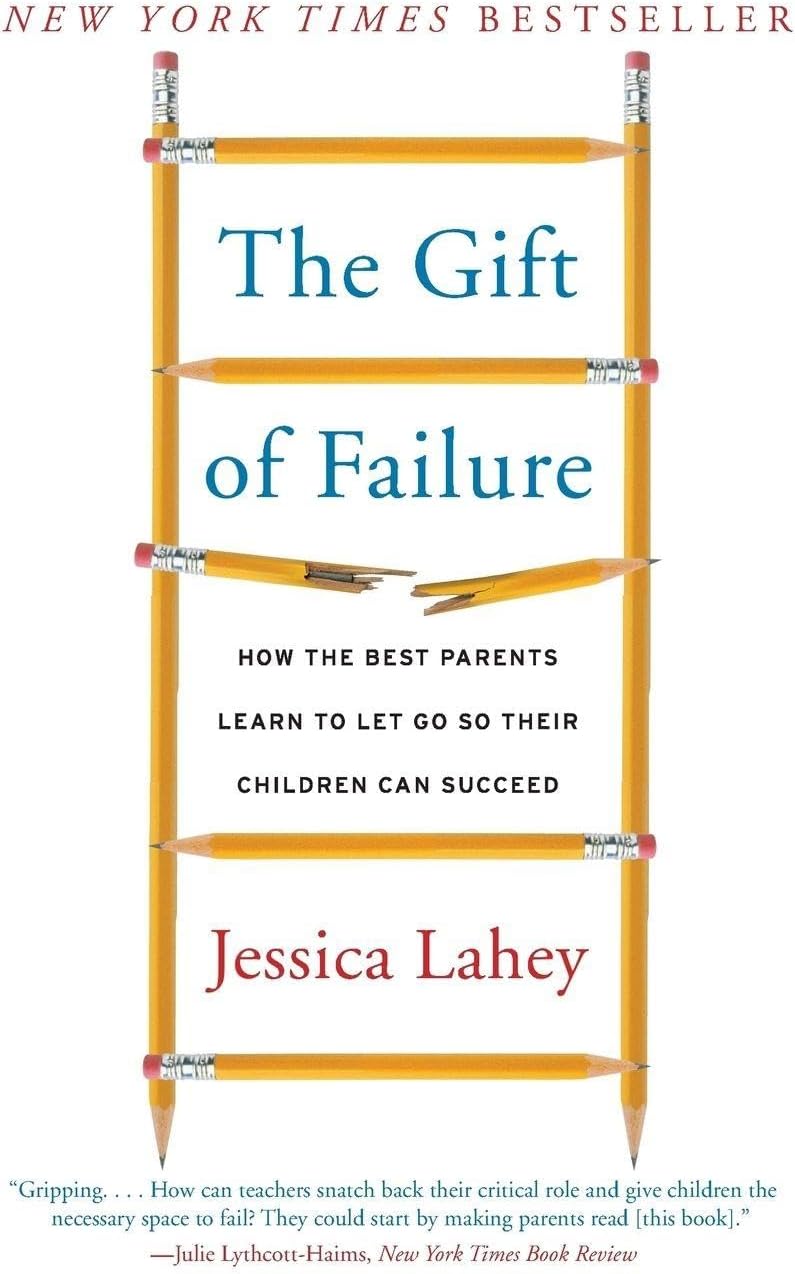
The Gift of Failure: How the Best Parents Learn to Let Go So Their Children Can Succeed
Product ID: 33698163
Buy anything from 5,000+ international stores. One checkout price. No surprise fees. Join 2M+ shoppers on Desertcart.
Desertcart purchases this item on your behalf and handles shipping, customs, and support to Vanuatu.
The Gift of Failure: How the Best Parents Learn to Let Go So Their Children Can Succeed [Jessica Lahey] on desertcart.com. *FREE* shipping on qualifying offers. The Gift of Failure: How the Best Parents Learn to Let Go So Their Children Can Succeed Review: Practical and eye-opening guide for parents - This book had a profound effect on my thinking about how to be a parent. I don't think of myself as the type who hovers, but I'm starting to understand that I hover more than I realize. It's not that the author is advocating for hands-off parenting. Instead, she points out a lot of the ways in which parents take the reins and deny their kids all sense of control, and how detrimental that can be. We want our kids to grow up to be responsible and capable adults, but how can they do that when we take away their sense of autonomy? This book made me realize it's more important for me to teach my kids life skills like how to manage their time than it is for me to be managing every detail. My doing so comes from good intentions and a desire to see them succeed, but at the same time it conveys subtle messages to them I don't want conveyed. I read a lot of psychology and social science books because the research just plain fascinates me. While this book offers a lot of anecdotes, it's also infused with an excellent grasp of research. Lahey's background in education shines through, and her suggestions are grounded in the same evidence-based research that I've read. If kids seem different today, it's because they are, and it's not just technology that's driving this change, it's the way parents treat their children and how they view them. We want them to be successful, but in our test-driven, high achieving culture, we are sometimes guilty of emphasizing the wrong things. After reading a great deal about helpless college students, children suffering from stress-related ills, and the mental health problems plaguing universities, this book helped me form an idea as to why this may be: rather than teaching our children to work for the things they want, we're setting them on a prescribed path and sending them the message that they're only okay as long as they follow that prescribed path. Reading this book makes the mystifying question of why children don't want to take risks quite clear: because we've taught them that there's nothing worse than failure. Yet this book doesn't just discuss research, it also offers a lot of practical solutions for parents. Fair warning, though: not all of these suggestions are easy to swallow. This is where some of the pain came in for me, because I saw myself reflected in some of the behaviors Lahey suggests parents need to break. Giving her suggestions a try isn't going to be easy from a parenting standpoint, and it will require me to retrain myself as well. I also think there's a lot of value in how this book offers some very good insight into the educational system, which I think is a big benefit to parents who don't come from a teaching background. Lahey proposes that parents and teachers work as partners, and she offers suggestions for how parents can open up dialog with their kids' teachers. Considering how adversarial our current culture and politics paint the relationship between educators and parents, there is a great deal of value in this aspect of the book. It doesn't serve anyone for parents and teachers to be at one another's throats, not when both sides want the same thing. This book offers constructive ways parents can form that partnership with teachers, so that everyone can work together toward the same goal. I highly recommend this book to both parents and educators. Review: If you're a parent, you want to read this book - Jessica Lahey and I have never met in person, though we have been online writerly acquaintances for about five years. She has read my writings and commented on them (as has, in one case, her son, Finn), and I am professionally acquainted with her sister, Anna Jones. All this to let you know that while this comment is as unbiased as possible, there is a connection between us. THE GIFT OF FAILURE is an important book, useful and lucid. Jessica has researched many resources -- the book's bibliography is six pages of small type, listing 154 sources -- and has distilled their findings, conclusions, suggestions, prescriptions, proscriptions, warnings, and encouragements into a tight, well-structured, and eminently readable guide for the possibly perplexed American parent. If you have school-aged children, please allow me to urge you to read this book and keep it handy. The one caveat I will raise is that Jessica is writing from a certain solidly middle-class perspective, in the older definition of the middle class as a well-educated, professionally successful, and financially privileged population. Some readers may find her casual references to such luxuries as private schools, Latin classes, and schedules jam-packed with soccer games, dance lessons, and music tutorials, to be distancing. Don't let those frills distract you. They are minimal and immaterial. This book is filled in generous measure, packed down and flowing over, with insights and advice of value to any parent of school-aged children, from any segment of society. I can only wish that THE GIFT OF FAILURE had been available when I was raising my own son and trying to figure out how best to do it. (NB -- desertcart tells me that if I give this book four stars, that means "I like it," while if I give it five, that means "I love it." Well, I don't "love" it, but I more than "like" it; since I can't give it four-and-a-half stars, or 4.9, or some such, I am giving it five. It is an important book.)
| Best Sellers Rank | #15,304 in Books ( See Top 100 in Books ) #14 in Medical Child Psychology #31 in Parenting Boys #38 in Popular Child Psychology |
| Customer Reviews | 4.5 out of 5 stars 1,136 Reviews |
B**E
Practical and eye-opening guide for parents
This book had a profound effect on my thinking about how to be a parent. I don't think of myself as the type who hovers, but I'm starting to understand that I hover more than I realize. It's not that the author is advocating for hands-off parenting. Instead, she points out a lot of the ways in which parents take the reins and deny their kids all sense of control, and how detrimental that can be. We want our kids to grow up to be responsible and capable adults, but how can they do that when we take away their sense of autonomy? This book made me realize it's more important for me to teach my kids life skills like how to manage their time than it is for me to be managing every detail. My doing so comes from good intentions and a desire to see them succeed, but at the same time it conveys subtle messages to them I don't want conveyed. I read a lot of psychology and social science books because the research just plain fascinates me. While this book offers a lot of anecdotes, it's also infused with an excellent grasp of research. Lahey's background in education shines through, and her suggestions are grounded in the same evidence-based research that I've read. If kids seem different today, it's because they are, and it's not just technology that's driving this change, it's the way parents treat their children and how they view them. We want them to be successful, but in our test-driven, high achieving culture, we are sometimes guilty of emphasizing the wrong things. After reading a great deal about helpless college students, children suffering from stress-related ills, and the mental health problems plaguing universities, this book helped me form an idea as to why this may be: rather than teaching our children to work for the things they want, we're setting them on a prescribed path and sending them the message that they're only okay as long as they follow that prescribed path. Reading this book makes the mystifying question of why children don't want to take risks quite clear: because we've taught them that there's nothing worse than failure. Yet this book doesn't just discuss research, it also offers a lot of practical solutions for parents. Fair warning, though: not all of these suggestions are easy to swallow. This is where some of the pain came in for me, because I saw myself reflected in some of the behaviors Lahey suggests parents need to break. Giving her suggestions a try isn't going to be easy from a parenting standpoint, and it will require me to retrain myself as well. I also think there's a lot of value in how this book offers some very good insight into the educational system, which I think is a big benefit to parents who don't come from a teaching background. Lahey proposes that parents and teachers work as partners, and she offers suggestions for how parents can open up dialog with their kids' teachers. Considering how adversarial our current culture and politics paint the relationship between educators and parents, there is a great deal of value in this aspect of the book. It doesn't serve anyone for parents and teachers to be at one another's throats, not when both sides want the same thing. This book offers constructive ways parents can form that partnership with teachers, so that everyone can work together toward the same goal. I highly recommend this book to both parents and educators.
T**S
If you're a parent, you want to read this book
Jessica Lahey and I have never met in person, though we have been online writerly acquaintances for about five years. She has read my writings and commented on them (as has, in one case, her son, Finn), and I am professionally acquainted with her sister, Anna Jones. All this to let you know that while this comment is as unbiased as possible, there is a connection between us. THE GIFT OF FAILURE is an important book, useful and lucid. Jessica has researched many resources -- the book's bibliography is six pages of small type, listing 154 sources -- and has distilled their findings, conclusions, suggestions, prescriptions, proscriptions, warnings, and encouragements into a tight, well-structured, and eminently readable guide for the possibly perplexed American parent. If you have school-aged children, please allow me to urge you to read this book and keep it handy. The one caveat I will raise is that Jessica is writing from a certain solidly middle-class perspective, in the older definition of the middle class as a well-educated, professionally successful, and financially privileged population. Some readers may find her casual references to such luxuries as private schools, Latin classes, and schedules jam-packed with soccer games, dance lessons, and music tutorials, to be distancing. Don't let those frills distract you. They are minimal and immaterial. This book is filled in generous measure, packed down and flowing over, with insights and advice of value to any parent of school-aged children, from any segment of society. I can only wish that THE GIFT OF FAILURE had been available when I was raising my own son and trying to figure out how best to do it. (NB -- Amazon tells me that if I give this book four stars, that means "I like it," while if I give it five, that means "I love it." Well, I don't "love" it, but I more than "like" it; since I can't give it four-and-a-half stars, or 4.9, or some such, I am giving it five. It is an important book.)
A**S
So helpful to me, as someone who works with kids
I know one of my issues at work is that I am just waiting to help the kids be done rather than to let them learn and be independent. I remind them to ask for help constantly. This is a great book to give reasons why failure is good and how to let go (to varying degrees). It hasn't totally changed what I do, but it has been a great reminder to tone down the control freak nature. I enjoyed the examples from both teacher and parent perspectives as I fall more on the education side but dip into enforcing parenting. I think this book could use some examples of kids with disabilities and some in-depth discussion on the topic. (It may have, but I've been reading this over several months.). I think such a discussion would point to how important being capable of intrinsic motivation is and strengthen the discussions already present in the book. Errorless learning, as I see it sometimes called, is a tool and sometimes I think we rely on it a bit heavily. Definitely a recommended read for educators and parents, and people in between.
J**N
Common sense analysis of how we damage kids.
Lovely book written by a middle school teacher for parents. Is feels more applicable to teachers, especially up to about 14 years old.
L**S
Top Shelf
I've been waiting for this book and it was definitely worth the wait! Jessica Lahey not only provides one of the most concise and thorough histories of parenting, but goes on to identify ways in which we - as a parents and as society - have insulated and protected our kids from the reality of failure to the point we are disabling them. As I started this book, I reflected on where I failed and made the same mistakes, but I also rejoiced in the few points where it seems I've nailed it. The details of my self reflection are not important, but it was more Jessica's voice, authority and empathy that allowed me to travel down that path. Jessica reveals where she recognized her short comings and then swiftly intervened with a plan of action that yielded slow but steady benefits. Her narrative, punctuated with research and anecdotes, makes the reader see the value in letting kids fail while gaining the necessary sense of competence and autonomy - and see that one is not alone on this challenging journey called parenting. As a teacher, consultant and parent, this book takes a place on my shelves among my most influential books. I'm certain I'll refer to it often for both personal and professional references. Well-done, Jessica! Lisa Wells educator, consultant, parent, writer www.wonderofchildren.com
K**S
Essential Read for Parents & Teachers
I read this book because it was on sale on Bookbub. Though I don't have kids, my personal fear of failure is something I want to avoid instilling in my own future children, so I am interested in this topic. I think every parent would benefit from reading this book. At points I got a little annoyed with the author's assumption that all teachers can do no wrong (because let's face it, we've all at some point had a teacher who did not care), but I do agree that for the most part teacher's want the absolute best for their students. I also think teacher's, especially upwards of 5th grade, would be able to better equip their students' parents to support their children's success after reading this book. Even if you don't have kids (like me), it's an interesting topic to ponder on, though certain chapters can be tough to make it through if you don't have a reason to be invested in the material; particularly the grade by grade guide to parental behavior. Overall, I highly recommend!
R**T
Good book for parents
A good review for parents to keep as they struggle, but as reviewer noted a bit oversimplified. I bought after had listened to a panel on Forum discussed screen time. As a grandparent, sitting with my wife each on our I pads, I recall eating at restaurants when you look an see so many n smart gadgets texting, tweeting selfing and wonder where the talk is. I did post a photo of a wee grandchild playing while tv playing and three other in room were on their gadgets. The discussion was good. No answers. But, the discusses all recommend Lahey's book. In a period when helicopter parents strive for kids and overpower them, success comes without self motivation, and absent of failing , or at least the skills needed to overcome failure, grit and resilience and desire. Good to,learn early that they are part of a community and tasks are performed not for bribes or pay, but part of all pulling together. She spends a few pages on bullying and how to deal with it. Certainly for sandbox or recess in early years letting kids figure out how to work together through squabbles and fights is good. How do we handle the issues when kids get older? Teddy Roosevelt said learn to box. Sometimes really big kids pummel the weak. Stepping in may be needed. Bullying which now is felt a larger part of school with snubbing, nasty notes, cliques causes no bodily harm, but is part of life. Dealing with it Is a difficult task for teachers and parents. I applaud the new generation of teachers and parents who work as teams. A quarter century ago the moms at our kids elementary school were called the mafia moms. No prisoners. I recall an episode when well dressed ladies said whatever the vogue n radon gas wrong, ..they knew cause they could read and they didn't have to learn what their kids were saddled with and the new math, now very old, was wrong. Maybe now teachers and parents can complain together about the evil core, or how much time the teachers should spend prepping for a test.
K**A
Extraordinarily Helpful - A total game changer
I read this book at the recommendation of my son's school counselor. It was a total eye opener and will greatly impact and change the way I raise my son going forward. This book could have easily been titled, "The way I used to parent" because it is so accurate down to so many details as it describes my parenting techniques and motivations. I have made many changes already and my son doesn't quite understand who I am anymore. I'm certain that he appreciates the changes although he's a bit disoriented currently, but I know he will be better off in the long run. I wish there were more anecdotes or perhaps several role playing scenarios added to help offer more suggestions on how to handle more situations but the book was extremely helpful and insightful regardless. Most of the anecdotes I saw play out in our family or with other students from my son's school within hours or days of reading the book. It was amazing.
Trustpilot
2 weeks ago
2 weeks ago