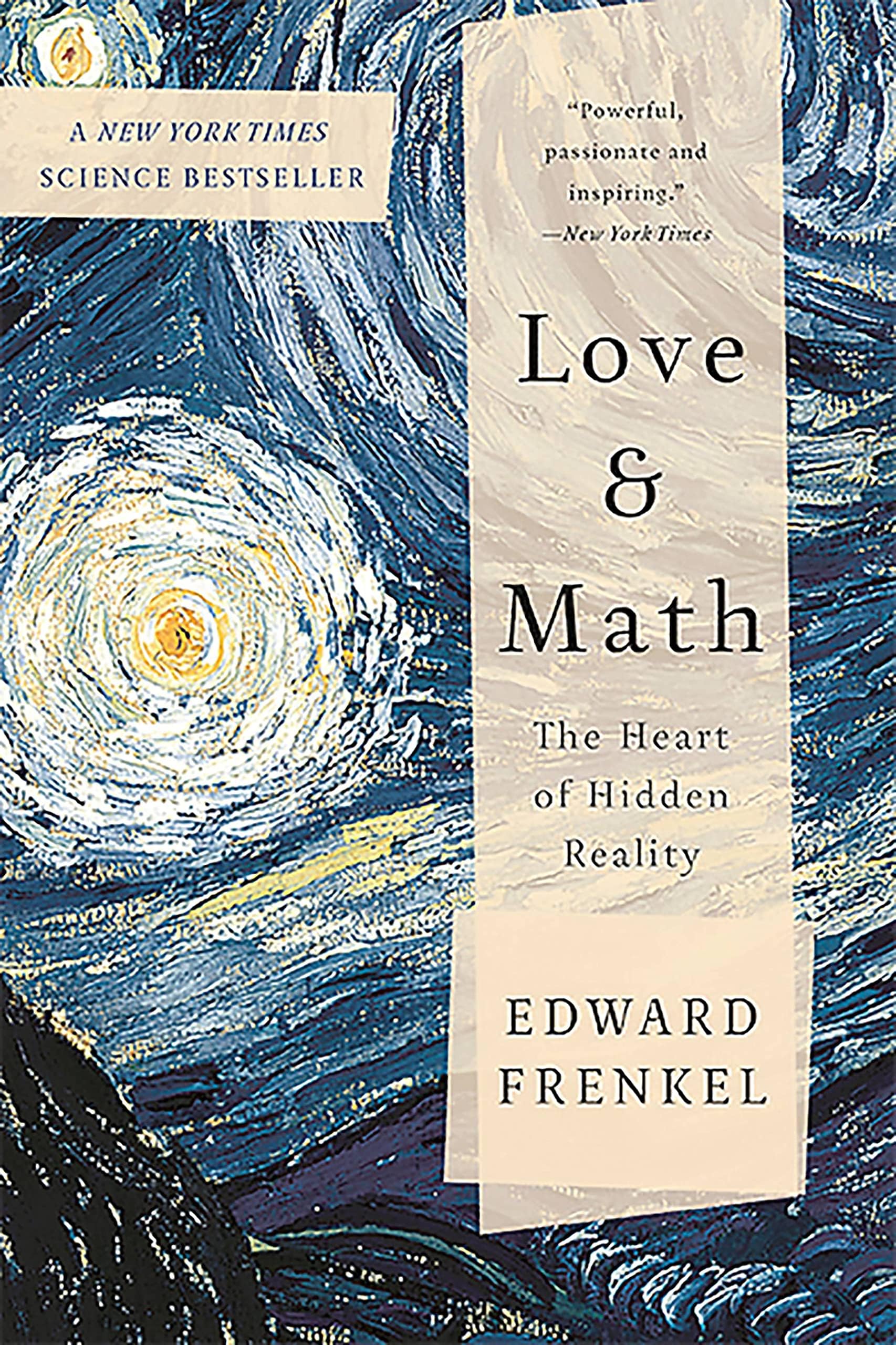
Love and Math: The Heart of Hidden Reality
Product ID: 347318189
🌍Bridges math & culture
📚NYT Bestseller status
🔢Explores Langlands Program
Desertcart purchases this item on your behalf and handles shipping, customs, and support to Vanuatu.
🔍 Unlock the hidden beauty of math and join the intellectual elite!
Love and Math: The Heart of Hidden Reality is a New York Times Science Bestseller by Edward Frenkel that reveals the elegance and cultural significance of mathematics. It intertwines the author’s personal journey with the revolutionary Langlands Program, inviting readers to see math as a unifying, artistic, and deeply human pursuit.
| Best Sellers Rank | #61,199 in Books ( See Top 100 in Books ) #16 in Biographies of Educators #33 in Geometry & Topology #36 in Mathematical Physics |
| Customer Reviews | 4.5 out of 5 stars 396 Reviews |
J**A
What I REALLY like about this book is that Frenkel talks about real ...
What I REALLY like about this book is that Frenkel talks about real math without talking down to the reader. I don't follow it all, since I did not read it as carefully as it needs to be read, but I will take another pass at it soon. This is in contrast to textbooks, which 1. I wouldn't be able to follow at all since I don't have the background nor will I spend the time to get it, and 2. I would probably never re-read a math textbook. Come on, really? Nope. I read "My Brain is Open" about Paul Erdos a few years ago, and loaned it out, so I can't remember for sure how it compares to this one, but I think I was left a little frustrated. Paul Erdos collaborated in many mathematical ventures, but as I remember, it is assumed the reader couldn't possibly follow what they were. Edward Frenkel makes the attempt. I am flattered and delighted. He is skillful enough in this so that I want to rise to the occasion. In addition, he tells the story of his own life and career in an engaging way. One of the things that I find remarkable in Frenkel's account is the view into a mostly-male field that isn't about soldiering or something similarly physical. As a woman, I did take four years of math in college but didn't continue. It wasn't because I didn't like it - I loved it! It was because of the toxic posturing that accompanies the field, or at least, in my college it seemed to. We students were subtly and not-so-subtly evaluated by our professors and classmates to see if we had "what it takes" to be a great mathematician. One of my professors actually called the other female student in my year to his office and told her that, while she would never be a first-tier mathematician, she had what it took to become a second-tier thinker and she should consider going into math as a career. When she told me about this, she was crying. She did math because she liked to do it, and it had not occurred to her that such rankings were part of the winnowing process. I, of course, was also devastated because clearly I was not even going to be second-tier. Neither of us continued in the field, though, looking back, I think that we should have. Female brains are different than male brains, and we both frequently noted that we found some classes hard and others easy, and that seemed to be in inverse relationship to what our male classmates found. If we had gone on in the "difficult" fields that we thought were easy, who knows where it might have led? With what we know now about the relationship between focused practice and achievement, it seems insane to worry so much about what minds look like in the moment. If my friend had wanted to become a first-tier mathematician, she ought to have been advised to do what Frenkel does, that is, think about math all the time and poke around in the literature and talk to other mathematicians and think about it some more and talk with colleagues some more and do that with passion and verve. I personally work very well in collaboration, but collaboration, while Frenkel talks about it a LOT, was not encouraged in my college. It was too important to evaluate how brilliant people were as they stood alone. The one time I did hang out with a mathematician who was in a class further on than mine, I did so well in the class that we had been talking about, that I went to the professor and confessed that I had an unfair advantage. He said that cheating was frowned upon but he would let it pass this time. I certainly never made the mistake of cheating by talking to another mathematician again! And now, as I read Frenkel, I see how crucial that is. Of course.
Á**O
Livro apaixonante
O livro toca em temas extrenamente complexos, o que pode desmotivar os leitores mais para o final. Contudo parece-me que é isso mesmo que se quer ser transmitido que fazer matemática é complexo e apaixonante, mesmo que não se perceba os promenores essas ideias de mais alto nível é que devem passar ao leitor.
J**S
A exciting approach to Modern maths
This is a great book, it stimulated me to brush up on my maths. It's addictive, but to understand it I had to read every chapter multiple times and I had a few sessions on chatgpt on group theory, modular forms. In the end I am begging to really understand what modern maths is about, the grand unification seems to be a possibility. There are some great YouTube videos by the author that help a lot with some of the difficult ideas.
堂**忠
「無謀な」試みに拍手!
これほど無謀な一般向け数学解説書は、見たことがありません。何しろ、群論、数論、トポロジー、結び目理論、楕円曲線論、場の量子論、超ひも理論等の入門的教科書を読んだ後でも、この本を読んでいる間は、メインテーマに対応する6章から17章の内容の半分も理解できないのですから。 でも無理もありません。説明している内容が、最先端数学と場の理論のはざまの、また、その最先端なのですから。 しかし、読んだ後で、手元の教科書類を開いてみると、びっくりですね!今までわからなかったことが、にわかに、つながってくるのですね! と、いうわけで、ラングランズ対応と場の量子論のかかわりに興味のある方は是非読んでみてください。英語は極めて平易ですが、内容は、非常に難解ですが。
W**G
I read Love and Maths alongside Hacking’s “Why is there a Philosophy ...
Frenkel’s book deserves a much wider audience this side of the Atlantic than it currently has. I read Love and Maths alongside Hacking’s “Why is there a Philosophy of Maths at all”, and at least in the first few days, I persevered with the dual task until I eventually focused on Frenkel almost exclusively. I’ve now read the book twice and must admit to having been moved from being merely entertained to being seriously impressed. The title and the first few largely biographical chapters are, in truth, slightly misleading. Once Frenkel gets going, however, he impresses as a serious writer with no quarter given for the less than serious reader. But the “cost”, as can happen so often, is not clarity of accessibility. This last point is interesting. The way that Frenkel ensures no compromise is by providing, in the main body of the book, a fairly low lying terrain. Think of this as a strenuous but ultimately achievable trek up Kilamanjaro. Yes, you have to be able to breath the thin air, but there are no serious 5:5 stretches. You don’t need your climbing rope and crampons or ice pick. However, laced, literally page by page, are footnotes that are more like the diversion to K2. And what an amazing diversion. You can (if you want) be seriously addressed with credible mathematical discourses, and yet stay the course if you feel threatened. Its a smart way of delivering a superb read. Leaving aside this very clever mechanism, the heart of the book brings together a beautifully crafted exposition of the importance of the Langlands programme with a topical weft and weave of contemporary maths. A few months after I read the book a second time I had the chance to meet Frenkel very briefly. He is a disarming and charming man with a steely eyed determination to convey his feelings. The book is the same. Don’t be fooled by the title, and don’t give up in the foothills. The peaks are what count. You will be infected by the love of the subject that so many of us wish we could share with loads more people. I just hope the book gets more of an audience in Britain. Frenkel also wrote the obit for Grothendieck in the NY Times. Well worth the read for those who dont know a mathematician who may well deserve the title of the 20th century's greatest (and yes, I include Godel, Hilbert and Weyl et al in that comparison).
Trustpilot
1 month ago
4 days ago