🔪 Sharpen Smarter, Anywhere You Go!
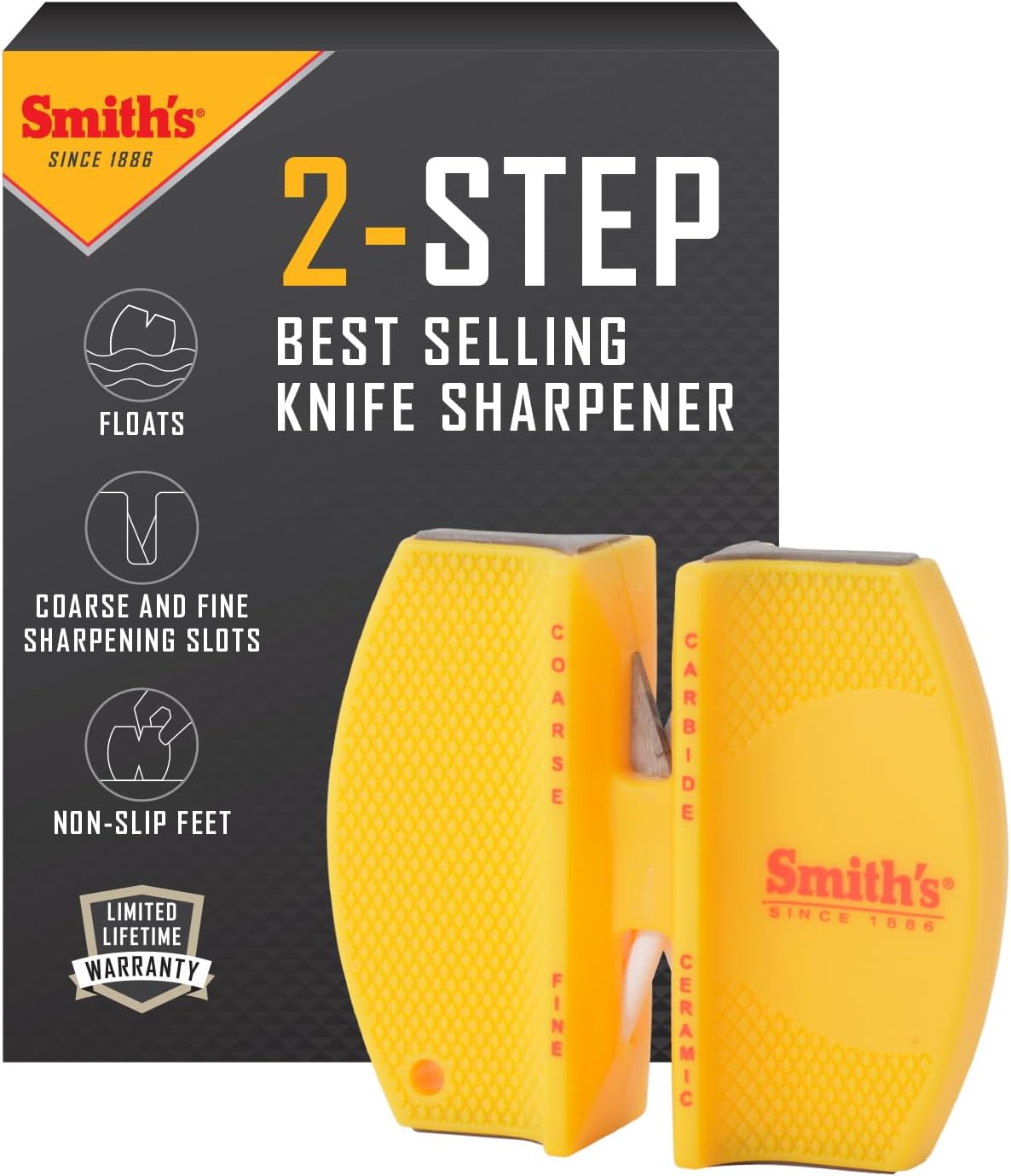
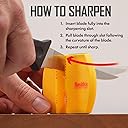
Smith's CCKS 2-Step Knife Sharpener is a compact, portable tool featuring preset tungsten carbide and ceramic sharpening slots that quickly restore and polish knife edges. Designed for outdoor enthusiasts, it floats on water, includes non-slip feet for safety, and fits easily on a keychain or in a pack, making it ideal for fishing, hunting, and everyday knife maintenance.


| ASIN | B00032S02K |
| Best Sellers Rank | #13,337 in Kitchen & Dining ( See Top 100 in Kitchen & Dining ) #54 in Knife Sharpeners #510 in Kitchen Knives & Accessories |
| Brand Name | Smith's |
| Color | Yellow |
| Customer Reviews | 4.5 4.5 out of 5 stars (16,911) |
| Global Trade Identification Number | 00027925190043 |
| Grit Type | Coarse,Fine |
| Included Components | 1 sharpener |
| Item Dimensions L x W x H | 2.71"L x 0.88"W x 2.33"H |
| Item Type Name | Smith's CCKS 2-Step Knife Sharpener - Yellow - 2-Step Preset Coarse & Fine Slots - Outdoor Handheld Knife Sharpener - Fishing, Hunting, Fillet, Pocket Knives - Compact Plastic Portable Keychain Tool |
| Manufacturer | Smith's |
| Manufacturer Warranty Description | See Manufacturer |
| Material Type | Synthetic |
| UPC | 343538775737 027925190043 703709422066 703570117351 |
| Unit Count | 1.0 Count |
J**S
Simple, Effective Knife Sharpener That Really Works
This 2-step knife sharpener is easy to use and delivers excellent results. The preset angle guides make it simple to get a consistent edge every time, even if you’re not experienced with sharpening. The coarse stage quickly restores dull blades, and the fine stage polishes them to a smooth, sharp finish. The yellow design is bright and easy to spot in the kitchen. It’s compact, sturdy, and works well for most standard knives. A reliable tool for keeping your knives razor-sharp with minimal effort.
M**Y
Great little sharpener!
Works as should,,nice little sharpener great quality, price, fast shipping, the no -slip pads are nice makes a sharp knife sharper! ,just post office screwed up by 3 days again,, after useing it I can cut paper for sharpness test . awesome.
J**U
Effective sharpener, but has design flaw
I used this to repair an old Frontier stockman that had its edges mangled years ago by an attempted bench grinder sharpening. The carbide side set pretty good edges on the carbon steel blades after just 10 passes, and I got surprisingly sharp, paper-slicing finishes with the ceramic side, using about 30 strokes with moderate pressure. However, there's a bit of issue with the plastic case on either side of the sharpeners. It protrudes out too far, so I couldn't sharpen about 5 millimeters of edge on the pivot side of the blades. The bolster would hit the case before the edge could reach the sharpener. This is an annoyance, as a little of the blades are still dull. Keep that in mind if you plan to sharpen pocket knives with this. Also, applying pressure until the end of the blade make the knife cut into the case under the sharpener when it comes out. Not too big a deal, just thought I'd note that. I also used it on some kitchen knives that haven't been sharpened in a couple decades. The carbide side bit into the softer stainless steel more than the pocket knife, and had more resistance and removed metal per pass (so much so that I could see curly shavings on the table, I'd suggest not using the carbide side unless the edge really needs work). I got them very sharp too, and didn't have the aforementioned problem because the edge started further down the blade on these knives. Overall I'd say I got my 4 bucks out of it. I can see doing a few light ceramic passes to hone some blades from time to time. We'll see how long it lasts. Thought about giving it 3 stars because of the problem, but 4 because it's so simple and effective otherwise.
N**7
Works well and quickly, a great bargain.
I bought this to sharpen 2 blades on my Victorinox Swiss Army pocket knife, and 3 German kitchen knives. The kitchen knives over the years had gotten to where they were sharp enough once you got them slicing, but couldn't do things like just pull it through the plastic covering on frozen pizzas without it often snagging and tearing instead of cutting. When pulling them through the carbide sharpeners, it was obvious that some small dings and snags in the knife had developed, not really visible but easy to feel. Once they were gone, I then finished the job on the ceramic sharpeners. Very sharp, like new,though I then intentionally slightly dulled them on the ceramic to make a light tap on skin not draw blood. On the pocket knife, they were more dinged up, but sharpened well after a bit more work, still easy. I slightly dulled the smaller blade that I use for cutting wire, etc. I didn't dull the bigger blade that I use on food and rope. I should have. I accidentally bumped it very lightly with a knuckle a few days later, and immediately felt it cut me. Great sharpener for the price, just be careful about how sharp you decide to make a blade.
S**Y
>>> DOES THE JOB
> The most convenient, compact, knife sharpener that I've found. > I use the ceramic side (with the little white cylinders) for sharpening kitchen knives (and my pocket knives). I hold the knives edge-up under running water in my sink with my left hand, and lightly move the sharpener with my right hand along the blade. About 10 very light strokes is usually enough to touch up an already fairly sharp knife. > I've nicked and scratched my kitchen countertop trying to sharpen long chef's knives using sharpeners that I have to place on a countertop and drag knives through. I appreciate that I don't have to set the Smith's sharpener on a countertop. > A few other reviewers claim that the ceramic rods broke when they were trying to sharpen knives --- if so, they were using WAY too much pressure. Use only a very light touch. > Generally speaking the carbide (metal) side should NEVER be used on chef's knives or other fine blades. The carbide takes off too much metal. In quality knives, only the very edge is treated to be hard enough to hold a very sharp edge --- grind that off (or scrape it off with a carbide sharpener), and all the sharpening in the world is a waste of time. Don't misunderstand, you can sharpen such a blade to razor sharpness --- but the blade will not hold the edge, it will quickly dull. A couple of other reviewers claim that the carbide chips fine blades -- in which case the blades are permanently ruined. > Use the carbide side for axes, machetes, and other utility blades made of comparatively softer steel. But even a utility blade can be damaged by using too much pressure with a carbide sharpener --- the edge of the blade becomes wavy and irregular. > You can touch up a utility blade, (that is, make it a little sharper) using the ceramic edge afterward --- but that extra step is usually a waste of time for utility blades, which will dull quickly in use anyway. > Maybe "medium quality" blades (such as an average quality hunting knife) might benefit from carbide followed by ceramic, but try the ceramic only, first. If, say 30, swipes with the ceramic side does not adequately sharpen the knife, then try 5 light swipes with the carbide sharpener, followed by 20 light swipes with the ceramic, and so on. > There is another option for truly fine blades -- a honer. If you see a chef "wiping" two chef's knives against each other, that's what he/she is doing -- honing. But it is better to use a honing rod (and follow the instructions which come with it, or watch a U-tube video). Honing straightens up microscopically bent or folded portions of the edge, and can dramatically "sharpen" a knife without removing any metal. If you use a honer, maybe once in 5 or 10 times that you hone the knife, you'll probably need to sharpen it with a ceramic sharpener -- albeit only a few strokes, 10 at most. > Caution, large rod-like ceramic sharpeners are sometimes described as (or sold as) "honers" -- maybe they hone and sharpen at the same time, but, if so, they are removing metal from your blade. The purpose of a honer (or a leather barber's strop) is to sharpen without removing metal. I recommend using a metal honer, followed (if necessary) by minimal sharpening with a ceramic sharpener. > How can you tell when a chef's knife is sharp? If (with a light sawing motion) the blade can cut a ripe tomato without depressing the skin, then it is sharp. I recommend that you forget about trying to sharpen blades sharp enough to shave the hair off your arms -- in the real world, there is no use for chef's knives, table knives, hunting knives, or pocket knives that sharp, and the weakened blade edges are more likely to chip, and will lose the 'edge' (become dull) much faster. I doubt that you could get a knife that sharp with a Smith CKK sharpener, anyway. That's not criticizing the Smith CKK sharpener -- it does what it needs to do quickly and easily. > Do NOT use on scissors, bypass garden shears, or grafting blades, or any other blades that are sharpened on only one side. Doing so will permanently ruin the blades.
R**T
Not making very sharp
Works ok, but does not make the knife very sharp. But it is a good cheap alternative if you do not have anything else.
W**T
It’s a great design, brilliantly product. Transformed my knives, I have used alternatives before but this is the best of the bunch and worth the money. Top marks 👍
T**Y
Sharp bit of kit and great for touching up a dull blade.
M**O
Es un producto pequeño, y los cuchillos los afila muy bien
C**E
I like the fact that it is lightweight and it floats. A simple design makes knife sharpening easy with 2 hoaning tools and it is small enough to throw in a camping kit.
A**M
Really good one. It really sharpens the knife after 5-10 strocks. Though the price is pretty high but is worth it. I had a cheaper one earlier but is was of no use. Pretty crap. This one is handy and portable. But since this is imported delivery takes some time.
Trustpilot
2 weeks ago
2 months ago