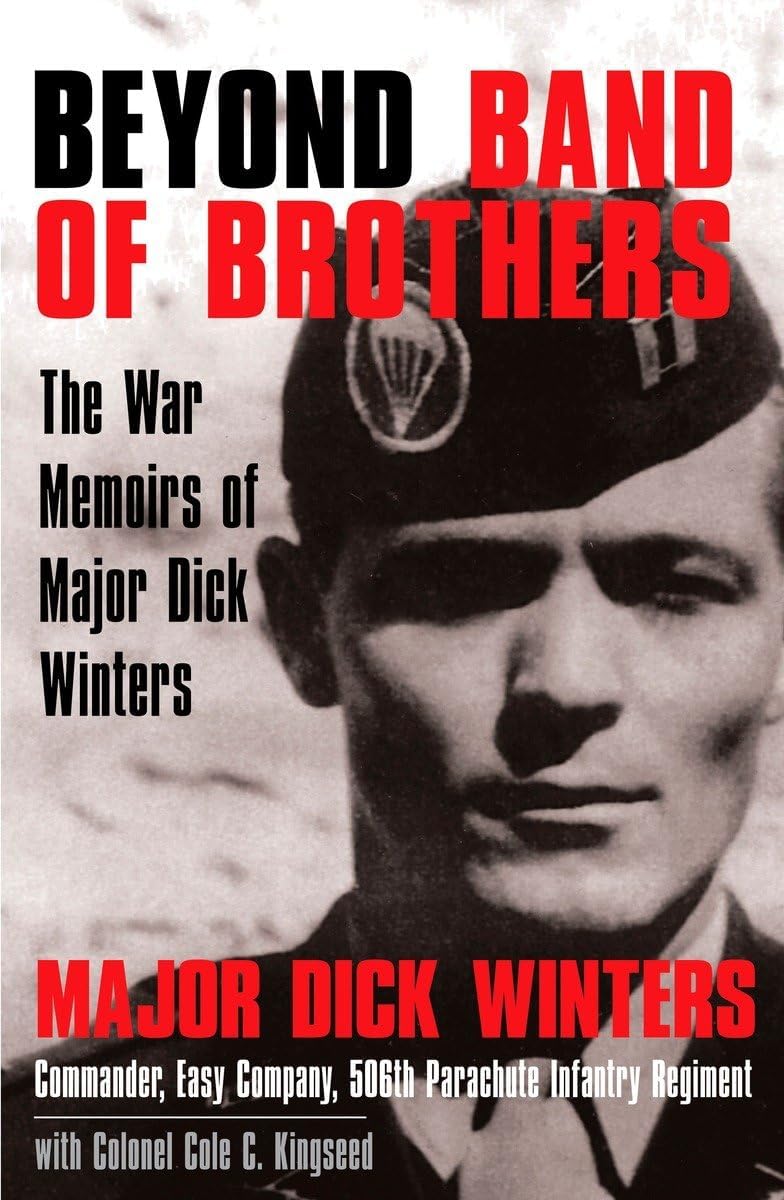
Beyond Band of Brothers: The War Memoirs of Major Dick Winters
Product ID: 37586277
Buy anything from 5,000+ international stores. One checkout price. No surprise fees. Join 2M+ shoppers on Desertcart.
Desertcart purchases this item on your behalf and handles shipping, customs, and support to Vanuatu.
Beyond Band of Brothers: The War Memoirs of Major Dick Winters [Winters, Dick, Kingseed, Cole C.] on desertcart.com. *FREE* shipping on qualifying offers. Beyond Band of Brothers: The War Memoirs of Major Dick Winters Review: The best officers account of airborne action - The cover notes this book was on the New York Times `bestseller' list and while this surely reflected his profile following the `Band of Brothers' miniseries, I am pleased to say it also had a lot to do with the quality of Winter's story as well. As is widely known, Winters served with Easy Company of the 506th PIR of the 101st Airborne Division. He takes over the company at the outset in Normandy and finishes the war as commander of the 2nd Battalion. Throughout he is one excellent soldier, who it's widely felt should've won the Medal of Honor for his action against the Brecourt battery. He writes extensively of this action and is surprisingly detailed, given the normal reticence of veterans, regarding killing his opponents. Indeed, he is quite crisp in the way he describes his actions. He also writes extensively about the battle of the Island in Holland. His perspective on how his leadership was crucial is very interesting, as is his thoughts on the absence of German leadership here. Winters writes at length on his training and time in England and in particular on his relationship with his company commander, Sobel. He essentially credits Sobel with creating the special bond that Easy company had - by driving everyone else together in mutual hatred of him. Winters describes many instances of petty bullying and Sobel's inadequacies, resulting in the NCO's `rebellion' prior to Normandy. It is amazing to read. Winters is also quite free with his thoughts on other characters, the material on Dike is fascinating but there is some wonderful stuff on Lt Spiers. Winters is forthright, more so than most of the authors on this list. He reveals much of interest, including the occasion when Spiers shot dead an NCO in Normandy for refusing to follow an order. Winters didn't hold this against him. He recognised that men like Spiers were the ones required to win the war. He writes of how much he valued the `killers' in E Co, the ones he went to when he really needed things to be done right - and violently. I think this particular characteristic of his was not as apparent in the mini series. On these grounds alone, I can say that this book is not just a rehash of Ambrose's work. Winters clearly went into battle to kill and he is more detailed than most on the engagements he fought in. He tried to join the 13th Airborne to serve in the Pacific but was told he'd done enough. Amusingly, these positions were reversed for Korea. I felt I really got to know Winters, certainly better than the other airborne officers listed here. His account, including his post war reflections, was many layered. For instance, he writes lovingly about the family he befriended in England, yet he also reveals he found battle exciting. So there are many dimensions to Winters and full credit to him for being so open about the extremes. In between there is lots of fascinating stuff about leadership in battle, being a soldier and about what made being in E company so special. He is also glowing in his praise of Ambrose. He updates the fates of many of his comrades and again, this is very interesting and even emotional. The special connection between these men is very evident. There is no false modesty, Winters is conscious of, and very proud of his achievements, not surprisingly the way he expresses this, is in terms that further reveal his veneration for his men. I found it to be a very satisfying read indeed but because his story is so familiar it is fair to say it had less impact than some of the other books I have read here. This said, I think Winters (with Kingseed's help) has done such a good job of telling his story, that it is a very worthwhile read and I think there is a wonderful pay-off for those who are interested in the topic of Easy Co. Taking everything into account, I'm going to rank it just under Burgett and level with Wurst as the most interesting of the airborne accounts. Review: A Heart-felt Legacy of Leadership and Respect - Are natural leaders born or made? It seems that Richard D. "Dick" Winters' life has been a quest to answer that question. And in the final chapters of _Beyond Band of Brothers: The War Memoirs of Major Dick Winters_, he does provide the answer. Winters, the level-headed commander of Easy Company, portrayed in Stephen E. Ambrose's book, turned HBO mini-series "Band of Brothers," needs no introduction. Written in the autumn of his years, Winters culls a lifetime of inner reflection and a quest to live in peace, after leading soldiers in some of the most deadly combat of World War II. The result is a frank, sometimes brutally honest testament to the moral fiber of the American citizen soldier, who shouldered an undying responsibility to God, country, family, and above all, the men he led into battle. Sixty years from now, when the events of the Second World War sink ever so deeper into the pages of history, Winters' message will still be sought. Like the men he led of Easy Company, he will gain the respect of new generations of soldiers, and, if events mirror those of his life, continue to save lives. As in a resent biography by Larry Alexander ( _Biggest Brother: ... _ [2005]) Winters pens only a dozen pages of his early life before delving right into his military career. Winters was the product of many good influences in his upbringing: his family, Mennonite background, a strong work ethic, and no vices. Unlike Alexander's gallant attempt to penetrate his subject without much success, Winters' prose is down to Earth. The sense the reader gets of the words coming from the horse's mouth is reassuring, and holds one's attention. Also unlike Alexander's biography, Winters refers to the correspondence with his wartime pen-pal, DeEtta Almon sparingly. Winters confesses early on that his aim in writing the book is to tell the stories that Ambrose and HBO left out. There are some new addenda. Sadly, Winters updates us of the most recent passing of the men from Easy Company we have come to know and admire for their portrayal in the film, and in the documentary, "We Stand Alone Together: The Men of Easy Company." It is evident that Winters loves and respects those men as much as they do him. For the most part, however, Winters' version holds true to Ambrose's book, and Hanks and Spielberg's film, barring artistic license of the latter, of course. One can easily detect the strong contribution Winters had on Ambrose's work. In some places, the narrative is so similar to Ambrose, one gets the impression Ambrose quoted Winters liberally, without the customary quotation marks. Winters admires the late historian immensely, however, and devotes a chapter to Ambrose at the end of the book. The bulk of Winters' memoir is devoted to the people and events that left an indelible mark on his life: the men and battles of Easy Company. He goes on at length about the man we have all come to despise: Herbert M. Sobel. Despite Sobel's brutal leadership style, Winters credits him with molding the character of the core of Toccoa men that made-up Easy Company. Winters offers his take on the myths surrounding Ronald Speirs, who was rumored to have murdered German prisoners, and shot an American sergeant who was allegedly drunk, and disobeyed an order to attack. Curiously, a strategically placed "typo" may perhaps be a loop-hole out of a possible slander suit...see if you can find it, and you be the judge. Likewise, Winters makes no qualms about utilizing what he called "my killers," in vital tactical situations, most notably, the silencing of four 105mm. guns at Brecourt Manor, the textbook execution that was without a doubt, Winters' crowning moment in combat. For devoted "Band of Brothers" fans, the two individuals he singles out will not surprise. There are also heart-felt accolades for his two closest friends, Lewis Nixon, and Harry Welsh, as well as, a cadre of Easy Company enlisted men, most notably, Floyd Talbert, and Carwood Lipton, just to name a few. The loving relationship Winters formed with the English couple he was quartered with at Aldbourne, Wiltshire, his "second parents," never left him. Winters' life after the war is treated as briefly as his life before. Winters was a self professed "ninety-day wonder," whose warrior spirit was molded running up Currahee, and tempered in combat. As a combat leader, he felt there was no place for him in a peacetime, and "chickens**t army." His chapter spelling out his principles of good leadership should be memorized by every aspiring military officer or corporate manager. So were Winters' leadership abilities innate, or nurtured? That is for the reader to decide. We are indeed privileged to have this memoir of a truly extraordinary and humble man. But I am sure he would be the first to agree, that there were probably scores of Dick Winters who fought their way across the fields of Europe, or the deserted islands of the Pacific. Many lie beneath thousands of white marble crosses, or Stars of David. Many more, like the men Winters led, are embarrassed by the word "hero," and prefer to remain silent. Dick Winters is their messenger, their representative, and a model field grade officer of the Second World War. The media has made Winters a celebrity, and his peaceful life that he promised himself on D-Day has been shattered by well-wishing, and autograph seeking fans from all over the world. There is even a campaign to up-grade his Distinguished Service Cross to a Medal of Honor. This memoir is, I suspect, Winters' final word on the subject. Read it! Learn from its many lessons, and respect the officers and men of Easy Company. That is Dick Winters' legacy, and worth more to him than a chest full of medals.
| ASIN | 0425208133 |
| Best Sellers Rank | #46,608 in Books ( See Top 100 in Books ) #7 in United States Military Veterans History #26 in WWII Biographies #65 in World War II History (Books) |
| Customer Reviews | 4.8 4.8 out of 5 stars (5,253) |
| Dimensions | 6.2 x 1.2 x 9.3 inches |
| Edition | First Edition |
| ISBN-10 | 9780425208137 |
| ISBN-13 | 978-0425208137 |
| Item Weight | 1.2 pounds |
| Language | English |
| Print length | 320 pages |
| Publication date | February 7, 2006 |
| Publisher | Dutton Caliber |
J**N
The best officers account of airborne action
The cover notes this book was on the New York Times `bestseller' list and while this surely reflected his profile following the `Band of Brothers' miniseries, I am pleased to say it also had a lot to do with the quality of Winter's story as well. As is widely known, Winters served with Easy Company of the 506th PIR of the 101st Airborne Division. He takes over the company at the outset in Normandy and finishes the war as commander of the 2nd Battalion. Throughout he is one excellent soldier, who it's widely felt should've won the Medal of Honor for his action against the Brecourt battery. He writes extensively of this action and is surprisingly detailed, given the normal reticence of veterans, regarding killing his opponents. Indeed, he is quite crisp in the way he describes his actions. He also writes extensively about the battle of the Island in Holland. His perspective on how his leadership was crucial is very interesting, as is his thoughts on the absence of German leadership here. Winters writes at length on his training and time in England and in particular on his relationship with his company commander, Sobel. He essentially credits Sobel with creating the special bond that Easy company had - by driving everyone else together in mutual hatred of him. Winters describes many instances of petty bullying and Sobel's inadequacies, resulting in the NCO's `rebellion' prior to Normandy. It is amazing to read. Winters is also quite free with his thoughts on other characters, the material on Dike is fascinating but there is some wonderful stuff on Lt Spiers. Winters is forthright, more so than most of the authors on this list. He reveals much of interest, including the occasion when Spiers shot dead an NCO in Normandy for refusing to follow an order. Winters didn't hold this against him. He recognised that men like Spiers were the ones required to win the war. He writes of how much he valued the `killers' in E Co, the ones he went to when he really needed things to be done right - and violently. I think this particular characteristic of his was not as apparent in the mini series. On these grounds alone, I can say that this book is not just a rehash of Ambrose's work. Winters clearly went into battle to kill and he is more detailed than most on the engagements he fought in. He tried to join the 13th Airborne to serve in the Pacific but was told he'd done enough. Amusingly, these positions were reversed for Korea. I felt I really got to know Winters, certainly better than the other airborne officers listed here. His account, including his post war reflections, was many layered. For instance, he writes lovingly about the family he befriended in England, yet he also reveals he found battle exciting. So there are many dimensions to Winters and full credit to him for being so open about the extremes. In between there is lots of fascinating stuff about leadership in battle, being a soldier and about what made being in E company so special. He is also glowing in his praise of Ambrose. He updates the fates of many of his comrades and again, this is very interesting and even emotional. The special connection between these men is very evident. There is no false modesty, Winters is conscious of, and very proud of his achievements, not surprisingly the way he expresses this, is in terms that further reveal his veneration for his men. I found it to be a very satisfying read indeed but because his story is so familiar it is fair to say it had less impact than some of the other books I have read here. This said, I think Winters (with Kingseed's help) has done such a good job of telling his story, that it is a very worthwhile read and I think there is a wonderful pay-off for those who are interested in the topic of Easy Co. Taking everything into account, I'm going to rank it just under Burgett and level with Wurst as the most interesting of the airborne accounts.
G**S
A Heart-felt Legacy of Leadership and Respect
Are natural leaders born or made? It seems that Richard D. "Dick" Winters' life has been a quest to answer that question. And in the final chapters of _Beyond Band of Brothers: The War Memoirs of Major Dick Winters_, he does provide the answer. Winters, the level-headed commander of Easy Company, portrayed in Stephen E. Ambrose's book, turned HBO mini-series "Band of Brothers," needs no introduction. Written in the autumn of his years, Winters culls a lifetime of inner reflection and a quest to live in peace, after leading soldiers in some of the most deadly combat of World War II. The result is a frank, sometimes brutally honest testament to the moral fiber of the American citizen soldier, who shouldered an undying responsibility to God, country, family, and above all, the men he led into battle. Sixty years from now, when the events of the Second World War sink ever so deeper into the pages of history, Winters' message will still be sought. Like the men he led of Easy Company, he will gain the respect of new generations of soldiers, and, if events mirror those of his life, continue to save lives. As in a resent biography by Larry Alexander ( _Biggest Brother: ... _ [2005]) Winters pens only a dozen pages of his early life before delving right into his military career. Winters was the product of many good influences in his upbringing: his family, Mennonite background, a strong work ethic, and no vices. Unlike Alexander's gallant attempt to penetrate his subject without much success, Winters' prose is down to Earth. The sense the reader gets of the words coming from the horse's mouth is reassuring, and holds one's attention. Also unlike Alexander's biography, Winters refers to the correspondence with his wartime pen-pal, DeEtta Almon sparingly. Winters confesses early on that his aim in writing the book is to tell the stories that Ambrose and HBO left out. There are some new addenda. Sadly, Winters updates us of the most recent passing of the men from Easy Company we have come to know and admire for their portrayal in the film, and in the documentary, "We Stand Alone Together: The Men of Easy Company." It is evident that Winters loves and respects those men as much as they do him. For the most part, however, Winters' version holds true to Ambrose's book, and Hanks and Spielberg's film, barring artistic license of the latter, of course. One can easily detect the strong contribution Winters had on Ambrose's work. In some places, the narrative is so similar to Ambrose, one gets the impression Ambrose quoted Winters liberally, without the customary quotation marks. Winters admires the late historian immensely, however, and devotes a chapter to Ambrose at the end of the book. The bulk of Winters' memoir is devoted to the people and events that left an indelible mark on his life: the men and battles of Easy Company. He goes on at length about the man we have all come to despise: Herbert M. Sobel. Despite Sobel's brutal leadership style, Winters credits him with molding the character of the core of Toccoa men that made-up Easy Company. Winters offers his take on the myths surrounding Ronald Speirs, who was rumored to have murdered German prisoners, and shot an American sergeant who was allegedly drunk, and disobeyed an order to attack. Curiously, a strategically placed "typo" may perhaps be a loop-hole out of a possible slander suit...see if you can find it, and you be the judge. Likewise, Winters makes no qualms about utilizing what he called "my killers," in vital tactical situations, most notably, the silencing of four 105mm. guns at Brecourt Manor, the textbook execution that was without a doubt, Winters' crowning moment in combat. For devoted "Band of Brothers" fans, the two individuals he singles out will not surprise. There are also heart-felt accolades for his two closest friends, Lewis Nixon, and Harry Welsh, as well as, a cadre of Easy Company enlisted men, most notably, Floyd Talbert, and Carwood Lipton, just to name a few. The loving relationship Winters formed with the English couple he was quartered with at Aldbourne, Wiltshire, his "second parents," never left him. Winters' life after the war is treated as briefly as his life before. Winters was a self professed "ninety-day wonder," whose warrior spirit was molded running up Currahee, and tempered in combat. As a combat leader, he felt there was no place for him in a peacetime, and "chickens**t army." His chapter spelling out his principles of good leadership should be memorized by every aspiring military officer or corporate manager. So were Winters' leadership abilities innate, or nurtured? That is for the reader to decide. We are indeed privileged to have this memoir of a truly extraordinary and humble man. But I am sure he would be the first to agree, that there were probably scores of Dick Winters who fought their way across the fields of Europe, or the deserted islands of the Pacific. Many lie beneath thousands of white marble crosses, or Stars of David. Many more, like the men Winters led, are embarrassed by the word "hero," and prefer to remain silent. Dick Winters is their messenger, their representative, and a model field grade officer of the Second World War. The media has made Winters a celebrity, and his peaceful life that he promised himself on D-Day has been shattered by well-wishing, and autograph seeking fans from all over the world. There is even a campaign to up-grade his Distinguished Service Cross to a Medal of Honor. This memoir is, I suspect, Winters' final word on the subject. Read it! Learn from its many lessons, and respect the officers and men of Easy Company. That is Dick Winters' legacy, and worth more to him than a chest full of medals.
A**R
Excellent
Very well written. This is among the best war memoirs I’ve read, and I’ve read many.
F**N
great wartime memoirs from a true leader
L**I
Very interesting view on matters that were little or not at all discussed in band of brothers. Very much recommended.
M**E
Arrived in perfect nick. Not a scratch, no damage.
R**R
For anyone interested in the 101st, this is certainly one of the books to read, together with Ambrose’s “Band of Brothers”. If the mini-series by Tom Hanks and Stephen Spielberg has been watched prior to reading, the characters will quickly blend and, for the most part, fit neatly together. The first fifty pages are devoted to his family history but mainly the creation and development of a parachute regiment which latter became the 101st. His assessment of the officers and men is detailed and, in my mind, very fair, none more so than Captain Sobel, the character played by David Schwimmer. Although he sees all Sobel’s faults as an officer, Winters credits Sobel with the fundamental development of the “raw recruits” into a fit and formidable fighting force, sometimes, despite their own efforts and dislike of Sobel. His tough fitness regime centred on Curahee, the mountain, developed a unique bond in the men, a tight bond forged by their dislike of Sobel. Winter’s detailed description of the training and the various camps, provides a real insight into the American’s training regimes, the development of a unique regiment and the characters involved. No amount of training could have prepared them for the reality of an airdrop into a battle zone; Winters described pilots desperately trying to maintain height and course surrounded by anti-aircraft fire, other planes engulfed in flames dropping from the skies. One of these was Easy’s command plane which meant; he realised that, when they landed, he was Easy’s commander. He mentions passing over Ste Mere-Eglise, lit up by a fire. Most planes missed their drop zones. Some by as much as fourteen miles but, as he points out, it was just as well. Many drop zones were surrounded by machine gun posts. Later in the campaign, Winters recalls an incident: “‘I can’t see. I can’t see!” he [Blithe] replied. I remember trying to comfort him by saying, ‘It’s okay, Blithe. Relax. They’ll soon have you out of here, and they’ll send yu back to England.’ As I started to move away, Blithe stood up, saying suddenly, ‘I’m okay. I’m okay. I can see now.’” Winters comment on the toughness, guts and determination. Terrified and blinded by fear, the thoughts of being airlifted to England, away from Easy, was too much. (P.185) It would be pointless to “rewrite” or attempt to summarise this book in order to understand Major Winters, Easy Company, War and what it does to people - on both sides. Winters’ detailed descriptions do all of that - and more. To end this review of a highly recommended, well-written book, he writes about his realisation of why they were fighting when they enter the Landsberg-Buchloe area and the discovery of the concentration camps. He comments that it is natural in war to ask: “Why am I here?” “The impact of seeing those people behind the fence left me saying, if only to myself: Now I know why I am here! For the first time I understand what this war was all about.” (P.215) A review would not be complete without mentioning Bastogne, Austria and Bechtesgaden and the Eagle’s Nest, each of which has made the 101st famous today. Winters describes each in detail from a commander’s point of view and illustrates what made him such a great CO. However, what fascinates me are his observations on war in general, people who wage it the effects it has; this is nowhere made clearer than P. 234, after the war, governing Austria. He meets a Nazi officer who, it turns out, had been fighting against him at Bastogne. Winters has great respect for his opponent and they strike up a friendship, during which the officer surrenders his side-arm, a Luger. “The day following our revelations [about Bastogne], he presented me his pistol as a token of friendship between us and as a formal surrender to his captor.He did so of his own volition rather than leaving his pistol on a desk in some office. When he handed me his sidearm , I noticed the pistol had never been fired. There was no blood on it. It remains one of the few momentos I have kept from the war. The pistol has still not been fired and it never will be. This is the way wars ought to end. Let the generals and politicians participate in elaborate ceremonies. At the soldier level, a peaceful transfer of weapons, a smart salute …” For anyone interested in D-Day, 101st Airborne, WWII, war in general, turning a book into a mini-series, learning about human nature or Major Winters himself, I highly recommend this book. NOTE: My paperback edition was published by Ebury Publishing, 2011, ISBN 9780091941581
C**L
Brother's love
Trustpilot
2 weeks ago
3 weeks ago