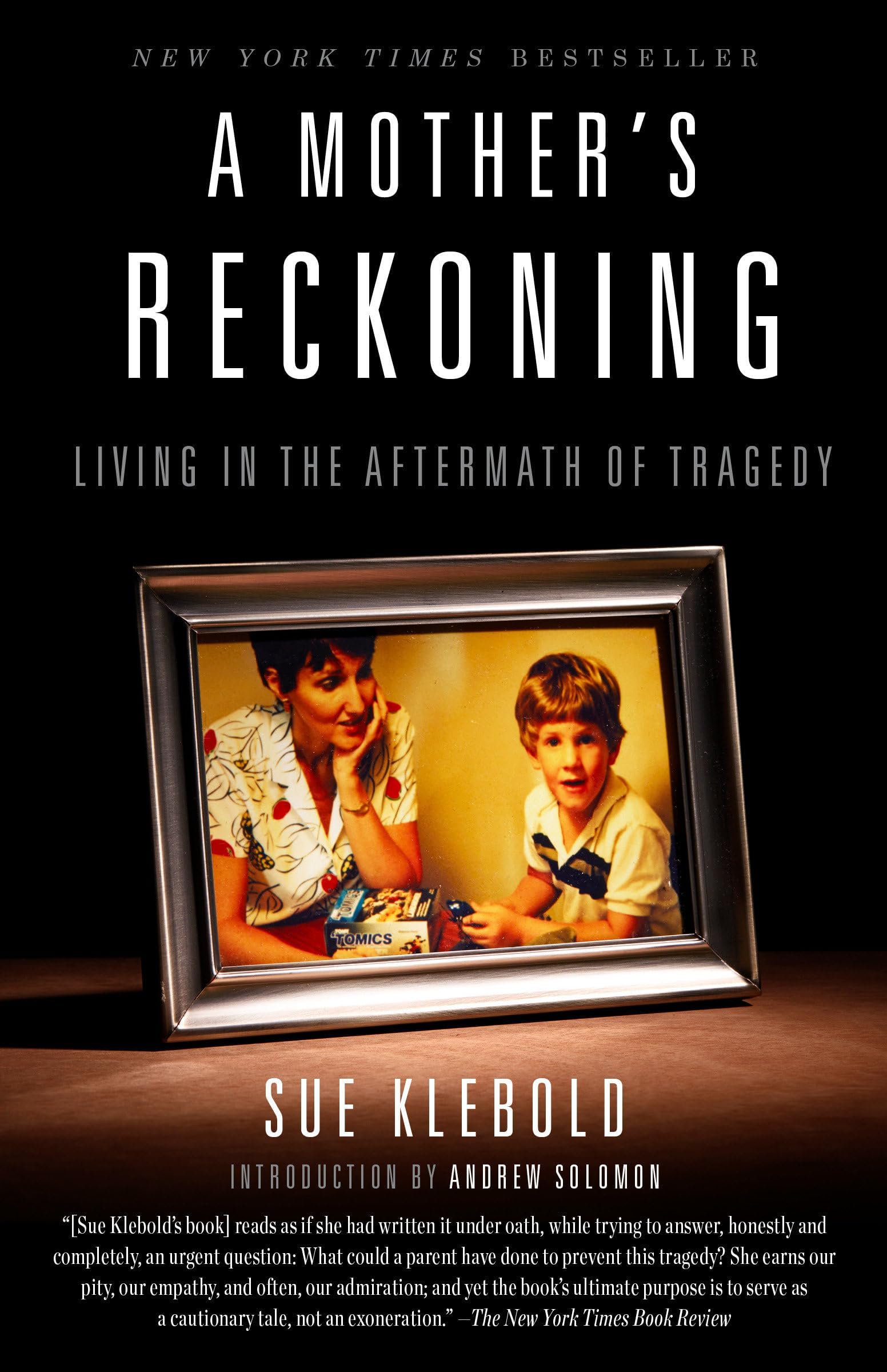
A Mother's Reckoning: Living in the Aftermath of Tragedy
Product ID: 39007728
Buy anything from 5,000+ international stores. One checkout price. No surprise fees. Join 2M+ shoppers on Desertcart.
Desertcart purchases this item on your behalf and handles shipping, customs, and support to Vanuatu.
A Mother's Reckoning: Living in the Aftermath of Tragedy [Klebold, Sue, Solomon, Andrew] on desertcart.com. *FREE* shipping on qualifying offers. A Mother's Reckoning: Living in the Aftermath of Tragedy Review: A very difficult book to read ~ A sad story, but one that had to be told - Since so many of the negative reviews for this book state that Sue Klebold wrote it for monetary profit, I would like to set the record straight. The author profits from the book are being donated to research and to charitable foundations focusing on mental health issues. I think it's important that people know this prior to reading the book, as it removes any doubt that Sue Klebold wrote it for purposes other than to tell her side of the story and to educate the public on hidden mental health issues in teenagers. This is the most difficult book to review that I've ever read. I'm giving it 5 stars for the quality of Sue Klebold's writing, but I have to admit that at times while reading it; I was somewhat put off by her constant praising of her son Dylan. With that said; this is an extremely compelling story of a life gone wrong, and the impact that it had on a small town, state, country, and the entire world. I immensely respect the opinions of the author, and fully understand that the story she tells is exactly as she sees it. It's one thing to be the mother of the son of a suicidal mass murderer, and quite another to be a reader who can in no way know the entire background of the story without having actually lived it. This is the story of a mother who loved her son, continues to do so to this day, and through no fault of her own, missed the signals that something was terribly wrong. This is also the story of a woman who cares deeply about the victims, their families and the survivors. While it may appear to casual readers such as myself that she's proselytizing the attributes of her son; she does so knowing that it will offend some people, but more importantly because at least in her eyes, it's the truth as she sees it. While it's written honestly and with a great deal of compassion and empathy; I personally still have trouble coming to terms with the manner in which she writes about her son Dylan. As mentioned above; it's quite different to view this event through my eyes, than those of the author. I'm trying to be as objective as possible and to place myself in a similar situation to hers, but find that impossible to do. After completing the first part of the book; I was upset by her effort to diminish blame for the Columbine tragedy on her son and his accomplice, Eric Harris. I couldn't help from feeling as if Sue Klebold was trying to portray her son as just a slightly troubled teenager, no different than any other teenager that you see everyday. I felt as if the first part of the book delved much too heavily on how wonderful Dylan was, and far too little on the devastating consequences of what he and Eric did. Than again, I ask myself if I would have reacted any differently. As the book progressed, she finally started to address the victims of this horrendous crime. I believe that Sue Klebold was being completely honest throughout the book, but despite her good intentions; I was still left with the feeling that too much time was spent on her trying to absolve herself from guilt, and too little time spent on addressing the fact that there were real warning signs that possibly could have prevented this horrendous calamity. She mentions that both Dylan and Eric were arrested the previous year for breaking into a van. She also mentions that her son wrote a paper that was so graphically disturbing that she and her husband were summoned to the school to learn of its contents. Than, as I continued to read the book; I kept second guessing my own opinions of her. One moment I was viewing her in a very negative way, the next moment I felt total empathy and compassion for Sue Klebold. I kept telling myself that it wasn't my right to question her motives, after all, she's the one who lived through it, not me. To me, there were plenty of warning signs. Obviously, regardless of these signs, no one would ever expect that their child would be capable of committing such an atrocity. Yet, with these warning signs being front and center; it would certainly have been enough for intervention to have taken place. Obviously they weren't, but why not. It's easy for me to say that faced with the same set of signals, I would have reacted differently. Who knows; unless you've lived it first person, how can you know for sure that you would have heeded the warning signs. Teenagers are adept at hiding their feelings, and although many of the same signals play out on a daily basis in homes across America, crimes such as this, don't. While the actions of Dylan Klebold and Eric Harris should be viewed as abominable, the fact that Dylan suffered from hidden depression plays a major role in his behavior. It's nearly impossible for me to be critical of Sue and Tom Klebold, as no one can possibly know what it was really like to be in their shoes, except themselves. Speaking only for myself; I'd like to think that presented with the warning signs mentioned above, I would have intervened. Perhaps I too would have been blindsided, as she says they were. Yes, it's hard for me to imagine such a scenario, but than again, how do I know for sure that I wouldn't have been blindsided too. I most certainly feel incredible empathy for what her family has gone through, but on the other hand, after reading the book; had I been one of the parents of the victims or one of the injured survivors; I would have felt as if she was being somewhat disingenuous in her portrayal of the situation. This is not meant to diminish her portrayal of the way things played out. I honestly believe that Sue Klebold feels as if she was honest and forthright in her appraisal of the situation, but I'm left with the uncomfortable feeling that this book is more about making her feel better, than about addressing the disaster straight on. That is, until I continued reading. It becomes obvious that Sue Klebold is a kind, compassionate person. She is not to blame for what her son did. As atrocious as his and Eric's actions were; they were not the result of bad parenting on the part of the Klebold's. It gives me no pleasure to at times being critical of this book. I think it's nearly impossible to read it without getting upset and shaken to the core. The subject matter is incredibly sad, as is the situation that the Klebold family and all of the victims families are in, and will be for the rest of their lives. Had the book been more oriented on the devastating impact of Dylan's and Eric's despicable actions; I would have finished it feeling that justice had been done to the story. Having completed it; I now realize that it's not possible for justice to be served. Without diminishing the fact that Sue Klebold obviously feels tremendous pain at what her son did; I'm still left feeling as if she spent too much time talking about the virtues of her son. That's when I come to realize that she does so in order to drive home the fact that in most ways he was a normal, loving child. It leaves the reader wondering, if such a loving son, from such a loving family, could commit such a despicable act of violence, couldn't the same thing take place from other loving homes. Everything about this book leaves you wondering, questioning, asking what's right and what's wrong. In the end, there simply are no definitive answers. Toward the middle and end of the book, there's a lot of talk about child suicide and how depression can be masked so well by teenagers. I'm not doubting any of this. What I find troubling is that there's a heavy emphasis throughout the book on Dylan's suicide, but not enough on the homicide that he committed. Granted; Sue Klebold is writing about her son for whom she has unconditional love. I know that I wouldn't have the ability to talk about my own son in such a positive light, had he committed such a horrendous crime. Once again, since I'm not in her situation; it's impossible to know how I would react. I guess what I'm trying to say, is that faced with a similar situation; I believe I would not be able to ever feel unconditional love toward the perpetrator of such a crime, regardless of who it was. My heart would bleed for the victims and the families, at least that's how I think I would react. Sue Klebold does not make excuses for what Dylan did, but she tries to explain that due to his hidden depression, he was suicidal. Once he teamed up with Eric Harris, the suicidal intentions became a carefully planned mass murder, with suicide as the anti-climatic finish. This was a well though out out plan; it's incredibly sad that no one saw it coming. In summary; I come away from reading this book with mixed emotions. The writing is superb, and I do feel as if the author is speaking from her heart. I believe that she's being totally honest when she talks about how much she loved and continues to love her son. I believe that her compassion toward the victims families is genuine and heartfelt. Her extensive coverage of suicide prevention, knowing the signs of depression, etc. is to be commended. I believe her when she says that her family saw no warning signs to the impending disaster. It's just that I want to believe that faced with a similar scenario; I would have been more aware of these signs. While they obviously didn't see them; the warning signs were there. Her son did a terrible thing. This is a no win situation, and regardless of how I feel, nothing will reverse the course of history. I only wish that the author had spent a little less time praising her son, and a little more time coming to terms with the devastation that he caused to so many people. While it was an integral part of the story, I felt as if there was too much time spent talking about the lawsuits against the family. Finally; I know that there were many survivors of the tragedy who will be physically and mentally challenged for the rest of their lives. Some are unable to walk, others have other physical disabilities. All are emotionally scarred for life. Sue Klebold wrote compelling letters to all of the survivors. In addition, she wrote letters to the families of the deceased. These were heartfelt, sincere letters that were extremely difficult for her to write. This is a caring woman who was dealt a horrible blow. The actions of her son can never be forgiven, but to blame her for what her son did is wrong. What he and Eric did is beyond comprehension, but aside from missing signals that any parent could miss, it's not fair to blame the messenger. Yes, I'm still left with the feeling that something could have been done to prevent this tragedy. After reading the book, however, I'm not placing blame on anyone. Placing blame accomplishes nothing, and faced with the exact same set of circumstances, I have no doubt that many people would have done things exactly the same way. I don't think that Sue Klebold is in denial; I actually feel quite the opposite. This book was her sincere effort to explain how her son was raised, and how, despite the loving home he lived in, something went dreadfully wrong. There is no doubt that this kid was loved, no doubt whatsoever. Perhaps had it not been for Eric Harris, this catastrophe may have been averted. It would be nice to hear from the Harris family, but it's unlikely that we will. It does appear that Eric Harris was the lightning rod behind this event, but without additional information, we'll never know for sure. Certainly, both boys are responsible for the carnage. I don't think that it's possible for any of us to truly know all of the answers to this incredibly sad story; we can only move on and learn. I wish the best to Sue Klebold and her family. I especially wish the best to the victims families, and to all of the survivors who are coping with this tragedy every day of their lives. It's difficult to imagine what it's been like for the survivors and for the victims families. April 20, 1999 changed their lives forever. The immense power of empathy is needed for every person affected by this awful event. Hopefully the passage of time will heal. Perhaps forgiveness is the only way to truly survive this unthinkable tragedy. Review: Unflinching Glimpse into Unthinkable Grief - I was a senior in high school in 1999 when the Columbine massacre took place. I remember signing a giant banner to be mailed to Littleton and I struggled with what to write in condolence. I believe I said something to the effect of "May God hold you in His arms." What can one possibly say to people bereaved by loss this horrific? The Columbine tragedy set off a series of copy cat events across our nation. In fact, at my high school graduation in June we did not walk across a stage, because school administrators were rightfully terrified of another "event". My name was called and I walked across the 50 yard line clutching my shiny new diploma. I marched right out of that stadium and into my new life. Throughout my life I've often thought of the victims, denied their own graduation march... they should be graduating HS, graduating college, starting jobs, buying homes, marrying, have children of their own... I've always been haunted by Columbine, it seemed so utterly shocking to me; it is still shocking. It was perhaps the first time I was ever truly rattled by a world event. This felt all too close to home and I had a deep desire to know the unknowable "why". I felt the answer must begin at home with the parents of the perpetrators. I had many questions, paramount among them, how could they not know? How could it be be possible to live with someone horribly depraved and not know? Sue Klebold, mother of Dylan, one of the killers bravely bares her soul in her new memoir "A Mother's Reckoning". In it she describes what she missed, what she would do differently, and how to recognize depression and suicidal thoughts in a loved one. It is a powerful read and I was left humbled. Not only is Ms. Klebold articulate and sincere she has filled these pages with profound insights into mental health issues. It is as honest and open of a memoir as one could ever hope to read. It teaches, using the most devastating first hand account, why we must work to educate ourselves to recognize the signs of depression and suicide. It further teaches why mental health disorders should be destigmatized and treated like we would treat other ailmentents. Sue spares nothing in this unflinching account of her bewilderment, shame, and grief. She has struggled and still struggles to reconcile the loving son she knew with the horrors he caused. This book will open your eyes and shatter preconceived notions about this family. I wish I could take Sue in my arms and hold her. I sincerely hope that she is able to find a measure of peace in bravely sharing her story. In remembering the devestation of Columbine it is easy to forget that Dylan walked into that school wanting to die. When one understands this piece of the puzzle it becomes more plausible to try to grasp the other facets of the tragedy. I believe everyone should read this book. Only when we begin to understand how to treat and diagnose mental health issues can we hope to end the violence that has plagued our nation. This is a book about the enormity of grief, about mental health, the exorbitant tragedy of suicide, and how mental disorders left unchecked can unfurl in tragedy so profound it can haunt a nation.


| Best Sellers Rank | #48,289 in Books ( See Top 100 in Books ) #105 in Murder & Mayhem True Accounts #356 in Memoirs (Books) #548 in Women's Biographies |
| Customer Reviews | 4.5 4.5 out of 5 stars (7,184) |
| Dimensions | 5.1 x 0.7 x 8 inches |
| Edition | Reprint |
| ISBN-10 | 1101902779 |
| ISBN-13 | 978-1101902776 |
| Item Weight | 2.31 pounds |
| Language | English |
| Print length | 336 pages |
| Publication date | February 7, 2017 |
| Publisher | Crown |
E**S
A very difficult book to read ~ A sad story, but one that had to be told
Since so many of the negative reviews for this book state that Sue Klebold wrote it for monetary profit, I would like to set the record straight. The author profits from the book are being donated to research and to charitable foundations focusing on mental health issues. I think it's important that people know this prior to reading the book, as it removes any doubt that Sue Klebold wrote it for purposes other than to tell her side of the story and to educate the public on hidden mental health issues in teenagers. This is the most difficult book to review that I've ever read. I'm giving it 5 stars for the quality of Sue Klebold's writing, but I have to admit that at times while reading it; I was somewhat put off by her constant praising of her son Dylan. With that said; this is an extremely compelling story of a life gone wrong, and the impact that it had on a small town, state, country, and the entire world. I immensely respect the opinions of the author, and fully understand that the story she tells is exactly as she sees it. It's one thing to be the mother of the son of a suicidal mass murderer, and quite another to be a reader who can in no way know the entire background of the story without having actually lived it. This is the story of a mother who loved her son, continues to do so to this day, and through no fault of her own, missed the signals that something was terribly wrong. This is also the story of a woman who cares deeply about the victims, their families and the survivors. While it may appear to casual readers such as myself that she's proselytizing the attributes of her son; she does so knowing that it will offend some people, but more importantly because at least in her eyes, it's the truth as she sees it. While it's written honestly and with a great deal of compassion and empathy; I personally still have trouble coming to terms with the manner in which she writes about her son Dylan. As mentioned above; it's quite different to view this event through my eyes, than those of the author. I'm trying to be as objective as possible and to place myself in a similar situation to hers, but find that impossible to do. After completing the first part of the book; I was upset by her effort to diminish blame for the Columbine tragedy on her son and his accomplice, Eric Harris. I couldn't help from feeling as if Sue Klebold was trying to portray her son as just a slightly troubled teenager, no different than any other teenager that you see everyday. I felt as if the first part of the book delved much too heavily on how wonderful Dylan was, and far too little on the devastating consequences of what he and Eric did. Than again, I ask myself if I would have reacted any differently. As the book progressed, she finally started to address the victims of this horrendous crime. I believe that Sue Klebold was being completely honest throughout the book, but despite her good intentions; I was still left with the feeling that too much time was spent on her trying to absolve herself from guilt, and too little time spent on addressing the fact that there were real warning signs that possibly could have prevented this horrendous calamity. She mentions that both Dylan and Eric were arrested the previous year for breaking into a van. She also mentions that her son wrote a paper that was so graphically disturbing that she and her husband were summoned to the school to learn of its contents. Than, as I continued to read the book; I kept second guessing my own opinions of her. One moment I was viewing her in a very negative way, the next moment I felt total empathy and compassion for Sue Klebold. I kept telling myself that it wasn't my right to question her motives, after all, she's the one who lived through it, not me. To me, there were plenty of warning signs. Obviously, regardless of these signs, no one would ever expect that their child would be capable of committing such an atrocity. Yet, with these warning signs being front and center; it would certainly have been enough for intervention to have taken place. Obviously they weren't, but why not. It's easy for me to say that faced with the same set of signals, I would have reacted differently. Who knows; unless you've lived it first person, how can you know for sure that you would have heeded the warning signs. Teenagers are adept at hiding their feelings, and although many of the same signals play out on a daily basis in homes across America, crimes such as this, don't. While the actions of Dylan Klebold and Eric Harris should be viewed as abominable, the fact that Dylan suffered from hidden depression plays a major role in his behavior. It's nearly impossible for me to be critical of Sue and Tom Klebold, as no one can possibly know what it was really like to be in their shoes, except themselves. Speaking only for myself; I'd like to think that presented with the warning signs mentioned above, I would have intervened. Perhaps I too would have been blindsided, as she says they were. Yes, it's hard for me to imagine such a scenario, but than again, how do I know for sure that I wouldn't have been blindsided too. I most certainly feel incredible empathy for what her family has gone through, but on the other hand, after reading the book; had I been one of the parents of the victims or one of the injured survivors; I would have felt as if she was being somewhat disingenuous in her portrayal of the situation. This is not meant to diminish her portrayal of the way things played out. I honestly believe that Sue Klebold feels as if she was honest and forthright in her appraisal of the situation, but I'm left with the uncomfortable feeling that this book is more about making her feel better, than about addressing the disaster straight on. That is, until I continued reading. It becomes obvious that Sue Klebold is a kind, compassionate person. She is not to blame for what her son did. As atrocious as his and Eric's actions were; they were not the result of bad parenting on the part of the Klebold's. It gives me no pleasure to at times being critical of this book. I think it's nearly impossible to read it without getting upset and shaken to the core. The subject matter is incredibly sad, as is the situation that the Klebold family and all of the victims families are in, and will be for the rest of their lives. Had the book been more oriented on the devastating impact of Dylan's and Eric's despicable actions; I would have finished it feeling that justice had been done to the story. Having completed it; I now realize that it's not possible for justice to be served. Without diminishing the fact that Sue Klebold obviously feels tremendous pain at what her son did; I'm still left feeling as if she spent too much time talking about the virtues of her son. That's when I come to realize that she does so in order to drive home the fact that in most ways he was a normal, loving child. It leaves the reader wondering, if such a loving son, from such a loving family, could commit such a despicable act of violence, couldn't the same thing take place from other loving homes. Everything about this book leaves you wondering, questioning, asking what's right and what's wrong. In the end, there simply are no definitive answers. Toward the middle and end of the book, there's a lot of talk about child suicide and how depression can be masked so well by teenagers. I'm not doubting any of this. What I find troubling is that there's a heavy emphasis throughout the book on Dylan's suicide, but not enough on the homicide that he committed. Granted; Sue Klebold is writing about her son for whom she has unconditional love. I know that I wouldn't have the ability to talk about my own son in such a positive light, had he committed such a horrendous crime. Once again, since I'm not in her situation; it's impossible to know how I would react. I guess what I'm trying to say, is that faced with a similar situation; I believe I would not be able to ever feel unconditional love toward the perpetrator of such a crime, regardless of who it was. My heart would bleed for the victims and the families, at least that's how I think I would react. Sue Klebold does not make excuses for what Dylan did, but she tries to explain that due to his hidden depression, he was suicidal. Once he teamed up with Eric Harris, the suicidal intentions became a carefully planned mass murder, with suicide as the anti-climatic finish. This was a well though out out plan; it's incredibly sad that no one saw it coming. In summary; I come away from reading this book with mixed emotions. The writing is superb, and I do feel as if the author is speaking from her heart. I believe that she's being totally honest when she talks about how much she loved and continues to love her son. I believe that her compassion toward the victims families is genuine and heartfelt. Her extensive coverage of suicide prevention, knowing the signs of depression, etc. is to be commended. I believe her when she says that her family saw no warning signs to the impending disaster. It's just that I want to believe that faced with a similar scenario; I would have been more aware of these signs. While they obviously didn't see them; the warning signs were there. Her son did a terrible thing. This is a no win situation, and regardless of how I feel, nothing will reverse the course of history. I only wish that the author had spent a little less time praising her son, and a little more time coming to terms with the devastation that he caused to so many people. While it was an integral part of the story, I felt as if there was too much time spent talking about the lawsuits against the family. Finally; I know that there were many survivors of the tragedy who will be physically and mentally challenged for the rest of their lives. Some are unable to walk, others have other physical disabilities. All are emotionally scarred for life. Sue Klebold wrote compelling letters to all of the survivors. In addition, she wrote letters to the families of the deceased. These were heartfelt, sincere letters that were extremely difficult for her to write. This is a caring woman who was dealt a horrible blow. The actions of her son can never be forgiven, but to blame her for what her son did is wrong. What he and Eric did is beyond comprehension, but aside from missing signals that any parent could miss, it's not fair to blame the messenger. Yes, I'm still left with the feeling that something could have been done to prevent this tragedy. After reading the book, however, I'm not placing blame on anyone. Placing blame accomplishes nothing, and faced with the exact same set of circumstances, I have no doubt that many people would have done things exactly the same way. I don't think that Sue Klebold is in denial; I actually feel quite the opposite. This book was her sincere effort to explain how her son was raised, and how, despite the loving home he lived in, something went dreadfully wrong. There is no doubt that this kid was loved, no doubt whatsoever. Perhaps had it not been for Eric Harris, this catastrophe may have been averted. It would be nice to hear from the Harris family, but it's unlikely that we will. It does appear that Eric Harris was the lightning rod behind this event, but without additional information, we'll never know for sure. Certainly, both boys are responsible for the carnage. I don't think that it's possible for any of us to truly know all of the answers to this incredibly sad story; we can only move on and learn. I wish the best to Sue Klebold and her family. I especially wish the best to the victims families, and to all of the survivors who are coping with this tragedy every day of their lives. It's difficult to imagine what it's been like for the survivors and for the victims families. April 20, 1999 changed their lives forever. The immense power of empathy is needed for every person affected by this awful event. Hopefully the passage of time will heal. Perhaps forgiveness is the only way to truly survive this unthinkable tragedy.
T**L
Unflinching Glimpse into Unthinkable Grief
I was a senior in high school in 1999 when the Columbine massacre took place. I remember signing a giant banner to be mailed to Littleton and I struggled with what to write in condolence. I believe I said something to the effect of "May God hold you in His arms." What can one possibly say to people bereaved by loss this horrific? The Columbine tragedy set off a series of copy cat events across our nation. In fact, at my high school graduation in June we did not walk across a stage, because school administrators were rightfully terrified of another "event". My name was called and I walked across the 50 yard line clutching my shiny new diploma. I marched right out of that stadium and into my new life. Throughout my life I've often thought of the victims, denied their own graduation march... they should be graduating HS, graduating college, starting jobs, buying homes, marrying, have children of their own... I've always been haunted by Columbine, it seemed so utterly shocking to me; it is still shocking. It was perhaps the first time I was ever truly rattled by a world event. This felt all too close to home and I had a deep desire to know the unknowable "why". I felt the answer must begin at home with the parents of the perpetrators. I had many questions, paramount among them, how could they not know? How could it be be possible to live with someone horribly depraved and not know? Sue Klebold, mother of Dylan, one of the killers bravely bares her soul in her new memoir "A Mother's Reckoning". In it she describes what she missed, what she would do differently, and how to recognize depression and suicidal thoughts in a loved one. It is a powerful read and I was left humbled. Not only is Ms. Klebold articulate and sincere she has filled these pages with profound insights into mental health issues. It is as honest and open of a memoir as one could ever hope to read. It teaches, using the most devastating first hand account, why we must work to educate ourselves to recognize the signs of depression and suicide. It further teaches why mental health disorders should be destigmatized and treated like we would treat other ailmentents. Sue spares nothing in this unflinching account of her bewilderment, shame, and grief. She has struggled and still struggles to reconcile the loving son she knew with the horrors he caused. This book will open your eyes and shatter preconceived notions about this family. I wish I could take Sue in my arms and hold her. I sincerely hope that she is able to find a measure of peace in bravely sharing her story. In remembering the devestation of Columbine it is easy to forget that Dylan walked into that school wanting to die. When one understands this piece of the puzzle it becomes more plausible to try to grasp the other facets of the tragedy. I believe everyone should read this book. Only when we begin to understand how to treat and diagnose mental health issues can we hope to end the violence that has plagued our nation. This is a book about the enormity of grief, about mental health, the exorbitant tragedy of suicide, and how mental disorders left unchecked can unfurl in tragedy so profound it can haunt a nation.
K**R
The story is fascinating but the book could be 50% shorter. The author repeats the same things mutliple times throughout the book and I found that repetitivness tirying. The author comes across very desperate, and I understand why, but again this was quite tiring for me.
S**E
This is a thoughtful, courageous and well written book. Sue Klebold has walked a road that most of us will not have to, and the public needs to read first, not judge. The commonly held belief that everyone is a product of their family of origin, is challenged here. People want to believe this mantra because to admit otherwise, is too scary, and it contradicts the order and predictability that most people desire for their world. The Klebold home provided every athletic, cultural and community opportunity, complete with animal companionship and the love of two caring parents. An older child was not involved at all. This book is gripping and is a must read.
A**R
Amazing book . I loved it . Must read . I just love Sue Klebold . Such a strong and wonderful lady .
C**N
Sue Klebold donne ici un éclairage sur son quotidien post Columbine, mais reste quelque peu en surface. N'en demeure pas moins que le livre vaut la peine d'être lu, surtout si vous êtes parent.
M**O
I read the Columbine story in the early 2000s and I was in shock. At that time I was able to read the boys journals and to see the so called Basament Tapes inthe Internet (I don't think that today they are still there). The shock was even greater. As Sue Klebold says in the book, in the videos Dylan seemed the crazy one of the pair, but the journals told another story. Eric writings were depicting him as a real psycho while Dylan was more misterious. I have no son, and -as the majotity of the people did - I was putting a lot of the blame for what Eric and Dylan did on their parent's shoulders. I'm grateful to Sue Klebold for the courage she had to told her side of the story changing my mind and showing us how easy is being deceived when interacting with depressed or problematic teen agers. I was convinced that Eric and Dylan came from dysfunctional families but I was really wrong. And this is scary. Despite some repetitions the book is well written, gripping as a thriller, at times hard to bare and interesting because gives hope that something can be done to prevent such horrible events and to heal those in despair.
Trustpilot
1 month ago
1 month ago