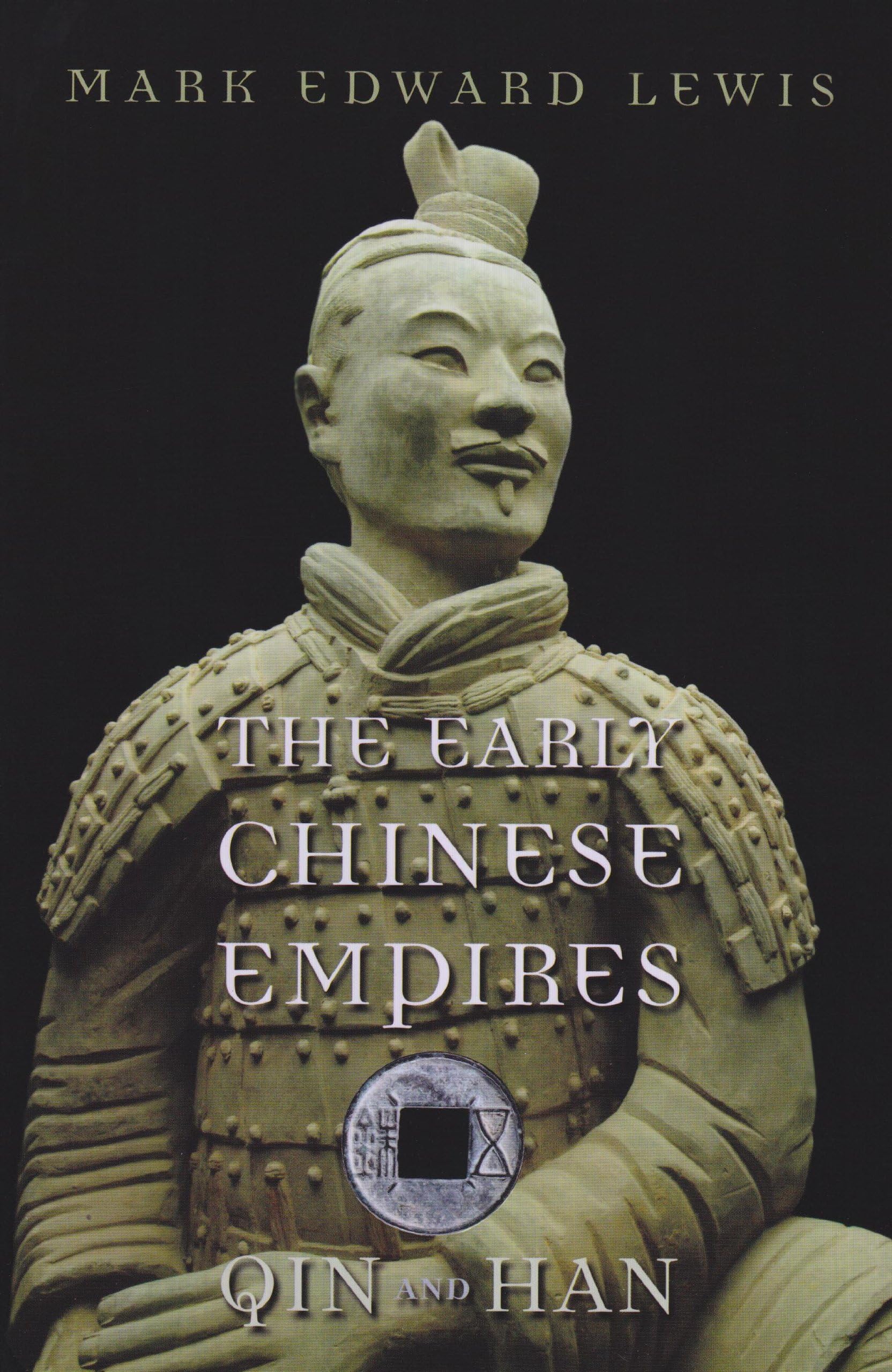
The Early Chinese Empires: Qin and Han (History of Imperial China)
Product ID: 4500210
Buy anything from 5,000+ international stores. One checkout price. No surprise fees. Join 2M+ shoppers on Desertcart.
Desertcart purchases this item on your behalf and handles shipping, customs, and support to Vanuatu.
The Early Chinese Empires: Qin and Han (History of Imperial China) [Lewis, Mark Edward, Brook, Timothy] on desertcart.com. *FREE* shipping on qualifying offers. The Early Chinese Empires: Qin and Han (History of Imperial China) Review: Early Chinese Prototypes - Mark Edward Lewis inaugurates Harvard University’s ‘History of Imperial China’ series in this first installment. The major themes are set, and the format will remain mostly consistent over six volumes and three authors. Generally 100 pages are dedicated to political and military history, and 200 to urban and rural life, foreigners, family, religion, literature and law. The aim is to synthesize these elements, rather than to provide discrete essays. Major dynasties (such as Han, Tang and Ming) are paired with pivotal ones (such as Qin, Sui and Yuan). Minor dynasties are glossed over in favor of brevity. Lewis begins with an inevitable comparison of the Han empire with the Roman empire, which co-existed during 27 BC to 229 AD. He sees a distinction in the Chinese empire’s ‘ability to reform itself again and again after periods of disunity’ due to a ‘reshaping of Chinese culture by the earliest dynasties, the Qin and the Han’. It is true that all later and even foreign dynasties (such as the Yuan and Qing) would adopt Han culture as their own. Lewis shows how future dynasties ‘cannot be understood without a grasp of China’s first period of unification’, as Western culture cannot without the Greco-Roman periods. The five major features of the Chinese classical period are defined by Lewis as: ‘regional cultures transcended but not eradicated’, a ‘political structure centered on the emperor’, a ‘state-sponsored script and literary canon’, ‘military activities assigned to people on the frontier’ and ‘wealthy families in the countryside who maintained order’. This last principle differed from Roman patricians in that the great Han families were not large landowners deriving wealth from tenant or slave workers. They were groups of relatives and associates who formed leagues able to augment the power of the state. The Han city had outer defense walls and an inner walled forbidden city. ‘Unlike Rome, where the ruler showed himself to the people, the ruler in China derived status from being invisible’, writes Lewis. While Rome had Latin and Greek for law and science, the Qin invented non-alphabetic symbols so that different languages could share the same written words. ‘Pliny complained that all of Rome’s gold was flowing east to pay for silk’. Silk was used by China to pay for nomadic military confederates. ‘Whereas the stone ruins of Rome survived, the capitals of China burned when a new dynasty took control.’ Lewis, as with his other two volumes in the series, is consummately erudite. When he discusses the material in the topical sections, he provides readings from the ancient sources his text is based on. This is a cut above mere footnotes, engaging the reader in his process of interpretation, and revealing the lens the ancient past is being viewed with. Usually this is ’through a glass darkly’, but happily the Chinese (like the Romans) had a great wealth of historical and other literature to draw from. He is a generalist in Chinese history, equally at home with religion and arts as with war and law. A tour de force. Review: A comprehensible history of Early China - If your eyes glaze over at the discussions of the interminable battles of the Warring States and Spring and Autumn periods of Chinese history. This is the book for you. Lewis presents the history of the early Chinese empires and their precursors in comprehensible fashion with enough background information to help the reader organize what happened. If you're interested in the early history of China, this is a good place to start.
| Best Sellers Rank | #108,839 in Books ( See Top 100 in Books ) #1 in History of Ancient China #90 in Chinese History (Books) #166 in History of Civilization & Culture |
| Book 1 of 6 | History of imperial China |
| Customer Reviews | 4.3 4.3 out of 5 stars (212) |
| Dimensions | 6.12 x 0.9 x 9.25 inches |
| Edition | Illustrated |
| ISBN-10 | 0674057341 |
| ISBN-13 | 978-0674057340 |
| Item Weight | 2.31 pounds |
| Language | English |
| Print length | 336 pages |
| Publication date | October 30, 2010 |
| Publisher | Belknap Press: An Imprint of Harvard University Press |
D**R
Early Chinese Prototypes
Mark Edward Lewis inaugurates Harvard University’s ‘History of Imperial China’ series in this first installment. The major themes are set, and the format will remain mostly consistent over six volumes and three authors. Generally 100 pages are dedicated to political and military history, and 200 to urban and rural life, foreigners, family, religion, literature and law. The aim is to synthesize these elements, rather than to provide discrete essays. Major dynasties (such as Han, Tang and Ming) are paired with pivotal ones (such as Qin, Sui and Yuan). Minor dynasties are glossed over in favor of brevity. Lewis begins with an inevitable comparison of the Han empire with the Roman empire, which co-existed during 27 BC to 229 AD. He sees a distinction in the Chinese empire’s ‘ability to reform itself again and again after periods of disunity’ due to a ‘reshaping of Chinese culture by the earliest dynasties, the Qin and the Han’. It is true that all later and even foreign dynasties (such as the Yuan and Qing) would adopt Han culture as their own. Lewis shows how future dynasties ‘cannot be understood without a grasp of China’s first period of unification’, as Western culture cannot without the Greco-Roman periods. The five major features of the Chinese classical period are defined by Lewis as: ‘regional cultures transcended but not eradicated’, a ‘political structure centered on the emperor’, a ‘state-sponsored script and literary canon’, ‘military activities assigned to people on the frontier’ and ‘wealthy families in the countryside who maintained order’. This last principle differed from Roman patricians in that the great Han families were not large landowners deriving wealth from tenant or slave workers. They were groups of relatives and associates who formed leagues able to augment the power of the state. The Han city had outer defense walls and an inner walled forbidden city. ‘Unlike Rome, where the ruler showed himself to the people, the ruler in China derived status from being invisible’, writes Lewis. While Rome had Latin and Greek for law and science, the Qin invented non-alphabetic symbols so that different languages could share the same written words. ‘Pliny complained that all of Rome’s gold was flowing east to pay for silk’. Silk was used by China to pay for nomadic military confederates. ‘Whereas the stone ruins of Rome survived, the capitals of China burned when a new dynasty took control.’ Lewis, as with his other two volumes in the series, is consummately erudite. When he discusses the material in the topical sections, he provides readings from the ancient sources his text is based on. This is a cut above mere footnotes, engaging the reader in his process of interpretation, and revealing the lens the ancient past is being viewed with. Usually this is ’through a glass darkly’, but happily the Chinese (like the Romans) had a great wealth of historical and other literature to draw from. He is a generalist in Chinese history, equally at home with religion and arts as with war and law. A tour de force.
R**K
A comprehensible history of Early China
If your eyes glaze over at the discussions of the interminable battles of the Warring States and Spring and Autumn periods of Chinese history. This is the book for you. Lewis presents the history of the early Chinese empires and their precursors in comprehensible fashion with enough background information to help the reader organize what happened. If you're interested in the early history of China, this is a good place to start.
W**N
An excellent introduction to Chinese history
Positive: An excellent introduction to Chinese history. You can still see the Qin/Han imprint on Communist China today with the CCCP's emphasis on social stability and rigid focus on the supremacy of the state. Negative: Many illustrations left out of the Kindle edition. Recommendation: Watch 'The Qin Empire: Alliance' on Netflix for a visual treat of this period of history.
M**Z
Geography is destiny
This is a very readable, enjoyable book. Perhaps unusually for a history book, it begins with geography. The opening chapter reads as if China's unification and splendid isolation were all but inscribed in her geography. As far as unification, the decade long campaign to unify the Warring States (230-221) is covered en passant in a single sentence, not even naming the successful Qin king. It is perhaps a good thing that history writing has moved away from endless chronologies of rulers and battles--but has it now landed at the other extreme, of not even mentioning these at all? It is rather as if a history of Hellenism mentioned en passant that the entire space spanning the Mediterranean to the Indus was unified, without even naming the successful Macedon king (what was his name again.... something with an A...). Anyways, it is not important since it was all predetermined by geography. As far as splendid isolation, the author implies it but that does not make it historical. In fact, China (or the Sinitic realm, prior to 221), was never isolated, and likely owes more than you might thing to the outside world, namely the "West" (by which I mean everything west and northwest of classical China proper). The author does allocate one chapter to "The Outer World," but it focuses exclusively nomadic barbarians whose impact on China is acknowledged but downplayed. Yet these "barbarians" were the conduit through which, very likely, things like writing, bronze working, iron working, chariot and cavalry warfare, and the associated weaponry and dress, reached China. Most importantly, the fact that after Alexander's (oh, there he is) death in 325 first the Hellenistic Seleucids and then the Greco-Bactrians stood in the Fergana Corridor, on the threshold to the Tarim Basin, the main passageway into what was to become China, and the possibility that they substantially shaped Chinese literature and philosophy--this idea would not come to you upon reading Lewis' "history." How "historical" is it, then? Much about how China's civilisation really emerged and evolved may remain speculative, but one can hardly claim to cover the ground without introducing some of the pertinent speculations, especially not if one offers a whole chapter on "Literature," which could have been the place to do so, but sadly isn't.
M**R
Informative and thought-provoking.
This isn't light reading for most people, but I wanted some background to for a more thorough appreciation of some literature I've been reading. This is fascinating and accessible as a history source, and I'll be purchasing the others in the series.
K**R
why no images
Interesting though too short on actual history and long on fairly arcane aspects of these two early dynasties. Although there are several maps, none of the images from the print edition are included, instead the images are replaced with the ridiculous suggestion: "to view this image, refer to the print edition of this title". Kindle books that do not include original images or maps should make this clear in the description.
A**N
I found the book both informative and very readable
I became interested in early Chinese history while watching a TV fictional series set during this period. I wanted to know what was fiction and what was historically accurate. This book filled the bill.
P**G
Pas de surprise, ce livre correspond à ce qu'on en attend. Je le recommande pour les passionés de la Chine.
C**A
If you are wanting to read up on early Chinese history and want a book that is well written and easy to digest then this one is probably a good buy. Chapters are well organised with first chapter giving a 'potted history' which makes sense of the time period. The only recommendation to the authors/publishers is to include more coloured plates/pictures.
M**O
O livro veio em bom estado de conservação e a entrega foi rápida. O conteúdo do livro é sensacional com bastante detalhes e certamente recomendo para qualquer interessado em história da China.
M**A
VERY INFORMATIVE set of books, I AM ENJOYING the books. You can tell that the authors had put their best works in these books, I feel like I have a personal prof , while reading them...
B**3
Der Autor hat ein gut lesbares Buch über 2 Dynastien vorgelegt, die jede für sich eine Einzeldarstellung verdient hätten. Das Kapitel über die Reformen unter den Qin sind einleuchtend und präzise (deshalb gibt es 4 Sterne anstatt 3), die politische Physiognomie der Han-Dynastien bleibt blass, ein Übersicht über die Kaiser fehlt, die knappe Zeittafel auf 2 Seiten 267-269 ist lächerlich. Die politische Geschichte und die Abfolge von Ereignissen und Persönlichkeiten kommt entschieden zu kurz, was auch für die folgenden Kapitel zu sozialen und religösen Aspekten chronologische Unklarheiten schafft. Manchmal ist der Autor sehr genau und detailliert, dann wieder sehr generell ("die westliche Han-Dynastie", "die östliche Han-Dynastie"), wenn man gern genauer wüsste, welcher Kaiser welche Initiativen ergriffen hat. Besondere Mühe hatte ich mit den sehr abstrakten Karten, die zum Verständnis eine genaue Kenntnis der Geographie Chinas beim Leser voraussetzen, da bei den häufigen Kriegen an den Grenzen die geographischen Bedingungen eine wichtige Rolle spielen. Dass die Serie insgesamt mit Bildmaterial von sehr bescheidener Qualität ausgestattet ist, mag dem niedrigen Preis geschuldet sein, schade ist es aber doch. Dass im ganzen Buch kein einziges chinesisches Zeichen (nur pinyin) vorkommt, geht eigentlich nicht.
Trustpilot
1 month ago
2 days ago