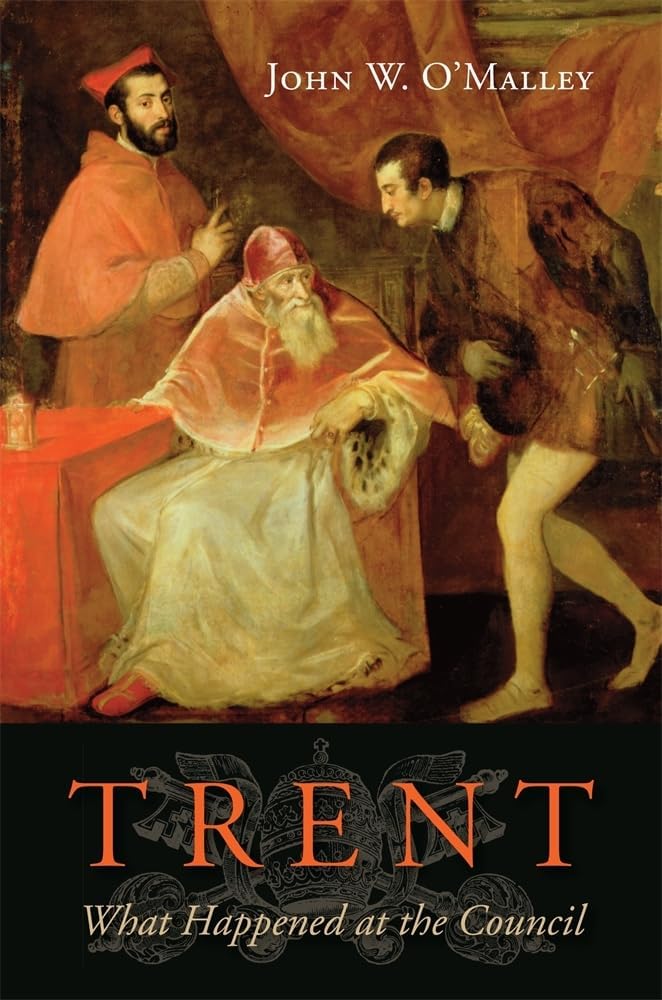
Trent: What Happened at the Council
Product ID: 4508468
Buy anything from 5,000+ international stores. One checkout price. No surprise fees. Join 2M+ shoppers on Desertcart.
Desertcart purchases this item on your behalf and handles shipping, customs, and support to Vanuatu.
Trent: What Happened at the Council [O'Malley, John W.] on desertcart.com. *FREE* shipping on qualifying offers. Trent: What Happened at the Council Review: Keeping the Bark Afloat - For the generations of us who experienced and implemented the teachings of the Council Vatican II (1962-1965), the "great before" was (and may still be) frequently defined as the Council of Trent (1547-1563). Much of what was seen as problematic in the 1960’s and beyond seemed traceable to the mandates of Trent, a Council convoked in a modest city in northern Italy. The term "Tridentine" became an enormous adjective umbrella covering all disputed issues of contemporary Church life, from justification by faith and confessional division to the communion cup and Mass in the vernacular. Given this Tridentine baggage, so to speak, it is remarkable that until John O'Malley produced his remarkable one volume history of the Council of Trent, only one other history had been attempted, Hubert Jedin's four volume work of the mid twentieth century; of Jedin's labors, only the first two volumes were even translated into English. O'Malley's is thus the first full treatment of Trent available to English readers; all the better that it is a first rate, masterful synthesis of an event, an era actually, remarkable for both its fractiousness and it's unity of purpose. Trent is remembered in today's catechetic as the Catholic response to the Reformation, but in truth several reform councils had preceded it, and at least one, Constance [1414-1418], had made matters more complicated by its assertion of Conciliar (bishops’ collective) authority in ending the Great Schism. Thus there was no enthusiasm for more councils among sixteenth century popes. The forces that prompted the Council of Trent included the Emperor Charles V, hopeful to stabilize his energetic and disruptive minority of German Lutheran subjects, fervent Catholic Spanish reformers, concern over a French nation drifting dangerously close to an independent Gallican Catholicism, and a widespread sense among Catholics in many sectors that Luther and his adherents were right about one indisputable fact: Catholic reform was needed at its head, specifically its bishops and particularly the papacy itself. The decision to meet at Trent, a city poorly equipped to host a council, was a political one: Trent straddled the boundaries of the Papal States and the German Empire, then at odds. The almost insurmountable difficulties in opening the Council are chronicled in detail, but for all of that, the first session was remarkably fruitful, and its spadework was probably a primary reason that the Council lingered on through dangerously bleak future sessions. O'Malley describes the stage management of Trent as two-tiered; one track pursued the doctrinal issues of Protestant theology while the second examined Catholic Church discipline and order, particularly the issue of bishops residing within their own dioceses--a costly monetary reform for many of the Council's very participants. It is often forgotten than the first session debated, among other things, the terms by which Protestant leaders might participate in the Council's deliberations. The Council had two major breaks--a second session in Bologna, a concession to creature comforts and accessibility of the city's university libraries, and the Pontificate of Paul IV (1555-1559). Paul suspended the Council, determined to prove that a pontiff was indeed capable of effecting reform without the dangers of Conciliarism. However, his reign proved to be excessive medicine. Paul's radical discipline led no less a loyal son of the Church, St. Peter Canisius himself, to decry the expansion of the Index of Forbidden Books. O'Malley's discussion of the evolution of the Council from its 1547 opening to its 1562 third session is particularly enlightening. He observes that by 1562 it was no longer possible for a council to address Christian unity in terms of Luther and his issues. By the 1560’s Protestantism had many branches and many faces; a Protestant theological methodology was well developed along different lines from traditional Catholic scholasticism. Regrettable as this might be for the Council Fathers, the expansive challenge of critical doctrinal discussion was now far beyond their purview or even their endurance. Thus, the third session, masterfully directed by Cardinal Morone, moved exclusively to its second track, internal reform and strengthening of the Roman Church. The Council's thinking and deliberation now focused upon the health of dioceses and parishes, particularly the above-mentioned matter of bishops attending to the pastoral care of their own sees. Not surprisingly, improved formulation of traditional Church teaching was generally endorsed but with greater emphasis upon priestly formation, preaching, elimination of superstition, and catechetical method. Emphasis upon greater lay reception of the sacraments, notably the Eucharist and Confession, was well received by the Fathers. In a number of matters, as in the questions regarding the vernacular, priestly celibacy and the communion cup, the Council specifically directed these matters to the Holy See for final deliberation. O'Malley discusses the implementation of the Council after 1563, commenting that most of the implementation was indeed managed by successive popes, such as Pius V, who reformed the Missal still in use through the 1960’s. Much of what is today attributed to the Council of Trent is actually the Church's subsequent work in the spirit of that Council, a point of consideration for those who currently use the term "Spirit of Vatican II" in a pejorative way to critique recent generations of experimentation. In the author's view, the greatest legacy of Trent was the gradual awareness of the need for healthy parochial life, under the ministry, discipline, and example of residential bishops assisted by competent pastors. O'Malley's prime model here is St. Charles Borromeo, a conciliar participant who would become the embodiment of the Tridentine bishop. The Council of Trent prefigured Vatican II in one sense—it concluded without hard and fast resolution of key issues; in the case of Vatican II, for example, the issues of artificial birth control and priestly celibacy come to mind. Trent did not meet the initial expectations of its proponents, but it did strengthen the structure of the Church to the degree that Catholicism was able to retain its integrity and structure until a new wave of reform was at hand. Review: Chatty can still be informed - “What do we do about the Lutherans?” was the question that agitated popes, cardinals, bishops, priests and many of the Catholic laity in the mid-sixteenth century, when it had become clear that the Protestant movement had truly caught on and showed every sign of continuing. Almost everyone recognized that, in calling for reform in the Church, Luther and the others had a point. It seemed clear that if this insurgency continued gaining ground, all Europe was in danger of abandoning allegiance to the Church of Rome. If the Papacy and the Church it governed were to survive, they needed to respond to the challenge by engaging in a process of reform from within. Some of the abuses were obvious to all. Some bishops held multiple titles, from which they derived income, but often chose to live elsewhere and pay modest sums for others to do the work of administering their dioceses. Many parish priests did likewise. Ordinary clergy were often woefully ignorant and incompetent. Preaching was largely abandoned to the friars of the mendicant orders who had no pastoral responsibility for their hearers. Higher offices were virtually for sale. Popes enriched themselves and their relatives from the offerings of the faithful, often naming teenaged boys as cardinals. The sale of indulgences was only one example of profiting from the credulity of the laity. But how to begin? The popes, though powerful, could not enact sweeping reforms on their own, even if so inclined; they were up against the power of the secular rulers of Europe, in particular the Holy Roman Emperor and the kings of France and Spain. After years of negotiations among the various powers, Pope Paul III was reluctantly persuaded to call a general council of the Church, to be held within the domains of the Emperor. The rather insignificant town of Trent, on the Italian side of the Alps, was chosen. As it turned out, the Council of Trent was to be one of the most significant events in early modern history, with ramifications far beyond Europe, beyond the Roman Church, and beyond its time. Among other things, it established standards for the selection and education of parish clergy (including the invention of seminaries), it required clergy, including bishops, to reside in their charges unless specifically exempted, and it clarified points of doctrine and practice without quashing legitimate theological dispute, in most cases. In his fascinating, meticulous, and simply written account, Trent: What Happened at the Council (Harvard University Press, 2013), John W. O’Malley, University Professor at Georgetown, relates how the Council came to be (it almost didn’t), how it managed to last (with two intermissions) from 1545 to 1563, what it accomplished and what it didn’t (both married clergy and vernacular liturgy were considered seriously), and how the personalities and political pressures upon the most important personalities of Europe shaped the outcome. He discusses the difference between the actual Council and its later reputation, and gives a good sense of how the attempt to bring the Protestants back into the fold was doomed from the start. In many ways, the modern Roman Catholic Church took its shape at the Council of Trent. This evenhanded yet sympathetic book gives us one way to understand how this happened, and why.
| Best Sellers Rank | #334,820 in Books ( See Top 100 in Books ) #529 in History of Religions #1,340 in History of Christianity (Books) #1,753 in Christian Church History (Books) |
| Customer Reviews | 4.6 4.6 out of 5 stars (131) |
| Dimensions | 5.5 x 1.1 x 8.25 inches |
| Edition | Illustrated |
| ISBN-10 | 0674066979 |
| ISBN-13 | 978-0674066977 |
| Item Weight | 1.25 pounds |
| Language | English |
| Print length | 352 pages |
| Publication date | January 15, 2013 |
| Publisher | Belknap Press: An Imprint of Harvard University Press |
T**S
Keeping the Bark Afloat
For the generations of us who experienced and implemented the teachings of the Council Vatican II (1962-1965), the "great before" was (and may still be) frequently defined as the Council of Trent (1547-1563). Much of what was seen as problematic in the 1960’s and beyond seemed traceable to the mandates of Trent, a Council convoked in a modest city in northern Italy. The term "Tridentine" became an enormous adjective umbrella covering all disputed issues of contemporary Church life, from justification by faith and confessional division to the communion cup and Mass in the vernacular. Given this Tridentine baggage, so to speak, it is remarkable that until John O'Malley produced his remarkable one volume history of the Council of Trent, only one other history had been attempted, Hubert Jedin's four volume work of the mid twentieth century; of Jedin's labors, only the first two volumes were even translated into English. O'Malley's is thus the first full treatment of Trent available to English readers; all the better that it is a first rate, masterful synthesis of an event, an era actually, remarkable for both its fractiousness and it's unity of purpose. Trent is remembered in today's catechetic as the Catholic response to the Reformation, but in truth several reform councils had preceded it, and at least one, Constance [1414-1418], had made matters more complicated by its assertion of Conciliar (bishops’ collective) authority in ending the Great Schism. Thus there was no enthusiasm for more councils among sixteenth century popes. The forces that prompted the Council of Trent included the Emperor Charles V, hopeful to stabilize his energetic and disruptive minority of German Lutheran subjects, fervent Catholic Spanish reformers, concern over a French nation drifting dangerously close to an independent Gallican Catholicism, and a widespread sense among Catholics in many sectors that Luther and his adherents were right about one indisputable fact: Catholic reform was needed at its head, specifically its bishops and particularly the papacy itself. The decision to meet at Trent, a city poorly equipped to host a council, was a political one: Trent straddled the boundaries of the Papal States and the German Empire, then at odds. The almost insurmountable difficulties in opening the Council are chronicled in detail, but for all of that, the first session was remarkably fruitful, and its spadework was probably a primary reason that the Council lingered on through dangerously bleak future sessions. O'Malley describes the stage management of Trent as two-tiered; one track pursued the doctrinal issues of Protestant theology while the second examined Catholic Church discipline and order, particularly the issue of bishops residing within their own dioceses--a costly monetary reform for many of the Council's very participants. It is often forgotten than the first session debated, among other things, the terms by which Protestant leaders might participate in the Council's deliberations. The Council had two major breaks--a second session in Bologna, a concession to creature comforts and accessibility of the city's university libraries, and the Pontificate of Paul IV (1555-1559). Paul suspended the Council, determined to prove that a pontiff was indeed capable of effecting reform without the dangers of Conciliarism. However, his reign proved to be excessive medicine. Paul's radical discipline led no less a loyal son of the Church, St. Peter Canisius himself, to decry the expansion of the Index of Forbidden Books. O'Malley's discussion of the evolution of the Council from its 1547 opening to its 1562 third session is particularly enlightening. He observes that by 1562 it was no longer possible for a council to address Christian unity in terms of Luther and his issues. By the 1560’s Protestantism had many branches and many faces; a Protestant theological methodology was well developed along different lines from traditional Catholic scholasticism. Regrettable as this might be for the Council Fathers, the expansive challenge of critical doctrinal discussion was now far beyond their purview or even their endurance. Thus, the third session, masterfully directed by Cardinal Morone, moved exclusively to its second track, internal reform and strengthening of the Roman Church. The Council's thinking and deliberation now focused upon the health of dioceses and parishes, particularly the above-mentioned matter of bishops attending to the pastoral care of their own sees. Not surprisingly, improved formulation of traditional Church teaching was generally endorsed but with greater emphasis upon priestly formation, preaching, elimination of superstition, and catechetical method. Emphasis upon greater lay reception of the sacraments, notably the Eucharist and Confession, was well received by the Fathers. In a number of matters, as in the questions regarding the vernacular, priestly celibacy and the communion cup, the Council specifically directed these matters to the Holy See for final deliberation. O'Malley discusses the implementation of the Council after 1563, commenting that most of the implementation was indeed managed by successive popes, such as Pius V, who reformed the Missal still in use through the 1960’s. Much of what is today attributed to the Council of Trent is actually the Church's subsequent work in the spirit of that Council, a point of consideration for those who currently use the term "Spirit of Vatican II" in a pejorative way to critique recent generations of experimentation. In the author's view, the greatest legacy of Trent was the gradual awareness of the need for healthy parochial life, under the ministry, discipline, and example of residential bishops assisted by competent pastors. O'Malley's prime model here is St. Charles Borromeo, a conciliar participant who would become the embodiment of the Tridentine bishop. The Council of Trent prefigured Vatican II in one sense—it concluded without hard and fast resolution of key issues; in the case of Vatican II, for example, the issues of artificial birth control and priestly celibacy come to mind. Trent did not meet the initial expectations of its proponents, but it did strengthen the structure of the Church to the degree that Catholicism was able to retain its integrity and structure until a new wave of reform was at hand.
R**B
Chatty can still be informed
“What do we do about the Lutherans?” was the question that agitated popes, cardinals, bishops, priests and many of the Catholic laity in the mid-sixteenth century, when it had become clear that the Protestant movement had truly caught on and showed every sign of continuing. Almost everyone recognized that, in calling for reform in the Church, Luther and the others had a point. It seemed clear that if this insurgency continued gaining ground, all Europe was in danger of abandoning allegiance to the Church of Rome. If the Papacy and the Church it governed were to survive, they needed to respond to the challenge by engaging in a process of reform from within. Some of the abuses were obvious to all. Some bishops held multiple titles, from which they derived income, but often chose to live elsewhere and pay modest sums for others to do the work of administering their dioceses. Many parish priests did likewise. Ordinary clergy were often woefully ignorant and incompetent. Preaching was largely abandoned to the friars of the mendicant orders who had no pastoral responsibility for their hearers. Higher offices were virtually for sale. Popes enriched themselves and their relatives from the offerings of the faithful, often naming teenaged boys as cardinals. The sale of indulgences was only one example of profiting from the credulity of the laity. But how to begin? The popes, though powerful, could not enact sweeping reforms on their own, even if so inclined; they were up against the power of the secular rulers of Europe, in particular the Holy Roman Emperor and the kings of France and Spain. After years of negotiations among the various powers, Pope Paul III was reluctantly persuaded to call a general council of the Church, to be held within the domains of the Emperor. The rather insignificant town of Trent, on the Italian side of the Alps, was chosen. As it turned out, the Council of Trent was to be one of the most significant events in early modern history, with ramifications far beyond Europe, beyond the Roman Church, and beyond its time. Among other things, it established standards for the selection and education of parish clergy (including the invention of seminaries), it required clergy, including bishops, to reside in their charges unless specifically exempted, and it clarified points of doctrine and practice without quashing legitimate theological dispute, in most cases. In his fascinating, meticulous, and simply written account, Trent: What Happened at the Council (Harvard University Press, 2013), John W. O’Malley, University Professor at Georgetown, relates how the Council came to be (it almost didn’t), how it managed to last (with two intermissions) from 1545 to 1563, what it accomplished and what it didn’t (both married clergy and vernacular liturgy were considered seriously), and how the personalities and political pressures upon the most important personalities of Europe shaped the outcome. He discusses the difference between the actual Council and its later reputation, and gives a good sense of how the attempt to bring the Protestants back into the fold was doomed from the start. In many ways, the modern Roman Catholic Church took its shape at the Council of Trent. This evenhanded yet sympathetic book gives us one way to understand how this happened, and why.
R**H
This is an excellent book dealing with an area of history I have long wondered about.
What is extrodinary about this book is that it deals with a subject that has always intrigued me. What were the forces leading to the Reformation? On the one hand there was Henry VIII who choped off heads to get a queen he wanted...not dignified in my book. And then there was Martin Luther, who nailed his complaints against the Church on the door of his church in Leipzig. And then there was the war between the French and the German forces led by the firs Emperor of the Habsburg dynasty. What a setting! O'Mally does a splendid job of weaving these factors together and showing how the Roman Catholic Church was able to emerge from this horrible situation in a way that delt with the issues and healed much of what had gone wrong with their church. I applaud O'Malley and believe Trent is a great book for those interested in this subject.
C**G
the Council at Trent
This book is absolutely fabulous. Here's what it doesn't do: it doesn't take a side on the issues. O'Malley didn't write it to push a position or set an agenda, or even give his own opinion. O'Malley simply wrote a book about how the council got started, and he describes so well, what these men were all about. I am not by any stretch a Roman Catholic, and I loved this book. This book should be made into a movie! It shows you what fallible men do, don't so, succeed at, fail at, and most importantly, it shows you what happens when sinful men join hands. I couldn't recommend this book more highly. But don't think for a minute that this book will help clear up theological questions. The book is meant to show how complex that era was.
P**X
This book provides not only an accessible account of the three sessions of the Council of Trent, but sets these in the context of the Euro[en political scene that weighed so heavily on the conduct of the Council, provides good character sketches of the main religious and secular individuals involved, and also managed to situate the Council in the historical evolution of the conciliar movement. The fact that, despite all the conflicts, personal and national, its teaching had enduring value, and was at the same time open enough to be seen, with the benefit of contemporary experience, as being able to lead to Vatican II, can only lead one to ponder on the work of the Holy Spirit. For those normally fed on a diet of Tudor history, this book also provides a useful shift in focus, as England was, of course, such a minor character in the drama, havomg been marginalized by Henry VIII' religious changes.
T**S
This shows the "simple" tridentine event to have been an enormously complicated series of events over 20 year period with three Popes and significant influence from three monarchs (German Emporer,various Kings of France and Kings of Spain who were sometimes also emporers) ccarried out in that most human of conditions, "wars and rumors of wars". POlitics demanded that at leas a nod be made to relations with the Lutherans but it was essentiall a reform council that set the direction for the Catholic Church for some centuries. The title is already there so stop bothering me or oil your computer.
A**F
O autor parte de uma vasa bibliografia e aprofunda o estudo sobre o concílio de Trento, e sua importância, não só para a Igreja católica, como também para a sociedade da época. As intrigas políticas e um amplo panorama dos motivos que levaram à reforma também são apresentados. Ótima leitura.
F**N
A highly useful guide to a major historical event, clearly written and with an unusual absence of bias for or against the Counter-Reformation or Roman Catholicism in general. It should become a standard work on 16th century Europe.
D**L
Not sure how I should communicate on this point - but you list this book as Trent (Early Modern and Modern Greek) John W. O`malley (Author) Where on earth does that Early Modern and Modern Greek) come from - it confused me!
Trustpilot
1 month ago
1 day ago