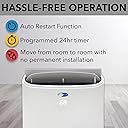
โ๏ธ Stay cool, breathe easy, and never miss a beat with Whynterโs powerhouse climate control!
The Whynter ARC-147WFH is a versatile 14,000 BTU (10,000 BTU SACC) portable air conditioner featuring a dual-hose system for efficient cooling in spaces up to 500 sq ft. It combines cooling, heating, dehumidifying (134 pints/day), and fan functions with quiet operation at 51 dBA. Equipped with HEPA and activated carbon filters, it ensures superior air quality. The unit includes a remote control, window installation kit, and patented auto-drain technology, making it a reliable, all-season climate solution for modern living spaces.


| ASIN | B09TKCTSJH |
| Additional Features | Active Carbon Filter |
| Air Conditioner Application | Indoor use in rooms and spaces |
| Air Flow Efficiency | 0.2 Cubic Feet Per Minute Per Watt |
| Annual Energy Consumption | 1000 Kilowatt Hours |
| BEE Star Rating | No Energy Star |
| Best Sellers Rank | #765,384 in Home & Kitchen ( See Top 100 in Home & Kitchen ) #401 in Portable Air Conditioners |
| Brand | Whynter |
| Brand Name | Whynter |
| Capacity | 134 Pints |
| Color | White |
| Compressor Type | rotary_scroll |
| Control Method | Remote |
| Controller Type | Remote Control |
| Cooling Power | 14000 British Thermal Units |
| Customer Reviews | 3.8 out of 5 stars 1,235 Reviews |
| Efficiency | 7.83 |
| Filter Type | HEPA and activated carbon |
| Floor Area | 500 Square Feet |
| Form Factor | Portable, with caster wheels, dual-hose system, and top-mounted control panel |
| Global Trade Identification Number | 00850014459154 |
| Included Components | Window installation accessories, remote, plus storage cover bag with pocket |
| Installation Type | Window |
| Inverter Type | No Inverter |
| Is Outdoor Unit Required | No |
| Is Product Cordless | No |
| Item Dimensions D x W x H | 15.81"D x 18.74"W x 30.87"H |
| Item Type Name | Whynter ARC-147WFH 14,000 BTU (10,000 BTU SACC) Dual Hose Cooling Portable Air Conditioner, Heater, Dehumidifier, and Fan with Remote Control, up to 500 sq ft in White |
| Item Weight | 77 Pounds |
| Manufacturer | Whynter |
| Model Name | Whynter ARC-147WFH 14,000 BTU (10,000 BTU SACC) Dual Hose Cooling Portable Air Conditioner, Heater, Dehumidifier, and Fan with Remote Control, up to 500 sq ft in White |
| Model Number | ARC-147WFH |
| Noise | 51 Decibels |
| Number of Heating Elements | 1 |
| Number of Power Levels | 3 |
| Number of Tubes | 2 |
| Power Source | Corded Electric |
| Product Dimensions | 15.81"D x 18.74"W x 30.87"H |
| Refrigerant | R-32 |
| Seasonal Energy Efficiency Ratio (SEER) | 7.83 |
| Special Feature | Active Carbon Filter |
| UPC | 850014459154 |
| Unit Count | 1.0 Count |
| Voltage | 115 Volts |
| Warranty Description | ONE YEAR LIMITED PARTS WARRANTY THREE YEAR WARRANTY ON COMPRESSOR |
| Warranty Type | Limited |
| Wattage | 1341 |
| Window Opening Maximum Height | 82 Inches |
| Window Opening Maximum Width | 46 Inches |
| Window Opening Minimum Height | 26.75 Inches |
| Window Opening Minimum Width | 6.5 Inches |
F**L
Whynter 12,000BTU Dual Hose Portable Air Conditioner, Frost White (ARC-12SDH)
After extensive research, reading customer reviews, professional reviews and pricing at my local appliance stores, I broke down and bought two of these units, 2 weeks apart. My son and I moved in with the elderly 'rents to look after them. They keep the central AC at 80 and watch TV with wool caps, slippers and lap blankets... yes, in the middle of the Florida summer! To say the least my son and I were sweatin' it out at night. I got only one portable AC (PAC) at first because of some of the negative reviews, large investment on something I wasn't too sure was going to work well for us, problems with the drainage, etc... I didn't want to invest in two, if one didn't work. The room I am cooling is approx. 12x 12. I probably got too much in the BTU department, but I wanted to be sure that it would do the job. It ABSOLUTELY DOES THE JOB AND THEN SOME! I did get the second one. The PAC came in a large box, packaged well. Easy to disassemble, box was taken away by recycling. All good. My brother-in-law set the PAC in my bedroom. I only have a sliding glass door to work with, so he needed to do some modifications and adjustments. All of the parts were in the box and easily assembled. Follow the directions (and pictures) and all should match up well. I went to Home Depot, purchased a 4' x 8' piece of AC insulation board (foam in the middle and covered with silver foil on the outside...cuts easily with a utility knife), a roll of AC duct tape (not duct tape, but the kind that is foil and used for AC duct work), 2 packages of 1" x 1" foam weather stripping, and 3 feet of 1/2" diameter tubing. ($30-$40 all together). The tools that my brother in law used were a drill to make a 1/2 inch hole in the insulation board, a utility knife, and a measuring tape. I'll tell you how he put it together and the reasons for doing it the way he did... after all, he is a clever guy and he saw a design flaw here or there... First, he measured how wide he would need the insulation board to be. Remember, it went into a sliding glass door, which would render the slider useless, once the PAC was installed. (I didn't care, I NEEDED the AC). He cut the insulation board 4" wider than the width of the plastic window kit (comes with the unit, has 2 holes to attach the duct hoses). Of course, the height of this piece has to fit into the door. Next, he decided where he wanted to put the plastic window kit in the insulation board. He centered the plastic window kit vertically and pressed it into the insulation board to leave an imprint in the board. He used the utility knife, followed the straight lines of the impression, to cut out the shape of the plastic window kit. He used the AC duct tape to tape the window kit into the insulation board, front and back. He next taped this, (the piece of insulation board with the plastic window kit taped into it) into place in the door jamb/frame of the slider. All taped in. It doesn't look pretty, or it looks as good as it can for being what it is, but it certainly is functional. He then attached the exhaust hose to one of the round circles (4" hole on the plastic window kit) and put one of the caps (provided) on the other. ***HERE IS WHERE HE THINKS THERE IS A DESIGN FLAW, AND WHY HE DID NOT ATTACH THE SECOND HOSE TO THE SECOND HOLE. The directions and the whole idea of the DUAL HOSE SYSTEM is to blow out the hot exhaust through one of the hoses and then to draw in cool air, from outside, through the other hose. This is the problem with this idea (according to my brother in law): "THE TWO HOSES, WHEN CONNECTED TO THE WINDOW KIT, ARE ONLY 1 1/2"-2 " APART. HE DOESN'T BELIEVE IT'S POSSIBLE TO DRAW IN "COOL" AIR FROM THE OUTSIDE FOR TWO REASONS: IT'S HOT OUTSIDE, HENCE THE NEED OF THE AC AND BECAUSE THE INTAKE IS GOING TO 'SUCK' THE HOT AIR IN FROM THE EXHAUST BECAUSE IT'S TOO CLOSE TO THE INTAKE." So, the intake hose is attached to the unit, but not to the vent hole. It's simply leaning up against the door, out of the way, sucking in the cooled air from inside the room. When I explained what I was doing to the Home Depot guy, he reminded me that once that sliding glass door was opened a few inches, there would be a gap between the two doors... in the middle, if you will. Simple solution was to stuff the foam weather stripping in there! Done. I was concerned about the drainage issues... Florida is HUMID! I read on some reviews that the unit would shut down in the middle of the night because the drip pan was full... Again, my brother in law to the rescue!!! He removed the plug, drilled a hole in the insulation board at the same level or height of the drain. He attached the tubing to the drain on the unit, and threaded it out through the insulation board to the outside. Problem solved! After he installed the unit, I noticed that there were tiny little gaps in the plastic window kit, around the circles... I could see light shining through. I ran a bead of caulk around it. No more light, no air escaping and no ants getting in. I turn the PAC off when I'm not home. Remember, the central AC is set at 80 degrees and the outside temperature, at this time of year, during the day is between 90 and 95. When I return, I turn the PAC on and set it at 74. Within 15 minutes, the room is cooled down to 74. (I have a separate thermometer and wanted to make sure that it was cooling to what I had it set at.) As I type right now, my fingers and toes are cold! I'm comfortable... I might even have to turn it a little warmer! Some reviews mentioned that it is a loud unit.... I don't agree... it is no louder than a window shaker! I would definitely recommend this unit. So far, so good! It's only been three weeks, but I am optimistic that it will continue to work well. (I waited 10 days or so to order one for my son and he, too, is now comfortable in his room. It's about the same size as mine.)
M**E
ARC-131GD comparison to ARC-12SD
I have been using this for about 2 weeks. I bought this for my master bedroom which is about 23x16 (368 square feet) and has vaulted ceilings. It was to replace a Whynter ARC-12SD which was working great but was going to be moved to my wife's office. Not to make this a review about the ARC-12SD but comparing it to the ARC-131GD reveals the latter's pros and cons. The ARC-12SD has been in use for about 1.5 years and has performed great. It had two downsides. Its first downside may not be a downside depending on the room you place it in. It has a bright blue led display and several other led indicators that could not be turned off. At night, in a bedroom, the led's are quite bright. We taped a credit card over the main display. The card blocked most of the light at night and we could flip it up if we wanted to see it if we wanted. The ARC-131GD has a remote control that contains the display rather than having it on the air conditioner itself. My wife and I both like that. There is a spot on the unit to store the remote but my wife keeps it on the nightstand. The ARC-131GD does have a blue led on the front of the unit but you can turn it off. Again, depending on the room you are putting this in, either may work for you. We only realized the ARC-12SD's second downside when we started to use the ARC-131GD, The ARC-131GD is quieter than the ARC-12SD. The compressor seems to quietly engage in the ARC131GD whereas the compressor on the ARC-12SD seems to be more abrupt and noisier. Although I do remember hearing the ARC-12SD cycling at times (I guess it woke me up), I have not noticed the ARC-131GD cycling at night (I guess it does not wake me up). On paper, the ARC-131GD is ever so slightly better suited for a larger room. The ARC-12SD is rated for 400 square feet while the ARC-131GD is rated for 420 square feet. After reading a few reviews it seemed like the ARC-131GD was slightly more efficient than the ARC-12SD. Believing that the ARC-131GD was more powerful and more efficient lead me to consider the ARC-131GD rather than just getting another ARC-12SD. Price wise, it seems that the ARC131-DG is generally available at a lower price than the ARC-12SD. When the ARC-131GD dropped to a particularly low price, I jumped on it. The first night with the ARC-131GD revealed just how quite it is. Of course you can hear the fan, similar to, but slightly quieter than the ARC-12SD's fan. From a cooling perspective, the ARC-12SD cooled the room faster. Not sure why this is but...every night the ARC-131GD is slower to cool then the ARC-12SD. Both were set to maximum fan speed. During the night, both cooled the room fine. Neither my wife nor I have been uncomfortable. We both notice the room cooling slower with the ARC-131GD as compared to the ARC-12SD. The ARC-12SD does have adjustable vents while the ARC-131GD does not. We used to point the vents on the ARC-12SD as high as they would go, almost vertical. Since hot air rises, it seemed like a good idea to push the cold air towards the ceiling. The ARC-131GD pushes the air out at a more horizontal angle. Maybe if it could push the cold air towards the ceiling, it would do an better job at cooling the overall room faster. This may only be an issue with a room with a vaulted ceiling. Would I buy another ARC-131GD? Based on the price I got it for (much less than the ARC-12SD) I would say yes. How much am I saving in electricity using the ARC-131GD in comparison to the ARC-12SD? If your requirements are for the room to be cooled a bit more quickly than the ARC-12SD may be better choice. If you have to run the ARC-131GD 20 minutes longer a day to get the room to a specific temperature, does its slightly better efficiency pay off? If the ARC-131GD is priced the same as the ARC-12SD, I would get the ARC-12SD. If the ARC-131GD is at an all time low price-wise, I would get the ARC-131GD again. It has its pluses and minus's (both of which depend on where it will be located and your personal preferences). A couple of additional points. The ARC-12SD has an intake and exhaust hose. Both are the same diameter. The ARC-131GD intake hose is the standard size. The exhaust hose is smaller. The connectors are standard as far as connecting to the air conditioner or window vent but the tube connections are different sizes to match the hoses. The tube lengths on the ARC-131GD are about 8 inches shorter than the ARC-12SD. Whereas I could maneuver the ARC-12SD away from the window and point it an any direction I wanted, the limited hose length on the ARC-131SD did not allow for this. I had to place the air conditioner as close to the wall as I could. Although I had standard replacement hoses which were longer, I could not utilize them because of the non-standard exhaust hose connector of the ARC-131GD. My solution, buy 2 more standard connectors. I live in FL. My back yard, which is where the air conditioner cooling intake pulls air in from, is basically a jungle. The air being pulled in is extremely humid. When I hooked up the new air conditioner, I replaced both the intake and exhaust tubes. The intake hose I was replacing was full of a very light coating of mildew. Yuck! Even given those conditions, I never had a problem with the ARC-12SD filling up with water. I have read other reviews of the ARC-131GD and some have reported problems with the unit filling with water. So far (2 weeks) I have not had a problem with the unit filling with water even with the very high humidity.
T**S
You really want a dual hose air conditioner.
I live in a southern California where 10 months a year, it's pretty nice. But I also live a bit inland, so about two months a year it gets unbearably hot. I was toying with doing a whole house air conditioner (3-ton, aka 36000 btu/hr), but the bit for doing it up to code was well past ten g's. So I started to research alternatives. Since I have sliding windows, I really couldn't use a window air conditioner. There are casement air conditioners sized to fit sliding windows, but the selection isn't as good. I wasn't really considering a portable air conditioner because I only knew about single hose units and there were too many drawbacks. The idea of a single vent portable air conditioner is pretty attractive until you consider the thermodynamics of it: all of the heat producing parts are in your house -- which means that you have to cool them too. And even though the gets vented to the outside, that air has to come from somewhere... like that precious cool air that you just made. And all that air being blown out the window has to be replaced, which means hot air is being sucked into your cool room under the doors and through various air leaks. In short, while you're trying to cool the room you're fighting against the heat from the compressor, the cold air you're throwing away, and the hot air that's being sucked in. A single hose air conditioner is the worst way to cool a room short of leaving your refrigerator door open. *** That's why you *want* a dual hose air conditioner. It solves two of the three big limitations of single hose portable air conditioners: it uses outside air for the condenser (hot side) core airflow, so it doesn't waste your just cooled air, and it isn't replacing that cooled air with hot air. The hot side stays hot and the cool side stays cool. Sure that pesky compressor is still getting hot, but the only way you're going to solve that is to buy a window air conditioner. So, needless to say I'm quite happy with my purchase. It gives me 1/3 of the cooling of a whole house AC, for less than 1/10 the cost. Granted I can only cool one room at a time, but this means being able to get a good night's sleep rather than being miserable two months a year. One other technical things I'd like to talk about: drainage. The act of cooling will draw moisture from the air. This unit gives you two options to get rid of it. For low humidity climates, it is designed to drip to a pan at the bottom of the unit. As the hot-side air is drawn over it, the water will evaporate again, pass over the condenser (hot side) coils and be vented to the outside. You *want* this to happen: moisture laden air holds more heat than dry air, and will pull more heat out of the hot side coils. Thus letting the moisture fall to the drip pan at the bottom and evaporate again will cool more efficiently than if you drained it off and let dry air pass over the hot side coils. However, if too much condensed water accumulates in the drip pan, a float switch shuts off the compressor. Which happens in humid weather. For mid/high humidity areas, there is a drain port halfway up the unit with a garden hose fitting. There is already plenty of water vapor in the air for heat transfer: no more is needed in the drip pan. Thus you should just drain it: I took a hose fitting and a meter of clear plastic tubing and ran the drain output into a glass jug (see attached photo). In two evening's use, I got about 1.5 gallons out of it. (See other attached photo) That's almost 6 liters of water that was in the air making things muggy. I was amazed over how much water came out of the unit. The remote is pretty nice. I can leave it on the nightstand and turn on/off the unit without getting out of bed. One more thing, this particular model is also a heater (actually a heat pump). It can warm your room in winter, providing the outside air is above 45 deg F. It won't work as a heater in Minnesota, but can be used on southern California winter days to take the chill out of a room and where the whole house furnace would be overkill. Now to deal with some of the objections I've seen in other reviews: 1. Size. It's 12000 BTU/hr, that's bigger than many/most air conditioners, but it is not enough to cool your entire house. It does make 200 sqft into a meat locker though. Most would agree that it should adequately cool 400-550 sqft. 2. Noise. Now that we're all used to whole house AC and climate controlled offices and cars -- where all the moving parts are tucked out of the way -- we forget that all that equipment makes noise. It's not quiet/silent, but it's not too loud either. I usually run mine about 3 hours before bedtime and turn it off. There is a timer so you can run it for an hour or two after you turn in. Even if I had to run it all night, I'd rather sleep with the fan and compressor noise rather than tossing and turning and not sleeping from the heat. 3. Water/dampness. There were a lot of complaints about the unit stopped working in humid weather. That's because the condensate could accumulate in the drip pan and the limit switch would shut off the compressor. The solution would be to drain the moisture from the upper drain port. The second water complaint was that the unit would leave a puddle on the floor. Again the same thing. The drip pan is just that: a pan. If you tip the unit, water will spill. (Don't ask how I found that out.) If you're not on a level surface, you may be spilling before the limit switch shuts off. If you have that much water production, maybe you should be using the upper drain instead. 4. Lights. This would be *MY* biggest complaint. They're pretty bright. In fact they keep me up at night more than the noise. Worse yet, there are no labels explaining what they mean. Which means RTFM if you're wondering what the purple LED means vs the blue one or green one. And you have no idea what the fan speed is or other indicator lights because they're all blue, just different positions for different settings. Not quite enough to drop my rating from 5 stars to 4, but close.
S**H
Buy w extreme caution - it works under certain conditions and is a rare double hose unit
Update Jul 26 This unit does not get rid of any condensate via it's air hoses as does the Freidreich unit, which gets rid of 100% of condensate that way. There is NO evidence this gets rid of ANY condensation. It only 'worked' when the building AC was on and that was removing moisture from room air first. I can't prove this to call this false advertising but read on. I can say outside of ability to cool, it's very poorly designed with NO easy way to make it work, or this is so defective as to be nearly useless read on. I have to drain 2 qts of water from this every few hours. This is on line with a dehumidfier indicating it's not evaporating any condensate out the window via the air hose. While this does cool really well, you'll have to shell out the extra I don't know $100 or $150 for the upper drain port hose run it into a 2 or 3 gallon jug you buy and set a timer to empty it 2 to 4 times a day depending on humidity and temp setting as you'll loose the auto shut off when drain pan full feature and it'll keep pouring out water until you remember to ck. Worse yet, the biggest selling feature of this unit is the slanted rear discharge, which lets you locate it closer to the window, have more efficient air intake and discharge. But as you need continuous access to the back of it to drain it, you have to turn it away from window kinking hoses and taking up about 2x it's foot print negating it's biggest selling point. Worse yet using the drain pan, the lower drain, I had to put it up on 2x4 blocks, making it unstable when tilting to drain, so I can use a one cup measure to remove the 2 qts of water every few hours, as otherwise you can barely slip a cookie backing pan under drain tap I have to tilt the unit backwards towards the drain to get the last 2 cups out, meaning the drain pan does not tilt towards the drain plug which is more horrible design. It' s not a small tilt either, it's a good 10 or 15 degrees It also appears the unit resets itself to dehumidify at restart instead of cooling your room. You get some cooling but not all. If it does evaporate condensate IF big IF It only does so if air has very little humidity and IF the temperature is high enough and internal temps are high enough to evaporate enough water. This is dependent on outside air and inside air temps. The hotter ea are the better the chance it will not fill with water. The lower the more likely. So, assuming it's not very humid, and it's really hot out, and you keep the temp in the room high certainly over 68 what I set it for, it MIGHT keep up with 'condensate'. If it's really humid, you'll need higher and higher room temps 75, 80, more, I don't know what. Co seems to know this is a problem. The trouble shooting note is actually to dump the super hot discharge air into your room to warm it up presumably so the equip heats up enough to boil off the condensate. Co seems to blame it on it being too humid, well, summer, heat humidty = why you buy an AC. You can work around most of the issues, so IF you need max cooling and can live with work arounds, what choice do you have? A Freidreich if you can find one or a $3,500 computer room model? Will I return this, well, after a month I got rid of the HUGE box, so there's a problem as is getting another unit in the middle of a heat wave. I might move this to a vacation cabin where AC is infrequently needed and get another Freidreich even though they cheaped out and got rid of their rear sloped air discharge, but effectively this ones is useless anyway so Freidreich easily wins the race. I had 2 of them. After some 5 - 7 yrs one developed a faulty water tray full sensor. Other still works but is only 2 yrs old. From orig 4 wk review in May before humidity hit : Without double hoses these portables blow, money out the window sucking up cold room air and throwing it away. Sad that there as so few double hose units. Instead cheap wins and most are single hose units. You'll pay in your electric bills though. These should be RATED like window AC's and the truth would be known. ALSO this seems to be the only unit now with a rear plenum that allows hoses to angle up at 45 degrees. This makes it possible to place closer to window and not use as many 90 degree bends which reduce air flow. ALSO this uses larger hoses and shrinks them at ends, which again increases air flow. The more / easier air flows, the better the unit runs, cooler it is, cheaper it is.
M**F
A/C is adequate, but don't buy this for use as a fan; window mount needs improvements
I'll start my review by stating that I've never owned another air conditioning unit, whether a "portable" one like this model or something else. I did a fair amount of research before buying this unit, though, and decided on this model because of the dual hoses and because the BTU rating seemed appropriate for my living area. Here are the pluses of this unit as I see it: Easy to follow installation instructions until it gets to the window plate. (More on that under the cons.) Okay looking for what it is. Has remote control. Puts out cold air when set to a/c, as promised. Not too loud. (I'm not sure whether other people who've commented on the loudness just got defective units or have different expectations.) Here are the cons/minuses: 1. Window plate. Who designed this thing? I anticipated, based on the manufacturer's description, that I would simply be able to slide out a panel or two and lock the panel in place somehow since my window is in the size range this is supposed to fit. Well, when I used the small plate in conjunction with the one that the hoses go into, it was too small to cover the entire vertical space. When I used the long one, it was too big to put into the window. I had to cut the larger one down to size, and given that I don't have a saw (don't have much use for tools, generally speaking) it was quite a task to cut through the thing with a pair of scissors! The other issue I don't quite understand with the wall plates is why aren't designed to simply be more accommodating to different lengths. I'm not sure how to describe what I was expecting, but I used to have a dual window fan with slide-out accordian panels and I expected something a little more easy like that. 2. Fan mode. One of the reasons I bought this model was the dual hoses, and I thought this would not only be useful when the unit was in a/c mode (exhausting hot air outside while drawing in new air to be cooled so as not to create a negative air pressure issue) but also in fan mode. Well, the unit does not draw air in from outside while in fan mode; it simply circulates the air that's already in the room. This makes sense when the unit is set in "auto" mode because you certainly wouldn't want it to draw in hot air from outside in between the a/c compressor's cycles. But when the outside temperature is actually cooler than it is inside, not being able to simply use this unit as a fan to draw in cool air is a MAJOR design flaw. Had I known this about this unit, I surely would not have purchased it. My need for this unit was actually more that I have difficulty getting an exchange of air from outside my condo with what's inside due to the builder's poor decision to install only one operating window. I figured that instead of simply getting a dual window fan like I had before that was really only effective in the area immediately adjacent to the fan due to a lack of power that I would get something like this that would surely be more effective at drawing in outside air while exhausting existing inside air. I figured that I'd really only need the a/c a few times per year when it's extremely hot outside where I live. When the evening air is 60 degrees but the inside of my condo is in the upper 70s, I can cool it down just as fast with a fan in the window as I can using this unit in a/c mode, using only about 20% of the energy. So I guess I'll be happy when it is actually hot outside and I have something that will actually provide cool air, but that only happens where I live on rare occasions. My other major beef about this unit is the designer's decision to have the a/c unit deliberately miscalibrated by 5 degrees. Want your room cooled down to 73 degrees? You must set the a/c to cool down to 68 degrees. If you set it to 73 degrees and it's currently under 78 degrees inside, the a/c unit won't even turn on. I understand the manufacturer's logic that this will save energy, but that's only true if the unit is being used by someone stupid. It's the equivalent of deliberately setting one's clock to the wrong time in order to trick one into getting up on time. I don't know about you, but if I know the clock is set 10 minutes fast then I'll simply compensate for that in my mind; I won't be fooled into thinking that 6:00 am is really 6:10 am. In a way, I feel like my star rating is overly generous since I actually do regret this purchase. To give it less than 3 stars when it basically does what it's supposed to do, though, doesn't seem fair. It's just the case that the product doesn't suit my needs very well and I probably would have been just as well served buying a new dual window fan for 10% of the cost of this unit.
J**R
Custom installation- through wall
We read many reviews before deciding on this unit to cool my wife's studio, a 16x24 barn style building on our property (with 18' rounded barn style ceilings). It's a larger area, so we were looking for a unit with at least 12,000btu power. I toyed with the idea of getting a 240v unit, since I did run 240v power out there when we built it (we use a 240v garage heater for heat in the winter). We decided on this one because of the price-to-performance-to-ratings ratio (which isn't an actual mathematic ratio, but you get the gist). We were happy that ours arrived undamaged and complete. I had a very specialized installation, since this building has no windows that open (more on that later). After install, we powered the unit up and it began cooling the place down. The real test was a couple days later when my wife had a photo shoot with clients in there... I went and checked it out for myself and was very satisfied with the cooling! The space was very comfortable, even on a sunny, hot, muggy (70ยบ dew point) day. It does make a bit more noise than we'd like for this space, but for the comfort of air conditioning, we're willing to make a sacrifice. It hasn't been in service for but a week now, but thus far it is everything we were hoping for. Now for my installation... If you have windows that open (double or single hung style), this install is super easy. For any other type of window, or, in our case, an installation without operable windows, the installation gets a bit trickier. I had planned this out in my mind beforehand and knew exactly what I was going to do: cut 2 holes (for the intake and exhaust) through the side of the building and install the hose mounting plate directly onto the wall. - I started by tracing the 2 holes to be cut by placing the hose plate on the wall. Quick cuts with the Dremel and I had 2 holes through the shiplap wall covering and drywall. - I then cut out the insulation to match the holes made on the interior. - I then marked center on the holes and drilled a small hole through the back of the exterior siding from inside the building. Moving to the outside of the building, and using the mounting plate as a guide again, I traced 2 circles on the exterior siding and cut out those holes, so I now had 2 holes all the way through the exterior wall. - To install the mounting plate on the interior, I actually *reversed* it, so it sits flush against the wall, and the mounting adapters for the hoses are attached with screws from the back side of the plate. To attach to the wall, I simply drilled and countersunk 6 new holes and used flat head screws. (For winter I will remove the plate, remove the hose adapters, replace the insulation, reinstall the bare plate without the hose fixtures, and then use the included hole cover piece to hide the holes and make it look a lot cleaner.) - For the exterior, I bought two 4" dryer vent kits, which come with sheet metal sleeves to install through the wall. Since the holes for this unit are larger than 4", I simply left the sleeves un-hooked and set them in the holes. They'll just help keep the insulation tucked where it's supposed to be, but aren't absolutely necessary. I decided on a flat louvered vent for the exhaust and an open-style angled vent (with critter guard) for the intake. I lined them up with the holes on the exterior and screwed them in to place. - *** Many have expressed concern with how close the exhaust and intake ports are to each other. I agree with their assessment (that they should be separated more, so you don't pull in hot exhaust air constantly), so I angled my intake away from the exhaust port. Looks a bit goofy, but this is on an unused, unseen side of the building. Even if people were to see it all the time, I'd rather have a slight visual quirk than be constantly overworking the AC. - Caulked around the newly installed vents to prevent water intrusion into the wall, and DONE! We now have a comfortable studio at a fraction of the cost of a mini combo unit. Very happy with the performance and quality thus far!
E**R
Wonderful product
I have never written a product review even though I rely on them heavily when purchasing new products, but felt compelled this time. My husband and I live in New York city and as many of us know, summers in New York are always very hot, very humid, and with very little respite. Air conditioners are a necessity here, period. We had a small window unit in the bedroom, but always feel trapped in there because the rest of the home is too hot, so this summer we decided to buy a unit for the living room, kitchen, etc. area, but our window frames are just slightly too small for any window unit, so to the dreaded portable unit we went. Most reviews of portable units are not great and mixed at very best, including this product's review so I felt I was taking a REALLY pricey risk in purchasing it. Luckily, we were VERY pleasantly pleased! Our whole apartment is about 550-600 sq. ft. and this unit can cool down the whole space, and I am not exaggerating. The bedroom doesn't get quite as cool as the other part of the house, but it is all the way at the end of a long hallway and in the far back so that's not so bad. The temperature range goes from 89 to 61F and there 3 fan speed settings. In our recent heat wave that consisted of an entire week of temperatures in the 95-102 range, this baby kept us cool and comfortable. It works so effectively in fact, one might need a blanket to keep warm. The rest of the time we set it at about 75 on the low setting and it keeps the home very comfortable. Also, the fan sound is not too loud. It does make sound, but it would be foolish to think no sound would come from a machine of this size. I find it more tolerable than our old 5,000Btu window unit, so I think that says something! Further more, the assembly and cleaning is quick and easy. The only down side I really see is that the assembly directions are not very well layed out, but there is an online video that can help clear up any questions one might have. Finally, the price is pretty high, but I truly believe it is worth every penny. We could not be happier, so I hope this review can help relieve the stress of trying to find an useful AC unit. What a life saver!!!!
T**N
The reviews are spot on...
I read the reviews for several of these air conditioners prior to buying. The reviews for this product are pretty accurate. If you don't want to read further, the overall point is that this product works well for what it is. I'm pleased with the purchase and glad I did not buy one of the other brands. First, it is important to note that stand-alone air conditioners will never be as good as window units. That is a fact. However, there is often a need to buy these stand-alone units (such as in my case, where window units are banned in my apartment lease). I live in Detroit, which is not the hottest place is summer, but does get quite hot and humid nonetheless. Overall, this product does cool off my bedroom, which is actually quite large. Yes, it does take some time to do so (about an hour at the hottest times), but can run for a good 12 hours straight. I run it on high, with the fan on high as well (they are separate controls), and my bedroom can get quite cold. There are some downsides, which are true of all these stand-alone units. First, if you have "non-standard" windows (which will apply to most buyers), the directions tell you to cut the pvc window cover to fit. That's great if you know someone who has expertise in cutting through pvc. I do not. I ended up using styrofoam from the packaging to "tweak" the window cover to fit. It's not a great seal, and even has some spaces, but the unit still cools effectively. So that's a plus for this product. If you run the unit for 12 hours or more, you will need to empty it. Water collects at the bottom and the unit will automatically shut itself off. There is a spout at the very bottom, only about an inch off of the ground. When you open it, water pours out. To empty, you will need a cookie sheet. I have not found anything else, other than a cookie sheet, that is thin enough to sit below the inch-high spout. And I often have to put the plug back in, empty the sheet, then resume the process two to three times before it is empty. Sometimes I will even balance the unit on the cookie sheet and tip it over slightly to get all of the water out. This is a bit annoying, but I suspect it is the same with all stand-alone units. And on the hottest of days, it's really a small inconvenience for a nicely cooled room. Other than these issues, the unit works well. It is definitely effective in cooling, (even a large and oddly shaped bedroom like mine). The controls allow you to personalize the cooling temperature, the cooling output, and the fan. It was also relatively easy to assemble (I had a few minutes of trouble figuring out the hoses, but I'm also a novice) and put in place. It has wheels, so you can easily move it from room to room (but may have an issue if windows in different rooms are different sizes). I think it's one of the better stand-alone air conditioners.
Trustpilot
2 weeks ago
5 days ago