Buy anything from 5,000+ international stores. One checkout price. No surprise fees. Join 2M+ shoppers on Desertcart.
Desertcart purchases this item on your behalf and handles shipping, customs, and support to Vanuatu.
🌍 Master your microclimate with pro-grade precision!
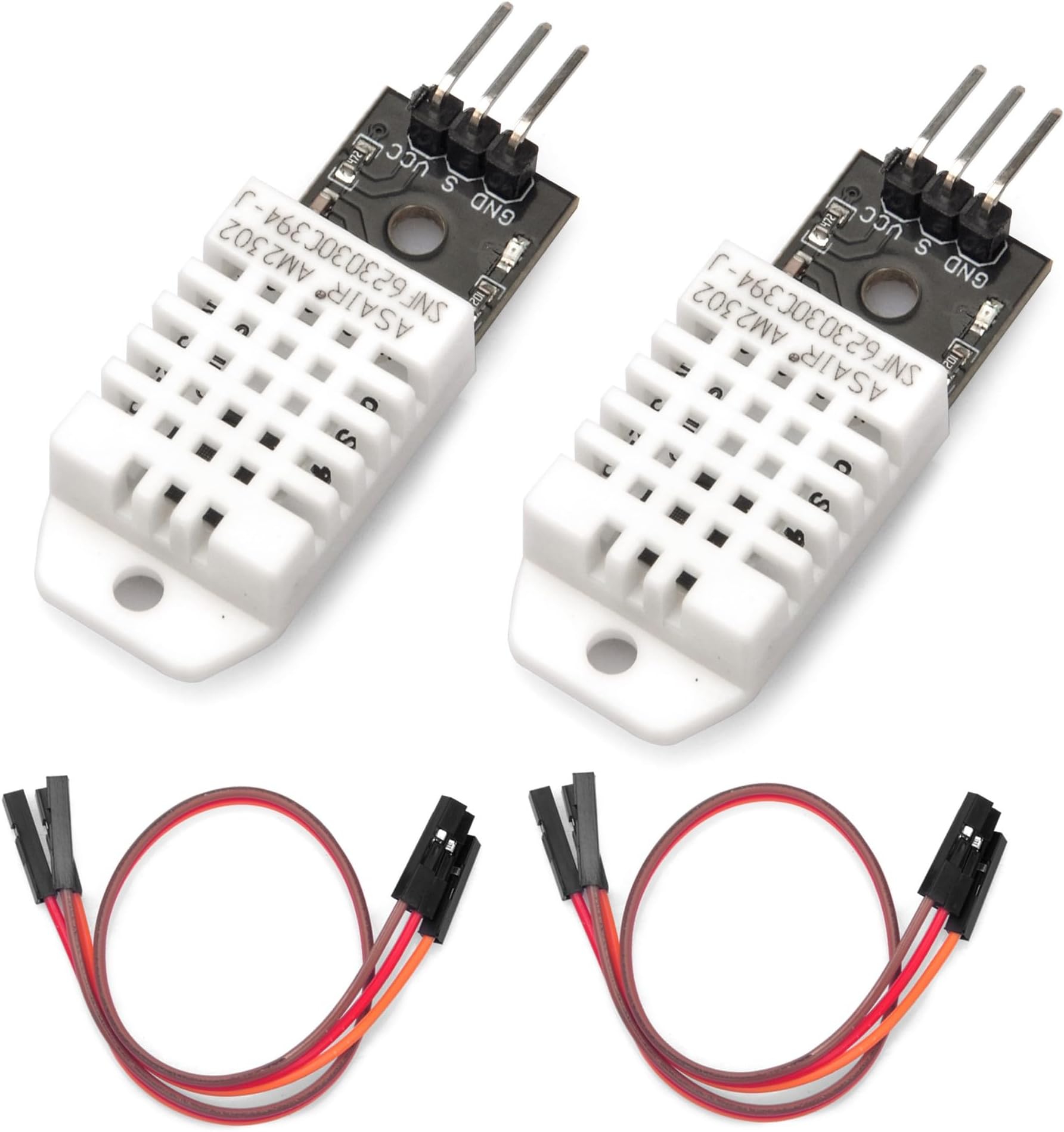
The Gowoops 2pcs DHT22/AM2302 sensor modules deliver high-precision digital temperature and humidity measurements with ±0.5°C and ±2% RH accuracy. Compatible with 3.3V and 5V systems, they easily connect to Arduino, Raspberry Pi, and other microcontrollers, making them ideal for DIY electronics, IoT, and robotics projects. Their wide operating range (-40°C to 80°C) and low power consumption ensure reliable performance across diverse environments.


| ASIN | B073F472JL |
| Additional Features | Portable |
| Best Sellers Rank | #779 in Single Board Computers (Computers & Accessories) |
| Brand | Gowoops |
| Built-In Media | DHT22/AM2302 Digital Temperature Humidity Sensor Module, DuPont wire |
| CPU Model Number | 43221-4105 |
| Color | DHT22*2 |
| Compatible Devices | Arduino, Raspberry Pi, Microcontrollers |
| Connectivity Technology | USB, Wi-Fi |
| Customer Reviews | 4.4 4.4 out of 5 stars (342) |
| Display Type | Digital |
| Graphics Card Interface | Integrated |
| Graphics Description | Dedicated |
| Hardware Interface | USB |
| Human-Interface Input | Buttons |
| Manufacturer | Gowoops |
| Model Name | Gowoops Digital Humidity and Temperature Sensor Module |
| Model Number | 43221-4105 |
| Native Resolution | Digital |
| Personal Computer Design Type | Barebone |
| Power Consumption | 100 Milliwatts |
| RAM Type | DDR2 SDRAM |
| Screen Size | 2.6 Millimeters |
| Specific Uses For Product | Business |
| Style Name | Minimalist |
| Total Usb Ports | 2 |
| UPC | 705586405750 |
| Wireless Compability | 802.11n |
| Wireless Network Technology | Wi-Fi |
| Wireless Technology | Wi-Fi |
M**D
inexpensive, worked great, average quality.
I used these to make an experimental thermostat for my house. They worked perfectly and I had a great time playing around with the project. They are easy to use and easy to wire. The quality seemed about average for this type of product. They were pretty cheap too!
J**.
Works well if wired correctly.
I bought this to monitor temperature and humidity in a proofing box. I'm using a RPI 4 to read the sensors. I used a python library by Adafruit to take the sensor readings. The schematic on their site (and any other site that comes up when you google this thing) all say to wire it to 3.3v constant power. When its constantly powered it works intermittently. Sometimes it'll run for hours, sometimes it runs for 20 minutes and stops. Powering off the RPI resents the sensor and it'll work again. To fix this, I wired power to GP17 (instead of 3.3 constant), and I turn it high (turn on the power to the pin) take my temperature reading, then turn GP17 back to low (power off). After making this modification, it's been very stable now for weeks on end. All other wiring for it should stay the same.
M**N
Good product, some frustration using it in C code
The Python libraries provided by hobby supply vendors are probably fine for this sensor. I scrounged some C code which appeared to work but in less than a day the sensor would stop responding. The code seemed OK based on the somewhat cryptic datasheet the hobby supply sites provide. But some more digging found a more thorough protocol description on the waveshare web site. Refactoring using the new information resulted in no errors after 48 hours of operation. Amazon does not allow links to external sites but you can probably find the waveshare page by searching on: waveshare wiki DHT22_Temperature-Humidity_Sensor In case that does not work this is the pertinent information: We will present the steps for data reading in the communication between the host and the sensor. Step 1 After the AM2302 is powered up (please wait 2s for AM2302 to become stable. In this period, no command will be sent out on device reading.), the sensor tests the environment temperature and humility and records relative data. When finished, the sensor enters the Sleep mode automatically. And the SDA data line of AM2302 is pulled up and remains HIGH as the effect of the pull-up resistor. At this moment, the pin SDA of AM2302 is in the INPUT state, detecting any possible external signal. Step 2 The Microprocessor I/O is set to OUTPUT and outputs a LOW level for more than 800us (The typical hold time is 1ms). Then, the microprocessor I/O is set to INPUT and the bus will be released. At this moment, the microprocessor I/O (the SDA data line of AM2302) goes HIGH as the effect of the pull-up resistor. After the host released the bus, AM2302 sends out a response, a LOW level of 80ms, and then outputs a HIGH level of 80ms to inform the peripheral to receive data. The signal transmission is shown as below: IMAGE OMITTED - see web page Step 3 After the AM2302 sends the response, the SDA outputs a string of 40 bits serial data continuously and the microprocessor receives the data according to the changes of I/O level. Bit data "0" signal: the level is LOW for 50ms and HIGH for 26-28ms; Bit data "1" signal: the level is LOW for 50ms and HIGH for 70ms; The relative signal diagram is shown below: IMAGE OMITTED - see web page After the SDA of AM2302 outputted the 40 bits of data, it remains LOW level for 50ms, and then switches to INPUT state and goes HIGH as the effect of the pull-up resistor. At the same time, the AM2302 internally re-tests the environmental temperature and humidity and records the relative data. When finished, the MCU will enter the Sleep mode automatically. Only when the MCU receives the new start signal from the host, the sensor will wake up and enter the working state.
D**E
Works well, can plug directly into raspberry pi and good customer service!
They work well. The only issue is that occasionally you get a bad read, humidity will read around 3000% and the temperature during the same read will be incorrect. In your Python script, just make sure to ignore any humidity readings above 100% and the temperature reading when the humidity is above 100%. Also the first read when you start the script might not be right, but it corrects by the second read. I accidentally fried one of my sensors and Gowoops offered to replace it for me, great customer service!
B**.
Accurate and easy to use
These are as accurate as any other thermometer and hygrometer I have in my home. I connected these up to some Raspberry Pi Zeros and set them up in a few rooms in my house where the temperature fluctuates wildly so I could monitor the temperature remotely on my phone. I set up a website that displays the reading from these sensors and sends me text alerts when the temperature or humidity go outside of some defined limits. These are easy to hook up to GPIO pins on a Raspberry Pi, come with all the wires you need to hook them up, and the example code to get this working on an Arduino or Pi linked to in the product description are a great starting point for using them in your own projects.
R**K
Good module but needs better English docs
I used this in a temperature controller to sense temperature and humidity in two places inside an incubator. Much more accurate than the DHT11 and uses a very similar communications strategy. Good luck finding an *accurate* English version of the spec sheet however. All of the “translations” from Chinese materially mis-state timing and state information, but a deep Google will lead you to what you need (ie, a properly rewritten spec sheet done by a frustrated hobbiest. Lol). Documentation issues aside, these are good modules and very stable in operation. They do NOT like to be pushed however, so keep the query rate down to about 1 poll every 1.5 to 2 seconds. In most applications this should not be an issue, but know this limitation and expect it. 5/5 stars for performance.
D**Z
Not as accurate as I had hoped but good enough for Gov. work as they say.
They are easy to use and wire up and have great built quality but they are crazy inaccurate! I have them sitting side by side and they are off by more than the margin of error of one device. Granted when taking both units margins into account then they technically work but I found this to be rather crazy. I use them to monitor Temp and Humidity in my PETG filament box so I guess the inaccuracy is not a huge deal breaker for me but I was hoping NOT to see such large difference on two items literally in the same packaging. I would definitely buy it again because of the price but if accurate is your game DHT's should not be your game.
Trustpilot
3 weeks ago
1 month ago