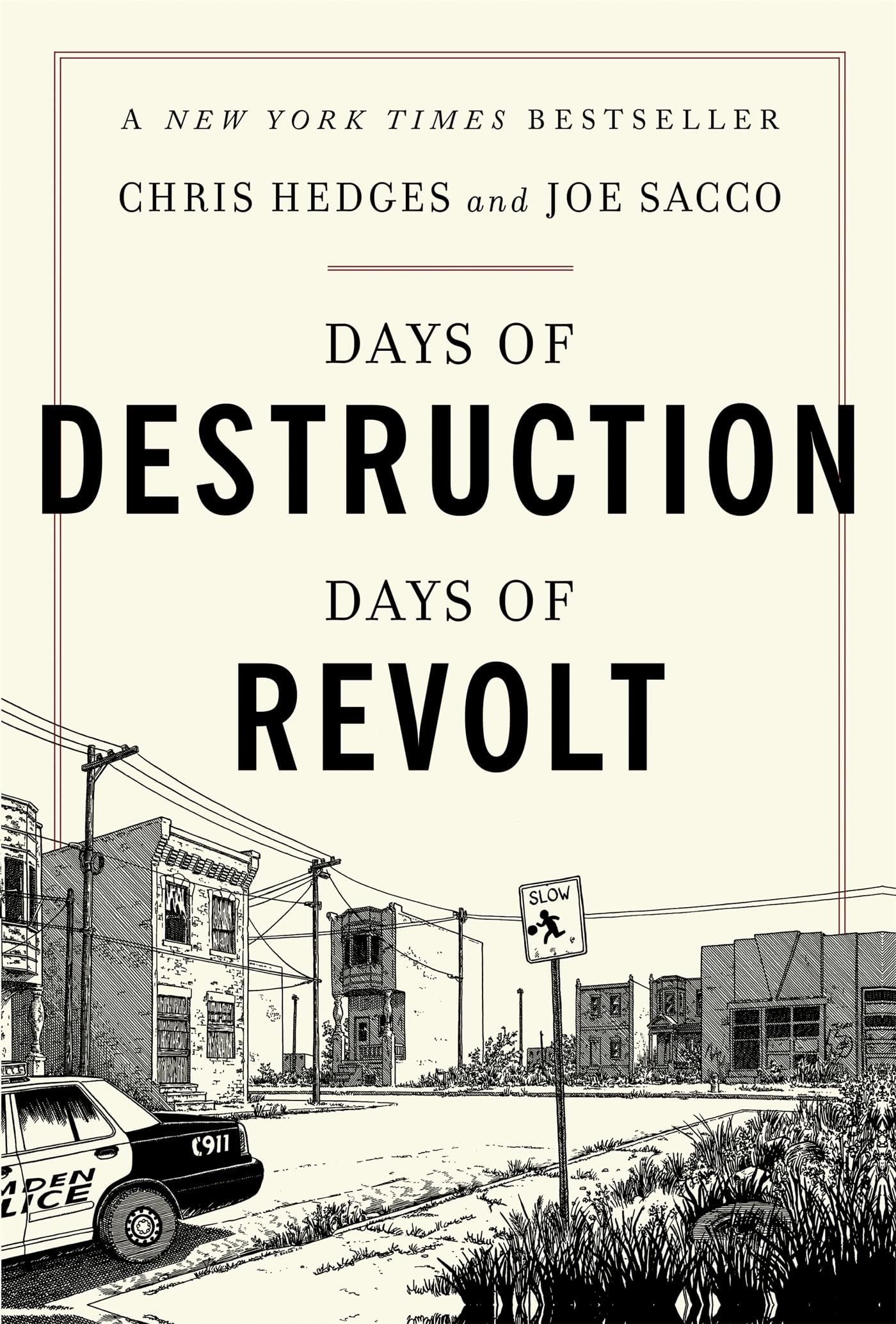

Days of Destruction, Days of Revolt
Product ID: 4776450
Buy anything from 5,000+ international stores. One checkout price. No surprise fees. Join 2M+ shoppers on Desertcart.
Desertcart purchases this item on your behalf and handles shipping, customs, and support to Vanuatu.
Through a mixture of words and drawings, two award-winning journalists tell the stories of Americans surviving in the parts of the country most ravaged by capitalism, and the ways they manage to find hope “As moving a portrait of poverty and as compelling a call to action as Michael Harrington’s The Other America .” — The Boston Globe A New York Times Bestseller • A Washington Post Best Book of the Year In this blend of rigorous journalism and graphic novel, Pulitzer Prize–winner Chris Hedges and award-winning cartoonist and journalist Joe Sacco set out to explore “sacrifice zones,” those areas in America that have been offered up for exploitation in the name of profit, progress, and technological advancement. Beginning in the Great Plains, where Native American reservations bear the legacy of ethnic cleansing, Hedges and Sacco travel to some of the most neglected regions in the United States. They speak to families in Appalachia whose lives are subject to the whims of coal companies; they meet agricultural laborers who endure brutal working conditions and live below the poverty line. In each region, they seek pockets of optimism and resistance, from union organizers to neighbors who shelter each other, and ultimately end up in Zuccotti Park during the first days of the Occupy movement. Days of Destruction, Days of Revolt is the searing account of Sacco’s and Hedges’s travels. Review: A Brilliant Snapshot Of A Nation In Despair - There is so much to like about Chris Hedges's and Joe Sacco's, Days of Destruction Days of Revolt (Nation Books, New York, 2012), I hardly know where to begin. What's not to like when a book that speaks the unvarnished truth? Corporations flourish, ordinary people languish; the super rich get richer, ordinary people suffer; the American Dream is an illusion, with "winners" tap-dancing uneasily over the freshly dug graves of those for who have long since lost hope. Do you want change? Behold the national security state, the smartly clad and well-armed local police departments, the smug prosecutors, Wall Street and the politicos, dancing hand-in-hand round and round in Washington while the rest of us turn away in disgust. Hedges tells it like it is. Sacco illustrates. This work is part text and part graphic presentation. I was at first put off by the graphic component. Times are grim. This is no time for comic books, I found myself thinking. But as I studied the graphic portraits of despair in such places as the Pine Ridge reservation in South Dakota, the desolate streets of Camden, New Jersey, the desiccated mountains of West Virginia, or the plantation-like cruelty supporting the tomato harvesting agribusiness in Immokalee, Florida, I was moved by the grimness on the look of the characters' faces. These line drawings convey what words have difficulty expressing. Call it dignified hopelessness: There are Americans who read their death warrants written on corporate ledgers of firms too big to fail who nonetheless continue to speak the truth. I devoured this book in an afternoon, feeling as though I had found friends: My ruminations about a country adrift, corporate fat-cats hand-in-hand with their cronies in government turning the nation into a fascist fat farm, these thoughts don't mark me as a solitary grievant. There are thousands, if not millions, of Americans thinking and feeling the same thing. Hedges gives voice to a grumbling evidence to any who will listen. Hedges and Sacco traveled to some of the most distressed regions of the country to see how the dispossessed live. Their reports are grim: Alcoholism and despair on the Pine Ridge reservation; drug use and rage in the ghetto; fear and exhaustion in immigrant communities; wary resignation in coal country. But alongside all this misery the bitch goddess profit and her handmaidens in the form of corporate thuggery and political diffidence among the elite. It's enough to make you want to ... Well, what, exactly? The book ends with a chapter on the Occupy Movement that flourished in an instant, and then vanished almost as quickly as it came. Hedges interviews Occupiers, and you can hear something like flinty hope in their voices. They may not have had a vision of how to reconstruct a better world. It was enough to assert that the world as it is fails to deliver what is both needed and promised. There was, and there remains, a value in refusal. Where has that struggle gone? Hedges writes too briefly about a trial in Utah of an activist named Tim DeChristopher, who disrupted a Bureau of Land Management auction in 2008 - he sought to impede the Bush administration's selling of federal land to gas and oil interests. DeChristopher hoped to rely on jury nullification to defend himself. He was devastated when the judge told jurors they could do no such thing. The judge "said it was not their job to decide [what]... is right or wrong, but to listen to what he said the law was and follow that even if they thought it was morally unjust. They were not allowed to use their conscience." The fact that he was surprised by the fact that the law can be applied devoid of conscience was oddly refreshing. Perhaps people can be taught to reclaim their sovereignty. When DeChristopher was convicted and sentenced to two years in prison, he told the judge: "I am here today because I have chosen to protect the people locked out of the system over the profits of the corporations running the system. I say this not because I want your mercy, but because I want you to join me." Fat chance the judge will do that; it is far easier to decide cases according to law, to put blinders on about who writes the law to serve what interest -- a sleeping people are easily managed. Jury nullification remains, in my view, a powerful means of citizens' taking direct action to challenge the law, a topic I wrote about at length in Juries and Justice. (Sutton Hart, 2013). I've not seen enough written on the topic and its potential to radicalize and mobilize ordinary people in literature about what can be done to reclaim the promise of the American dream. The final chapter on the Occupy movement rings with hope and fiery prose. "There are no excuses left. Either you join the revolt or you stand on the wrong side of history." I like the sentiment, but the call to "create monastic enclaves where we can retain and nurture the values being rapidly destroyed by the wider corporate culture and build the mechanisms of self-sufficiency that will allow us to survive," rings a little defeatist and hollow - even prosaic, even if, as it seems, it is the only realistic course. The American century has ended, and with it visions of common dreams. And that is, I suppose, the flaw in this otherwise wonderful book. The world is unhinged. Corporations and government are joined at the hip in a new form of something like fascism. The new national security or surveillance state promises security at the expense of a numbing uniformity. If ever there were a time that the anarchists in our history looked like prophets, it is now. I wonder why Hedges couldn't bring himself more directly say so? When even radicals pull punches the future seems dark indeed. Review: Volcano Peace Studies member - I was asked to "vet" this book for a professor of sociology & political science. The illustrated book examines 4 communities in the USA that have been ravaged & changed forever by corporate greed (Pine Ridge Indian reservation which represents the role of resource greed in this county's earliest growth; Camden NJ, pillaged by crooked politicians and abandoned after the steel industry collapsed; a West Virginia town ruined by mountain topping coal extraction; and a Florida town that is central to the migrant picking fruit and vegetable trade). Initially I thought, "This is just too grim, the information is so relentlessly depressing." While you read the heartbreaking stories of people who live in these communities it just feels that "the fix is in," corporate power is just too entrenched to ever be regulated to be more humane and fair. But after the profiles Hedges writes an extremely eloquent summary of why it's important to care about these issues and speak out against them even in the face of what seem like impossible odds. I don't have the book with me anymore; I gave it to a nephew who teaches. But he wrote something to the effect of the importance of standing for the side of good, standing up against greed and human exploitation. He cited examples of many corrupt periods and places that reached the tipping point and changed. He said many of the people who protested in places over the years were marginalized and lonely and never saw the results of their actions. However, their actions resonated with younger people and planted the seeds of change. The illustrations start w. sketches of the community itself in each section, then with a portrait of one person they speak to, and finally, one of their interviews turns into an 8- or ten-page comic strip of someone's story of their life in that community. All of these have the effect of humanizing the tough information being chronicled. They literally put a face on corporate excess and exploitation. So while it was very tough information, it was translated very succinctly into how corporate excesses affect families and communities. I felt it was an important read, and recommended it highly as a college textbook. I will also give it as gifts to many young people I know who care about the state of the world and are civicly engaged.


| Best Sellers Rank | #297,556 in Books ( See Top 100 in Books ) #189 in Biographies & History Graphic Novels #401 in Educational & Nonfiction Graphic Novels #481 in Political Conservatism & Liberalism |
| Customer Reviews | 4.6 out of 5 stars 611 Reviews |
N**S
A Brilliant Snapshot Of A Nation In Despair
There is so much to like about Chris Hedges's and Joe Sacco's, Days of Destruction Days of Revolt (Nation Books, New York, 2012), I hardly know where to begin. What's not to like when a book that speaks the unvarnished truth? Corporations flourish, ordinary people languish; the super rich get richer, ordinary people suffer; the American Dream is an illusion, with "winners" tap-dancing uneasily over the freshly dug graves of those for who have long since lost hope. Do you want change? Behold the national security state, the smartly clad and well-armed local police departments, the smug prosecutors, Wall Street and the politicos, dancing hand-in-hand round and round in Washington while the rest of us turn away in disgust. Hedges tells it like it is. Sacco illustrates. This work is part text and part graphic presentation. I was at first put off by the graphic component. Times are grim. This is no time for comic books, I found myself thinking. But as I studied the graphic portraits of despair in such places as the Pine Ridge reservation in South Dakota, the desolate streets of Camden, New Jersey, the desiccated mountains of West Virginia, or the plantation-like cruelty supporting the tomato harvesting agribusiness in Immokalee, Florida, I was moved by the grimness on the look of the characters' faces. These line drawings convey what words have difficulty expressing. Call it dignified hopelessness: There are Americans who read their death warrants written on corporate ledgers of firms too big to fail who nonetheless continue to speak the truth. I devoured this book in an afternoon, feeling as though I had found friends: My ruminations about a country adrift, corporate fat-cats hand-in-hand with their cronies in government turning the nation into a fascist fat farm, these thoughts don't mark me as a solitary grievant. There are thousands, if not millions, of Americans thinking and feeling the same thing. Hedges gives voice to a grumbling evidence to any who will listen. Hedges and Sacco traveled to some of the most distressed regions of the country to see how the dispossessed live. Their reports are grim: Alcoholism and despair on the Pine Ridge reservation; drug use and rage in the ghetto; fear and exhaustion in immigrant communities; wary resignation in coal country. But alongside all this misery the bitch goddess profit and her handmaidens in the form of corporate thuggery and political diffidence among the elite. It's enough to make you want to ... Well, what, exactly? The book ends with a chapter on the Occupy Movement that flourished in an instant, and then vanished almost as quickly as it came. Hedges interviews Occupiers, and you can hear something like flinty hope in their voices. They may not have had a vision of how to reconstruct a better world. It was enough to assert that the world as it is fails to deliver what is both needed and promised. There was, and there remains, a value in refusal. Where has that struggle gone? Hedges writes too briefly about a trial in Utah of an activist named Tim DeChristopher, who disrupted a Bureau of Land Management auction in 2008 - he sought to impede the Bush administration's selling of federal land to gas and oil interests. DeChristopher hoped to rely on jury nullification to defend himself. He was devastated when the judge told jurors they could do no such thing. The judge "said it was not their job to decide [what]... is right or wrong, but to listen to what he said the law was and follow that even if they thought it was morally unjust. They were not allowed to use their conscience." The fact that he was surprised by the fact that the law can be applied devoid of conscience was oddly refreshing. Perhaps people can be taught to reclaim their sovereignty. When DeChristopher was convicted and sentenced to two years in prison, he told the judge: "I am here today because I have chosen to protect the people locked out of the system over the profits of the corporations running the system. I say this not because I want your mercy, but because I want you to join me." Fat chance the judge will do that; it is far easier to decide cases according to law, to put blinders on about who writes the law to serve what interest -- a sleeping people are easily managed. Jury nullification remains, in my view, a powerful means of citizens' taking direct action to challenge the law, a topic I wrote about at length in Juries and Justice. (Sutton Hart, 2013). I've not seen enough written on the topic and its potential to radicalize and mobilize ordinary people in literature about what can be done to reclaim the promise of the American dream. The final chapter on the Occupy movement rings with hope and fiery prose. "There are no excuses left. Either you join the revolt or you stand on the wrong side of history." I like the sentiment, but the call to "create monastic enclaves where we can retain and nurture the values being rapidly destroyed by the wider corporate culture and build the mechanisms of self-sufficiency that will allow us to survive," rings a little defeatist and hollow - even prosaic, even if, as it seems, it is the only realistic course. The American century has ended, and with it visions of common dreams. And that is, I suppose, the flaw in this otherwise wonderful book. The world is unhinged. Corporations and government are joined at the hip in a new form of something like fascism. The new national security or surveillance state promises security at the expense of a numbing uniformity. If ever there were a time that the anarchists in our history looked like prophets, it is now. I wonder why Hedges couldn't bring himself more directly say so? When even radicals pull punches the future seems dark indeed.
B**T
Volcano Peace Studies member
I was asked to "vet" this book for a professor of sociology & political science. The illustrated book examines 4 communities in the USA that have been ravaged & changed forever by corporate greed (Pine Ridge Indian reservation which represents the role of resource greed in this county's earliest growth; Camden NJ, pillaged by crooked politicians and abandoned after the steel industry collapsed; a West Virginia town ruined by mountain topping coal extraction; and a Florida town that is central to the migrant picking fruit and vegetable trade). Initially I thought, "This is just too grim, the information is so relentlessly depressing." While you read the heartbreaking stories of people who live in these communities it just feels that "the fix is in," corporate power is just too entrenched to ever be regulated to be more humane and fair. But after the profiles Hedges writes an extremely eloquent summary of why it's important to care about these issues and speak out against them even in the face of what seem like impossible odds. I don't have the book with me anymore; I gave it to a nephew who teaches. But he wrote something to the effect of the importance of standing for the side of good, standing up against greed and human exploitation. He cited examples of many corrupt periods and places that reached the tipping point and changed. He said many of the people who protested in places over the years were marginalized and lonely and never saw the results of their actions. However, their actions resonated with younger people and planted the seeds of change. The illustrations start w. sketches of the community itself in each section, then with a portrait of one person they speak to, and finally, one of their interviews turns into an 8- or ten-page comic strip of someone's story of their life in that community. All of these have the effect of humanizing the tough information being chronicled. They literally put a face on corporate excess and exploitation. So while it was very tough information, it was translated very succinctly into how corporate excesses affect families and communities. I felt it was an important read, and recommended it highly as a college textbook. I will also give it as gifts to many young people I know who care about the state of the world and are civicly engaged.
J**Y
A spectacular and moving account: read it!
This book is painful to read, and should be read by everyone. For me, it illustrated how almost everyone has now joined the ranks of the dispossessed, or is in danger of doing so sooner than they think. The scorn formerly poured on indigenous populations who succumbed to alcoholism and unemployment after the forcible removal of their lands and their livelihoods can now apparently be extended to large portions of the USA's population: people who used to have homes, careers and families and who have been rendered trash by the machinations of large corporations. They now also sit in ruined towns, comatose in front of the TV, clutching the bottle for comfort. Sometimes it might be the pill bottle rather than the booze bottle, but it's killing them just the same. And those who are brave enough to protest the ruination of their lives and those of their neighbours are likely to be attacked and in some cases killed for their efforts. We no longer need dystopian science fiction novels: we have turned our planet into one. This book is one of the many wake-up calls published in recent years by people who value the future of the planet and the species it houses (including humanity). It is one of the best. Its intimate examination of the lives of ordinary people is chilling in its thoroughness and its straightforward description of their betrayal and despair. The giant corporations are truly psychopathic if they can continue to pretend that what has happened in the Appalachian mountains, in cities like Camden, and to people like the migrant workers on fruit farms, is actually good for anything other than the shareholders' bank balances. A revolt is most definitely needed, before the world runs out of time. The lunacy of digging up mountains in order to release coal with which to further damage our already damaged ecosystems further almost defies belief - except it's actually happening. The abandonment of people to unemployment and ruin is criminal. Governments around the world should be uniting to fight off the corporate evil that is described in this book. Instead, they have been bought by those very corporations and are working assiduously to aid the destruction. Shame!
S**P
Deeply Disturbing Content
This book is extremely difficult, emotionally, to read through. I've been having to take it one chapter at a time because it is so heartwrenching. I've had the book for 2 months now (since May 29th) and I've just finished chapter 3. I'm not a slow reader, I probably could've finished it in a few hours if it weren't for the content involved. I am deeply moved (to lamentations and profound listlessness) after reading about what has happened. I especially found it difficult to get past the racially charged content but I did for the sole purpose of understanding the very real torment and pain that fellow Americans have endoured from all backgrounds. I wanted to put the book down in anger several times but like seeing a trainwreck happen in slow motion, no one can look away. If there is anything to say about this book, it is that it illicits compassion and understanding for those outside your own cultural background, because the book talks about many in so short a discussion. If you aren't crying at any point (inside or out) by end of chapter 3 or affected on a profound level by what you've read, then you fail to have placed yourself in the shoes of those outside your experiences. So many lives have been destroyed. So many. If there's anything I learned so far it is that you don't need to call it a war for it to be a detrimental and violent experience for those affected. Lady Liberty is patina from all the tears she weeps. I study global scale problems, looking for newly released technological or philosophical answers for solving them on regional and localized scales. I haven't yet been able to get past the sadness associated with the content of this book to even begin to seek out potential solutions yet. Something has been going very, very wrong on such a grand design scale and for so long that I question the viability and survivability of the culture and way of life I was born into. I fear for my fellow Americans from all walks of life, all creeds, cultures and backgrounds. The silence is deafening and the violence of it all is overwhelming at it's core. The only reason I knocked off one star for this book is because there are pointed statements, claims that where made generalized rather then specified. The writer seems to have painted a picture in terms of black and white, us and them. I haven't completed reading the book yet, so will update this review upon completion. I STRONGLY advocate its purchase or at the very least read it cover to cover if your local library has a copy. If you are a problem solver, this work is a complicated challenge quagmired in political swamps, social upheaval and a kind of financial instability that can only best be described as "complete insolvency for the future of humanity as a civilized society due to greed." There is nothing civil about it, and this book cuts to the core of a profoundly disturbing subject. Financial interests have taken priority over the human element. Update: July 22nd. Upon completion of reading the book, cover to cover I must conclude that my opinion on the content hasn't changed much. There are some elements of racism contained in this book but the context must be read to understand and determine where it is coming from. There are also strong anti-capitalist sentiments within the content, but coming from the standpoint of environmental degredation as well as the complete disregard for human life and human capital as they pertain to community stability overall. The book is a STRONG BUY, if only for the storytelling element alone. Though I am concerned that the book may incite hate towards specific ethnicities rather than identified individuals, the authors do a fantastic job of bringing to light stories not otherwise searchable in news and other media outlets. I stand firm on my stance that the book has strong elements of "us vs. them" mentalities, and there is clearly zero understanding involved in how the stock market or business works on a fundamental level. If I had a sit down with the author, it would result in another book. I've been working on a way to serve the disenfranchised by developing "plug and play" or "key in door" solutions that can be emulated on shoestring budgets and from 3rd world country scenarios. I've found a few solutions to some of the elements the problems the author speaks about and the potential to end unemployment as we know it today without dropping elements of automation which have affected everyone around the world. In this highly competitive 21st century we live in, we must understand as a combined force- humanity as a whole, that automation offers us all the freedom from menial tasks which limit our own potential. The missing element in the economy thus far has been the complete replacement of the old, dead system which has never worked for anyone born after 1975. What we need are those automations made cheaper and available to more consumers for the purpose of dropping industry pricing and more home based businesses. My own solutions focus on environmental restoration as a commercial endeavor and to alleviate the brunt of prolonged unemployment through financial tactics and combined efforts of business endeavors. The author's sequal should focus entirely on the solutions the world has come up with to resolve the existing problems of today. As much as I appreciate the history lesson, it doesn't help the starving homeless and the bankrupted disenfranchised to look for a target group to blame for all these ills. Instead, step out of the 20th century decay and rot. Stroll effortlessly right into the 21st century, where the age of collaboration has reached full swing and is now cresting and about to overlap the next age. This book is a fascinating read and I am deeply affected by it on an emotional level. However, cerebrally, I've already jumped past the problems and have been trying to find the solutions. Humanity literally doesn't have the time left required to fight out a war and the kind of war we need isn't against one another but a race against the clock to rebalance the earth's ecosystem before it's too late. I personally feel that we may have already passed the point of no return with the climate but trying to place blame on one group of people doesn't fix the problem but instead serves as a distraction when there is real work to be done.
N**Y
Chris Hedges is one of the most important voices of our time
I believe Chris Hedges is probably the most gifted, credible, honest and relevant intellectual of our time (having recently inherited that mantle from Chomsky). The man scarcely puts a foot wrong on any issue. If you are not familiar with him, go to TruthDig and read his columns from start to finish. By the time you are done, you will have a clearer understanding of why the world is as screwed up as it is, why the US is to blame for most of it, and why the US is in terminal decline (except for the privileged few). If this doesn't make you very very angry - then check yourself for a pulse. Chris Hedges is one of those rare people, speaking truth to power right in the moment when it is CRITICAL to speak truth to power. With this book he and Joe Sacco lay bare numerous examples of what he terms America's "sacrifice zones" - zones of people and places who have fallen by the wayside ... tossed aside ... forgotten. Where the "American Dream" has turned into a nightmare of almost unimaginable dimensions. And this nightmare is not getting better - it is getting worse. It is impossible not to be touched by the heart-rending stories of the people whom they interview - people who for the most part have done very little (if anything) wrong, but who are being run into the ground under the bulldozer of misbegotten corporate and legal power. It was Plato who said "the people who see past the shadows and lies of their culture, will never be understood, let alone believed by the masses." Well, Chris Hedges is carrying a torch for truth, and we would do well to listen to his clarion call. If you want to see an amazing 9 minute video of Hedges which sums this all up nicely, then Google "Chris Hedges Inverted Totalitarianism Youtube" Buy the book. Give it as a gift. Share it widely. We need to hear these people's stories.
T**Y
IGNORE the FAKE bad reviews, Chris Hedges has important things to say
I find it very odd that a handful of bad reviews all came in on the same day, all complaining about issues using on various e-readers. That has nothing to do with the merit of the book itself, and unfortunately those complaints bring down the ratings significantly. Don't listen to people who gripe about not being able to read this book on their iPad. I suspect those reviews were planted deliberately (and all it cost them was about $40). Also consider who is writing them. Odds are they only have one (this) review or only a hand full and are done all on the same one day/week. Seems like the types of people getting paid to do this (planting negative reviews). Neo-conservatives. Shame on them. Whether the e-readers are a failure or not, Amazon's mistake shouldn't drive down the rating for the printed book. They could at least still leave a 3 or 4 star review and still mention the e-reader problem in the title. Don't listen to the guy who thinks Chris has nothing important to say. Or that he causes more problems that helps. Honestly, the first and most important part to any solution is hearing the truth. The raw reality of how things are. And Chris does an amazing job of being honest. Things are NOT getting better. Better times are NOT around the corner. The 'economy' (whatever that is) 'turning around' (whatever that means) isn't going to make life all rosy. That's what the media, politicians, corporations, etc all want you to believe. To even remotely consider alternative ways of living, perhaps even radical ways of living, we first have to see the truth so we feel compelled to reject the larger system we are a part of. If we remain blind, numb, comfortable, then we won't ever be motivated to do anything differently or to take charge in our lives. You need to look at the larger spectrum, to look at history, to look at what happened over the past 100 years to make sense of certain situations of today. You will start to see the trends of manipulation, greed, recklessness, selfishness, domination, and deception of the masses to comply with the small few who supposedly know best. Camden wasn't always a bad place to live. South Jersey used to be a booming economic and industrial area. But today I try to avoid Camden County entirely. It's totally disturbing when you have a run down inner city town with beat-up rowhomes and only 15 minutes away you have swank suburbs in a place like Cherry Hill or even better, Mount Laurel (which I believe is that way merely because it's in a different county, despite it's proximity to Camden). To complain about Chris not being some saint is preposterous. He's just one man. To even think a single person can be put on a pedestal is ridiculous. Just because he's not the savior of the world doesn't mean his words are useless. Sometimes people are better at some things than others. Whether he makes a comfy living or not is beyond the point. The kind of raw ugly truth that our society is inherently destructive is perhaps the very message we need to hear so we decide to live radically differently. Every last person has a responsibility to live in a sustainable way and to create goodness around them. Perhaps it's because we believe that a small group of people (leaders) can represent everybody, that we are in this mess. Maybe people ought to represent themselves. History has proven that people are largely self-interested, especially the larger the things they have control over. We have this foolish idea of what options there are for control/power. We seem to be under the illusion that if we are to participate at all, we need to do so on a grand scale, that either we lead the world or we wait to be led. On a large scale of change, leadership, control, etc I think this mentality of all or nothing will end up making most people give up and let the small few who are determined enough to control everything do what they want, and foolishly believe that they somehow care about all of us (and not some agenda). But the thing that I think we fail to see is that power/control doesn't need to be an all-or-nothing thing. We ought to live in smaller independent communities, towns, etc and then participation isn't something so frightening or discouraging. It doesn't feel like we have the weight of the world on our shoulders. So personally, I don't think we can or should expect much of anything from any one individual. We each have the responsibility to participate in our system, and maybe it's best that we do so in a system where participation isn't so overwhelming - on a small community scale, where our web of interdependence isn't so complex that destruction and powerlessness are inherent. Chris may not have all the answers, and maybe is a bit naive about 'Occupy Wall Street' actually making things better - but to show what mainstream media will not bother discussing - I think it's worth noting and congratulating him for his efforts. At the very least, his writing ought to open your eyes to a very disturbing view of the world, and hopefully open up an interest in seeking the truth in it's many levels through the countless other history/sociology/political books that show society for the sham that it is.
A**R
... who don't know what a life in poverty is like living in daily desperation to survive well I dedicate ...
There are some people in America the 1% who don't know what a life in poverty is like living in daily desperation to survive well I dedicate this book review to those of you who have never had to taste the bitterness of being poor in America. I am going to focus my attention on chapter 2 "Camden, New Jersey" as an African-American man aged 58 I have seen and lived through the triumph and failure of the civil-rights movement as for this movement's failure on the bottom of page 64-65 "The United States is home to almost twenty-five percent of the world's prison inmates. One out of every three African American males go to prison. More African Americans today are subject to the coercive forces of correctional control through prisons, probation, or parole than were enslaved a decade before the Civil War. The days of segregated buses and lunch counters may be over, but integration never became a reality except for a few middle class blacks. Integration would mean new taxes to lift African-Americans out of their internal colonies, new schools to educate the poor and give them a chance, and making sure there were jobs available with living wages. The civil rights movement was a legal victory, not an economic one. And the economic barriers remain rigid and impenetrable for the bottom two-thirds of African-Americans whose lives today are worse than when King marched in Selma. The violence of overt segregation ended. The violence of poverty remains. Wealth was never redistributed. And when cities were deserted by whites, who took with them the jobs and tax base to keep those cities alive, who made it plain by their departure that they would not live with or allow their children to be educated with blacks, city halls were turned over to compliant black elites whose loyalty rarely extended beyond their own corrupt inner circle. White power hid, as in any colony, behind black faces." On the middle of page 65 an excellent description is given of where us poor people live "Camden sits on the edge of the Delaware River facing the Philadelphia skyline. A multilane highway, a savage concrete laceration, slices through the heart of the city. It allows commuters to pass overhead, in and out of Philadelphia, without seeing the human misery below. We keep those trapped in our internal colonies, our national sacrifice zones, invisible." One important aspect of poverty is the unhealthy diet of us poor people as stated on the bottom of page 75 "Camden, like many poor pockets in the United States, is a food desert. Camden is dominated by Church's chicken- where nearly everything on the menu, from Jalapeno Cheese Bombers to the Double Chicken N Cheese, is fried- and doughnut shops. Grease and sugar. Decay and crime. Despair and poverty. Cities and manufacturing hubs across the country suffered similar assaults, but in Camden the breakdown was total, and the city, at least as a self-sustaining community, was obliterated." The monstrous specter of economic segregation reared its ugly head once again as stated in the middle of page 76 "Economic segregation is the new, acceptable form of segregation. And it turned New Jersey into one of the most segregated states in the nation. Mount Laurel, seized by developers, became a haven for whites fleeing urban decay. Its original inhabitants could no longer afford to live there. The blacks were driven from their land, forced into squalid internal colonies such as Camden." The American Flag is not in my apartment and never will be until us poor people the 99% will be able to live like decent human beings with dignity rather than having to wallow in dire poverty. This book should be read by all those 1% who don't know what it is like to be poor in the good old U.S. of A.
M**H
Just read this.
Hedges, like few other journalists, plunges deep into the heart of darkness to bring light to real injustices that are too often marginalized by the mainstream media. A bleak book that deals with the "sacrifice zones", those areas of America of extreme poverty and deprivation. Yet still, if you look hard enough at the stories of human tragedy, perversity, avarice, and exploitation, after you wipe away the tears, and you read of figures such as Lolly Davis,you will agree with Father Michael Doyle that "The best four-letter word in the English language is 'hope'." (110) "A culture is no better than its woods" W.H. Auden "Workers in this country paid for their rights by suffering brutal beatings, mass expulsions from company housing and jobs, crippling strikes, targeted assassinations of union leaders, and armed battles with hired-gun thugs and state militias. Unions created the middle class. They opened up our democracy. Federal marshals, state militias, sheriff's deputies, and at times even U.S. Army troops, along with the courts and legislative bodies, were repeatedly used to crush organized workers. Striking sugar cane workers were gunned down in Thibodaux, Louisiana, in 1887. Steel workers were shot to death in 1892 in Homestead, Pennsylvania. Railroad workers were murdered in the nationwide Pullman strike of 1894. Coal miners were massacred at Ludlow, Colorado, in 1914 and at Matewan, West Virginia, in 1920. The Rockefellers, the Mellons, the Carnegies, and the Morgans--the Goldman Sachs and Walmarts of their day--never gave a damn about workers. All they cared about was profit. The eight-hour workday, the minimum wage, Social Security, pensions, job safety, paid vacations, retirement benefits, and health insurance were achieved becasue hundreds of thousands of workers physically fought asystem of capitalist exploitation. They rallied around radicals such as Mary Harris 'Mother' Jones--arrested at one point in the West Virginia coalfields for reading the Declaration of Independence to a crow of miners--United Mine Workers' President John L. Lewis, and 'Big' Bill Haywood and his Wobblies, as well as Socialist presidential candidate Eugene V. Debs. 'The whole history of the progress of human liberty shows that all concessions yet made to her august claims, have been born of earnest struggle...' Frederick Douglass said. 'If there is no struggle there is no progress. Those who profess to favor freedom and yet deprecate agitation are men who want crops without plowing up the ground. They want rain without thunder and lightning. They want the ocean without the awful roar of its many waters. The struggle may be a moral one, or it may be a physical one, or it may be both moral and physical, but it must be a struggle. Power concedes nothing without a demand. It never did and it never will. Find out just what any people will quietly submit to and you have found out the exact measure of injustice and wrong which will be imposed upon them, and these will continue till they are resisted with either words or blows, or with both. The limits of tyrants are prescribed by the endurance of those whom they oppress.'" (159-160)
F**N
Imprescindible
Extraordinaria combinación de testimonios de denuncia social con las ilustraciones del maestro Joe Sacco. Un 'must'. La edición es tapa blanda pero de buena calidad.
M**.
Depressing an eye opening
A joint effort this book mixes comic style with straight prose, to provide an overview of the decline of working class America. Based on interviews brought to life through pictures and text, this is a book you should get if you want a different take on the American dream. I only give it 4 stars instead of 5 because the style of drawings aren't to my taste. But overall, it's a great book.
G**P
delusione
Il libro è privo di copertina (non era specificato nella descrizione). In piratic ac'è la copertina rigida e non la copertina che si vedeva nella foro del libro. Inoltre il libro è tappezzato di etichette e prezzi, più volte cambiati e appiccicati l'uno sull'altro. Sulla copertina ci sono macchie di unto. Le pagine interne sono a posto.
C**N
Unflinching Picture of Modern Capitalism
I came to this book because of my enthusiasm for the work of Joe Sacco, but finished it searching on the internet for more info about the ideas of Chris Hedges, who for me is one of the most articulate radicals i have come across in a very long time. Sacco is one of a kind, a political investigative journalist through the media of comic strips. I have several of his books, and particularly enjoyed "Safe Area Gorazde", an account of the conflict in Bosnia. He puts you on the ground and introduces you to his friends and associates. He does the same thing here as he and Hedges visit four areas, where interestingly four different racial groups have been chewed up and spat out by corporate America. These are Pine Ridge Indian reservation, Camden New Jersey where departing manufacturing industry has left little but a drug culture, the Appalachian mountains, where mountains are literally taken apart in open cast coal mining, and Florida where Central American immigrant labour is exploited in tomato picking without any kind of regulation. The common theme is that corporate industry has bought and sold government at police, state and federal levels in such a way that whereas lipservice is paid to liberal and constitutional ethics and standards, in practice justice is not a commodity that is generally available for poor working class people, at least not without a fight. As an English person several of these scenarios were new to me. Corruption is not quite as entrenched or uninhibited I don't think in my country, although it works in a similar way. The section on Pine Ridge stands out because the travesties of justice go back a hundred and fifty years or more, and we realise that what we are seeing now all over was always the American way when ethics come up against profit. Hedges' writing is very impressive. If you research him on the internet as I have done you discover he has a track record of reporting oppression and over the years has put himself at risk in a number of situations, he seems a fairly committed guy. He is also very thoughtful and spiritual as a person. His point of view is never negative imo. A lot of people found this book depressing according to the reviews. I didn't. I found it truly shocking, and I speak as a guy who has thousands of books on his shelf, many of them about history and politics. This book is shocking because it talks to real people, depicts them, and then comes up with a poltical narrative built up from their experience, and it demonstrates the conflict between the "democratic" narrative and reality. The final chapter is about the Occupy movement, and Hedges gives his poltical credo. I am not sure what I think about this but it is cohesive, clearly put, and far more intelligent than any other such credo I have read for several decades at a political level. it is easy to criticise and not easy to come up with a plan, and this is a fairly intelligent and unflinching attempt at least. This book is an up to date indictment of modern capitalism and put together in an extremely thought-provoking way
M**A
Decepcionante!
Decepcionante. Comecei a ler o primeiro capítulo, cuja história conheço bem, e o achei bastante mal escrito. As fontes primárias são interessantes, mas não chegam a dar uma visão equilibrada da situação. A bibliografia é lamentável, todos os brilhantes historiadores e escritores indígenas são ignorados. No final, a visão permanece eurocêntrica. Impossível continuar a leitura até o final. É melhor buscar outras fontes de informação.
Trustpilot
2 weeks ago
1 week ago