
Desertcart purchases this item on your behalf and handles shipping, customs, and support to Vanuatu.
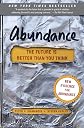
The New York Times bestselling “manifesto for the future that is grounded in practical solutions addressing the world’s most pressing concerns: overpopulation, food, water, energy, education, health care and freedom” ( The Wall Street Journal ). Since the dawn of humanity, a privileged few have lived in stark contrast to the hardscrabble majority. Conventional wisdom says this gap cannot be closed. But it is closing—and fast. In Abundance , space entrepreneur turned innovation pioneer Peter H. Diamandis and award-winning science writer Steven Kotler document how progress in artificial intelligence, robotics, digital manufacturing synthetic biology, and other exponentially growing technologies will enable us to make greater gains in the next two decades than we have in the previous 200 years. We will soon have the ability to meet and exceed the basic needs of every person on the planet. Abundance for all is within our grasp. Breaking down human needs by category—water, food, energy, healthcare, education, freedom—Diamandis and Kotler introduce us to innovators and industry captains making tremendous strides in each area. “Not only is Abundance a riveting page-turner…but it’s a book that gives us a future worth fighting for” ( The Christian Science Monitor ). Review: Great must have book - This here is one mus have of a book! If you ever felt like the World is going to s*** this book will change your mind. This is not hippy propaganda about a fairer World through peace and positive thinking. This book is filled with facts and trends that are changing the world as we speak and are bringing abundance. Whether this abundance will be used for a common good or squandered is something outside the scope of this book. In the end this book gives a great and optimistic vision of the future. Review: optimism about the future - My son got me to read this because I was pessimistic about the global future for subsequent generations (I'm a lucky post-war baby boomer). It really made be optimistic and hope I last another 30+ years to see much of this technical development come about. I'd recommend the book to anyone - it is not too technical although some chapters you will want to read a second time to fully grasp the subject. The book labours the first point - the exponential growth of computing power - but you can whip through this if you find it obvious. Then the rest of the book with amaze you. I'm longing for the self-contained loo - so thanks to Bill Gates for largely funding this development. I doubt though that I will see singularity. Abundance: The Future Is Better Than You Think


| Best Sellers Rank | 245,896 in Books ( See Top 100 in Books ) 103 in Professional Financial Forecasting 103 in Environmental Engineering & Technology 9,973 in Popular Science |
| Customer Reviews | 4.5 out of 5 stars 2,759 Reviews |
M**O
Great must have book
This here is one mus have of a book! If you ever felt like the World is going to s*** this book will change your mind. This is not hippy propaganda about a fairer World through peace and positive thinking. This book is filled with facts and trends that are changing the world as we speak and are bringing abundance. Whether this abundance will be used for a common good or squandered is something outside the scope of this book. In the end this book gives a great and optimistic vision of the future.
P**R
optimism about the future
My son got me to read this because I was pessimistic about the global future for subsequent generations (I'm a lucky post-war baby boomer). It really made be optimistic and hope I last another 30+ years to see much of this technical development come about. I'd recommend the book to anyone - it is not too technical although some chapters you will want to read a second time to fully grasp the subject. The book labours the first point - the exponential growth of computing power - but you can whip through this if you find it obvious. Then the rest of the book with amaze you. I'm longing for the self-contained loo - so thanks to Bill Gates for largely funding this development. I doubt though that I will see singularity. Abundance: The Future Is Better Than You Think
I**D
The Future really is Better than you think
Abundance by Peter Diamandis and Steven Kotler is a well-researched and hugely optimistic book. Its central thesis is that new technologies are going to solve many of the world's resource problems over the coming ten to twenty years, bringing about a world of future abundance. The book's structure follows what the authors term 'The Abundance Pyramid': water, food, shelter, energy, education, health care and freedom (a hierarchy of human needs based loosely on Maslow). Each of these needs are explored in depth and the authors share insights from leading edge research and the likely benefits that they might bring. Energy Take, for example, energy, "arguably the most important lynchpin for abundance" (p.156): where is all the energy going to come from? The authors explore three options: solar and photovoltaics, synthetic biofuels and "fourth generation" nuclear power. Of these, they argue, solar has the most potential: "The German Aerospace Centre estimates that the solar power in the deserts of North Africa is enough to supply forty times the present world electricity demand" (p.157). The chapter unpacks each of these three energy sources as well as outlining other significant technical developments, which will enhance these, such as Liquid Metal Battery technologies which promise to enable us store clean energy; and development of "an intelligent network of power lines, switches and sensors able to monitor and control energy down to the. Level of a single lightbulb" (p.169). Alongside discussion of the developments in these key areas, the authors outline four key drivers of technological progress: The DIY Innovator - collaboration through e Internet means that small groups are far more powerful than ever before. On the Wikipedia principle, it is possible for enthusiasts and experts to work together to solve problems more efficiently than is possible in large corporations. The Technophilanthropists - Billionaire philanthropists, such as Microsoft's Bill Gates and eBay's founder Pierre Omidyar, are pouring resources into solving many of the world's problems on a scale that previously was possible only at a Governmental level. Unlike e Mega-rich philanthropists of the past (Rockefeller, Vanderbilt Carnegie et al) the current breed are young and see the world (as opposed to NYC/USA as their stage). The Rising Billion - "the bottom billion" (= four billion people) are becoming connected and are set to be net economic contributors and consumers in the next two decades. The Power of Incentive Competitions - competitions with large prizes put up by philanthropists have a long history of promoting innovation and technological break-throughs. (Here Peter Diamandis is plugging the X-PRIZE of which he is the founder and CEO, but the argument is nevertheless an interesting one. The World of Abundance: The world of Abundance is one where all are fed and watered and there is enough power that we can start to clean up the planet by removing carbon from the atmosphere or to think about investigating Space seriously. People will continue to get healthier as medicine becomes "predictive, personalised, preventive and participatory" (= P4 medicine; p.201-3); X-ray machines will be the size of a suitcase (p.194), spare organs will be 3-D printed or cultivated to order from stem cells (p.200-1) and most, if not all Blue-collar work will be taken over by robots, including care of the elderly (how do you feel about the prospect of "robo-nurse"?). Robots will also perform routine, repetitive operations (e.g. Cataract p.197). Education In the context of such abundantly interesting read, the chapter on Education was a little disappointing, but that's perhaps only because it was the area with which I am most familiar. The authors retrace the New Delhi hole-in-the-wall research, Negroponte's One Laptop per Child (OLPC) initiative, before regurgitating Sir Ken Robinson's critique of the present educational system (see Sir Ken's TED talk "Schools kill Creativity"). Learning like Video Games However, there is an eloquent argument that "we need to make learning a lot more like video games and a lot less like school" (p.183). Indeed there may be much to learn from the ways in which Game Designers motivate gamers and reward success. Game designers never give negative or bad grades because gamers don't like it. Lee Sheldon, a professor at the University of Indiana, has "implemented an 'experience points' game based design. Students begin a semester as a level zero avatar (equivalent to an F) and strive toward a level 12 (an A). This means that everything you do in class produces forward motion, and students always know exactly where they stand - two conditions that serve to motivate." This makes enormous sense. We are all familiar with Dweck's research that demonstrate that many pupils prefer to do the same puzzle again and again rather than attempting a harder puzzle for fear of failing. Yet, many of those very same pupils will devote hours of their free time gaining experience to get to the next level in a computer game. The Inverted School The Khan Academy is held up as a model for classroom teaching of the future (yes, you read it correctly): Los Altos School District in California "are taking an approach that inverts the 200-year old schoolhouse model": "Instead of teachers using classroom time to deliver lectures, students are assigned to watch Khan Academy videos as homework, so that class time can be spent solving problems . . . This lets teachers personalise education trading their sage-on-stage role for that of a coach. Students now work at their own pace and only advance to the next topic they have thoroughly learned the last." (p.186-7) Conclusion Abundance is a fascinating and challenging read for anyone who is interested in learning about what the future might hold. The book is fully indexed and referenced and has some informative indices outlining the data - mainly in graphic form - which supports the thesis. Above all it is a much-needed and most welcome counterblast to the doomsday scenarios perpetuated in the media. Lets hope we can build a future where our grandchildren will in a world of abundance. The Author The principal author, Peter Diamandis, is the Chairman and CEO of the X PRIZE foundation and co-founder and executive chairman of Singularity University, which appears to be a very interesting think-tank that brings together forward-thinkers and futurists and whose mission is mission is "to educate, inspire and empower leaders to apply exponential technologies to address humanity’s grand challenges" (worth a look).
H**E
Great start to the series
This is the first of a 3 book series. Might seem strange to buy a book on the future which is more than 10 years old but Im glad I did. Its a super start to the set. Incrediblt well written and researched and jammed with insights. Only a third way through and already bought the 3rd one.
M**D
I'm now an optimist.
It is so easy to get bogged down in the noise of the modern world that one can scarcely be blamed for thinking that the world is falling apart. It is not, Peter Diamandis explains with evidence that the truth is in fact the opposite. Do yourself a huge favour and read this book, you'll think more critically and you'll never listen to the news media in the same way again.
G**Y
The place of technology and Innovation to address the world's needs
This is a very encouraging book. It certainly opened my eyes to the possibilities of technology and the I loved the concept that it's not about scarcity but about our current capability to access the resources. I realised I was ignorant about the safety of Generation IV nuclear technology. This is a great book to explore the art of the possible....
M**E
This is a book filled with an interesting and informative ...
This is a book filled with an interesting and informative mix of the planet' s problems and solutions. It is very readable and hopeful but lacks a pulling together of the solutions which makes for an unsatisfactory finish to the book.
D**Y
good message?
all I can remember is it was recommeded on a course. got it and thumbed through it. Wasn't for me. title seemd good but message didn't come across.
M**R
The way to erase misery and establish a truly human society
Privately, through an e-mail posting, I recommended this book, together with "Merchants of Despair," by Robert Zubrin, added to Ayn Rand's Philosophy of Objectivism, and Niall Ferguson's "Civilization" and "The Ascent of Money," describing the road we had to travel to reach the present times, and Seth Andrews' "Deconverted", as the guide to establish a truly peaceful and productive human society that would allow mankind to leave behind the present state of intellectually imposed irrational types of Society to over 200 Readers and/or institutions. Above paragraph suffices to underline the extreme importance of this book. Of course, it remains at the reader of this review's decision to follow my recommendation. If he does, he will enjoy a thoroughly researched, deeply reasoned and highly well written opus.
通**り
面白かったです
日本版の『楽観主義者の未来予測』に興味を持って、上下巻セットよりもKindle版よりも安かったペーパーバックを購入しました。 地球規模で豊かになれるのか、について広い視野で書かれている良書だと思います。 ここで言う豊かさとは水、食料、エネルギーと言った資源が、人口が増えた世界で足りるのか?という内容です。このまま世界全体が北米並みの消費を続けると、地球5個分の資源が必要だそうです。 てことは節約しないと駄目じゃね?とならないと書いてあるのがこの本です。 人口は増えますが、技術もムーアの法則で指数関数的に進歩するので、バイオ技術で植物を必要な場所で効率良く作ったり、ナノ技術で水を安価に濾過したり、スマホで知識を共有したり、通販でを個人でも僻地でもハイテク機器を買ってみんなが発明家になれたり、価格も数年で何分の一になって性能は上がって… と詳細は読んでのお楽しみですが、地球1個で賄うにはどうするべきかがたくさん書いてあります。 日本語タイトルの『未来予測』という受動的な感じよりも、そういう未来を作るための考え方を学ぶ能動的な内容だと感じました。単なるボランティアとか人道支援とかでは無く、自立して持続可能な仕組みを目指しているのも素晴らしいと思います。 第四世代の原子力発電のホープとして、2016年末に話題になった日本の某家電メーカーが記載されていて、感慨深いです。
D**W
Five Stars
Great read opened my eyes on just how fast our world is changing
D**Z
Excelente livro, gostaria de ter lido 5 anos antes.
Excelente livro, muito bom, trazendo temas muito relevantes e inclusive de fora conhecimento comum. Gostaria muito de ter lido esse livro 5 anos atrás pois teria me ajudado muito mais. Único detalhe que julgo poderia ser melhor é com relação as tabelas e gráficos que fundamentam o raciocino ao invés de serem apresentadas no decorrer dos capítulos são todos colocados no anexo do livro o que dificulta e perde uma ótima oportunidade de gerar a reflexão, analisando os dados dos estudo no momento da leitura do capítulo, fora isso o livro é impecável! Recomendo fortemente para quem quer enxergar o mundo de uma forma diferente do que é propagado em jornais e revistas tradicionalmente.
T**A
Lo recomiendo ampliamente pero si tendrás que investigas sobre algunos conceptos
Me bachateo el libro, la narración es compleja sino tienes el background de todos los temas pero al final los autores lo hacen accesible
Trustpilot
2 weeks ago
1 month ago