

Buy anything from 5,000+ international stores. One checkout price. No surprise fees. Join 2M+ shoppers on Desertcart.
Desertcart purchases this item on your behalf and handles shipping, customs, and support to Vanuatu.
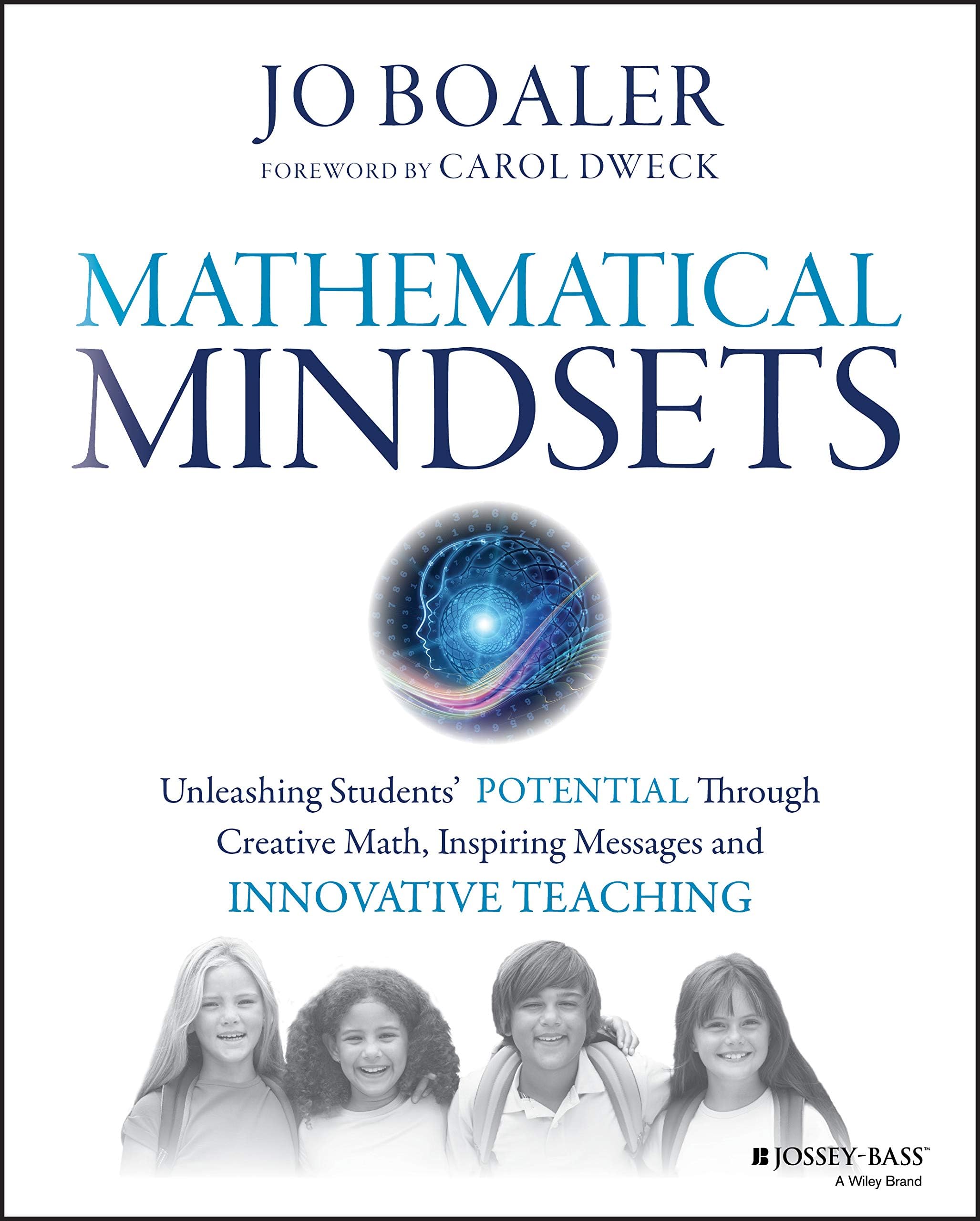
Buy Mathematical Mindsets: Unleashing Students' Potential through Creative Math, Inspiring Messages and Innovative Teaching (Mindset Mathematics) 1 by Boaler, Jo (ISBN: 9780470894521) from desertcart's Book Store. Everyday low prices and free delivery on eligible orders. Review: Inspirational and practical book on on how to approach maths. Love it! - Though only part way through this exciting book I am hugely one over by Jo Boaler's incites into maths and maths teaching. Like many I didn't much excel at maths at school and certainly didn't enjoy it. But ever since I have had a sneaky suspicion that maths might be a great deal sexier than I had once given it credit. This book proves my suspicions correct! It's refreshing to say the least to know that making conceptual and calculation mistakes is such a positive experience for the brain and learning. This is just one of the many empowering messages contained in the book. As a one time primary teacher I was trained to help kids to 'embed' their learning but in all honesty never really understood how to actually apply this to maths teaching. Now I am inspired to return to my own maths learning and see where this takes me and I have already got some concrete tips on how to approach maths from the outset with my young children. I had been slightly dreading bringing maths to my children (we are home schooling initially) and feeling unworthy of the task, but no more! Thanks Jo for giving me a whole new way to look at Maths. I think this book is for anyone, but especially those who feel they might have missed something when they see excited, secret scribbling in response to the number 421 on countdown. Review: Profound paradigm shifter - Before I proceed further, I offer a disclaimer - I have only completed one quarter of the book. I am therefore presuming the remainder of the book continues to be as extraordinarily brilliant. The author is a Mathematics Education professor in the US. She writes lucidly, and concisely, and offers a fantastic paradigm shift in the understanding of Mathematics teaching. There is sufficient on the first 20 pages or so to radically change how teaching should be delivered, and how the entrenched, age-old methods are not only incomplete and poor at teaching the subject, but are the principle reasons for massive levels of maths anxiety and phobias. For those in doubt, the book is heavily based on neurological and psychological research, and to very good effect, providing a sound foundation for a rethink in teaching across the world. It is that profound a book. I will offer no spoiler details as you should buy and read the book with a clear, open mind. I offer a warning that mathematics teachers may feel deep cognitive dissonance. I am not affiliated in any way to the author. I was just so thrilled by the messages in the book that I wanted others to receive them also.


| Best Sellers Rank | 327,553 in Books ( See Top 100 in Books ) 928 in Mathematics for Young Adults 1,017 in Mathematics Teaching Aids 1,838 in Children's Books on Maths |
| Customer reviews | 4.6 4.6 out of 5 stars (1,740) |
| Dimensions | 19.05 x 1.91 x 24.13 cm |
| Edition | 1st |
| ISBN-10 | 0470894520 |
| ISBN-13 | 978-0470894521 |
| Item weight | 617 g |
| Language | English |
| Print length | 314 pages |
| Publication date | 23 Oct. 2015 |
| Publisher | Jossey-Bass |
A**R
Inspirational and practical book on on how to approach maths. Love it!
Though only part way through this exciting book I am hugely one over by Jo Boaler's incites into maths and maths teaching. Like many I didn't much excel at maths at school and certainly didn't enjoy it. But ever since I have had a sneaky suspicion that maths might be a great deal sexier than I had once given it credit. This book proves my suspicions correct! It's refreshing to say the least to know that making conceptual and calculation mistakes is such a positive experience for the brain and learning. This is just one of the many empowering messages contained in the book. As a one time primary teacher I was trained to help kids to 'embed' their learning but in all honesty never really understood how to actually apply this to maths teaching. Now I am inspired to return to my own maths learning and see where this takes me and I have already got some concrete tips on how to approach maths from the outset with my young children. I had been slightly dreading bringing maths to my children (we are home schooling initially) and feeling unworthy of the task, but no more! Thanks Jo for giving me a whole new way to look at Maths. I think this book is for anyone, but especially those who feel they might have missed something when they see excited, secret scribbling in response to the number 421 on countdown.
M**T
Profound paradigm shifter
Before I proceed further, I offer a disclaimer - I have only completed one quarter of the book. I am therefore presuming the remainder of the book continues to be as extraordinarily brilliant. The author is a Mathematics Education professor in the US. She writes lucidly, and concisely, and offers a fantastic paradigm shift in the understanding of Mathematics teaching. There is sufficient on the first 20 pages or so to radically change how teaching should be delivered, and how the entrenched, age-old methods are not only incomplete and poor at teaching the subject, but are the principle reasons for massive levels of maths anxiety and phobias. For those in doubt, the book is heavily based on neurological and psychological research, and to very good effect, providing a sound foundation for a rethink in teaching across the world. It is that profound a book. I will offer no spoiler details as you should buy and read the book with a clear, open mind. I offer a warning that mathematics teachers may feel deep cognitive dissonance. I am not affiliated in any way to the author. I was just so thrilled by the messages in the book that I wanted others to receive them also.
C**E
Inspirational book
Inspirational! Really easy to read, thought provoking and practical. Has changed my whole approach to teaching maths- I am a primary school teacher in England.
S**R
Highly recommend for teachers
I had to order this book for my university course. This arrived exactly as shown and I would’ve given it a 5/5. I am solely giving this product a 4/5 because of the bent corners of the book otherwise it arrived in perfect condition. However this could just be blamed on the shipping of the product. This would greatly help any primary teachers who are looking to teach maths more effectively with a focus on growth mindset within children!
A**R
I have been working with some very happy and focused mini mathematicans
A very thought provoking book. Since using some of its ideas, I have been working with some very happy and focused mini mathematicans. When they solved a problem yesterday, there were shouts of "oh yes" and high fives all around (and this was a previously fed up and maths hating, year 6 group).
A**R
I made the mistake of telling one of them in particular that she is intelligent rather than encouraging a growth mindset
In found this book really excited me about the possibilities of all of us having maths capabilities. I started doing a free online maths mindset training during the time I was reading this in kindle form whilst on holiday. Unfortunately I lost the tab on my iPhone and then couldn't get back to it but I was really enjoying it. I only wish I had known about this when my now grown up children were younger. I made the mistake of telling one of them in particular that she is intelligent rather than encouraging a growth mindset, which was a mistake. But the good news is that I was growing my brain by making that mistake!
M**D
Excellent book on where maths teaching should be going. If you teach and haven't read this week another career path.
This book shows what maths teaching is about and what maths really involves. An excellent source of ideas and how to implement them.
M**C
Fantastic book
I really enjoyed this book and found the content thought provoking. Along with 'the Elephant in the Classroom' this is going to be one of the few books from my teacher training year that I will be referring to regularly in future.
M**D
Had to buy it for a class I took. Seems like an informative book--but I don't know, because I didn't read through it once. The textbook-scam continues...
M**A
This is a great book for parents. I wonder to know if a translation to Spanish will come soon. Thank you.
A**R
A very insightful book that changes the paradigm of math teaching from rote and procedure based to one of creativity, collaboration, connection and visualization. This is a must read for all parents and teachers endeavoring to inculcate a love for mathematics and helping their children/students to understand the conceptual underpinnings of mathematics. This will stand in very good stead for the children not only in math but for all other aspects of problem solving
C**E
A fantastic book for professional development in math teaching, with state of the art ideas backed by research and with practical suggestions for application in the classroom. Quite revolutionary.
M**E
Prof. Boaler has encouraged me to try a more open approach with my teaching in algebra. I have tried to present a more open-minded perspective for my students than I have in the past. I have also tried to emphasize that it’s alright, and actually good, to make mistakes, when we struggle to learn, because then we are growing. I also tried to present the problems we have worked on in class in a more open-minded way. One can, to a certain extent, emphasize an open-minded viewpoint even with the very narrow procedural, and rule-oriented problems that we tend to work in an algebra class. For instance, one can emphasize that there are usually several approaches to solving problems, not necessarily the book’s or mine. The focus on narrow, procedural problems is, as Prof. Boaler emphasizes, just a focus on one facet of mathematics, often not the most important. There is a whole aspect of critical and creative thinking that is being neglected. I like her analogy for the types of problems she seeks: Low-floor and high-ceiling. Switching students from a fixed mindset to a growth mindset is very challenging. For example, projects in which the students engage in creative and critical thinking are frequently inefficient relative to narrowly focused procedural problems. Do the students actually learn what they need as adults when there is a more open-minded, i.e. a greater growth mindset, environment? Isn’t it the procedural, the calculations, that they need to learn? Isn’t that the heart of mathematics? If we consider actual mathematicians, we recognize this is not actually the case. As students develop into mathematicians, they become interested in formulating problems, in mathematical reasoning, and in developing intuitions about the mathematics. Also, many (most?) mathematicians work collaboratively, rather than in the isolated ways we encourage in our competitive environments in schools. Inevitably, aren’t mistakes bad. Aren’t our limitations as human beings, and the limitations of our environments, simply forcing a fixed, rather than a growth, mindset on us? We become expert and seek to minimize errors. As one grows, certainly those things we become expert and proficient at become more automatic. The limitations we are subject to are, more often than not, amount to such an accommodation with our environment. This can make us want to neglect the struggles, the mistakes and the ambiguities inherent in learning. However, they are essential elements of learning and the growth of our minds, and they force us to consider more open-minded approaches, more creative and critical approaches, to progressing. This is the case even as we grow older and more fixed in our ways. We can make an allusion to Plato's allegory of the cave. We all tend to live in Plato’s cave: Seeing shadows reflected on the wall. Perhaps we are barred from reality, or perhaps we are just limiting ourselves. Research in neuroscience seems to suggest that, at least to a fair extent, we limit ourselves. Even when we are old, there is a certain plasticity to our minds: A growth mindset is of at least some merit even for older people. There is at least some substantial evidence that we can improve learning in the classroom, and help students be more effective and creative, by developing a growth mindset, and by helping students develop such a mindset. This is Prof. Boaler’s main perspective. It seems to open all sorts of doors for people learning mathematics, not only to greater proficiency at mathematics but to more appreciation of mathematics and its aesthetic aspects. It also seems to be a very helpful perspective even for students who already achieve highly in mathematics. I can recommend Prof. Boaler’s book even if you disagree with her point of view. She is trying to challenge, in a well-supported way from experience and research, ideas that are common among many teachers of mathematics and in our culture generally. I think her book is very thought-provoking.
Trustpilot
2 weeks ago
2 weeks ago