We remain fully operational. Our teams are working around the clock to ensure your deliveries continue safely.

DOWNLOAD THE APP


Copyright © 2025 Desertcart Holdings Limited
DOWNLOAD THE APP
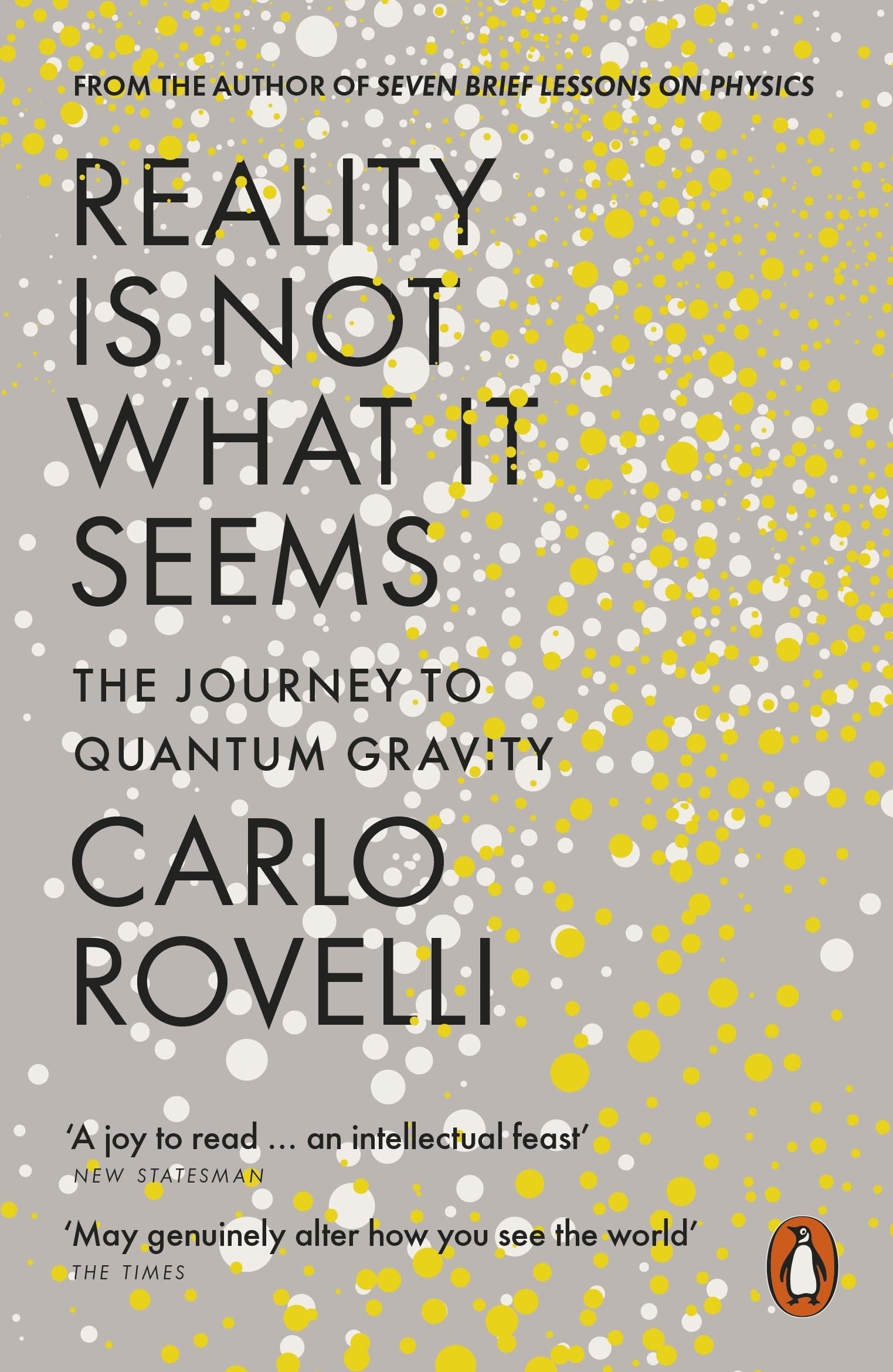
Buy Reality Is Not What It Seems: The Journey to Quantum Gravity 1 by Rovelli, Carlo, Segre, Erica, Carnell, Simon (ISBN: 9780141983219) from desertcart's Book Store. Everyday low prices and free delivery on eligible orders. Review: Elegantly civilized introduction to a powerfully illuminating view of the cosmos - Carlo Rovelli is a true heir to the legacy of the Renaissance man. Even in translation, his prose is flowery, even poetic, and his exposition is enriched with deeply learned references to artists and philosophers from Anaximander and Democritus to Dante Alighieri. More to the point, his exposition of loop quantum gravity is authoritative and, I am pleased to say, intelligible, so far as it goes, which is admittedly not far in a book of physics for poets. For too long, physicists have struggled to do what they regarded as justice to infinity in their theories of the spacetime continuum and their differential equations. The clear lesson of quantum mechanics is that finite limits bound any physics of small phenomena that we can devise, and a salient lesson of relativity theory is that not only do we face a finite universal speed limit but also the cosmos is quite possibly finite in extent too, even when our curved spacetime now seems to be shooting off to a hyperbolic infinity under the mysterious influence of dark energy. Putting finite bounds on the granularity of spacetime rescues us both from the paradoxes of renormalization in QED and from the singularities at the heart of black holes, not to mention the incalculability of the Big Bang itself. If higher mathematics is the science of grappling with infinity, which is the view that remains when all finite mathematics is consigned to logic and computation, then physicists like Rovelli need to purge physics of its higher mathematics. The paradoxes of measure theory, whereby basic quantum computations lead us to talk of infinitely improbable events, are only the tips of the iceberg. Rovelli is clear that all these paradoxes should be done away with in a decent theory of quantum gravity. Our challenge is to model the granularity of spacetime at the Planck scale in a way that does justice to the observed phenomena, and here we face a massive enterprise for which the definitive equations are not yet in sight. Fro decades now, the fashionable way to work toward a theory of quantum gravity has been via string theory, but that theory is still bogged down in its own mathematical intractability. By contrast, the approaches of such mavericks as Rovelli and Lee Smolin and others are less trodden and less massively developed. This is a shame, because the philosophical advantages of their approaches, not least in banishing infinities, are considerable. Rovelli also mentions approaches to physics via the concept of information, which are even less well trodden and still poorly understood. As pioneers of quantum information theory like David Deutsch take it further, and as the Everett interpretation of quantum branching that Deutsch favors becomes more amenable to reasonable debate, this may change, but meanwhile the reserve on quantum indeterminacy that Rovelli maintains may hold sway. This book is a report on a massive work in progress, where decades could pass before a widely agreed resolution of the outstanding problems comes into view. We are fortunate that Rovelli has entrusted us with his personal thoughts on the story, even though they cannot be final. Sadly, this is a topic that most lay readers will struggle with, but the book is already worth reading for the philosophical perspective on physics and science that Rovelli reveals, where his incomparable Renaissance erudition and wisdom makes for a truly thrilling read. Review: Enjoyable if you skip Carlo's ancient Greek (and some 1300's rubbish too) - I was quite impatient with the first 50 pages which were a daft attempt to claim that some Greek in the 5th century BC can be credited for most of the physics we know. Trouble is - no written work by said Greek has been found, with the only reference to it by another Greek who wrote a poem about this. By now I was really worried! This started improving and then - Bang, as I was starting to hope, Carlo is starting to demonstrate his knowledge of Dante Alighieri, assigning to him the discovery of the 3-sphere, ( Divine comedy is about 700 dense pages, he found two sentences which is Delphic in content and is ridiculus as an argument). Apart from some further excursions to Plato's forms, he then mainly starts to deliver. The book proper, without the above nonsense is great, the non scientist will get a flavour and a continuous thread, obviously this isn't the book to teach anyone QM, relativity (either or both), string theory or LQG, but it does have an understandable narrative and it does give you the relevant equations in the footnotes. As someone who understands relativity and QM I liked it, he (justifiably has a go at Schrodinger's methodology, and his preference for Heisenberg's matrix approach is very sound.) What does LQG say about the speed of light? In fact what is velocity in a world without time? Can LQG calculate the fundamental constants: Planck, G, Boltzmann, masses of electron, proton etc? What about Einstein's famous Lambda (the cosmological constant) which has a calculated value of 120 orders of magnitude larger than the measured value? (the largest discrepancy in science, so far). Summary: If you resolutely skip the nonsense and save some time (Ha, ha) the rest is well worth reading.
| ASIN | 0141983213 |
| Best Sellers Rank | 16,240 in Books ( See Top 100 in Books ) 7 in Theoretical & Mathematical Astronomy 17 in Mathematics References 18 in History of Science (Books) |
| Customer reviews | 4.5 4.5 out of 5 stars (4,662) |
| Dimensions | 19.8 x 1.6 x 12.9 cm |
| Edition | 1st |
| ISBN-10 | 9780141983219 |
| ISBN-13 | 978-0141983219 |
| Item weight | 199 g |
| Language | English |
| Print length | 272 pages |
| Publication date | 1 Jun. 2017 |
| Publisher | Penguin |
A**S
Elegantly civilized introduction to a powerfully illuminating view of the cosmos
Carlo Rovelli is a true heir to the legacy of the Renaissance man. Even in translation, his prose is flowery, even poetic, and his exposition is enriched with deeply learned references to artists and philosophers from Anaximander and Democritus to Dante Alighieri. More to the point, his exposition of loop quantum gravity is authoritative and, I am pleased to say, intelligible, so far as it goes, which is admittedly not far in a book of physics for poets. For too long, physicists have struggled to do what they regarded as justice to infinity in their theories of the spacetime continuum and their differential equations. The clear lesson of quantum mechanics is that finite limits bound any physics of small phenomena that we can devise, and a salient lesson of relativity theory is that not only do we face a finite universal speed limit but also the cosmos is quite possibly finite in extent too, even when our curved spacetime now seems to be shooting off to a hyperbolic infinity under the mysterious influence of dark energy. Putting finite bounds on the granularity of spacetime rescues us both from the paradoxes of renormalization in QED and from the singularities at the heart of black holes, not to mention the incalculability of the Big Bang itself. If higher mathematics is the science of grappling with infinity, which is the view that remains when all finite mathematics is consigned to logic and computation, then physicists like Rovelli need to purge physics of its higher mathematics. The paradoxes of measure theory, whereby basic quantum computations lead us to talk of infinitely improbable events, are only the tips of the iceberg. Rovelli is clear that all these paradoxes should be done away with in a decent theory of quantum gravity. Our challenge is to model the granularity of spacetime at the Planck scale in a way that does justice to the observed phenomena, and here we face a massive enterprise for which the definitive equations are not yet in sight. Fro decades now, the fashionable way to work toward a theory of quantum gravity has been via string theory, but that theory is still bogged down in its own mathematical intractability. By contrast, the approaches of such mavericks as Rovelli and Lee Smolin and others are less trodden and less massively developed. This is a shame, because the philosophical advantages of their approaches, not least in banishing infinities, are considerable. Rovelli also mentions approaches to physics via the concept of information, which are even less well trodden and still poorly understood. As pioneers of quantum information theory like David Deutsch take it further, and as the Everett interpretation of quantum branching that Deutsch favors becomes more amenable to reasonable debate, this may change, but meanwhile the reserve on quantum indeterminacy that Rovelli maintains may hold sway. This book is a report on a massive work in progress, where decades could pass before a widely agreed resolution of the outstanding problems comes into view. We are fortunate that Rovelli has entrusted us with his personal thoughts on the story, even though they cannot be final. Sadly, this is a topic that most lay readers will struggle with, but the book is already worth reading for the philosophical perspective on physics and science that Rovelli reveals, where his incomparable Renaissance erudition and wisdom makes for a truly thrilling read.
P**C
Enjoyable if you skip Carlo's ancient Greek (and some 1300's rubbish too)
I was quite impatient with the first 50 pages which were a daft attempt to claim that some Greek in the 5th century BC can be credited for most of the physics we know. Trouble is - no written work by said Greek has been found, with the only reference to it by another Greek who wrote a poem about this. By now I was really worried! This started improving and then - Bang, as I was starting to hope, Carlo is starting to demonstrate his knowledge of Dante Alighieri, assigning to him the discovery of the 3-sphere, ( Divine comedy is about 700 dense pages, he found two sentences which is Delphic in content and is ridiculus as an argument). Apart from some further excursions to Plato's forms, he then mainly starts to deliver. The book proper, without the above nonsense is great, the non scientist will get a flavour and a continuous thread, obviously this isn't the book to teach anyone QM, relativity (either or both), string theory or LQG, but it does have an understandable narrative and it does give you the relevant equations in the footnotes. As someone who understands relativity and QM I liked it, he (justifiably has a go at Schrodinger's methodology, and his preference for Heisenberg's matrix approach is very sound.) What does LQG say about the speed of light? In fact what is velocity in a world without time? Can LQG calculate the fundamental constants: Planck, G, Boltzmann, masses of electron, proton etc? What about Einstein's famous Lambda (the cosmological constant) which has a calculated value of 120 orders of magnitude larger than the measured value? (the largest discrepancy in science, so far). Summary: If you resolutely skip the nonsense and save some time (Ha, ha) the rest is well worth reading.
S**Y
as clear as anything about such a technical subject can be
Rovelli guides us through a brief history of the development of physical theories, to end up with a theory of quantum gravity, one of the big unsolved problems of today. The background, from ancient Greek natural philosophy, to modern quantum mechanics, is an excellent introduction how the ideas gradually reformulated, bringing in concepts of discreteness, fields, and relationships. It is well worn material, but presented in a new, fascinating way. Moving into the final topics is necessarily more limited: the material is both highly technical, and not yet accepted as the standard paradigm. Before we get to the quantum gravity, we move through Rovelli’s relational interpretation of quantum mechanics, which (modulo Leibniz) is a completely different way of conceptualising systems purely in terms of their relationships (interactions) with other systems: there is no state of an isolated system, only state revealed by its relationships and interactions. The concept of a Newtonian-like schema of a separately existing time that flows independently of everything else disappear in this relational model. Finally, we get to the particular quantum gravity theory here: a complex superposition of quanta of space interacting and relating. [p166-7] "Space is a spin network whose nodes represent its elementary grains, and whose links describe their proximity relations. Spacetime is generated by processes in which these spin networks transform into one another, and these processes are described by sums over spinfoams. A spinfoam represents a history of a spin network, hence a granular spacetime where the nodes of the graph combine and separate." That summary from the book makes sense in the context of all the material that has gone before. Go and read the whole thing yourself; it is beautifully written, includes fascinating perspectives on the development of physics, many great insights into contemporary quantum theory, and is as clear as anything about such a technical subject can be without actually invoking the technicalities.
V**E
L'auteur remonte loin (à Démocrite) mais c'est une excellente synthèse. Prose claire, limpide, sans jamais aucune obscurité. Sa gravité quantique à boucle semble soudain très simple et évidente. Très bon livre, bien traduit en anglais, très agréable à lire.
K**Y
I thought this book was very well written. I still have no clue about quantum physics or gravity but loved reading this book regardless.
B**.
I am an ardent reader of physics subjects, I have read many books on physics ,but only a few of them imparted a satisfactory outlook so that a person with basic awareness of physics can understand it's content, but this one is a amazingly special for the simple reason that a person with general awareness about physics can understand. It covered almost every topics of main theories of classical, relativistic and quantum mechanics with such brevity and simplicity... Thanks to the author who tried his level best to come to the strata of an average physics enthusiast. After reading this book I got immense satisfaction which no other books of the same sort could provide... This is a must read book and I assure that you will get something very special which you will experience later...
L**A
Carlo Rovelli presenta come si è evoluta la visione del mondo per arrivare attraverso la quantum gravity ad un tentativo di coniugare l’indeterminazione della teoria quantistica con la granularità delle cose della relatività generale. Ci si è riusciti? Le due teorie oggi sopravvissute string e loop sono ancora divise pure se quest’ultima sta raccogliendo indizi a suo favore. A fronte della mancanza di certezza rimane lo spirito della scienza che dubita di ogni certezza e che trova il suo valore nel dare le risposte che servono consapevole che domani queste cambieranno. Un libro molto bello da leggere.
O**N
Mind bogelling, not easy but gratifying to read. The way reality is experienced through the lens of quantum gravity comes very close to what Buddhist philosophy claims as seeing nirvana in samsara.
Trustpilot
1 month ago
2 months ago