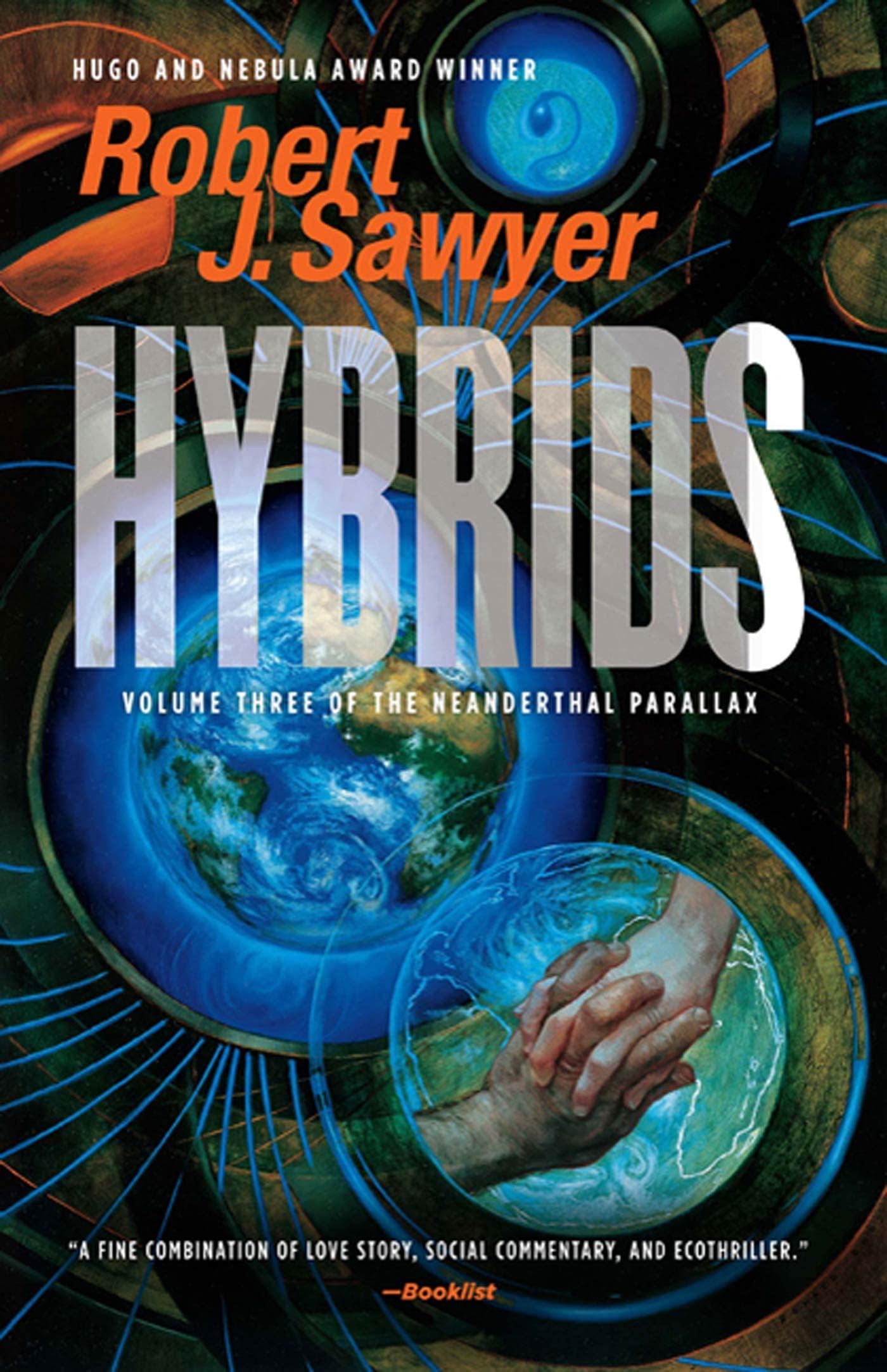

Hybrids: Volume Three of the Neanderthal Parallax
Product ID: 50732970
Hybrids: Volume Three of the Neanderthal Parallax [Sawyer, Robert J.] on desertcart.com. *FREE* shipping on qualifying offers. Hybrids: Volume Three of the Neanderthal Parallax Review: Third book doesn't disappoint - Sawyer really put together a great series with these three books. They explore a lot of controversial topics and show us what life could potentially be like if only we could give up many of our supposed freedoms to live in an Orwellian society. A great read! You owe it to yourself to finish this great series. Review: Loved the Whole Series - I like the whole series, but I have to admit this one was a little disappointing in comparison to the first two. Maybe it's the title: spoiler alert: the first hybrid is actually still in utero at the end of the book. But the strange things that lead up to the fetus being created are fascinating enough. Perhaps a fourth book for the series? That would definitely be cool. Ponter Boddit, a Barast (neanderthal) and Mary Vaughan, a Gliksin (like us), were in love and talking about bonding (marriage is not quite the term, but close) and having a child at the end of the second book. But of course there are some pretty obvious difficulties, not the least of which is that we have 23 chromosomes and they have 24. Still, Dr. Vaughan is a geneticist, so if anyone can work out a solution, it is she. Well, actually, it turns out a Barast geneticist is the one who solves it, but her technique has been banned by the High Gray Council. Her idea was not to create Barast/Gliksin hybrids, but it could be used for that, and for much else. It's the "much else" that forms the danger: once you can synthesize any DNA you want, sooner or later such power will be used for evil. Predictably, it is. While all this is going on, Ponter and Mary are working out the complications involved in sharing their two very different lives. To me, that's the most interesting part of the story. And again, the fact that Gliksins have brains hard-wired to religious experience while Barasts do not becomes an issue. As an atheist myself, I find this aspect intriguing. Remember, Mary is not simply religious, she is Catholic. I would rate the entire series 4.5 stars if that were possible, but I'll give this one 4.
| Best Sellers Rank | #4,355,388 in Books ( See Top 100 in Books ) #2,035 in Hard Science Fiction (Books) #6,113 in Genetic Engineering Science Fiction (Books) #332,655 in Literature & Fiction (Books) |
| Book 3 of 3 | Neanderthal Parallax |
| Customer Reviews | 4.0 4.0 out of 5 stars (588) |
| Dimensions | 5.5 x 0.88 x 8.5 inches |
| Edition | First Edition |
| ISBN-10 | 0765326345 |
| ISBN-13 | 978-0765326348 |
| Item Weight | 12.8 ounces |
| Language | English |
| Print length | 400 pages |
| Publication date | September 28, 2010 |
| Publisher | Tor Books |
J**N
Third book doesn't disappoint
Sawyer really put together a great series with these three books. They explore a lot of controversial topics and show us what life could potentially be like if only we could give up many of our supposed freedoms to live in an Orwellian society. A great read! You owe it to yourself to finish this great series.
B**K
Loved the Whole Series
I like the whole series, but I have to admit this one was a little disappointing in comparison to the first two. Maybe it's the title: spoiler alert: the first hybrid is actually still in utero at the end of the book. But the strange things that lead up to the fetus being created are fascinating enough. Perhaps a fourth book for the series? That would definitely be cool. Ponter Boddit, a Barast (neanderthal) and Mary Vaughan, a Gliksin (like us), were in love and talking about bonding (marriage is not quite the term, but close) and having a child at the end of the second book. But of course there are some pretty obvious difficulties, not the least of which is that we have 23 chromosomes and they have 24. Still, Dr. Vaughan is a geneticist, so if anyone can work out a solution, it is she. Well, actually, it turns out a Barast geneticist is the one who solves it, but her technique has been banned by the High Gray Council. Her idea was not to create Barast/Gliksin hybrids, but it could be used for that, and for much else. It's the "much else" that forms the danger: once you can synthesize any DNA you want, sooner or later such power will be used for evil. Predictably, it is. While all this is going on, Ponter and Mary are working out the complications involved in sharing their two very different lives. To me, that's the most interesting part of the story. And again, the fact that Gliksins have brains hard-wired to religious experience while Barasts do not becomes an issue. As an atheist myself, I find this aspect intriguing. Remember, Mary is not simply religious, she is Catholic. I would rate the entire series 4.5 stars if that were possible, but I'll give this one 4.
R**R
All three in this trilogy are very good.
Way better than I thought it would be. Robert J Sawyer now qualifies as one of the all-time great sci-fi writers.
C**R
Disappointing End to Neanderthal Parallax!
Hybrids is the least likeable of the Neanderthal Parallax trilogy. The implications for Man of a doorway to another alternate Earth is put aside as a subplot in favor of Mary's transformation. Mary has fallen in love with Ponder, one of the Neanderthal scientists. The "Barasts" have their own code of ethics and Mary struggles with it as it interferes with her Catholic faith. Much is made of Mary's beliefs and her struggles, much more than she deserves. She's a flighty character, who discovers that Man's religious beliefs, thanks to a pseudo-scientific experiment, creates religious fervor. But the atheistic Barasts don't have this "fault." Much is also made of the genetic device, banned on the Neanderthal world, that can rewrite any DNA and makes it possible to have a human/barast child, thus the Hybrid part of the tale. Do we get a cure for AIDS or cancer? Do we finally handle birth defects? Nope. Let's create a bio weapon! Sawyer rushes the end and I'm really disappointed to see that. Most of the time Sawyer's writing is pretty good, pace is good and not a lot of characters are cardboard. But as Mary goes from being concerned about her husband's divorce ("I don't want us to be excommunicated!") to not giving a whit that her kid will not have the "religion gene", it was just too much to sort out. Bottom Line: Not a lot of story regarding the scientists, athletes and so on, as they improve Man's lot. Instead we get a woman who wants all men to die (at least the ones with a special Y chromosome, since that's why some men are evil) and develops a bio weapon to handle that. Oh, and the New Year's scene and the final wedding scene are highly disappointing. Not recommended, except for Sawyer purists.
T**R
The Camel is in the tent
Hybrids Hybrids is the book Sawyer has been leading up to all along. You should definitely read all three books in this trilogy. Hominids (Neanderthal Parallax)], ]
B**E
Another wonderful tale
This is an incredible series, with fascinating characters, great science, and incredible imagination. It's good for many readings. I've never been disappointed by this author.
K**Y
End of the series? sad
Wraps up the series but I'd love to see more in the universe. It was a great view of possibilities in a different social structure compared to all the things we take for granted. Surprised myself how much of the Canadian geography I knew without looking it up.
N**N
Brilliant book, I couldn't put the kindle down until I reached the end. Very clever plots and interesting ideas. Definitely worth reading.
T**E
Too bad Vol. 2 and 3 weren't translated into German. Was happy to be able to read them in English. Great twists - and maybe some truths that are a bit too explosive for German readers? I wouldn't think so.
F**0
Parfait
F**R
This is the third book in The Neanderthal Parallax trilogy. The other two being Hominids (book 1) and Humans (book 2). In this book we find Dr Mary Vaughan (human geneticist) and Ponter Boddit (Neanderthal physicist) continuing their relationship that developed when they first met. Mary has gone over to the parallel Neanderthal world to learn more about their culture. From the first books we have learned that in the Neanderthal world: 1) The population has been limited to 185 million 2) All the men live on the outskirts of town and all the women live in the middle 3) The women live with their woman mate and children 4) The men live with their man mate 5) Every 25 days the men go into town and visit their woman mate for 4 days 6) Conception is limited to once every 10 years thus aiding the ZPG 7) Regressive genes (violence, disease etc )have been bred out of the population 8) While they have helicopters they don't have airplanes 9) They don't use fossil fuels but rather solar power 10) They have a strong opinion about religions, because they don't have any 11) They have an implanted electronic companion that records everything they do so crime and violence is rare Mary and Ponter want to have a child however their chromosomes are different so it would not be possible. They meet a disgraced Neanderthal geneticist who may have solved that problem and smuggle out her equipment that has banned to be used. However her boss, Jock, who works for the military designs an airborne virus that will only kill Neanderthals and leave their idealic world available to the humans. The race is then on with Ponter and Mary trying to stop Jock. There are other minor story arcs that add variety to the book and it is highly entertaining While this book is the third in a trilogy it stands alone as a great read. The background from the other two books, at least the highlights, is included in flashbacks to flush out the story arc.
K**E
A satisfactory ending to an interesting trilogy although it might upset those who have religious beliefs. I like what the author said about religion and why it exists plus why the Neanderthals in this trilogy have no religion. Mixed reviews but I enjoyed it. Ray Smillie
Trustpilot
3 weeks ago
1 month ago