We remain fully operational. Our teams are working around the clock to ensure your deliveries continue safely.

DOWNLOAD THE APP


Copyright © 2025 Desertcart Holdings Limited
DOWNLOAD THE APP
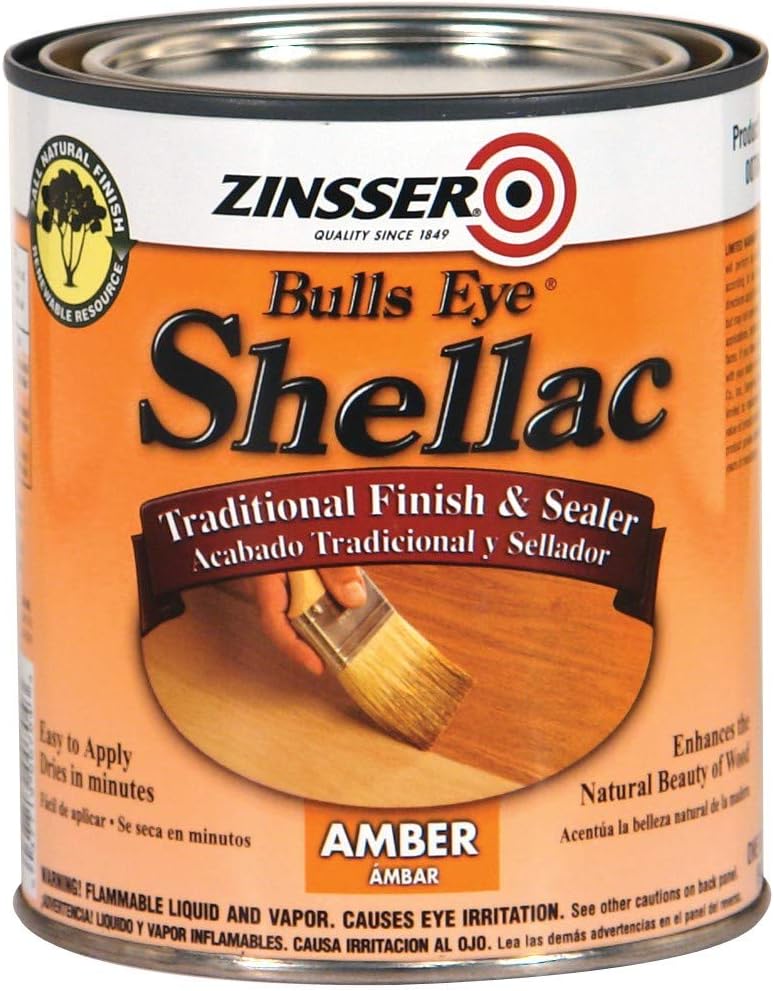
✨ Elevate your surfaces with the timeless shine of Bulls Eye Amber Shellac! 🖌️
Rust-Oleum Zinsser 704H Bulls Eye Amber Shellac is a high-quality, fast-drying liquid shellac that provides a durable, glossy amber finish. Ideal for decorative and protective use on wood, metal, and plastic surfaces, it covers up to 120 sq ft per quart and enjoys a stellar 4.8-star rating from over 550 users. Perfect for professionals and DIY enthusiasts aiming for flawless, long-lasting results.







| ASIN | B002KR0HEA |
| Best Sellers Rank | 310,719 in DIY & Tools ( See Top 100 in DIY & Tools ) 612 in Varnish |
| Brand | Zinsser |
| Compatible Material | Metal, Plastic, Wood |
| Coverage | 100-120 sq ft/quart |
| Customer Reviews | 4.8 4.8 out of 5 stars (558) |
| Finish | Gloss |
| Global Trade Identification Number | 00047719007043 |
| Item Form | Liquid |
| Liquid Volume | 1 Quarts |
| Manufacturer | Rust-Oleum |
| Material | Shellac |
| Model Number | 704H |
| Part Number | 704H |
| Recommended Uses For Product | Decorative and protective purposes on surfaces such as wood furniture, floors, cabinets, and other decorative items |
| UPC | 047719007043 |
| Unit Count | 1.00 count |
J**H
Follow-up (19 July, 2017); I had another project that requires this shellac, and my experiences were much more positive this time around. However, the reasons are mainly because I actually got the right accompanying tools, of the proper quality, to make everything go relatively well. First off, despite having multiple grits of sandpaper that were even finer than what was suggested to use between coats of shellac, I went and got what they specified - 220 grit. I also got a "high quality" brush - something that can be used with stains, oil-based finishes, and so on. I also went with an angled tip - these seem to be par for the course with a lot of projects that *might* involve something like shellac. Also, despite having numerous types of thinners and cleaners, I got a can of denatured alcohol - this was also explicitly referenced in the directions for cleanup. While the results weren't perfect, they're actually pretty good. I really chalk up any shortcomings to my (still) limited experience using this stuff. Anyway - I think I mentioned it initially, but one of the big benefits of shellac is that if you mess something up, it's easy to sand it off and try again. It's also just an hour between coats, so the time lost can be minimized, too. ...As I mentioned previously, I'm primarily using this shellac on guitar necks. While many other users may not be using it on the same thing, something worth noting is that even though you can put it over top something like a poly or acrylic clearcoat, I would advise you to thoroughly sand off the clear first, unless you're doing something that is flat/horizontal, with no vertical cutouts/holes, etc. If you don't the shellac is likely to drip/sag/run down any vertical or rounded surface. Even though it doesn't stain the grain, I think the shellac tends to hold best if it's making good contact with the wood. Beyond clearcoats, some wood is also grain filled, so just be advised that you may have not sanded it all off - the grain fill will cause the same phenomenon as if there were clear finish on the wood - the shellac might drip/sag/be blotchy/etc. Original review (6 June 2017): This review might be best taken with a grain of salt or two. First of all, I want to highlight the big pluses - this stuff has a nice amber color to it, and you can actually sand it off or re-work it. Also, you can put on subsequent coats to tweak just how deep you want the amber effect. Also, you can put this on top of just about anything (seriously). Now - where my aggravations come in is with my specific projects that I use this for (guitar necks). Other than one success story (a spot repair roughly 2"X2"), I'm having a tough time getting this stuff to go on evenly, and w/o having to deal with clumps and drips. If I was just varnishing floors or tables, I'd probably have no issues. Part of it is probably simply a matter of me learning how to work with this stuff, so thank goodness it can be removed. I just want to highlight that for some projects, there's a bit of a learning curve. I've done a bunch of woodworking projects using Minwax or similar stains, and they went easy and fast - something to think about if you don't really want or need the amber color. ...Another thing to consider is that I've heard that some applications might need some kind of more durable clearcoating on top. That's just something to keep in mind - some folks like an all-in-one finishing product. My last complaint might not apply to others, but this can is friggin' BIG if you're just doing little projects here and there. The issue may not be obvious, but if you don't get the lid on tightly, you might find that the contents of the can have turned to a thick, unusable goo. For me, it's kind of a mental value lost thing - you finally have a project for this stuff, only to find that 80% of it is unusable...and if you really want to finish it with this particular stuff, you'll have to order another 1-qt can... I wanted to point out that it doesn't seem to be just Amazon that only stocks this stuff in the big 1-qt size. I initially passed on buying this from Home Depot because that's the only size they have it in, too.
F**Y
Hubby loves this stuff. Great coverage. Nice color. Fast drying. Good blending with recoats.
P**S
I have a terra cotta tile floor that apparently had been given a protective coating of some sort when installed. Some of the tiles had a lighter pattern, and at some point I started seeing areas that did not match the rest, with a white pattern showing instead of a dull mustard-colored pattern.. I tried finding matching touch-up paint, but had no luck, so when a good hard look convinced me that a later of protective coating had simply peeled off I looked for a tinted product to use on the bad areas to make them blend again. This amber-toned shellac proved to be the perfect answer. It took several coats, because the old coating had darkened with time, but the problem areas now match and blend in again.
J**T
The word arcane applies. Shellac was the preferred finish for fine furniture all during the 1800s, and even farther back. Today, nobody can seem to figure out how to use it, hence the word arcane. Their initial attempts with shellac are such failures that they go back to polyurethane, which is also a very good finish, and not so inclined to bring failure. We should not use the shellac brushed on straight from the can. Take a small measuring cup and dip out some Zinssers to pour into a separate clear container with a screw-on lid. Add enough alcohol to make a thin mixture not much thicker than soda pop. So thinned, it will dry almost in seconds as we brush it on. We work quickly, starting at one side, adding the next brush stroke to the last before it can dry. Keep going, wet to wet, all the way over to the other side. The first side will be dry to the touch as you finish the last side. The wood stool in my photos received a half dozen coats with only about fifteen minutes delay between coats. The accumulated coats were now thick enough to fill the little irregularities in the wood surface. I let it cure overnight, and then used steel wool to scour the surface until it was dead smooth like a skating rink. The surface is now ready for a coat of wax and a good buffing out with a soft towel.
T**R
great. works as advertised
Trustpilot
2 weeks ago
2 weeks ago