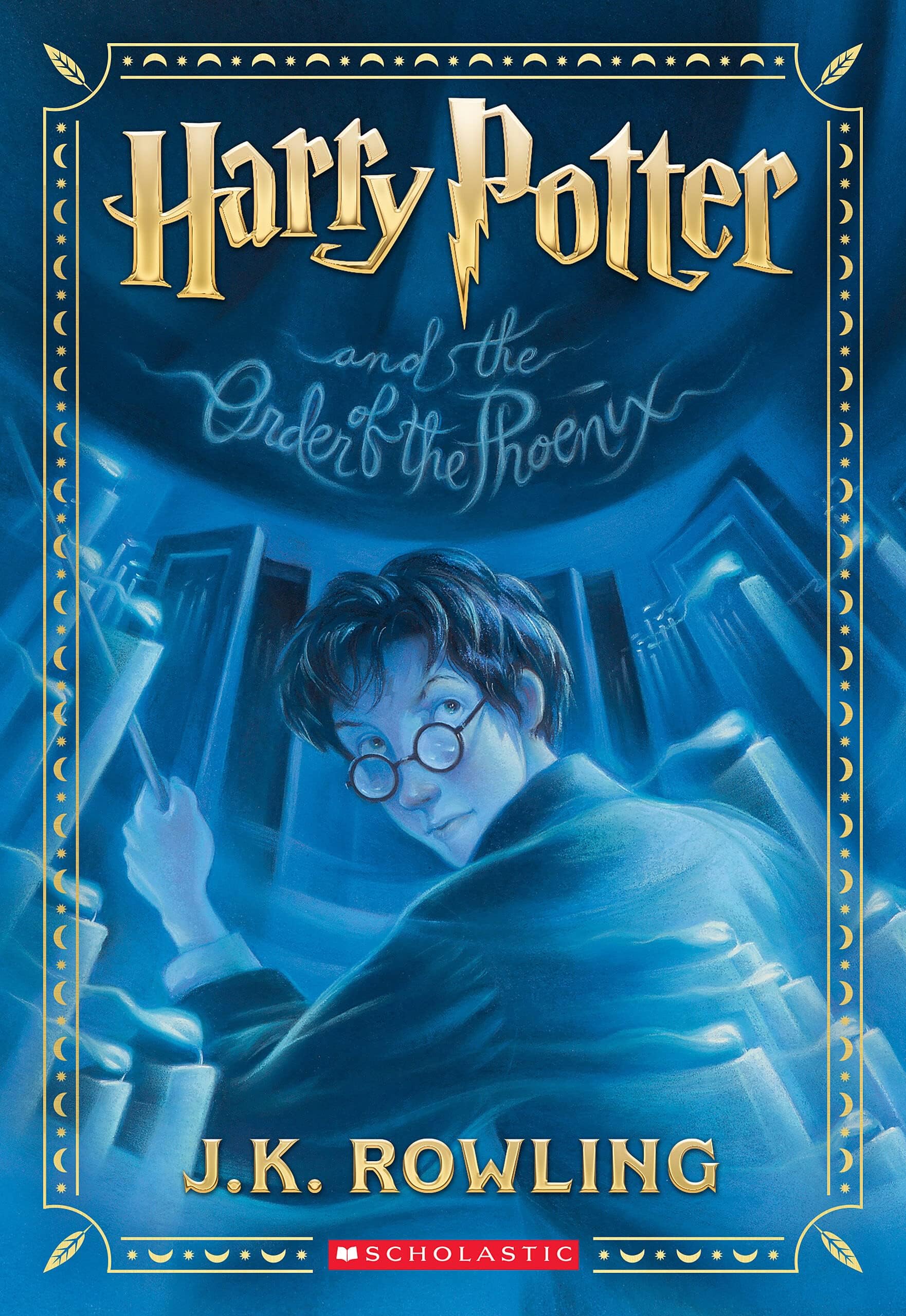
Harry Potter and the Order of the Phoenix (Harry Potter, Book 5)
Product ID: 527930487
Buy anything from 5,000+ international stores. One checkout price. No surprise fees. Join 2M+ shoppers on Desertcart.
Desertcart purchases this item on your behalf and handles shipping, customs, and support to Vanuatu.
Harry Potter and the Order of the Phoenix (Harry Potter, Book 5) (5) [Rowling, J. K., GrandPré, Mary] on desertcart.com. *FREE* shipping on qualifying offers. Harry Potter and the Order of the Phoenix (Harry Potter, Book 5) (5) Review: The wizarding world will never be the same again - Harry Potter and The Order of the Phoenix is the fifth book in J.K. Rowling's Harry Potter series of children's books. Several weeks ago I eagerly anticipated the arrival of Harry Potter #5 and had preordered it. When I woke up this morning, I found the book right at my doorstep. Elated, I quickly opened the package and started reading. I just finished the book, and I am not one bit disappointed. J.K. Rowling's writing style is still ever-present in this book, vivid and wondrous as it had been in the previous four books. There are many surprises in the book (like Ron getting to be prefect while Harry doesn't), but I also think that a lot of the details in the book were extraneous. The book was also a bit on the dark/moody side. When I read it, I was constantly disturbed and worried, and the book no longer had the flippant and jovial tone that the first book had, the original reason why I enjoyed it so much. However, that doesn't stop this book from being so great. Again, the magic of Hogwarts accompanies Harry, Hermione, and Ron throughout the book, but some developments in the book are disturbing, such as Percy's separation from the family, Dumbledore's aloofness in the beginning of the book, and the somber tone on which the book ends. The only characters I felt were unmarred by the morose theme stretched throughout the book were Fred and George Weasley (they operate a joke shop throughout the book). One of my complaints about the book was the length. This installment of the Harry Potter series is the longest at 870 pages. There are only two reasons I can think why J.K. Rowling would do this: 1) She gets paid by the word so the more she writes, the more money she makes. 2) She is afraid that once she writes all seven books, then she will have nothing more to write about, so therefore, she has to write as much as she can before the momentum of her series is over. Both of those are bad reasons why the book should be long. While the writing isn't Joyce (concise and perfect in all ways, but slightly unhumanistic), I think that a lot of it is overly verbose. However, I don't feel that the length of the book is something to complain about. Other people disagree though: in fact, upon hearing that HP5 was 870 pages, he responded, "HOLY...." That doesn't mean the book is bad though. I would still highly recommend this book and would agree that it is _on par_ with the previous writing of JK Rowling. Even though it is slightly depressing at times, it's still an excellent read. Now, for a brief summary - don't read ahead if you don't want the book spoiled. Harry is first caught fighting two dementors near Privet Drive. As a result of his breaching of the Underage Misuse of Magic, he has to go to a trial, where he defends himself so he won't get expelled from Hogwarts or get his wand snapped in half. Wizards from the Order of the Phoenix, an underground anti-Voldemort society, come to rescue Harry and take him to a hideout. Once Harry is acquitted of all charges, he finds out that Albus Dumbledore is extremely aloof and that Cornelius Fudge and Percy Weasley do not believe that Voldemort has come back to power. Percy is cold and disattached to the Weasleys because he "betrayed" the family when he went to work for Fudge. Harry also finds out that Ron and Hermione are prefects for Gryffindor, and he is not. Once Harry makes it back to Hogwarts, there are plenty of things to worry about. Aside from the new Defense from the Dark Arts Professor, Umbridge, who is working as a "spy" for the Ministry of Magic, Harry has to contend with O.W.L.'s and people who don't believe him when he tells them that Voldemort is back. Ron is made Keeper for the Quidditch Team in addition to being a prefect. Fred and George are selling pranks and pills for their joke shop. Tons of homework plague Harry and Ron, causing them many sleepless nights. Also, Umbridge inspects all the teachers as Head Inquisitor and she also disbands all clubs and teams (including the Gryffindor Quidditch Team), so they must reapply for reforming. This happens just as Hermione, Ron, and Harry decide that they are going to create a Defense Against the Dark Arts "study group" themselves. Later on, Harry and the Weasley twins are banned from Quidditch for life by Umbridge. In the middle of the book, Mr. Weasley is attacked. Harry has an out-of-body experience where he is actually a snake and attacks Mr. Weasley. It is even suggested that Harry is being possessed by Lord Voldemort. Harry eventually takes Occlumency (anti-mind reading) lessons from Snape. Right after the first Occlumency lesson with Snape, Harry realizes that the door at the end of the long, dark corridor in his dreams is the entrance to the Department of Mysteries. The next day, Hermione, Ron, and Harry find out from the Daily Prophet that ten Death Eaters escaped from Azkaban. Dumbledore eventually leaves the post as headmaster of Hogwarts and Umbridge takes over. It seems worse and worse everyday and that Voldemort is getting closer and closer to victory. Eventually the book climaxes and as you might suspect, Harry and the rest of the D.A. (Dumbledore's army) find themselves on a rescue mission to the Department of Mysteries. There is a showoff with Voldemort. There is a main character who dies. I won't tell you who it is, but it is a main character (not someone minor like Cedric). The book ends on a somewhat sad note, with the Ministry admitting their wrongdoing and that Voldemort is back, aka the start of the "second war." Let's hope that Harry can withstand two more years at Hogwarts with Voldemort around... Review: Unbelievably fantastic and completely absorbing - Having just reread the entire Harry Potter series in preparation for Book Six, it seems like the time is now right for me to finally review Harry Potter and the Order of the Phoenix. To call the book fantastic is a gross understatement. Without doubt, it is the most absorbing novel I've ever read - even on multiple readings. It may be well over 800 pages, but it's still a quick read. I'm betting most fans read this book in two days or less - you just can't put it down. There were times when I wanted to throw it at something, though, just because so many awful things happen to these beloved characters over the course of Harry's fifth and - by far - most trying year at Hogwarts. You sit there enraged, struggling to believe such awful events can possibly be happening, and you're quite powerless to do anything about it - except plow on, hoping for a proverbial break in the clouds. At other times, I wanted to put down the book and cheer - especially for Fred and George and Professor McGonagall. Heck, even Peeves had me cheering in this one. They're not lying when they call this a coming-of-age story. Fifteen is a tough age for anyone, a sort of purgatory between childhood and adulthood, but for Harry it's uniquely unbearable. He's just seen Cedric Diggory killed and barely escaped from a fully restored Lord Voldemort, and what happens? He goes right into a wizarding deprivation tank on Privet Drive, with absolutely no word for weeks on end about what is going on. Then Dementors attack him, and he's suddenly facing expulsion and a hearing before a council of grand wizards. Once he is reunited with his friends and godfather, the adults still keep him in the dark - and he blows up, as well he should. Knowing almost nothing about what the newly restored Order of the Phoenix is actually doing, he's then packed off to Hogwarts - where he is almost completely ignored by Professor Dumbledore. The most unbelievable (and enraging) thing about all of this is the fact that Cornelius Fudge, the git running the Ministry of Magic, refuses to believe Voldemort has returned, and the Daily Prophet devotes the whole year to stories about the unbalanced, unstable Harry Potter and his attention-seeking claims. Then, as if things couldn't get any worse, you have the arrival of Dolores Umbrage - easily the most hateful, infuriating character of the series - as Professor of Defense Against the Dark Arts and - in short order - High Inquisitor of Hogwarts. Well, I won't go through the whole list, but Harry is really on his own more than ever this year - facing the largest obstacles imaginable. When I first read this novel, I felt that Harry was really just a little bit on the mean side during this fifth year at Hogwarts. A second read shows me that I was wrong, however. Harry is a teenager, in many ways a normal teenager despite his unique situation. The whole relationship thing with Cho Chang, for example, is perfectly envisioned. And the young man has a right to be mad - the fact that he even survived Hogwarts this year, let alone another encounter with Lord Voldemort, is darned impressive. We really learned a lot about all of the characters in this book - Snape, in particular. Good old Ron finally gets a few moments in the sun of his own, Neville emerges as a crucial character to the whole saga, and Hermione (my favorite character) is still her delightful self - except even more so. And I love Luna Lovegood. I didn't think any book could be as good as The Goblet of Fire. Now, I don't see how any book could be as good as Order of the Phoenix. Knowing J.K. Rowling, though, I expect the best is yet to come.


| Best Sellers Rank | #2,467 in Books ( See Top 100 in Books ) #3 in Fantasy for Children #5 in Children's Action & Adventure Books (Books) #51 in Children's Friendship Books |
| Customer Reviews | 4.8 out of 5 stars 100,546 Reviews |
I**R
The wizarding world will never be the same again
Harry Potter and The Order of the Phoenix is the fifth book in J.K. Rowling's Harry Potter series of children's books. Several weeks ago I eagerly anticipated the arrival of Harry Potter #5 and had preordered it. When I woke up this morning, I found the book right at my doorstep. Elated, I quickly opened the package and started reading. I just finished the book, and I am not one bit disappointed. J.K. Rowling's writing style is still ever-present in this book, vivid and wondrous as it had been in the previous four books. There are many surprises in the book (like Ron getting to be prefect while Harry doesn't), but I also think that a lot of the details in the book were extraneous. The book was also a bit on the dark/moody side. When I read it, I was constantly disturbed and worried, and the book no longer had the flippant and jovial tone that the first book had, the original reason why I enjoyed it so much. However, that doesn't stop this book from being so great. Again, the magic of Hogwarts accompanies Harry, Hermione, and Ron throughout the book, but some developments in the book are disturbing, such as Percy's separation from the family, Dumbledore's aloofness in the beginning of the book, and the somber tone on which the book ends. The only characters I felt were unmarred by the morose theme stretched throughout the book were Fred and George Weasley (they operate a joke shop throughout the book). One of my complaints about the book was the length. This installment of the Harry Potter series is the longest at 870 pages. There are only two reasons I can think why J.K. Rowling would do this: 1) She gets paid by the word so the more she writes, the more money she makes. 2) She is afraid that once she writes all seven books, then she will have nothing more to write about, so therefore, she has to write as much as she can before the momentum of her series is over. Both of those are bad reasons why the book should be long. While the writing isn't Joyce (concise and perfect in all ways, but slightly unhumanistic), I think that a lot of it is overly verbose. However, I don't feel that the length of the book is something to complain about. Other people disagree though: in fact, upon hearing that HP5 was 870 pages, he responded, "HOLY...." That doesn't mean the book is bad though. I would still highly recommend this book and would agree that it is _on par_ with the previous writing of JK Rowling. Even though it is slightly depressing at times, it's still an excellent read. Now, for a brief summary - don't read ahead if you don't want the book spoiled. Harry is first caught fighting two dementors near Privet Drive. As a result of his breaching of the Underage Misuse of Magic, he has to go to a trial, where he defends himself so he won't get expelled from Hogwarts or get his wand snapped in half. Wizards from the Order of the Phoenix, an underground anti-Voldemort society, come to rescue Harry and take him to a hideout. Once Harry is acquitted of all charges, he finds out that Albus Dumbledore is extremely aloof and that Cornelius Fudge and Percy Weasley do not believe that Voldemort has come back to power. Percy is cold and disattached to the Weasleys because he "betrayed" the family when he went to work for Fudge. Harry also finds out that Ron and Hermione are prefects for Gryffindor, and he is not. Once Harry makes it back to Hogwarts, there are plenty of things to worry about. Aside from the new Defense from the Dark Arts Professor, Umbridge, who is working as a "spy" for the Ministry of Magic, Harry has to contend with O.W.L.'s and people who don't believe him when he tells them that Voldemort is back. Ron is made Keeper for the Quidditch Team in addition to being a prefect. Fred and George are selling pranks and pills for their joke shop. Tons of homework plague Harry and Ron, causing them many sleepless nights. Also, Umbridge inspects all the teachers as Head Inquisitor and she also disbands all clubs and teams (including the Gryffindor Quidditch Team), so they must reapply for reforming. This happens just as Hermione, Ron, and Harry decide that they are going to create a Defense Against the Dark Arts "study group" themselves. Later on, Harry and the Weasley twins are banned from Quidditch for life by Umbridge. In the middle of the book, Mr. Weasley is attacked. Harry has an out-of-body experience where he is actually a snake and attacks Mr. Weasley. It is even suggested that Harry is being possessed by Lord Voldemort. Harry eventually takes Occlumency (anti-mind reading) lessons from Snape. Right after the first Occlumency lesson with Snape, Harry realizes that the door at the end of the long, dark corridor in his dreams is the entrance to the Department of Mysteries. The next day, Hermione, Ron, and Harry find out from the Daily Prophet that ten Death Eaters escaped from Azkaban. Dumbledore eventually leaves the post as headmaster of Hogwarts and Umbridge takes over. It seems worse and worse everyday and that Voldemort is getting closer and closer to victory. Eventually the book climaxes and as you might suspect, Harry and the rest of the D.A. (Dumbledore's army) find themselves on a rescue mission to the Department of Mysteries. There is a showoff with Voldemort. There is a main character who dies. I won't tell you who it is, but it is a main character (not someone minor like Cedric). The book ends on a somewhat sad note, with the Ministry admitting their wrongdoing and that Voldemort is back, aka the start of the "second war." Let's hope that Harry can withstand two more years at Hogwarts with Voldemort around...
D**Y
Unbelievably fantastic and completely absorbing
Having just reread the entire Harry Potter series in preparation for Book Six, it seems like the time is now right for me to finally review Harry Potter and the Order of the Phoenix. To call the book fantastic is a gross understatement. Without doubt, it is the most absorbing novel I've ever read - even on multiple readings. It may be well over 800 pages, but it's still a quick read. I'm betting most fans read this book in two days or less - you just can't put it down. There were times when I wanted to throw it at something, though, just because so many awful things happen to these beloved characters over the course of Harry's fifth and - by far - most trying year at Hogwarts. You sit there enraged, struggling to believe such awful events can possibly be happening, and you're quite powerless to do anything about it - except plow on, hoping for a proverbial break in the clouds. At other times, I wanted to put down the book and cheer - especially for Fred and George and Professor McGonagall. Heck, even Peeves had me cheering in this one. They're not lying when they call this a coming-of-age story. Fifteen is a tough age for anyone, a sort of purgatory between childhood and adulthood, but for Harry it's uniquely unbearable. He's just seen Cedric Diggory killed and barely escaped from a fully restored Lord Voldemort, and what happens? He goes right into a wizarding deprivation tank on Privet Drive, with absolutely no word for weeks on end about what is going on. Then Dementors attack him, and he's suddenly facing expulsion and a hearing before a council of grand wizards. Once he is reunited with his friends and godfather, the adults still keep him in the dark - and he blows up, as well he should. Knowing almost nothing about what the newly restored Order of the Phoenix is actually doing, he's then packed off to Hogwarts - where he is almost completely ignored by Professor Dumbledore. The most unbelievable (and enraging) thing about all of this is the fact that Cornelius Fudge, the git running the Ministry of Magic, refuses to believe Voldemort has returned, and the Daily Prophet devotes the whole year to stories about the unbalanced, unstable Harry Potter and his attention-seeking claims. Then, as if things couldn't get any worse, you have the arrival of Dolores Umbrage - easily the most hateful, infuriating character of the series - as Professor of Defense Against the Dark Arts and - in short order - High Inquisitor of Hogwarts. Well, I won't go through the whole list, but Harry is really on his own more than ever this year - facing the largest obstacles imaginable. When I first read this novel, I felt that Harry was really just a little bit on the mean side during this fifth year at Hogwarts. A second read shows me that I was wrong, however. Harry is a teenager, in many ways a normal teenager despite his unique situation. The whole relationship thing with Cho Chang, for example, is perfectly envisioned. And the young man has a right to be mad - the fact that he even survived Hogwarts this year, let alone another encounter with Lord Voldemort, is darned impressive. We really learned a lot about all of the characters in this book - Snape, in particular. Good old Ron finally gets a few moments in the sun of his own, Neville emerges as a crucial character to the whole saga, and Hermione (my favorite character) is still her delightful self - except even more so. And I love Luna Lovegood. I didn't think any book could be as good as The Goblet of Fire. Now, I don't see how any book could be as good as Order of the Phoenix. Knowing J.K. Rowling, though, I expect the best is yet to come.
M**E
Not quite Twain or Dickens, But ...
J.K. Rowling has produced a great adolescent novel. While coming of age stories are staples of both quality and popular literature, modern "quality" ones tend to be painfully self-indulgent. A century or so ago, Mark Twain's Huck Finn had the sense to decide that freeing his friend Jim was more important than going to heaven and Dickens' Pip (_Great Expectations_) learned just how foolish had been his self-indulgent adolescence. The writers understood that purpose resides beyond the self. Then, around fifty years ago, critics became enamored with the likes of Holden Caulfield, and the self-indulgent study of adolescent ennui came into fashion. Granted, the readers receive a far deeper exploration of Holden Caulfield's psychological makeup than Twain or Dickens ever offered a reader, but we have paid a terrible price for this exploration. Authors and critics stepped forward to claim that solipsistic self-exploration was "what it's about," and few seemed ready to say, "Yes, this is what adolescence is like, but you've got to step out and take on the world even though the entirety of William James's 'blooming buzzing confusion' seems to be doing its blooming and its buzzing within the confines of your emotions." Can one experience the confusion of Holden Caulfield and yet set forth boldly as Huck Finn? Harry Potter tries, as the many of us who have not grown up to be self-indulgent agoraphobics have done exactly that. We've sorted through the world, discovered the faults and flaws of the outside world, come to terms with our own weaknesses, and occasionally saved the world (or some tiny little piece of it) in the process. Harry Potter is a real adolescent, writ large. He is a wizard; he has a Destiny; he is the hero of childhood fantasy. He is confused, impulsive, traumatized, and full of both anger at the world and self-doubt. In Harry Potter and the Order of the Phoenix, Harry suffers all the deep pangs that are the fodder of modern literature yet manages to stand true to himself at the end. Harry has heart, and, as Dumbledore notes, that is what matters. In the Harry Potter books, Harry tends to create or force the final confrontations. Harry unintentionally cooperates with Voldemort again in this piece, propelled, as always by selflessness rather than malice. Harry may need Voldemort in order to discover what is within himself; Harry also feeds Voldemort as he presses ever greater challenges onto himself, leaving us to ask: is Harry responsible for Voldemort's increasing power and the consequences of these ever more violent confrontations? It is dangerous to act in a world where we posses only incomplete knowledge, but part of Harry�s appeal is that he does act, rather than retreating Hamlet-like into indecision. Harry also must discover that his finest role models are not perfect; this is another element of the adolescent rite of passage. Harry, always the underdog in the Muggle world and always the defender of the underdog in the world of wizardry, discovers something unsettling in the form of one of Snape's memories. The revelation explains much of Snape's animosity toward the Potters and Black, and offers Rowling's readers an uncomfortable window into the adolescent world. The more rambunctious behavior of Harry and his friends, throughout the books, has consistently appeared as either benign or justified. In our real world, the behavior of "good kids" is all too often neither. Rowling reminds us of the adolescent play that is scarring to all involved: victims, victimizers, and even those who would object but were powerless to do so. And she leaves Harry with the choices of justifying (improperly) his heroes' actions, rejecting his heroes, or accepting that even the best wizards have flaws. The new Defense Against the Dark Arts teacher epitomizes the Dark Art of the Twentieth Century. Those of us who have lived through 1984 may see her as a figure of ultimate evil, one far more depraved than the merely malicious Voldemort. She is the bureaucrat, the agent of societal convenience and unquestioning obedience to authority. All who would argue with her are not merely wrong, they are misguided or deceitful obstacles to the Truth. Order is all, and Order derives only from unquestioned obedience to the rules as delineated by the State. Her methods of punishment are Kafkaesque; her aims include the destruction of independent thought. Question Nothing! It is basic nature for an adolescent to rebel against such a figure; what is difficult is efficacious rebellion, rather than pointless or self-destructive opposition. Can an adolescent learn when to fight and when to pretend acquiescence? Yes, this book is dark in tone, raw with the emotions of adolescence and with its external actions a perfect mirror to Harry's confused, angry young mind. In the world of childhood, tomorrow always dawns fresh and new; for an adult, tomorrow's dawn carries the consequences, for good or bad, of the night before. For an adolescent, the dawn is always painful as consequences are a fresh addition to the world, and last night's experiments in living were sure to have produced at least some undesired results. The lessons are intense, the learning rapid, but understanding may be long years away. The brightest thought, and Rowling lets us end with this thought, is that there are others who have felt the pain of adolescence, who have confronted the great human questions, and who have not only survived but have grown into strong, effective adults. Harry Potter may be letting a generation of kids know that one's life matters, even in its harshest, most confused periods. It should be letting a generation of critics know that there is more to adolescent self-discovery than simpering self-indulgence. This book suggests that Huck Finn can feel like Holden Caulfield on the inside, yet still behave as Huck Finn. It also suggests that there is no excuse for behaving like Holden Caulfield -- and I like that suggestion.
T**S
I cried, I really did. . .
I'm not going to say why I cried, because that would spoil the whole book (warning: DO NOT, I REPEAT, DO NOT read the review: Harry Potter Rocks! A Kid's Review. It gives away the ending!) But, I will say that that ending made me CRY! And I'm nearly 21 years old. How does one go about describing the Harry Potter books? They're almost indescribable! These books are so full of every emotion, every type of person and creature. They draw you in as the pensieve does into one's thoughts. As Harry witnesses Snape's worst memory (and trust me, you like I will actually feel sympathy towards Snape, believe me!) it is as though he is standing right there amongst his father, Sirius, Lupin and Wormtail. This is how I feel when I read these books. I feel as though I am right there with Harry, Ron and Hermione through every struggle, every injustice, every adventure no matter how dark or hopeless. I cry their tears, I burn with their sense of injustice, my heart leaps with theirs at every victory. But on to the story. The 5th year is the worst yet, no one will admit that You-Know-Who is back, all summer long The Prophet is making Harry look like an attention-grabbing, lying lunatic. Meanwhile, Harry has not seen his friends or Dumbledore all summer, and when they write they are incredibly vague, understandably frustrating after all the horrors Harry witnessed at the end of his 4th year. Then, before you know it, he is under magical attack on Privet Drive! Matters don't improve, Harry risks being expelled from no fault of his and Hogwarts is now under strict control from the Ministry of Magic, led by none other than the blind-to-all-facts Cornelius Fudge. Hagrid has disappeared and Harry is thwarted left and right in all the things he loves and needs to do! I don't understand how anyone could say that these books have been going downhill since the last 150 pages of year 4!? In my opinion, Prisoner of Azkaban was the best yet after years 1 & 2 and Goblet of Fire was better still! This book now is more on the lines of the end of Goblet of Fire, things are getting darker and more ominous and more difficult for everyone. And this is appropriate! With the return of the Dark Lord (eww) we must naturally expect that life will no longer be as fun. But lighten up, there are some truly funny scenes, and a little romance too! But, times are just not as carefree (if they could ever be called so) as they used to be. Someone said that Harry has no sense of humor anymore. I ask you, would you be full of laughs if you had seen the return of free magic's WORST ENEMY, seen someone die and then have to endure a year of people not believing you, teachers trying to discredit you, people you liked turning against you, insanity charges, visions of You-Know-Who doing his dirty work, all your favorite things being taken away? How would you feel if you thought all the world was against you??? These are the struggles Harry must endure, he is run through the mill, his limits are tested to the max, and we all must hope that he is able to survive it all. I'm not sure I could take it and I'm presently 6 years older than him! As they say, what doesn't kill you only makes you stronger, this will be Harry's test in the future books. Seems so real, doesn't it? Rowling has a style that makes you believe she is writing a biography! But it's more like watching a film of someone's life and walking right into that film and feeling every single thing that they feel, being in the same dangers, loving and caring about the same friends and almost-family. It's really like what Harry felt when he looked through Voldemort's (shudder) eyes and felt what he was feeling, did what he did but was powerless to stop it. Harry is tested to his limit in the Order of the Phoenix, he endures things no human should have to suffer, and he will receive a warning that may change his views and way of life forever. I don't envy poor Dumbledore, on his shoulders seems to rest the weight of the world, and now Harry must truly shoulder some of that weight. Dumbledore can no longer protect Harry from the worst, and in trying to protect him from the ultimate truth up to this point, Dumbledore may have made a very grave and horrible mistake. This book is wonderful, heart-breaking, astounding, depressing, and truly amazing all at the same time. World-Class author, kudos Ms. Rowling! How could I ever have been skeptical of these books??? They are now amongst my ALL-TIME favorites! I hope book 6 is released soon, I'm not sure I can stand the wait!
C**L
Harry Potter needs some serious counseling
The events that took place at the end of Harry's fourth year at Hogwarts, along with the events that unfold in his fifth year, make Harry a very angry person in this book. Fed up with being talked about his back and being accused as a liar, Harry spends a lot of this book being angry and lonely and losing his temper. He flies off the handle seemingly every other page in the first half of the book. It seems he has an uncontrollable temper, a lot of suppressed rage and bottled-up anger. He seems to have lost all sense of self-preservation and he seems intent on going around bad-tempered all the time making enemies and getting in trouble on a regular basis. He hates being whispered about, but he keeps giving people reasons to whisper. I got tired of reading about his constant unhappiness and his continual temper tantrums. It was overkill. This book was a bit too long. It's not until 200 pages into the book that the students even arrive at Hogwarts. A lot of that first 200 pages is devoted to the description of cleaning the old Black house. One good part about the pre-Hogwarts story was that it was interesting to finally read about the offices of the Ministry of Magic. But on the whole, Rowling starts trying to create too many subplots in this book. And as usual, everything tries to get explained all in the last 20 pages, but there were a lot of questions left unanswered. After five books, we find FINALLY find out at the end of this book the reasons why Harry is forced to spend his summers with the Dursley's. However, the explanation contradicts the fact that Harry had to be followed, guarded and protected during the first part of the summer, while he was still at the Dursley's. There were lots of other unanswered questions as well. What were the parchments that Bill and Mr. Weasley were looking at after the first Order of the Phoenix meeting that took place upon Harry's arrival? Why was the time and location of the hearing changed at the last minute and who changed it? Why did they have a full trial in the old courtroom? Why did Fudge seem flustered that Dumbledore managed to show up at the trial? What exactly was Umbridge's motivation for wreaking such havoc at Hogwarts? Why was Umbridge going to allow the Slytherin team to reform but not the Gryffindor team? What were the brains in the tank all about, and all the other strange stuff in the Department of Mysteries? What was with the veiled archway? Luna's "explanation" didn't really explain anything about what was behind that veil. And where did the person who fell through that veil end up going? But the book wasn't all bad, not by any means. Despite the problems I had with it, I still found it more enjoyable than not. The focus of the story is Dumbledore's and Harry's efforts to convince the wizarding community that Harry is telling the truth about the return of Voldemort. There are new revelations about Harry's past and some ominous warnings about his future. Despite the overall gloomy mood of the novel, there are some fun parts. The awkward relations between Cho and Harry are highly entertaining. I wish there had been more of that. Ron's reaction to Ginny having a boyfriend is quite amusing. There some interesting new characters in this book. Dolores Umbridge is the Ministry of Magic employee who takes over the Defense of the Dark Arts position and makes enemies out of nearly everyone she meets. She is convincingly hateful, sickeningly sweet and maddeningly irritating. An awful woman. My favorite new character is Tonks, who is only seen briefly at the beginning and end of the book, but who is hilarious nonetheless. I liked this book. It's not as good as the first four and there are too many ominous and dark parts for my taste, but I still enjoyed reading it. I do miss the lighthearted fun of learning about the magical world, though. For once, Harry thankfully doesn't end up in the hospital wing at the end of the book, but that doesn't change the fact that this book has a thoroughly depressing ending. It's one of the worst endings to a book that I've ever read.
D**M
Dolores Umbridge, the most evil character in the Harry Potter series.
It's hard to write a review for a book in a series that you've read more times than you can remember, and seen the movie more times than you could count. From that statement alone it should be obvious that I'm a big fan of the Harry Potter series. Do I write my review based upon my first time reading it, or the everlasting impression this book has left me with? I think that fact that this book has made me think and ponder certain ideas over the years, I think the everlasting impression should be the topic of my review. After encountering Dolores Umbridge, I was left pondering the question "What is evil?" Voldemort is obviously the Villian of the series, however I feel Umbridge is a much more sinister and evil Villian than even Voldemort. Voldemort's actions and evil deeds are really very simple to understand. What motivates him is power and greed and he is willing to go to any lengths to achieve those goals. While evil in itself, his motives and actions are very straight forward and easy to understand. It is easy to see Voldemort for the evil that he is, which therefore keeps him in hiding only surrounded by his Death Eaters. Dolores Umbridge is a very different type of evil. Dolores Umbridge is the type of evil that we, the muggles that we are, encounter on a daily basis. They are the people who enjoy the hurt, pain, chaos and distrust they cause through their manipulations and lies. The enjoy the devastation they cause in their wake. The fact that she can create the heartache she relishes so much with a false smile, sweet sanguine falsetto, and splashes of whimsy to give the impression of naïveté and an innocent childlike behavior which puts one off initially of comprehending the true evil she inflicts to hide the monster she is, and the fact that through these false tactics she has risen to a position of power to inflict heartache unto others, shows she is a master at hiding her true psychopathic personality. This sick personality trait is shown most clearly when she makes Harry write lines in detention. She knows Harry is telling the truth, yet she lies and manipulates him until she is in a position of power directly over him in detention at which point she not only continues her lies causing mental anguish to Harry, she continues her evil machinations by causing him physical pain by forcing him to use her quill which scratches and ultimately scars Harry for the rest of his life. Umbridge enjoys Harry's suffering. She even inspects his hand at the end of each detention to make sure he is being cut and that his hand is bleeding and then in a well satisfied way compliments Harry on completing his detention. Her only praise is when Harry does something to cause hurt and pain and twists what he knows is the truth into something false. This is standard textbook psychopathic behavior in domestic abusers. The fact that Doloros Umbridge can navigate society in such a way as to gain a position if importance in the Minisrptry of Magic and flourish in normal wizarding society while hiding her insidious psychopathic tendencies leaves her in an excellent position of power to inflict hurt to others. Her brand if evil is subtle and is not so obvious at a first glance which gives her the ability to "blend in" with others and yet she victimizes many in her wake, as she navigates through life. In Voldemort's case, his brand of evil is so obvious to everyone that he is an outcast of the wizarding community, which ultimately lessens the number of his potential victims to those simply standing in his way of power, while in Umbridge's case her victim pool is limitless die to her access to the community and all those she comes across. So here is the moral question I have pondered for many years since reading this book for the first time. "Which Behavior Is More Evil?" Personally, I feel Dolores Umbridge is the much more evil of the two characters based upon the reasons given in the prior paragraph. Whether you agree or disagree with me is not the point. The point is to make you think and ponder for yourself. The fact that this book makes you think long after you've turned the last page, is a mark of literacy success. Whiter you've read Harry Potter and the Order of the Phoenix once, or a hundred times, it is always a great novel to read again and again, and question what constitutes as evil.
S**R
Imagination, Heroism, Friendship, and Adventure
I will keep this spoiler free, so if I am vague about plot, that is why. May I suggest that all other reviewers do the same, at least for the first month or two? With each passing novel from JKR, I become more apprehensive that she will have lost her touch, that the shine will be gone. Rest assured, dear readers, that this novel has all the magic, all the excitement, all the adventure that we have come to expect--and more. The appearance of darker themes (death, consequences, truly evil villains who have an agenda that is definitely not wholesome) that marked the end of novel four were an unexpected twist for me. I had heard that this was not a fluke, that she was taking the septology into a serious examination of what happens when someone truly evil rises to power; this is indeed what she appears to be doing. Serious themes such as these form the backbone of the novel, and are apparent from the first pages. This disconcerted me a bit, as I was expecting the usual romp through Privet drive, a la Dobby; instead, I got a much different thing. The New York Times calls this section somewhat "ponderous", but I think that that is a specious view. In reality, it was important to change the tone of the world, and she wanted to make sure that we understood that all was not mandarin oranges and ice cream here. As JKR has admitted in interviews, Harry is much more angry in this novel. I felt that she handled this reasonably well--she does an excellent job portraying adolescent confusion. It feels like Harry spends a lot of time being very distressed, but when you imagine yourself, at 15, in his situation, he is not necessarily unrealistic. Teenage angst has been done better, but seeing this side of Harry is important in understanding how he is growing. The plot is where Ms. Rowling really shines. The Order of the Phoenix his one has significant plot twists where they should be, as well as where you least expect them. Ron and Hermione are there in spades, and there is significant character development for all the major characters as well as a few minor characters. We see new sides of McGonagall, Dumbledore, and Black, and Neville. I was thrilled to see threads from novels 1-4 that seemed unimportant at the time be picked up and woven skillfully into the narrative. Her grasp of the overall plan for her septology is admirable, and I am pleased that she even more careful a writer than any of us had anticipated. This is a united whole, a well planned world. This 7 book series has a definite beginning, middle, and an end, and we are in the thick of things now. All the old charm is back as well. Rowling's wit seems mostly absent for the first 100 pages, but don't give up hope. She was not not attempting to make the first hundred pages funny--she wants us to know she is in deadly earnest. The wit is always bubbling under the surface, however, and later in the novel, there are a number of laugh out loud funny passages. Descriptions, as always, are excellent. I needn't add that the names of her characters are always interesting, funny, and often revealing. Spells play an important role, of course, and their magic words never fail to amuse. Please note: This is not a novel for 6 year olds. They won't understand the adolescent issues. The plot is not as scary as the end of the fourth novel, but the overall tone is dark, as has been much discussed. Her literary style is much the same as the previous novels, but her vocabulary is becoming more advanced as Harry ages. This is an excellent novel for the precocious 10 year old; I'm not sure I would let 7-8 year olds read it unless they are exceptionally mature. No sex, but there is some violence, and as above, the dark themes. Overall, I would say that this is--hands down--her best novel yet. The climax left me literally breathless, turning pages as fast as I could, unable to believe what I was reading. I look forward to her 6th installment in this series. Well done, Ms. Rowling. Keep up the amazing work. Take your time on the next one--it will be well worth it when you do. And whenever it comes, we'll still be here.
L**E
Special edition
Beautiful book! love the printed edges, gave as a gift to HP fan. ⚡️ It was really enjoyed. Would buy other special edition books.
Trustpilot
2 weeks ago
5 days ago