Buy anything from 5,000+ international stores. One checkout price. No surprise fees. Join 2M+ shoppers on Desertcart.
Desertcart purchases this item on your behalf and handles shipping, customs, and support to Vanuatu.
🎶 Small amp, massive sound — power your space like a pro!
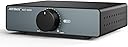
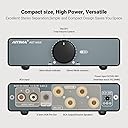
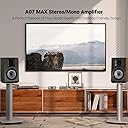
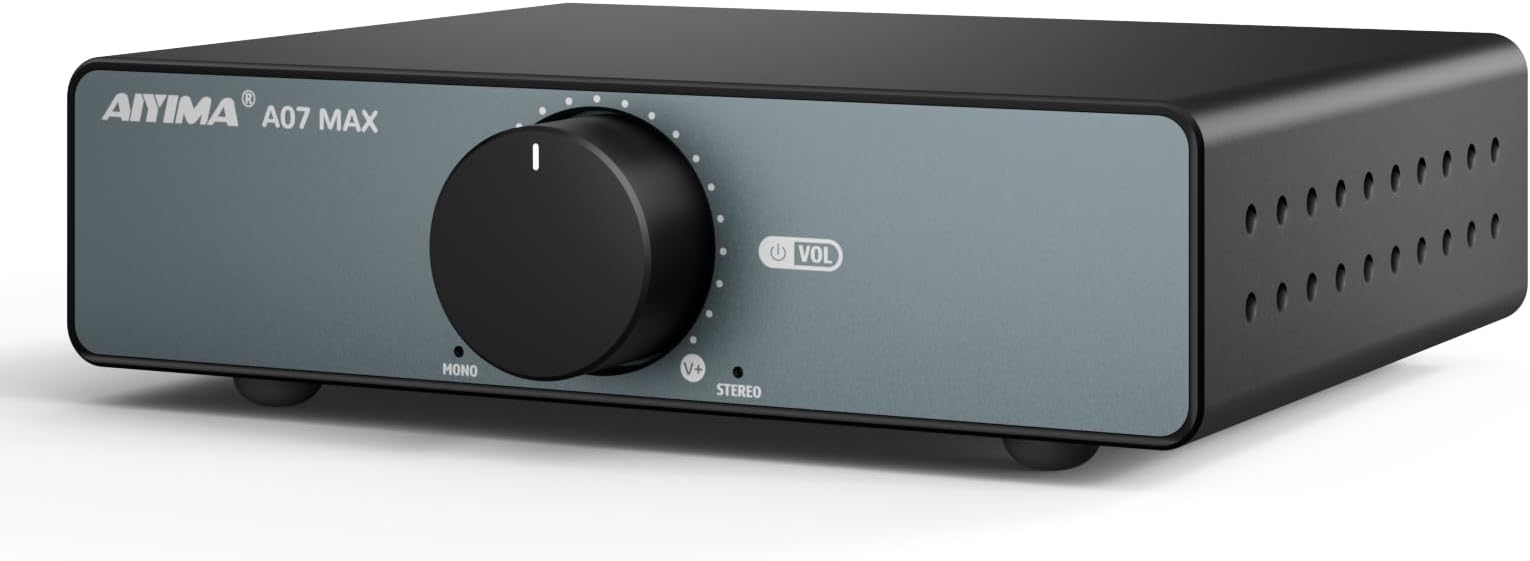
The AIYIMA A07 MAX is a compact yet powerful 2-channel Class D stereo amplifier delivering 300W per channel or 600W in mono bridge mode. Featuring premium TI TPA3255 amplification, advanced heat dissipation, and high-quality audio components, it offers audiophile-grade sound clarity and flexibility. Designed for passive bookshelf speakers, it includes a 3.5mm line output and a DC36V 6A power adapter for easy integration. Its replaceable Op-Amps enable personalized sound tuning, making it a top-tier choice for home audio enthusiasts seeking high performance without the bulk or price.


| ASIN | B0CJ6TSSY4 |
| Best Sellers Rank | #26,531 in Electronics ( See Top 100 in Electronics ) #133 in Audio Component Amplifiers |
| Brand Name | AIYIMA |
| Customer Reviews | 4.5 out of 5 stars 641 Reviews |
| Included Components | 1 pc A07 MAX Amplifier ;1 pc DC36V 6A Power adapter;1 pc User Manual |
| Item Dimensions | 6.02 x 3.94 x 1.57 inches |
| Item Weight | 1 Kilograms |
| Item dimensions L x W x H | 6.02 x 3.94 x 1.57 inches |
| Manufacturer | YIMA TECH |
| Material Type | Plastic |
| Maximum Output Power | 600W |
| Maximum Supply Voltage | 48 Volts (DC) |
| Minimum Supply Voltage | 24 Volts (DC) |
| Model | A07MAX |
| Mounting Type | Passive Speaker |
| Number of Channels | 2 |
| Output Power | 600 Watts |
| Part Number | B2D3176F |
| Specification Met | Tpa3255 |
| Unit Count | 1.0 Count |
| Voltage | 36 Volts (DC) |
F**T
Small but powerful in an elegant package
This is my review of AIYIMA A07 Max as comparing with AIYIMA A07 Pro and A08 Pro. I have had this unit for almost a month and I have been using it to test and listen to various audio tracks. My overall experience is that it offers very much the same sound quality, expansive sound stage, dynamic tones, and clear instruments; pretty much what the other latest AIYIMA amps offer based on the same TPA3255 and NE5532 amps. However, what sets this apart from others is probably its use case which is that it offers a mono-mode meaning, you can drive the left and right channel audio into two individual A07 Max and have the ability to push more power into the speakers (given you use the right power supply). Another distinction is that AIYIMA A07 Max does not have any Bluetooth support unlike the A07 Pro or the A08 Pro which maybe what might be preferred in certain cases. It not only simplifies the circuit and internal components but also keeps the cost down. Speaking of internal circuits, we can see from the images that AIYIMA has improved on the internal capacitors used. The two main capacitors have now be upgrades to Nichicon 63v as opposed to 50v used in a previous version. This gives it plenty of headroom to provide enough power during certain spikes in load. The TPA3255 chip is cooled with a massive heatsink that makes contact with the aluminum unibody, allowing it to dissipate the heat relatively quickly. There are plenty of vents on the sides and the bottom to circulate enough air to keep the amp at normal operating temperatures. The binding posts in the back are now much sturdier and feel premium compared to the other two amps. The posts are also staggered so there is more than plenty of room to plug in the speaker cables. I want to also quickly highlight the volume knob which also serves as the power switch similar to the A08 Pro and unlike the A07 Pro. However, the volume knob does not have physical indentations so you have to use visual markings to gauge the volume level. One thing to note is that in my experience, the volume knob had to be turned to at least 12 o'clock position to hear decent volume which I assume is because the potentiometer is a logarithmic and not linear. The NE5532 Op Amps are replaceable just like the case with A07 Pro and A08 Pro. Various other components are also upgraded over the previous two amplifiers so on paper, this amp should perform better which was evident when for example changing the volume while listening. The A08 Pro had a clear audible hiss when changing volume but A07 Max displayed no such behavior. It also suppressed any loud pops or noises when turning on. One thing that I did notice was that there was some cross-talk between the right and the left channel when using the mono-mode. I was able to hear the right channel audio coming into the left channel at quite high volumes but not so much as lower volumes. Overall, I believe this is a very decent and capable amplifier and even outperforms some other recent releases from AIYIMA in certain cases. The value for money is quite good and I definitely recommend this amp if you do not need the Bluetooth connectivity.
B**N
Sterling sound for such a low price - in particular, with select Op-Amp upgrades
I never thought I'd be writing about this, but some of these newly released class D amps (that allow for Op-Amp interchangeability), are now approaching audiophile level, class-AB amp sound reproduction. I've been giving many of these Asian-made class-D amps a try over the past few years. With the likes of the Aiyima A07 (the original), the A07 Pro, and now the A07 Max - along with the Fosi Audio BT20A Pro, V3, and most recently, the ZA3 - audio performance quality levels have risen dramatically among compact budget amplifiers - at a pace much faster than I could have previously anticipated. Before I get into the meat of the matter (for those of you interested in this comparison), in my opinion, the A07 Max begins life out of the box with a slightly overall warmer audio tonality to my ears than Fosi's recent ZA3 release. I find that with or without Op-Amp upgrades, the A07 Max has that slightly warmer sound signature (which tends to inch a bit closer to that much desired class AB tonality). As an aside, even the Fosi V3 has a slightly warmer overall sound signature as compared to the ZA3. I found that the A07 Max's sound-staging is pushed more to the rear (behind the speakers), whereas the ZA3's sound-staging is brought much closer to the listener and extends beyond the periphery of the speakers if it's a great recording (at least on my system). A tidbit of note is that with the A07 Max, one can use a variety of different speakers without noticing much of a tonal personality change. However, what I surprisingly discovered was that the Fosi ZA3's tonal personality changed, dependent on the speakers being used. For example, with the KEF Q150's and Q350 bookshelf models, the ZA3 sounded absolutely superb and and I could listen for hours on end! Yet with others - i.e. my Wharfedale, Mission, and Polk bookshelf speakers that I also have on hand - the ZA3 had a tad more of a coolish sound quality to it. The key to remember here is not to use speakers with the ZA3 that have pronounced treble capabilities (or are considered overly bright). With the A07 Max, that is not much of an issue from what I could discern. As to personal preferences for design appearance, I find that the A07 Max's design does not (subjective I know) look as appealing as the Fosi variants. I don't particularly care for the light gray (silver?) front panel which has a tinny and cheap feel to it - but that is just my interpretation because sonically, it far surpasses what one might think about its looks. In my opinion, the A07 Max punches far above it's price-point. This has brought me to say something that I never envisioned saying - and that is, between the Aiyima A07 Max and the Fosi Audio ZA3, they both are now what I would consider to be my standard desktop reference integrated amplifiers. In fact, they have supplanted my Cambridge Audio AXA25 and AXA35 integrated amps as my main reference units. With the Cambridge amplifiers, their size alone are some 8-10 times the size of the Aiyima A07 Max or the Fosi Audio ZA3. I've placed the Cambridge amps back in their respective boxes and will be selling them soon. I guess you could say that's high praise enough. The A07 Max music is a tad less "airy" than the Fosi V3 or ZA3 (where the latest Fosi amps tend to shine), however, its bass capabilities are about on par with the ZA3. However, in some cases, the A07 Max can project a bit too much bass. Highs such as can be found with stringed instruments in a full symphony orchestra, come through with a silky sheen in good recordings. I virtually get lost in the music from good quality recordings - those performances being characterized as highly immersive and musical. Every once in awhile, I have to remind myself that I'm listening to this diminutive box of an amp. More so, I can listen for hours to the A07 Max without experiencing listening fatigue - and yes, the same holds true for the Foxi Audio ZA3. Now here's the one variable to remember - and you have to determine if it's worth it to you to upgrade. I tend to change out the Op-Amps in most of the class D amps that have that feature. I changed out the 2 Op-Amps in the A07 Max, removing their generic cheap NE5532 versions (often used as the stock Op-Amp in most class D amps), with the more expensive discrete Sparkos Labs SS3602 versions. I've also used (and tested) the MUSES02 IC-based Op-Amps - and all sounded absolutely superb, and my comments in this review are based on my trying and using all of these Op-Amps. The upgraded Op-Amps elevated the audio qualities on the A07 Max quite noticeably - read "expanded sound-staging, smoother transients, warmer sound, increased depth and dynamics." More so, in my opinion, changing out the Op Amps to versions from either Sparkos Labs, Burson, or MUSES, brought the A07 Max more in tune with what a class AB amp would sound like. So do I recommend the A07 Max? A big time "hell-yes," I do - with a full 5 stars! Times are a changin' as they say. No longer does one have to spend $500 - $1000+ or so to get a decent audiophile level of amplifier. The likes of Aiyima and Fosi Audio (and a few other brands) are turning heads for less than $100 USD, and that's a good thing - actually, more so, that's a remarkable achievement! If there is one area that I would change, it would be with the appearance of the A07 Max. The Fosi units - in particular the V3 and ZA3, have a more refined (and higher quality) look to them, whereas the A07 max - for some odd reason - still feels a bit cheaper in both appearance and touch (particularly the front panel area). Of course, this is subjective on my part. I would also hope that Aiyima adds balanced inputs in one or more of their future releases if they want to remain competitive, and I bet they will in their next release of this particular style of amp. It is obvious that Fosi Audio and Aiyima are in competition with each other, trying to play leap-frog with their similar releases. It would be nice to now see Nobsound/Douk (really the same company) do the same thing. Choices are nice to have - but in the end, it is the sonic performance of a given amp that will determine a winner. Equipment-wise, I listened to this amp through the likes of the KEF Q150/Q350 bookshelf speakers, along with the Wharfedale D320 and Mission LX2 models. DAC's used were the iFi ZenDac V2, various Schiit DAC's and Head amps, Topping D10S, and the JDS Labs Atom DAC X. Cables used included Audio Quest interconnects, along with 10 gauge banana terminated speaker cable from Blue Jeans Cables. All music came through with a pleasant sense of musicality, great definition, and separation of instruments (and delineating the sound-stage properly). In the end, your mileage may vary of course, and who would I be to argue.
M**A
Build Quality. Impressive Performance.
I have always appreciated/enjoyed high quality sound systems. First time considering using mini Class D power amps; did not know they existed. Chose the Aiyima A07 Max because of upgraded quality parts and design, along with good reviews. Using the A07 with Dell PC and Realtek High Definition Audio. I was using an aging Klipsch ProMedia 4.1 system; problems with it's amplifier and bass speakers. So I thought I would try and reuse the perfectly good four Klipsch satellites; 2 each channel. Was not expecting much low end response. If needed, might get an Aiyima DAC-A2 Headphone Amplifier DAC with Bass Treble Controls. Started off with just the A07 Max and the 4 satellites. Very clear/clean but not much bass, as expected. New idea; dusted off some vintage Acoustic Research AR 206HO bookshelf speakers (6" bass/midrange with tweeter). Made the world of difference. It was the quality of the speakers, not the A07 Max lack of performance. Great at all listening levels; full response solid sound. I am not saying it's in audiophile class, but for the cost, build quality, performance and value, it's impressive. This is not the ultimate setup for a computer, but starting to think I prefer this flexible type of configuration over the "all in one" choices, e.g., Klipsch ProMedia's 4.1. For reference: Computer music library in WAV format. Streaming movies; full sound effects and very clear dialogue. Using triangle speaker placement; speakers angled to center. Great separation and definition; listening to studio mix moving from channel to channel (audio panning). No amplifier noise in stand by mode. When pushed, stays cool. I definitely will not need DAC or different Op-amp. Aiyima A07 Max is perfect for my application.
E**.
Always warm to the touch - 100°F
Interesting tidbit - it's like the amp is always operating at full tilt (just a guess!). This thing can be left on minimum volume and it'll be the same temperature as maximum volume. My IR thermal camera claims it's 100 degrees Fahrenheit. About the volume knob, it's great. Nicely damped, but not enough, in my opinion. The volume attenuation is all over the place, though... Once you click the volume on (7 o'clock to 8 o'clock), it isn't until 9 o'clock that sound is audible. Low volume control is almost non-existent, so you'll want to use a DAC/pre-amp with a volume control or your computer's volume slider to reduce the source. Continue rotating until about 1 or 2 o'clock for pretty even control. Anything from 3 o'clock till maximum (5:30) is a dramatic increase in loudness, so be careful. Sound quality is nice, but practically indistinguishable from an Onkyo TX-8020 stereo receiver I've been using since 2015, compared via KEF Q350 speakers. Nothing to write home about. This review is based on the included 36V power supply (which generates no apparent heat). I'm aware there is a 48V variant for sale separately. The included one is more than enough for a bedroom listening space.
M**R
A Class D mono/stereo amplifier with an upgrade path for delivering maximum power
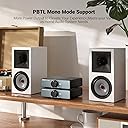
I purchased a pair of the Aiyima A07 Max amplifiers for use with a WiiM Ultra control preamplifier. The A07 Max amplifiers performed well with the WiiM Ultra control preamplifier using the line out from the WiiM Ultra. I compared this combination with the WiiM Amp Pro. The WiiM Amp, WiiM Amp Pro and WIIM Vibelink Amp each support digital optical input, that is how I prefer to listen to music via the WiiM Ultra to the WiiM Amp Pro versus the line out/line in (RCA) connection. The Aiyima A07 Max does not provide an optical input, only one pair of L/R RCA connections. The Aiyima A07 Max can be set to stereo mode or mono mode. You can start out with a single A07 Max amplifier set for stereo mode. You later can add a second A07 Max amplifier, set both A07 Max amplifiers for mono mode in a two channel system. Mono mode can provide increased channel separation. Using two amplifiers in mono mode unburdens a single power supply from having to supply power to both channels while maximizing dynamic headroom. As excerpted from the A07 Max owner's manual maximum rated power with the included 36V/6A power supply (in stereo mode) is: 107 Watts x 2 channels @ 4ohms, 100Wx2@6ohms, 94Wx2@8ohms. (In mono mode) the maximum power rises to 190 Watts x 1 channel @ 4 ohms, 150Wx1@6ohms, 118Wx1@8ohms. A single Aiyima A07 Max amplifier in stereo mode provides very engaging, dynamic sound. I actually prefer the sound of a single A07 Max amplifier versus a pair of A07 Max amplifiers set to mono mode for some music. In stereo mode the input sensitivity of the A07 Max is ~3dB higher than in mono mode. The damping factor, not stated, will be reduced by half in mono mode. To be sure, in mono mode, the channel separation is improved, the midrange frequencies come through with better instrument and vocal definition than in stereo mode. Still, in stereo mode the A07 Max draws me in with its very punchy, musical bass performance; The Allman Brothers Band sounds great when using a single A07 Max amplifier in stereo mode. In comparison , a pair of A07 Max amplifiers in mono mode sound more refined but not as ready to rock. A single A07 Max amplifier is a great way to start listening. You can always add a second A07 Max amplifier. The A07 Max amplifier has no tone controls. I prefer to use the WiiM Home app's equalizer functions (both graphic and parametric equalizers are included) rather than conventional bass and treble tone controls. The volume knob on the front of the A07 Max is also the power switch. There are two blue LEDs on the front of the A07 Max. One LED is on the left and the other LED is on the right side of the volume control. These LEDs indicate whether the amplifier is set for stereo mode or mono mode. There is a recessed Stereo/Mono mode switch on the bottom of the A07 Max. Among the small, inexpensive Class D amplifiers the Aiyima A07 Max is noteworthy for being able to be switched between stereo mode (BTL) and mono mode (PBTL). [Update 8/31/25: In attempting to connect a Fosi Audio P2 headphone amplifier using the A07 Max amplifier's 3.5mm Aux Out connection I discovered that the A07 Max amplifier must be turned on; the A07 Max amplifier's volume control affects the Aux Out signal level. The audio output level of the speakers was greatly reduced when I connected a 3.5mm stereo audio cable from the Aux Out on the A07 Max to the Fosi Audio P2 headphone amplifier. I did not test connecting the A07 Max amplifier to a powered subwoofer but the speaker audio level may also be reduced when you connect the A07 Max amplifier to a powered subwoofer via the Aux Out.] I found the A07 Max sounded better when set to mono mode, including bass extension and tightness of the bass notes. In mono mode, in addition to having to connect one pair of speaker wires to the binding posts labeled "+ Mono Mode -" you need to connect one channel of a typical dual RCA cable to the A07 Max's RCA white colored connector that is labeled "L". If you accidently connect the RCA cable connector to the red RCA connector that is labeled "R" you won't get any audio output from the A07 Max amplifier. Compared to some other small amplifiers, the speaker binding posts on the A07 Max are a bit larger (but still made of plastic and metal, not all metal) and are staggered with the lower connectors shifted slightly to the right for easier access. I recommend using banana plugs to connect the speaker wires. I use the Sewell deadbolt banana plugs (sold on Amazon.) While some have reported that the 3.5mm Aux Out connection on the A07 Max amplifier is a pass through from the RCA inputs terminals and that the Aux Out level is not controlled by the volume control on the A07 Max I found this to not be the case (see my update of 8/31/25). For connecting to a powered subwoofer I use the WiiM Ultra's single RCA subwoofer output connection. A key differentiator between a two channel audio system based around the WiiM Ultra with a one or a pair of Class D amplifiers (such as the A07 Max) versus using just the WiiM Amp or WiiM Amp Pro is that there is no upgrade path with the WiiM Amp/WiiM Amp Pro that does not involve replacing the WiiM amplifier unit with another amplifier unit. [Update: WiiM has introduced the WiiM Vibelink Amp as the matching amplifier for the WiiM Ultra. You could start out with or upgrade to the WiiM Vibelink Amp from the WiiM Amp/WiiM Amp Pro for ~3db more headroom and maximum power (100WX2@8ohms/200WX2@4ohms) when using the optical connection.] From a cost/value perspective a single Aiyima A07 Max amplifier (or a pair of A07 Max amplifiers used in Mono mode) are a viable alternative to one of the WiiM amplifiers. The maximum available power from the WiiM Ultra/A07 Max combination can be increased by adding a second A07 Max unit (while retaining the original A07 Max), in mono mode. You can maximize available amplifier power of the A07 Max by upgrading the power supply. Should you require maximum power from the A07 Max amplifier you can substitute a 48V/10A power supply for the standard 36V/6A power supply. In dual mono mode, a pair of A07 Max amplifiers set to mono mode and a pair of Aiyima brand GaN 48V/10A power supply units (sold on Amazon), each A07 Max amplifier unit can then provide (315Wx1@4ohms, 240Wx1@6ohms, 190Wx1@8ohms). This is significantly more power, (3dB or more headroom and available power @ 4 and 6 ohms) than the advertised maximum rated power of the WiiM Amp or WiiM Amp Pro (60Wx2@8ohms, 120Wx2@4ohms). I measured the temperature of the case of the A07 Max amplifier when using the stock 36V/6A power supply while powered on, while in use. The case temperature was 82F in standby. [It is now July. The room temperature is ~78/79F. The case temperatures of the two A07 Max amplifiers (stacked with the stock power supplies) while actively powering speakers are running ~98 to 100F, warmer than in previous months but not a concern. The WiiM Vibelink Amp, sitting beneath the two A07 Max amplifiers, is in standby with a case temperature of ~95F.] In comparison the earlier temperature readings this spring of the case of the WiiM Amp: 76F, WiiM Amp Pro: 79F, WiiM Ultra: 76F, WiiM Mini: 79F. In comparison the temperature of the case of the Fosi Audio TB10D amplifier with the stock 32V/5A power supply measured 72F. The cooler the better, for longevity. [Update: I measured the standby power consumption of the A07 Max amplifier. Plugged in, switched off, the power consumption measured 0.1 Watt. Powered on, no input signal, the power consumption measured 4.3 Watts. This measurement was for one A07 Max amplifier in either stereo mode or mono mode. A pair of A07 Max amplifiers switched on, with no signal, consume 8.6 Watts. I enjoy listening to the Aiyima A07 Max amplifier powering a pair of Saiyin DS6700M Passive Bookshelf Speakers. The Saiyin DS6700M is a small 2-way passive speaker with a 3.5" woofer & silk Horn tweeter, sold on Amazon. See my separate review of the Saiyin DS6700 speakers.]
J**R
Great sound and very durable
Totally worth the price. Built to last. Impressive for its small size. Has great volume and sound quality. Super easy to use as it only has the one knob. I used this for the sound system in my girls cafe, and its been running daily since christmas with no issues. All day every day, probably never gets turned off. Still working flawlessly.
R**S
Good and practical amp for casual use
Item worked for a few weeks and then stopped working on one side. Only powers one if the speaker I have. Giving 3 starts and it really worked well the time it worked.
C**0
Class D Done Right... mostly
Pros: 1 - Minimalist design 2 - Best in class sound quality 3 - Value 4 - Bridgeable Cons: 1 - Bridge mode doubles the power output (sometimes) 2 - No XLR input :-( 3 - Where's the power switch? 4 - Aux output (instead of pre out that is controlled by volume knob) Associated Equipment and sources Used For Review: 1 - Sabaj A20d DAC 2 - SMSL DO100 DAC 3 - Roon 4 - Chromecast Audio (48kHz) 5 - Infinity Primus P163 6 - Sony SACS9 Comments: For starters, while I think this is the best sounding TPA3255 based amp I've heard to date (heard them all), there's more than enough praise for this amp in reviews already so I'm going to focus primarily on things less praise-worthy in my review. So guys, where's the power switch? Face it. This is basically a power amp and people do in fact like to turn their amps off (to save electricity/money) from time to time without having to reset the volume if they're using a subwoofer. Yes, one could use a power strip to turn it off but why? The A07 had a power switch so this is a step in the wrong direction. Lose the blue LED floodlight and put in a power switch. Anything named Max should have probably had a single XLR input for fully balanced input in bridge mode as well as a full frequency preamp output instead of an aux output that's probably not even buffered (don't know that for a fact, just guessing). Speaking of Max, I suspect that it does not have a true bridge mode since the power output only doubles when using a 48v 5A power supply. This isn't a complaint so much as it is an observation and in fact, I applaud the engineers at Aiyima for being able to "bridge" a BTL amplifier. I applaud their skill. Last but not least, I would be remiss if I did not say something about the sonics of this amplifier. For as excellent as it sounds, this amplifier is far from neutral sounding. In fact, it's very bright. Significantly brighter than my Aiyima A07. On the other hand, while (also) being brighter than the Fosi A3, it manages to not be grainy or shrill (like the Fosi A3... sorry Fosi). For those of you with darker speakers, this will pair well otherwise you might want to tone it down. Recommendation: Are there better class D amplifiers? Yes, but they are nowhere near the value this amplifier offers and as I stated earlier, this is in my opinion the best TPA3255 based amplifier as far as sonics are concerned. While I suspect bench testing may reveal some deficiencies (the brightness can be fatiguing) the amp is truly a modern marvel of engineering. Do yourself a favor. Stop reading reviews, go buy one and enjoy. (thanks for reading)
R**.
Muy pequeñito, suena enorme; compra recomendada
Qué se puede decir de este Aiyima A07 que no se haya dicho ya en tantos videos que se han publicado? Sonido excelente, precio justo; no se calienta, no mete ruido; viene con una fuente de poder de 36 volts (los modelos parecidos de la misma marca y de la competencia como Fosi Audio y Douk Audio traen la fuente de 32 volts) ¿Eso importa? pues según los datos que publican las tres marcas mencionadas, el cambio de fuente de poder implica un aumento promedio de 25 a 30 whats, y si tomamos en cuenta que la fuente poder de 48 volts que vende Douk Audio por separado cuestas más de 80 dólares; pues el A07 tiene una pequeña ventaja sobre la competencia.
P**N
Un amplificateur compact et performant.
Le Aiyima A07 MAX est le dernier né des amplis à base de puce TPA3255 qui sont dernièrement très à la mode en raison de leur rapport puissance prix très favorable. Le A07 MAX est simple mais bien conçu, il dispose de gros borniers permettant de passer du câble d’enceinte de bon diamètre ou alors encore plus pratique, des fiches bananes. Il ne dispose que d’une entrée RCA simple, il vous faudra donc idéalement ajouter un DAC pour le brancher directement sur votre ordinateur et ainsi bénéficier de ses grandes qualités. L’installation est très simple, il est doté d’un bloc d’alimentation de 36 volts. Il peut également être équipé de blocs plus costauds jusqu’à 48 volts pour une puissance supplémentaire au prix d’un dégagement de chaleur plus élevé. L’ampli est à ce niveau bien conçu car équipé de petits trous permettant une meilleure dissipation de la chaleur. En utilisation et avec l’alimentation de 36 volts, l’amplificateur reste tiède. Il dispose également d’une line-out en mini-jack pour y relier un caisson de grave actif. L’allumage de l’ampli se fait par rotation d’un gros potentiomètre en façade, rien de plus simple. Détail intéressant pour les plus techniciens d’entre nous les op-amps sont remplaçables selon le désir de l’utilisateur, un détail sympathique pour les puristes. En l’état le son qui sort de cet amplificateur est remarquable, avec un rendu des percussions que je n’avais jusque-là jamais entendu sur aucun amplificateur chinois, les impacts sont époustouflants et transfigurent les enregistrements. La puissance développée par l’amplificateur est suffisante pour la plupart des enceintes et impressionnante par rapport à la taille minuscule de l’appareil. Un très bon appareil.
J**J
Un vero portento
Prodotto perfetto. Ne ho presi due e li uso come finali in mono uno per canale . Suono caldo e dettagliato . Li utilizzo con il loro alimentatore originale .
N**R
Great Amp for the price
I am in the process of breaking in. I felt this amp has sufficient juice with the 36v power brick supplied with the amp, however a 48v power supply option would helped customers extract more output from this amp. Out of the box the amp sounds great with the stock op-amps. I will have an op-amp rolling done to test the performance further. One notable inclusion are the speaker Banana Sockets they are strong and audio grade when compared to other amps with in similar price range. The only flaw I could find is the shape. Its more towards the side than going back, this can create some problems if you want to place a DAC on top of the amp unless Aiyima decides to launch a suitable DAC to compliment this amplifier. Over all a good amplifier for those who likes to listen to music with out tone controls. Muse or Sparko discrete Op amp rolling could be experimented to enhance the sound quality to the next level. Bare in mind these upgrades are not cheap
J**D
Works fine
Use them with Wharfdale Diamond 12.3i and some old Wharfdale Denon 2 speakers no problems. I've nothing really to compare it with but it works and there is no hum and the volume control is lovely and smooth with no crackle. There is a delay from input to output , which means that if you want to use an active sub woofer you'll need to take it's input from the aux out of this amplifier as that is also delayed. Talking about delays, when you turn it on, nothing happens for a second or two which surprised me but does not upset me.
Trustpilot
3 days ago
1 month ago