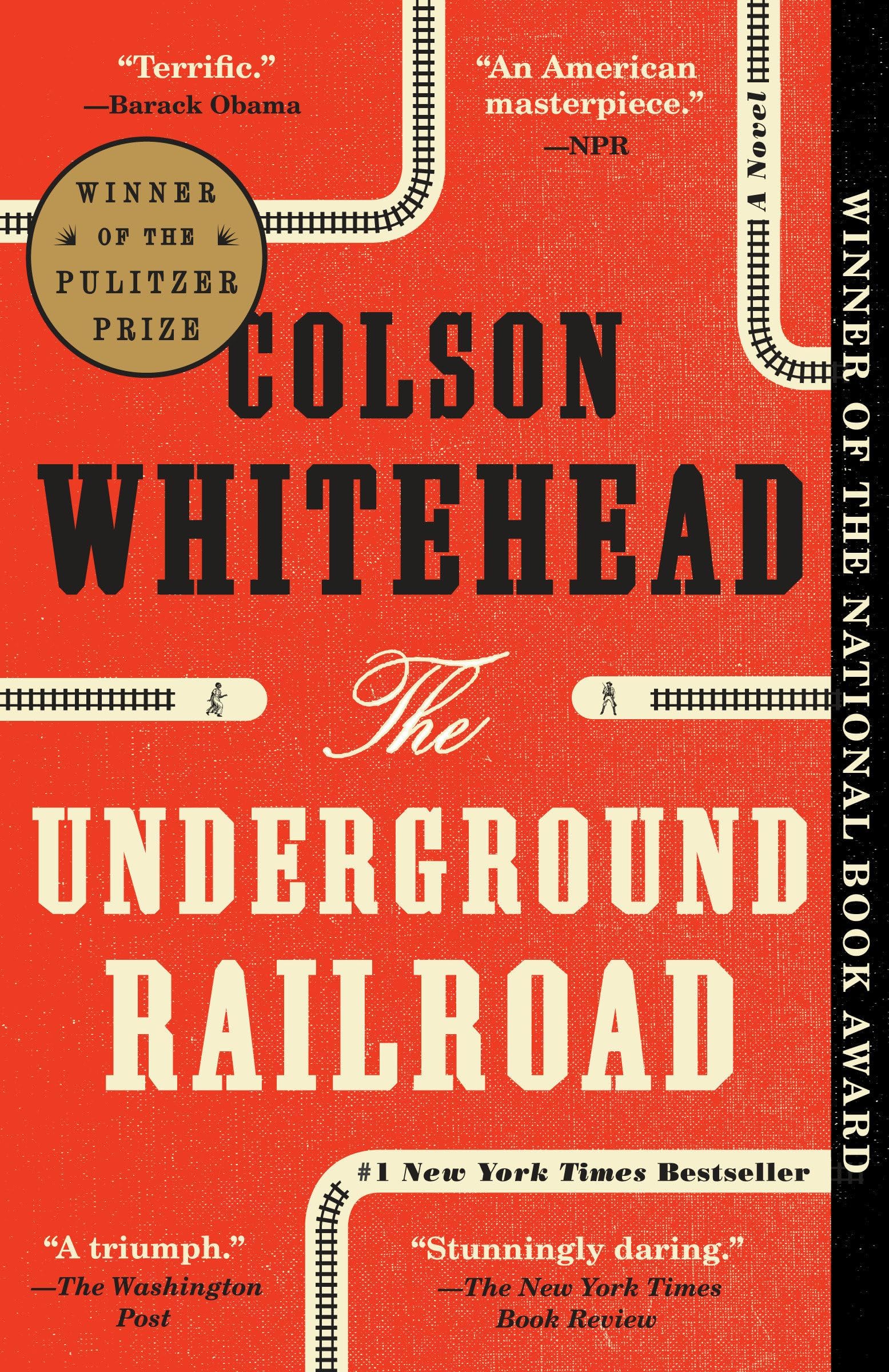
The Underground Railroad (Pulitzer Prize Winner): A Novel
Product ID: 56816026
Buy anything from 5,000+ international stores. One checkout price. No surprise fees. Join 2M+ shoppers on Desertcart.
Desertcart purchases this item on your behalf and handles shipping, customs, and support to Vanuatu.
desertcart.com: The Underground Railroad: A Novel: 9780345804327: Whitehead, Colson: Books Review: Fantastical and Heart-Wrenching - The Underground Railroad by Colsom Whitehead is a thrilling rendition of a young black girl named Cora’s escape from slavery on a Georgia Plantation by using a literal underground railroad system. Cora’s journey includes every experience an escaped slave could encounter, such as a wild capture by the slave hunter, Ridgeway, who holds a grudge against her mother. She sees and experiences the harsh realities of white supremacy at every station and comes to her own conclusions on the meaning of freedom and how to achieve it. Furthermore, through various backstories, Whitehead illustrates the discourse between warring ideologies of the antebellum south that led to the Civil War and abolitionist movement. This book was very thought-provoking on the power that groups of people have over one another, and how ideologies can be so pervasive as to cloud out rationality in a crowd-mentality. Though there were not characters that I could personally identify with in this novel, it is still quite emotional and gut-wrenching to read about some of the realities that black people had to experience and how hard they had to fight to be heard. This novel touches on topics like politics and race discussion that is still pertinent in the modern era, where racism and bigotry can still make a come-back. Cora’s plight is very compelling and keeps your attention, waiting to see what the conclusion of the story will be. This is a section of American history that, while formative, is nothing to be proud of and is not covered enough in public schooling. It is startling how Whitehead makes the story so fantastical, but also very real. I will most certainly be recommending this book to a few people. If you’re interested in emotionally charged historical fiction, then this is the perfect story for you. “The world may be mean, but people don't have to be, not if they refuse.” ― Colson Whitehead, The Underground Railroad Review: A fine book all in all - The Underground Railroad – Colson Whitehead The most compelling part of Colson Whitehead’s The Underground Railroad is the discussion of survival of a beautiful mind through terrible adversity. Cora’s matter-of-fact description of the trials she suffers—histrionics would do no good—and her understanding that to survive is to win against the forces of darkness is a commentary of the brutality of slavery no screed could better. I am an old white male. Slavery has always been a repulsive condition … but a “condition.” I can’t know how close Whitehead’s imagined reality is to the individual human reality of keeping hope alive when there is no reason to, but Cora has put a human face on the horrible condition I have imagined since childhood. The writing is economical, clear and sometimes just beautiful. The villain is as much cotton—“an engine that did not stop, its hungry boiler fed with blood”—as it is the enslavers and the Ridgeways. Colson says, “At the auction block they tallied the souls purchased at each auction, and on the plantations the overseers preserved the names of workers in rows of tight cursive. Every name an asset, breathing capital, profit made flesh. The peculiar institution made Cora into a maker of lists as well. In her inventory of loss people were not reduced to sums but multiplied by their kindnesses. People she had loved, people who had helped her.” A whole new take on the concept of human capital. There are aspects of the book that are either problems the writer and editors didn’t correct or are quite possibly an instance of a brilliant writer deciding to ignore the rules. In main line reviews, there is much mention made of the physical underground railroad. I found that helpful, because it loosed the bonds of history to remind me that the story is essentially science fiction. Tempting to call it historical fiction, but historical fiction almost always weaves fictional material around the true historical timeline. Whitehead did not do this, and it occasionally caused unnecessary trouble. I don’t think South Carolina had an especially paternalistic view of slaves and former slaves, but Colson’s imagining of it set the stage for what really happened at Tuskegee starting in the 1930’s. I’m sure there were some folks worried about an exploding Black population, but that seemed a weak pretext to base an (imaginary) doctrine on. But the railroad was always in the background, reminding us of the fictive basis of the novel. Other throwaway time disjunctures don’t work so well, e.g., Cora speaks of “the rags that made everyone happy.” While Joplin said the ‘ragged’ playing style had been around for a while, nobody called it ragtime until about 1895. So, why take our train of thought onto that side track when we are being regularly jolted between historical events, back and forward movement (e.g., Caesar’s backstory reappears for no particular reason ¾ through the book)? Also, there never was a credible reason Randall was so fixated on Cora, except to keep the indefatigable Ridgeway on her trail. Finally, I thought Whitehead was enslaved by his structure. Cora is pragmatic, always looking forward despite terrible loss. We don’t get inside her head to see her thoughts much, because to be true to his character must let her have her barricades against the outside world. I wish he’d let us in a bit more. Ah, well. The book is an often beautifully written, jumping, jarring, jolting ride very much like Cora’s ride under ground. A fine book all in all.


| Best Sellers Rank | #2,658 in Books ( See Top 100 in Books ) #8 in Black & African American Historical Fiction (Books) #266 in Literary Fiction (Books) |
| Customer Reviews | 4.4 4.4 out of 5 stars (70,127) |
| Dimensions | 5.18 x 0.74 x 7.96 inches |
| Edition | Reprint |
| ISBN-10 | 0345804325 |
| ISBN-13 | 978-0345804327 |
| Item Weight | 2.31 pounds |
| Language | English |
| Print length | 336 pages |
| Publication date | January 30, 2016 |
| Publisher | Vintage |
K**E
Fantastical and Heart-Wrenching
The Underground Railroad by Colsom Whitehead is a thrilling rendition of a young black girl named Cora’s escape from slavery on a Georgia Plantation by using a literal underground railroad system. Cora’s journey includes every experience an escaped slave could encounter, such as a wild capture by the slave hunter, Ridgeway, who holds a grudge against her mother. She sees and experiences the harsh realities of white supremacy at every station and comes to her own conclusions on the meaning of freedom and how to achieve it. Furthermore, through various backstories, Whitehead illustrates the discourse between warring ideologies of the antebellum south that led to the Civil War and abolitionist movement. This book was very thought-provoking on the power that groups of people have over one another, and how ideologies can be so pervasive as to cloud out rationality in a crowd-mentality. Though there were not characters that I could personally identify with in this novel, it is still quite emotional and gut-wrenching to read about some of the realities that black people had to experience and how hard they had to fight to be heard. This novel touches on topics like politics and race discussion that is still pertinent in the modern era, where racism and bigotry can still make a come-back. Cora’s plight is very compelling and keeps your attention, waiting to see what the conclusion of the story will be. This is a section of American history that, while formative, is nothing to be proud of and is not covered enough in public schooling. It is startling how Whitehead makes the story so fantastical, but also very real. I will most certainly be recommending this book to a few people. If you’re interested in emotionally charged historical fiction, then this is the perfect story for you. “The world may be mean, but people don't have to be, not if they refuse.” ― Colson Whitehead, The Underground Railroad
J**S
A fine book all in all
The Underground Railroad – Colson Whitehead The most compelling part of Colson Whitehead’s The Underground Railroad is the discussion of survival of a beautiful mind through terrible adversity. Cora’s matter-of-fact description of the trials she suffers—histrionics would do no good—and her understanding that to survive is to win against the forces of darkness is a commentary of the brutality of slavery no screed could better. I am an old white male. Slavery has always been a repulsive condition … but a “condition.” I can’t know how close Whitehead’s imagined reality is to the individual human reality of keeping hope alive when there is no reason to, but Cora has put a human face on the horrible condition I have imagined since childhood. The writing is economical, clear and sometimes just beautiful. The villain is as much cotton—“an engine that did not stop, its hungry boiler fed with blood”—as it is the enslavers and the Ridgeways. Colson says, “At the auction block they tallied the souls purchased at each auction, and on the plantations the overseers preserved the names of workers in rows of tight cursive. Every name an asset, breathing capital, profit made flesh. The peculiar institution made Cora into a maker of lists as well. In her inventory of loss people were not reduced to sums but multiplied by their kindnesses. People she had loved, people who had helped her.” A whole new take on the concept of human capital. There are aspects of the book that are either problems the writer and editors didn’t correct or are quite possibly an instance of a brilliant writer deciding to ignore the rules. In main line reviews, there is much mention made of the physical underground railroad. I found that helpful, because it loosed the bonds of history to remind me that the story is essentially science fiction. Tempting to call it historical fiction, but historical fiction almost always weaves fictional material around the true historical timeline. Whitehead did not do this, and it occasionally caused unnecessary trouble. I don’t think South Carolina had an especially paternalistic view of slaves and former slaves, but Colson’s imagining of it set the stage for what really happened at Tuskegee starting in the 1930’s. I’m sure there were some folks worried about an exploding Black population, but that seemed a weak pretext to base an (imaginary) doctrine on. But the railroad was always in the background, reminding us of the fictive basis of the novel. Other throwaway time disjunctures don’t work so well, e.g., Cora speaks of “the rags that made everyone happy.” While Joplin said the ‘ragged’ playing style had been around for a while, nobody called it ragtime until about 1895. So, why take our train of thought onto that side track when we are being regularly jolted between historical events, back and forward movement (e.g., Caesar’s backstory reappears for no particular reason ¾ through the book)? Also, there never was a credible reason Randall was so fixated on Cora, except to keep the indefatigable Ridgeway on her trail. Finally, I thought Whitehead was enslaved by his structure. Cora is pragmatic, always looking forward despite terrible loss. We don’t get inside her head to see her thoughts much, because to be true to his character must let her have her barricades against the outside world. I wish he’d let us in a bit more. Ah, well. The book is an often beautifully written, jumping, jarring, jolting ride very much like Cora’s ride under ground. A fine book all in all.
F**A
Il y a tout d’abord la métaphore. L’underground railroad, le chemin de fer clandestin, ce réseau de routes clandestines utilisé en Amérique du Nord par les esclaves pour rejoindre les états abolitionistes et gagner la liberté. Il n’y eut jamais ni chemin de fer ni tunnel, mais dans son roman Underground Railroad, Colson Whitehead lui donne existence. Il y a ensuite les stations qui s’ouvrent à des espaces et des temps imaginés, bousculant la précision historique. Il y a encore les allégories. Milieu du XIXe siècle, Géorgie. Nous sommes avant la Guerre de Sécession (1861-1865) et l’Amérique du Nord est encore divisée par la ligne Mason-Dixon qui sépare les états abolitionnistes du Nord des états esclavagistes du Sud. Cora est une jeune femme de seize ans, esclave dans une plantation de Géorgie. Sa grand-mère, Ajarry, a été amenée ici à bord d’un des navires négriers. Sa mère, Mabel, l’a abandonnée pour s’enfuir et contrairement à de nombreux autres esclaves qui ont tenté de trouver la liberté, n’a jamais été reprise. Terrence Randall, le propriétaire de la plantation, est particulièrement sadique. Cora, à son tour, s’enfuit, avec l’aide de l’Underground Railroad, ses conducteurs, et ses gardiens de station. Mais elle est poursuivie par Ridgeway, le chasseur d’esclaves ayant échoué à retrouver sa mère et qui cette fois a juré de ramener Cora à la plantation. Le parcours de Cora l’amènera à traverser plusieurs états américains qui, dans la construction imaginaire de Colson Whitehead, illustrent chacun à leur tour un modèle social et politique de traitement de l’esclave. Certains exercent une violence ouverte et institutionnalisée envers les Noirs, esclaves échappés ou hommes libres ; d’autres offrent ce qui s’apparente à un asile mais cachent sous des atours idylliques une réalité bien plus violente et sombre que la surface ne le laisse présager. Le roman s’organise en onze chapitres qui alternent portrait d’un personnage et portrait d’un état, une des stations empruntées par Cora dans sa fuite : Ajarry, Géorgie, Ridgeway, Caroline du Sud, Stevens, Caroline du Nord, Ethel, Tennessee, Caesar, Indiana, Mabel. Colson Whitehead s’appuie sur des réalités historiques mais brouille le temps et l’espace pour mieux en extraire la continuité des maux et étendre la question de l’esclave et de ses conséquences à l’époque moderne. Pour vous expliquer cela, je vais utiliser l’exemple de la Caroline du Sud, première étape de la fuite de Cora après la Géorgie. Cora ne s’appelle plus Cora, mais Bessie. (Cora est un personnage universel. En étant attentif, on croisera aussi une évocation d’Anne Frank…) Elle et son compagnon Caesar ont trouvé refuge dans cet état qui offre la protection du gouvernement aux esclaves fugitifs. La ville symbolise la modernité, notamment à travers le Griffin Building, à la fois hôpital et administration. Immeuble de douze étages, il possède un ascenseur. Le lecteur devine alors que nous avons effectué un saut dans le temps. Le premier ascenseur utilisé aux Etats-Unis le fut à New York, dans le Equitable Life Building construit en 1870, soit des années après la fin de la guerre de sécession. Cora/Bessie va découvrir l’envers du décor et les sombres desseins d’un gouvernement dont elle est devenue la propriété. Colson Whitehead parle du programme de stérilisation forcé qui a eu court au début du XXe siècle, ou encore de l’étude de Tuskegee sur la syphilis entre 1932 et 1972. Continuité des maux. Le récit saute ainsi, dans l’espace et le temps. Chaque nouvelle station apporte ses espoirs, ses horreurs et ses symboles, comme autant d’univers parallèles. L’un des puissants symboles du livre est le « Freedom trail », cette route bordée d’arbres qui accrochent à leurs branches les corps mutilés des hommes, femmes, enfants noirs assassinés dans un état, la Caroline du Nord, qui a aboli l’esclavage, mais a aussi aboli les noirs. Lieu d’horreur quasi mystique qui semble n’avoir ni début ni fin, le Freedom Trail symbolise à la fois la violence sans fin exercée sur les Noirs américains et le parcours de Cora vers la liberté parsemé de morts. Underground Railroad est un livre dur qui ne fait l’impasse sur aucune forme de violence, de la torture aux violences sexuelles, en passant bien sûr par le meurtre pur et simple. Mais la plus grande violence montrée par Colson Whitehead est celle qui ne guérit jamais : la déshumanisation. L’esclavage est montré comme un système économique. Le corps de l’esclave possède une valeur marchande. La grand-mère de Cora, Ajarry dont l’histoire ouvre le roman, est vendue et revendue plusieurs fois avant même d’arriver sur le continent américain. Les corps des esclaves morts sont vendus par des trafiquants de cadavres pour des expérimentations médicales. Cora travaille comme exposition vivante dans un musée sur l’histoire américaine alors même que les blancs sont représentés par des mannequins. Ridgeway, le chasseur d’esclaves, calcule la pertinence de ramener un esclave ou le tuer en fonction du profit réalisé face aux dépenses engagées. L’esclave n’est toujours qu’une marchandise, un objet, jamais un être humain. Le 26 juillet dernier, le sénateur républicain de l’Arkansas, Tom Cotton (ce nom ne s’invente pas), décrivait l’esclavage comme « un mal nécessaire » au développement économique du pays. Continuité des maux. Colson Whitehead use de l’imaginaire pour construire une histoire de l’Amérique noire et du mensonge que constitue à ses yeux ce pays. Il bat en brèche le mythe de la déclaration d’indépendance perpétuant la légende d’un pays dans lequel les hommes ont été créés libres et égaux en y opposant l’histoire des Indiens d’Amérique et des esclaves africains, des terres volées et des vies volées. Il porte son roman par une écriture puissante, réaliste et directe, qui ne joue jamais des artifices du pathos, mais qui pourtant ne s’éloigne jamais non plus du sujet et des personnages. Il vous laisse vous débrouiller avec vos sentiments, sans vous indiquer là où il faut rire, là où il faut pleurer. (Spoiler : il n’y a pas beaucoup d’occasion de rire.) Underground Railroad est un livre absolument remarquable. Une des meilleures lectures de l’année en ce qui me concerne.
N**T
This is one book that would leave an imprint in your mind for years to come. You cannot just breeze through the chapters like any other book. The feeling settles in your heart and mind as you understand the pain and suffering of African Americans at the hands of whites in the eighteen century . I went through the chapters forever and have gone past only 100 pages in 30 days. Buy this book if you love the craft of writing and want to be mesmerized by the story of slaves and their perpetrators. COLSON whitehead is at the top of his game,three cheers to him for all the accolades he has garnered for this gem of a book.
S**O
Storia ben scritta e trama avvincente ed emozionante. Segnalo anche che esiste una mini serie tv. Sicuramente ne consiglio l' acquisto e la lettura.
J**E
This is a reading which leads one to a kind of breathlessness - bereft of words to convey the utter horror of how it was to have been a slave in the New World of the American colonies/post-War of Independence world. How ugly can one variety of pale-pinkish-hued humans be to others of darker skin! Twelve Years a Slave - both book and movie - gave some inkling - while the original and the latest versions of Roots tell other aspects. And with the rise of Trump and his racist misogynistic appointees the fear is legitimately abroad again that the move to Canada is not merely a comfortable metaphor - but quite possibly the only sensible railway journey for people to take. My great x 3 grand-mother was sentenced to being hanged - then commuted to transportation to the American colonies as an indentured servant from her court appearance at the Spring Assizes in Thetford (Tom Paine's hometown - he the author of The Rights of Man -and triple citizen - of England, of Revolutionary France - and of the US). She had stolen quite a list of things - silver cutlery and linen items - from her butcher employer Jabez TAYLOR. She was then 19. I can't know for sure but I think I can hazard an intelligent guess that her Master - Jabez TAYLOR - was not keeping his hands nor his passions - unwanted - to himself. As it happened my great X 3 grand-mother did not head to the American colonies - nor the tall young man of almost exactly the same age in the same prison with similar sentence. They became part of the complement known in Australian history as The First Fleet which was the basis of the British invasion of the land where I was born - a direct line of paternal descent from that 1788 arrival in New South Wales. Exiled. My wife and I were in Georgia earlier this year - in Savannah. We visited several places important in the Black Civil Rights movement in that city - The Beach Institute and the Ralph Mark Gilbert Civil Rights Museum - on MLK Jr Boulevard. Moving stories and exhibits. Thank-you for this powerful and soul-searing evocation of the cruelty and capriciousness of the plantation and other forms of the slavery system. Black Lives Matter - more than ever!
M**H
A very good read - had me enthralled
Trustpilot
2 weeks ago
1 day ago