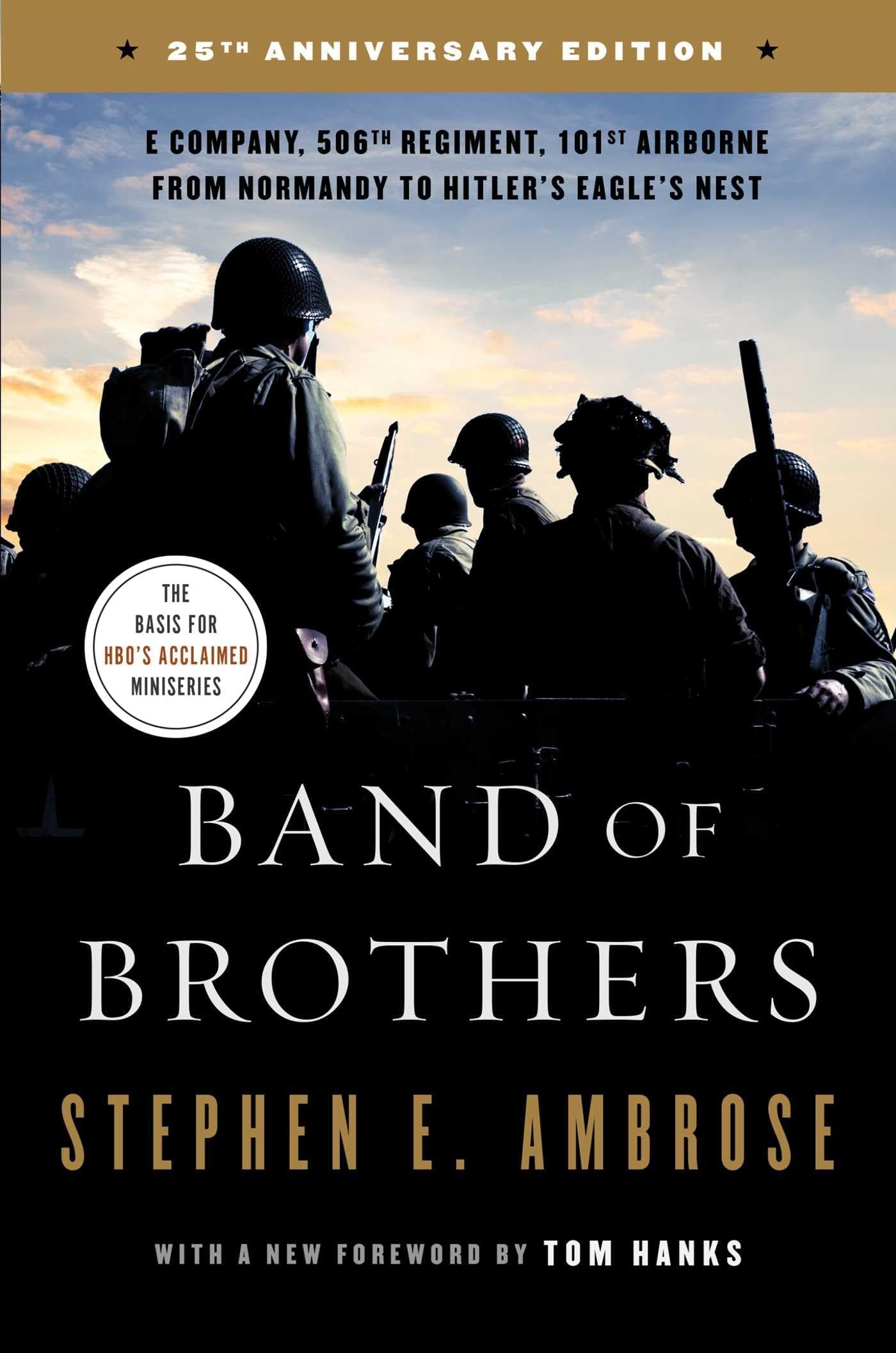
- Band of Brothers: E Company, 506th Regiment, 101st Airborne from Normandy to Hitler's Eagle's Nest
Product ID: 60825956
Buy anything from 5,000+ international stores. One checkout price. No surprise fees. Join 2M+ shoppers on Desertcart.
Desertcart purchases this item on your behalf and handles shipping, customs, and support to Vanuatu.
Stephen E. Ambrose’s classic New York Times bestseller and inspiration for the acclaimed HBO series about Easy Company, the ordinary men who became the World War II’s most extraordinary soldiers at the frontlines of the war's most critical moments. Featuring a foreword from Tom Hanks. They came together, citizen soldiers, in the summer of 1942, drawn to Airborne by the $50 monthly bonus and a desire to be better than the other guy. And at its peak—in Holland and the Ardennes—Easy Company was as good a rifle company as any in the world. From the rigorous training in Georgia in 1942 to the disbanding in 1945, Stephen E. Ambrose tells the story of this remarkable company. In combat, the reward for a job well done is the next tough assignment, and as they advanced through Europe, the men of Easy kept getting the tough assignments. They parachuted into France early D-Day morning and knocked out a battery of four 105 mm cannon looking down Utah Beach; they parachuted into Holland during the Arnhem campaign; they were the Battered Bastards of the Bastion of Bastogne, brought in to hold the line, although surrounded, in the Battle of the Bulge; and then they spearheaded the counteroffensive. Finally, they captured Hitler's Bavarian outpost, his Eagle's Nest at Berchtesgaden. They were rough-and-ready guys, battered by the Depression, mistrustful and suspicious. They drank too much French wine, looted too many German cameras and watches, and fought too often with other GIs. But in training and combat they learned selflessness and found the closest brotherhood they ever knew. They discovered that in war, men who loved life would give their lives for them. This is the story of the men who fought, of the martinet they hated who trained them well, and of the captain they loved who led them. E Company was a company of men who went hungry, froze, and died for each other, a company that took 150 percent casualties, a company where the Purple Heart was not a medal—it was a badge of office. Review: Great Book - Excellent book very well written Review: A very revealing three-year personal journey through World War 2. - The TV mini-series “Band of Brothers” is the absolute best historical WW2 drama ever made and I never get tired of watching it. The TV mini-series is very good adaptation of the book, but the book BAND OF BROTHERS is still an interesting and informative read since it fills in the gap on events and subjects that the TV mini-series could not or barely covered. For example, the book addresses the “Why?” Why risk your life to collect souvenirs from enemy bodies? Why go AWOL from a hospital to return to your unit on the frontline? Why loot the homes of civilians? Why weren’t supplies (e.g., soap, cigarettes, beer, candy) not making its way to the front line? If you ever served in the military, you’ll recognize yourself and others in BAND OF BROTHERS; especially the officers. There are good officers, but it’s the bad officers that you never forget. Command leadership during wartime is difficult and unforgiving if an officer is not up to the task and does not have the respect of those under his command. BAND OF BROTHERS should be required reading at the military academies, ROTC classes, and OCS. The leadership of Major Dick Winters is what every officer should attempt to emulate. BAND OF BROTHERS is unique because it gives the readers an insider’s look at the formation, organization, training, operation, tactics, leadership, comradeship, etc. of a small combat unit from its inception to the end of the war. BAND OF BROTHERS takes the reader on a very revealing three-year personal journey through World War 2. The PTSD that these men went through after World War 2 changed them forever. Stephen Ambrose gives closure to the book by telling what happened 50 years later to those who returned home. BAND OF BROTHERS revealed to me that the movie “Saving Private Ryan” was based on Fritz Niland of the 101st Airborne Division who fought on D-Day. Niland’s two brothers died on D-Day and a third brother was presumed KIA in Burma (later found to be a POW). After the deaths of his brothers, Niland was ordered from combat and returned home.
| Best Sellers Rank | #2,409 in Books ( See Top 100 in Books ) #1 in Military Regiment History #1 in Military Aviation History (Books) #4 in World War II History (Books) |
| Customer Reviews | 4.8 out of 5 stars 15,503 Reviews |
A**R
Great Book
Excellent book very well written
L**E
A very revealing three-year personal journey through World War 2.
The TV mini-series “Band of Brothers” is the absolute best historical WW2 drama ever made and I never get tired of watching it. The TV mini-series is very good adaptation of the book, but the book BAND OF BROTHERS is still an interesting and informative read since it fills in the gap on events and subjects that the TV mini-series could not or barely covered. For example, the book addresses the “Why?” Why risk your life to collect souvenirs from enemy bodies? Why go AWOL from a hospital to return to your unit on the frontline? Why loot the homes of civilians? Why weren’t supplies (e.g., soap, cigarettes, beer, candy) not making its way to the front line? If you ever served in the military, you’ll recognize yourself and others in BAND OF BROTHERS; especially the officers. There are good officers, but it’s the bad officers that you never forget. Command leadership during wartime is difficult and unforgiving if an officer is not up to the task and does not have the respect of those under his command. BAND OF BROTHERS should be required reading at the military academies, ROTC classes, and OCS. The leadership of Major Dick Winters is what every officer should attempt to emulate. BAND OF BROTHERS is unique because it gives the readers an insider’s look at the formation, organization, training, operation, tactics, leadership, comradeship, etc. of a small combat unit from its inception to the end of the war. BAND OF BROTHERS takes the reader on a very revealing three-year personal journey through World War 2. The PTSD that these men went through after World War 2 changed them forever. Stephen Ambrose gives closure to the book by telling what happened 50 years later to those who returned home. BAND OF BROTHERS revealed to me that the movie “Saving Private Ryan” was based on Fritz Niland of the 101st Airborne Division who fought on D-Day. Niland’s two brothers died on D-Day and a third brother was presumed KIA in Burma (later found to be a POW). After the deaths of his brothers, Niland was ordered from combat and returned home.
D**N
Great book (but bad Kindle edition)
This is the book that HBO based their "Band of Brothers" mini-series on, and it was excellent. I had already seen the mini-series, which was also excellent, so I was in a position similar to times when you see the movie and then go read the book. If you never saw it or have no idea what I'm talking about, this is the story of the men of Easy company, a group of 150 soldiers from the 101st Airborne division in World War II. It follows them from their training in the US through D-Day, the Battle of the Bulge and their defense of Bastogne, on into Germany, and their victory lap at Hitler's very own Eagle's Nest. For the most part, they were not career military men. They were merely citizens who went off to war. As an aside, books get turned into movies all the time, and if you read the book first, you then decry how much they cut to squeeze it all into the 2-hour movie. If you see the movie first, the book is then filled with all this extra stuff like backstory, extra plot-lines, and character depth. But a book and a mini-series are a good fit. HBO gave it ten hour-long episodes and managed to cover most of the book, so while I wasn't coming across tons and tons of new material, there were still plenty of newfound gems. More than anything, it was like reading the director's commentary of the DVD, except of course, it wasn't the director. In many cases, it was direct quotes from many of the soldiers who had fought through the war. It also had a bit of surreal sense in that I felt like I already knew these people and had clear pictures of them in my mind. All in all, seeing the series before-hand made reading the book that much more enjoyable. One section that was in the book that the mini-series only glossed over was what these remarkable soldiers did with their lives after the war. A large number of them went into teaching, and another big bunch of them went into construction. That was a nice turn, seeing them go from a world of destruction and violence to a life of building the future. I'm going to quote one little bit from those later years that really made an impression on me. Private Ralph Stafford wrote, "In 1950, I went bird hunting with some guys from the fire department. I shot a bird and was remorseful as I looked down at it. The bird had done me no harm and couldn't have. I went to the truck and stayed until the others returned, never to hunt again." He had had enough of killing. It looks like a number of these soldiers went on to write and publish their own memoirs of the war, but this is the place to start. My only negative comment about the book was that the Kindle edition (which is what I read) was a terrible e-book conversion. There were some glitches that looked like lost words, bad text conversions like 2nd to 2d, and the index was a worthless list of topics not linked back to any location in the book. Bad Publisher - No Donut! So if you want to read this, get it in a dead-tree edition.
R**S
"There's Nothing To Get Excited About. The Situation Is Normal; We Are Surrounded."
Long ago I read World War Two history almost exclusively. Recently, I have largely moved to other interests, but I took the time to read "Band of Brothers" after seeing the superb miniseries and reading Dick Winters' autobiography "Beyond Band of Brothers." While I liked the Ambrose book, I found "Beyond Band of Brothers" by Winters himself far more compelling, interesting, and in several instances, better written. "Band of Brothers" chronicles E Company, 506 PIR from training in Georgia through the post-war period. The book is quite easy to read, even for those with no military training, and in that regard I think it's an enormous positive that this important story of American heroism under horrifying circumstances has been read by so many people who might not otherwise read military history. Military historians would, no doubt, appreciate a more rigorous (and necessarily longer) treatment of the engagements (which Winters provides in his book), but I still found it a worthwhile book on balance. The book does not take long to read, and the basic themes are easily grasped. I appreciate that Ambrose sought to single out a single Company to reveal longitudinally their progress through the war: too many books focus solely on a single engagement, leaving the reader to figure out how to fit the subject into the bigger picture. I never felt that way here, and it is one of the books best features. The actual prose in the book varies dramatically from sublime to "high school essay," with most of the book adequate. There are quite a few punctuation, grammatical, and spelling errors in the book, which I found surprising given the profile of the author. Ambrose also can't seem to figure out where he as the author fits in: sometimes he writes in first person, sometimes in third person, etc. Overall I got the feeling that the book was hastily written and edited, which Mr. Ambrose seems to refute in a concluding editorial passage contrasting this book to his earlier book "Pegasus Bridge." I recommend this book, especially to those who have seen the miniseries (which I explicitly endorse), although if I could only choose one book on the subject, I would unhesitatingly select "Beyond Band of Brothers" by Major Dick Winters.
L**B
Good book
As described.
D**L
History Up Close and Personal
What happens if you throw a diverse group of young men together, give them all guns, make them run their butts off for a year or so and learn to shoot said guns and work as a team, then drop them out of airplanes over Hitler's Europe and tell them to start shooting bad guys? Stephen Ambrose tells the remarkable true story of E Company, just such a group of guinea pigs. E Company fought with distinction at Normany and in Holland, plugged a key gap in the Battle of the Bulge, and was in on the rather haphazard, MASHian ramsacking of the remains of Hitler's little paradise in the Bavarian clouds. The heart and soul of E Company was Dick Winters, a soft-spoken, teatotalling (NOT the norm) and kindly CO who works his way up to major by war's end, and who had the occasional Seargent York / Incredible Hulk moments, when Germans fall to the dozen. But after Winters has been promoted out of (much) direct action, Ambrose's spotlight falls more commonly upon the NCOs who provide the backbone of the company from the Battle of the Bulge on. Ambrose sugar-coats nothing: he relates acts of cruelty, drunken folly (too many to count), random acts of fate, and sheer stupidity, injustice, corruption (the front-line troops were robbed blind, and they robbed the locals), and incompetence. Though I have to say, Winters is the only character who really comes alive for me, along with a young writer from Harvard who refuses to be promoted, but does his job and writes competently about what he sees. (I think Ambrose exagerates his talent a bit, but that's fine -- he was at the right place at the right time with a competent pen, that's good enough.) Also Lieutenant Sobel, the hard-case CO against whom the troops rebel, and who gets left behind in England, and grows bitter. The others have their moments on stage, exit left, and are gone. By the end of the book, it's a bit hard to keep track. One comes to realize that with its high casualty and replacement rate, Company E has pretty much replaced all its original cells and we're talking about a new group of men almost entirely. Ambrose was not, in my opinion, a great styllist. I was reading Tom Wolfe's The Right Stuff at the same time I read this, and there is no comparison. Wolfe is truly brilliant. What Ambrose succeeds at most remarkably, is his act of historical reconstruction. This book involved interviewing survivors of E Company on or about 1990, some 45+ years after the fact, along with relentless gathering, reading, and sifting of written reports. As an historian of religion, I found the undeniable success of Ambrose's methodology particularly interesting. Some skeptics claim that the human memory is too frail a reed, too unreliable and suggestible, for historical reports written decades after the fact to be trustworthy. I think Ambrose shows them wrong. Given that the gospels were written under somewhat similiar circumstances -- 35-60 years after the fact, based apparently on the eyewitness testimony of many once young men (mostly) who had traveled together for a few years and experienced and witnessed traumatic and remarkable events -- I think Ambrose's success (despite occasionally contradictory sources) should give those skeptics pause. Read the book, and experience World War II from the front lines, as it was really fought. (Without needing to sleep in frozen foxholes with artillery rounds blowing up trees over your head.) Highly recommended. (Along with Tom Wolfe's The Right Stuff.)
T**N
Great and informative read!
I watched the Band of Brothers mini-series a little while after it came and long before I read this book. I have never known very much about either World War I or II but still found this series interesting and entertaining, although much of it I did not understand. After reading through the book however, I now have a much deeper understanding and appreciation for what those soldiers did to protect our freedom. Band of Brothers tells the very true story of Easy Company from the 506th PIR in World War II. It begins with Easy Company's formation at Camp Toccoa and goes through the end of the war and the company's disbanding. There are many personalities of the men in this company. Most were the normal soldier type, very aggressive in most situations and some were pure cowards. Richard Winters is definitely the one I looked at the most, he was not the normal soldier type as he very rarely drank and kept his mind focused on the war. He is one the biggest reasons why Easy Company made it through their campaign. I learned many things, from what it was like to live like a soldier during war to the ranking system used. The army is all about abbreviation and I never understood most of that until I read this book. It has many entries from the journals of the soldiers, describing a certain thing they were doing or how they felt during a situation. The author put it together very well and has a very profound interest of this type of history. Some scenes will make you laugh and some will make you sad, others might even make you a little disgusted. Joining the army during World War II seemed to be the most popular thing for men over 20 and they became hardened very quickly as they made the transition to the life of the soldier. Easy's basic training experience was much different from most other company's, for one thing they were some of the first paratroopers and they had quite a Sergeant in Sobel. Altogether it is a fantastic read, whether you are a war history buff or know nothing about it. It helps you to feel like you are watching it as it happens and shows you exactly what went on to protect our country and the world from the nazis.
L**Y
Amazing Book
"Band of Brothers" by Stephen E. Ambrose is an absolutely amazing book that deserves all the praise it has received. The story of Easy Company, a group of soldiers who fought in World War II, is both heart-wrenching and uplifting. Ambrose does an excellent job of bringing the soldiers to life and weaving their personal stories into the larger narrative of the war. The writing is engaging and the historical detail is impeccable. One of the things that sets "Band of Brothers" apart from other WWII histories is the way it manages to humanize the soldiers of Easy Company. These men are not just faceless soldiers, but fully realized characters with their own hopes, fears, and flaws. The camaraderie and bond that develops between them is palpable and makes their triumphs and tragedies all the more poignant. Additionally, Ambrose does an excellent job of putting the events of the war into context and explaining the larger strategic decisions being made by the Allied powers. This helps to give a more complete understanding of the war and how it impacted the soldiers of Easy Company. Overall, "Band of Brothers" is a must-read for anyone with an interest in WWII or military history. It is a powerful and moving tribute to the men of Easy Company and their service to their country, and I would give it a full 5 stars without hesitation.
T**D
Buy the book and watch the TV
An incredible book that goes well with the TV series. It is difficult to get your head around how brave Easy Company, and many others, were in WW2. Would governments now be able to get tens of thousands of eighteen and nineteen year old young men to parachute behinds enemy lines, and storm beaches under heavy fire? Easy Company no doubt were not the only company to display such skill and bravery but their story is told so well it is very difficult to put down. I have seen the TV series twice and found the book (which I am reading again) complements the TV filling out details. Strongly recommended.
H**N
Geniales Buch - Empfehlung!
Dieses Buch ist die Vorlage zur gleichnamigen HBO Miniserie von T. Hanks und S. Spielberg. Natürlich habe ich erst die Miniserie gesehen und bin dann auf das Buch gestossen. Obwohl der Film grossartig ist, vermittelt das Buch tiefere Infos und Eindrücke zu den 3 Jahren der Easy in Europa. Grandios recherchiert, super geschrieben und ist interessant. Verglichen mit dem Buch von Dick Winters liest sich dieses Buch super und mehr Infos zur Easy und dem Geschehen habe ich nicht finden können. Stephen Ambrose glorifiziert die Taten der Easy nicht, er bringt die Fakten und jeder Leser kann sich selber ein Bild machen. Gelungen sind auch die historischen Vergleiche und die Frage, warum wir Kriege führen. Dieses Buch ist zu sehr zu empfehlen, auch wenn man den Film gesehen hat.
C**A
Hele mooie toevoeging aan de tv serie
De tv serie is een aanrader en heb ik vaak herkeken, dit boek is daarnaast ook een grote aanrader voor iedereen die meer wil weten over de tweede wereldoorlog, de soldaten die erin gevochten hebben en wat voor impact dit op hen heeft gehad. Het leest goed weg en geeft nog meer diepgang aan de serie.
R**Y
a great read
Stephen E. Ambrose's "Band of Brothers" is a remarkable and gripping account of the brave men who served in Easy Company, 506th Regiment, 101st Airborne Division during World War II. This book, which served as the basis for the acclaimed miniseries of the same name, immerses readers in the harrowing and heroic experiences of these soldiers, forging a deep connection between the reader and the men who fought on the front lines. Ambrose's narrative prowess is evident from the very first page. He expertly weaves together personal accounts, interviews, letters, and historical records to create a vivid and heart-wrenching portrait of the men of Easy Company. Through his meticulous research and storytelling, Ambrose breathes life into these soldiers, making them feel like friends and comrades. The heart of the book lies in its exploration of the camaraderie and brotherhood that developed among these men. From their rigorous training at Camp Toccoa to the D-Day landings in Normandy, the brutal Battle of the Bulge, and the eventual capture of Hitler's Eagle's Nest in Bavaria, readers witness the unbreakable bonds formed under the most extreme conditions. The characters become more than just soldiers; they become heroes whose sacrifices and triumphs leave an indelible mark on the reader's soul. What sets "Band of Brothers" apart is its unflinching portrayal of the horrors of war. Ambrose doesn't romanticize combat but instead presents it with raw honesty. The vivid descriptions of battles, the physical and emotional toll on the soldiers, and the devastating losses they endured are portrayed with heart-wrenching clarity. This realism makes the moments of bravery and valor all the more powerful.
O**Z
Great tribute to great men!
Such a good book! Much better than the show.
Trustpilot
3 weeks ago
2 months ago