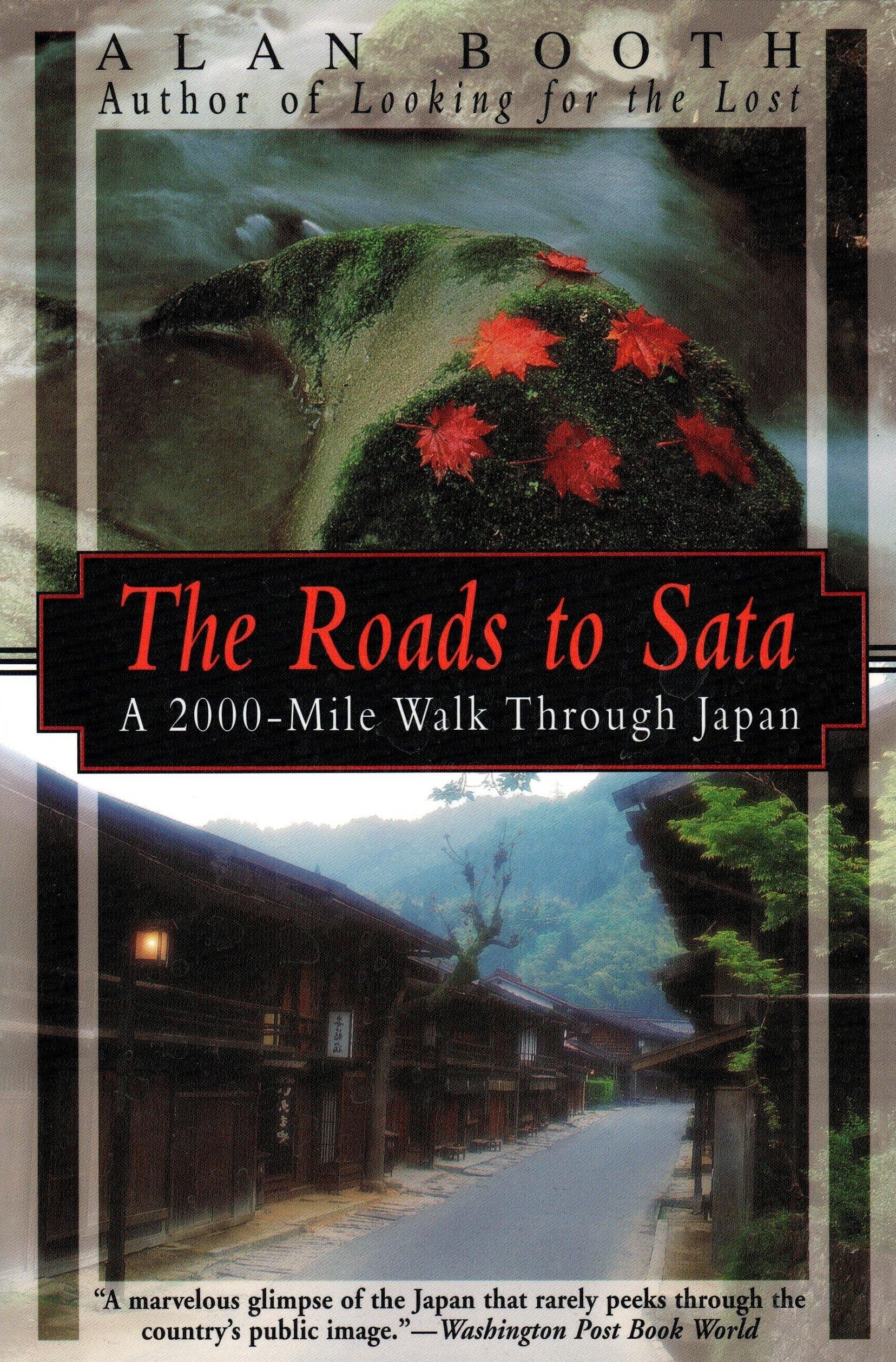
The Roads to Sata: A 2000-Mile Walk Through Japan
Product ID: 6427859
Buy anything from 5,000+ international stores. One checkout price. No surprise fees. Join 2M+ shoppers on Desertcart.
Desertcart purchases this item on your behalf and handles shipping, customs, and support to Vanuatu.
The Roads to Sata: A 2000-Mile Walk Through Japan [Booth, Alan] on desertcart.com. *FREE* shipping on qualifying offers. The Roads to Sata: A 2000-Mile Walk Through Japan Review: Inspirational... - Alan Booth walked the entire way, alone, from Cape Soya, on the far northern tip of the island of Hokkaido, to Cape Sata, as the title states, at the far southern end of the island of Kyushu. The subtitle states that it was a 2000-mile walk but he kept track of it in the local (and global) measure of kilometers, and felt it was a bit more, at 3,300 km. He therefore walked across three of the main Japanese islands (which included the main one of Honshu); he did not cross the fourth main island, Shikoku. It took him 128 days; he timed it right in terms of weather, starting in June in Hokkaido, with some snow still on the peaks, and ending in the October, as the leaves were turning, and it was becoming colder, in Kyushu. He never states the year; one reviewer suggest 1977, another, the early `80's. Clearly it was before 1986, when the book was first published. It is a marvelous guide for non-Japanese on what to expect in the rural areas of Japan. Most certainly, he is "off the beaten track," never traveling through Tokyo or Kyoto. It is also about Japan, not Alan Booth "finding himself." Knowledge about the author comes in bits and pieces, almost incidentally. He was in theater, and moved to Japan in 1970. He married a Japanese woman, and does speak the language (despite what some natives think!). Like a good Englishman, he drinks beer, and the references to this vital "foot gasoline," as he says, are frequent. He never once mentions drinking water! Almost always, he stays in one of the local inns, called "ryokans"; generally, it is possible to walk from one village to another, all of which seem to have them. He is offered numerous rides, in automobiles, which he always declines, usually to the amazement (and sometimes the anger) of the driver. He commences his book by saying that it is absurd to try to make sweeping generalizations about 120 million people. His meetings are the chance encounters of the road, generally quite brief. They are a wide spectrum, the good and the bad, but in general he does experience "the kindness of strangers," particularly towards foreigners, though he makes the exception for young boys, who tend to jeer at him, and wishes for more encounters with young girls, who are invariably polite. He has a wry sense of humor, most often conveyed when he tells anecdotes involving speaking Japanese with someone for 5-10 minutes, and yet they are still reluctant to let him stay in their ryokan, because he does not speak Japanese, and, of course, could not eat with chopsticks! "What was I speaking, Swahili"? Booth does "nuance." There are many "Japans." For example: "Crossing from Niigata to Toyama had reminded me a little of crossing from Yugoslavia to Austria: from a land of calloused laborers to one where slightly obese people consume cream pastries and have safe-deposit boxes in air-conditioned banks." Ever observant, he highlights some of the cultural differences; consider: "....I couldn't help noticing how different was the determinedly sanctimonious atmosphere that pervades most Christian churches from the breezy nonchalance with which visitors treat the religious monuments of Japan." Generalizations, there are a few: "And then the litany began: tiny country, no natural resources, misunderstood by everyone..." Booth even has observations about one of the classic divides between men and women: Why men don't ask directions! And the answer is: more often than not, the person questioned doesn't know, or gives the wrong directions! Booth left us far too soon, dying of colon cancer, in his 40's. In his legacy he has also left us Looking for the Lost: Journeys Through a Vanishing Japan (Kodansha Globe) which I intend to read. I envy his journey, and loved the way that he told the story. With his inspiration, perhaps I can emulate 7-day segments, with a few being in the national parks. 5-stars, plus. Review: An insightful look at Japan - This book is an insightful look at Japan away from the big cities. It is interesting because the British author speaks japanese fluently and reads it as well and so can go undercover to hear what ordinary folk really think of the foreigners wandering through their towns
| Best Sellers Rank | #1,884,888 in Books ( See Top 100 in Books ) #88 in General Japan Travel Guides #223 in Travelogues & Travel Essays #1,867 in Geography (Books) |
| Customer Reviews | 4.4 4.4 out of 5 stars (288) |
| Dimensions | 5.64 x 0.76 x 8.41 inches |
| Edition | Reprint |
| ISBN-10 | 1568361874 |
| ISBN-13 | 978-1568361871 |
| Item Weight | 14.4 ounces |
| Language | English |
| Print length | 302 pages |
| Publication date | August 14, 1997 |
| Publisher | Kodansha Globe |
J**I
Inspirational...
Alan Booth walked the entire way, alone, from Cape Soya, on the far northern tip of the island of Hokkaido, to Cape Sata, as the title states, at the far southern end of the island of Kyushu. The subtitle states that it was a 2000-mile walk but he kept track of it in the local (and global) measure of kilometers, and felt it was a bit more, at 3,300 km. He therefore walked across three of the main Japanese islands (which included the main one of Honshu); he did not cross the fourth main island, Shikoku. It took him 128 days; he timed it right in terms of weather, starting in June in Hokkaido, with some snow still on the peaks, and ending in the October, as the leaves were turning, and it was becoming colder, in Kyushu. He never states the year; one reviewer suggest 1977, another, the early `80's. Clearly it was before 1986, when the book was first published. It is a marvelous guide for non-Japanese on what to expect in the rural areas of Japan. Most certainly, he is "off the beaten track," never traveling through Tokyo or Kyoto. It is also about Japan, not Alan Booth "finding himself." Knowledge about the author comes in bits and pieces, almost incidentally. He was in theater, and moved to Japan in 1970. He married a Japanese woman, and does speak the language (despite what some natives think!). Like a good Englishman, he drinks beer, and the references to this vital "foot gasoline," as he says, are frequent. He never once mentions drinking water! Almost always, he stays in one of the local inns, called "ryokans"; generally, it is possible to walk from one village to another, all of which seem to have them. He is offered numerous rides, in automobiles, which he always declines, usually to the amazement (and sometimes the anger) of the driver. He commences his book by saying that it is absurd to try to make sweeping generalizations about 120 million people. His meetings are the chance encounters of the road, generally quite brief. They are a wide spectrum, the good and the bad, but in general he does experience "the kindness of strangers," particularly towards foreigners, though he makes the exception for young boys, who tend to jeer at him, and wishes for more encounters with young girls, who are invariably polite. He has a wry sense of humor, most often conveyed when he tells anecdotes involving speaking Japanese with someone for 5-10 minutes, and yet they are still reluctant to let him stay in their ryokan, because he does not speak Japanese, and, of course, could not eat with chopsticks! "What was I speaking, Swahili"? Booth does "nuance." There are many "Japans." For example: "Crossing from Niigata to Toyama had reminded me a little of crossing from Yugoslavia to Austria: from a land of calloused laborers to one where slightly obese people consume cream pastries and have safe-deposit boxes in air-conditioned banks." Ever observant, he highlights some of the cultural differences; consider: "....I couldn't help noticing how different was the determinedly sanctimonious atmosphere that pervades most Christian churches from the breezy nonchalance with which visitors treat the religious monuments of Japan." Generalizations, there are a few: "And then the litany began: tiny country, no natural resources, misunderstood by everyone..." Booth even has observations about one of the classic divides between men and women: Why men don't ask directions! And the answer is: more often than not, the person questioned doesn't know, or gives the wrong directions! Booth left us far too soon, dying of colon cancer, in his 40's. In his legacy he has also left us Looking for the Lost: Journeys Through a Vanishing Japan (Kodansha Globe) which I intend to read. I envy his journey, and loved the way that he told the story. With his inspiration, perhaps I can emulate 7-day segments, with a few being in the national parks. 5-stars, plus.
R**M
An insightful look at Japan
This book is an insightful look at Japan away from the big cities. It is interesting because the British author speaks japanese fluently and reads it as well and so can go undercover to hear what ordinary folk really think of the foreigners wandering through their towns
C**S
The funniest travel book I ever read.
Next to Steinbeck's TRAVELS WITH CHARLEY, this is the most enjoyable travel book I ever read (it practically reads like a novel), and certainly the funniest. Without coming off as patronizing, Alan Booth merely describes how the Japanese people he encounters react to him (usually hollering "Gaijin!"). He describes the routes he takes, food, hostels, bathhouses, hot spring resorts, shops, landscapes, and the citizens. Booth doesn't hesitate to make himself look like a foolish outsider (he freaks one woman out by farting during a pensive moment). Along the way, some Japanese he meets are kind to him and some have knee-jerk reactions to his status as a foreigner. Though it was written during the 1970's, some of the cultural aspects and views of 'gaijin' (foreigners) may not have changed too radically in some rural areas of Japan. It seems that some may have been friendlier to him upon learning that he was British, not American. Booth also wrote JOURNEYS THROUGH A VANISHING JAPAN which is also an enjoyable read though a bit gloomy if you know about Booth's coming demise from cancer.
W**S
A walk through scenes from the homey and homely back-of-beyond in Japan.
Great fun. I loved spending time in the author's company while reading this book AND I am sure I would enjoy recreating (some segment of) his journey, BUT I'm not so sure I'd want to go with him. As I like to note: 1. There is no travel writer like a British travel writer. 2. There is no eccentric like a British eccentric. These two facts are not unrelated. This is NOT the Japan of "Lost in Translation" or "Black Rain". This is a walk through the homely and homey back side of Japan, a counterpoint (more than a foundation) to the glittering Tokyo of popular western imagination. If you enjoy a book that takes you, not to the hotel lobbies and museums and oh-so-mystical touristic shrines, but to the fraying everyday, if you enjoy seeing a behind the stereotypes of a culture, this is fun stuff. That said, this book dates from 20 years ago, and I'm afraid that the scenes of back-of-beyond-Japan that the author describes have now faded from this world. So, all the more reason to climb into this book as a time machine! Also it's a great cross cultural study... I especially enjoyed the scenes he recounts where, after 10 minutes of conversation in Japanese, he is told "no, we can't serve/house foreigners, as we don't speak English". The author's reply "but we've been speaking in Japanese for 10 minutes" usually does not save the day for him. Been there, done that... as we used to say, 20 years ago.
A**ー
exactly as advertised and expected.
B**O
An unbelievable tale. An adventure out of time. I 'seemed to walk the streets of Japan. I suggest to read it.
D**D
Great read, funny and informative. I've been to Japan and yet I learned a lot from this book.
A**D
One of the best travel books ever written. If you want a better understanding of Japan, start here
R**Y
A wonderfully wirtten book and a remarkable story and journey by Alan Booth.
Trustpilot
3 weeks ago
1 week ago