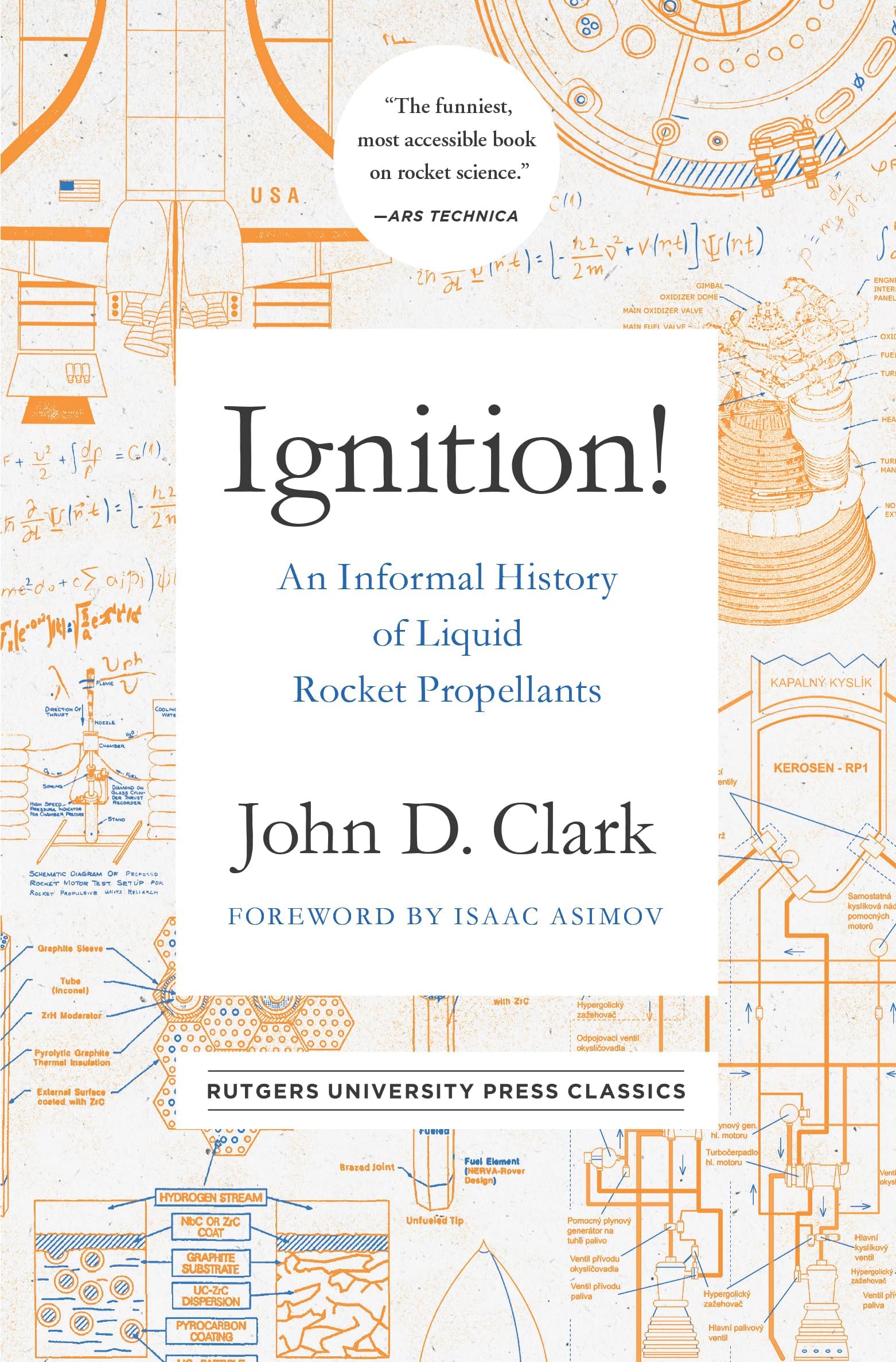

Ignition!: An Informal History of Liquid Rocket Propellants (Rutgers University Press Classics) [Clark, John Drury, Asimov, Isaac] on desertcart.com. *FREE* shipping on qualifying offers. Ignition!: An Informal History of Liquid Rocket Propellants (Rutgers University Press Classics) Review: Highly technical and highly entertaining - I came to this book from Derek Lowe's Things I Won't Work With blog and I was not disappointed. This is a history from an insider of a field I had no contact with, and Clark takes one through with an engaging style. Review: Great information presented well by one of the men who helped rocketry become what it has today. - Today it seems so easy. SpaceX and others launch rockets regularly so much so that it all seems like a forgone conclusion as to what fuels are used. But it wasn't always so. In the 1940s, 1950s, and into the 1960s, several men and labs around the nation worked hard (and sometimes dangerously) figuring out what fuels and oxidizers worked well together and gave the performance and characteristics desired. It was not easy. This book fleshes out the early history and development of how the fuels we use today came to be and why. While the information is technical in nature, and it helps if you have had some college level chemistry and physics classes, you don't have to be a "rocket scientist" to understand what the author is presenting. A very good read, even endorsed by Elon Musk, but it is the forward by the iconic Isaac Asimov that sets the stage. For anyone with more than a passing interest in how modern rocketry came to be, this book provides one of the foundations and in a very interesting way.

| Best Sellers Rank | #36,565 in Books ( See Top 100 in Books ) #11 in Astronautics & Space Flight #19 in History of Technology #19 in Aeronautics & Astronautics (Books) |
| Customer Reviews | 4.6 4.6 out of 5 stars (1,685) |
| Dimensions | 5.19 x 0.8 x 8 inches |
| Edition | Reprint |
| ISBN-10 | 0813595835 |
| ISBN-13 | 978-0813595832 |
| Item Weight | 8 ounces |
| Language | English |
| Print length | 216 pages |
| Publication date | May 23, 2018 |
| Publisher | Rutgers University Press Classics |
| Reading age | 15 years and up |
B**D
Highly technical and highly entertaining
I came to this book from Derek Lowe's Things I Won't Work With blog and I was not disappointed. This is a history from an insider of a field I had no contact with, and Clark takes one through with an engaging style.
R**N
Great information presented well by one of the men who helped rocketry become what it has today.
Today it seems so easy. SpaceX and others launch rockets regularly so much so that it all seems like a forgone conclusion as to what fuels are used. But it wasn't always so. In the 1940s, 1950s, and into the 1960s, several men and labs around the nation worked hard (and sometimes dangerously) figuring out what fuels and oxidizers worked well together and gave the performance and characteristics desired. It was not easy. This book fleshes out the early history and development of how the fuels we use today came to be and why. While the information is technical in nature, and it helps if you have had some college level chemistry and physics classes, you don't have to be a "rocket scientist" to understand what the author is presenting. A very good read, even endorsed by Elon Musk, but it is the forward by the iconic Isaac Asimov that sets the stage. For anyone with more than a passing interest in how modern rocketry came to be, this book provides one of the foundations and in a very interesting way.
C**E
A Fantastic Review of the History of Rocket Propellant Chemistry
This book is just delightful! It covers the history of rocket propellant research from the late 1800s to about 1980 through the eyes of a propellant chemist. The writing is engaging and humorous. For those interested in the specifics of propellant chemistry, this book is a fantastic starter. Note that this is a history, not a lab manual. The author spends plenty of time talking about why a particular chemical works and why others don't. Chemical handling problems are discussed along with spine-tingling accounts of accidents. There were a few fairly tedious sections where the specifics of a particular family of propellants were explored but these sections are easily skipped without serious impact on the following text. Readers are strongly encouraged not to try this at home because everything in this book is designed to go bang in a very big way. There is more than enough information provided in this book to get started with making liquid propellants. However, even experienced chemists accustomed to working in this field are hurt or killed. DO NOT TRY AT HOME.
M**E
A niche-interest book that the right reader will find fascinating.
This is a niche-interest book. Should you happen to be interested in the history of liquid rocket propellants, then this is absolutely the book for you. If you are interested in the history of the space program more generally, then it will likely also appeal. First published in 1972, it describes efforts to develop rocket propellants for military and space applications. These efforts are dryly described by the author, who was one of the key figures, and entail many unplanned explosions and a plethora of thoroughly noxious--if fascinating--chemicals. N.B. For a personal perspective on space history that is a little less niche, I'd recommend Gene Kranz's account "Failure is Not an Option." I note that the tone of the book is rather dated, reflecting the era it describes. For instance, I spotted only one brief mention of a female chemist amid the plethora of men. The following highlight from chapter six should give you an idea of whether you would enjoy the book: "It [chlorine trifluoride] is, of course, extremely toxic, but that's the least of the problem. It is hypergolic with every known fuel, and so rapidly hypergolic that no ignition delay has ever been measured. It is also hypergolic with such things as cloth, wood, and test engineers, not to mention asbestos, sand, and water--with which it reacts explosively." In case there is any doubt, I liked this book and the glimpse into extreme chemistry that it provides. About my reviews: I try to review every book I read, including those that I don't end up enjoying. The reviews are not scholarly, but just indicate my reaction as a reader, reading being my addiction. I am miserly with 5-star reviews; 4 stars means I liked a book very much; 3 stars means I liked it; 2 stars means I didn't like it (though often the 2-star books are very popular with other readers and/or are by authors whose other work I've loved).
W**Y
Explosion in 3…2…1…
This is a fascinating book if you’re curious about the history of rocket fuel or you’re going into making rocket fuel and you want to know what’s been tried before (and why it didn’t work). The author states (and I agree) that this should be required reading for any budding rocket scientist. The author’s tone is often a wry, tongue-in-cheek take on the trials and tribulations of discovering better ways to make things go faster through rapid combustion without explosions. (As well as excellent stories regarding the subsequent explosions, of which there are many.) Individuals with a strong grounding in chemistry will understand much in this book (the author claims he “dumbed it down”). Laypeople will have to skim through the very pithy (but well explained) chemistry (about 2/3 of the book) to find the entertaining stories and quotes. All in all an excellent book from an author who found many ways to blow Uncle Sam’s money in pursuit of new ways to put molecules together in unstable forms.
G**O
the tale of someone who never worked a day in his life!
An incredible (and as informal as possible) account of chemical research at the cutting edge of one of the most energetic regions of chemistry. The narrative is as dry as the salt flats and as humorous as the comedy club!
W**.
A very informative read
As an engineer I knew little about liquid rocket propellants. The book is well written and informative without being unduly scientific. Scientific, yes. Technical, somewhat. Informative, very. Educational and historical, very. Easy to read, yes. A great historical read. I bought a few more books to send to fellow engineers. BUT, you don't have to be an engineer to read the book. A friend who is a cook returned my book, commenting that he almost couldn't put the book down.
T**M
Chemestry geeks always did like the booms & fire
You must be chemistry friendly to get the biting sarcasm
N**H
Ignore any old reviews - its a completely new version!!! This much be a new version, because its not a "shoddy pdf" - its a normal text kindle e-book, font is changeable etc Works like every ebook i've had. This is an awesomely entertaining read! Super funny - great wit from the writer. There's a few heavy parts sure, but if you dont understand them - it doesnt detract from the read at all. Its a great read & gives massive insight into the challenges these poor souls had to go through & overcame. Written in a down to earth, informative way.
C**N
Pur se scorrevole e divertente, richiede pero ‘ una base di conoscenza di chimica non banale per essere letto. Consigliato.
F**P
Innehåll: Denna bok är ett absolut mästerverk för någon intresserad av kemi och raketer. Boken balanserar mellan teknisk briljans och komedi. John D. Clark ger en inblick i en tid då färre restriktioner fanns på forskning vilket leder till en del extrema resultat. Denna upplaga: Finns inte mycket att klaga på när det gäller upplagan. En stabil pocketbok där kvaliteten är i den övre klassen när det gäller just pocketböcker.
E**R
Habe das Buch aus einem allgemeinen Interesse an Raumfahrt und Raketentechnik gekauft und gelesen. Es handelt tatsächlich fast nur von Treibstoffen, die sonstigen "Hintergründe" beim Entwicklungsprozess kommen kaum vor, das sollte der geneigte Leser vielleicht vorher wissen, der Titel hält hier absolut was er verspricht. Das Buch ist aber sehr kurzweilig geschrieben, zuweilen sehr lustig aber immer informativ und nie langweilig. Man muss auch kein studierter Chemiker sein um das Buch zu lesen, ein wenig Grundwissen sollte man schon mitbringen aber wer in der Schule mal einen Chemiekurs hatte und bereit ist etwas zu recherchieren sollte gut klar kommen und darf sich auf ein spannendes und interessantes Buch über die ersten Jahre der Raketentreibstoffentwicklung freuen. Nebenbei bekommt man auch einen schönen Einblick in den Laboralltag, wie die Forscher damals gearbeitet haben und mit welchen technischen und bürokratischen Hindernissen sie sich herumschlagen mussten. Von mir eine klare Empfehlung für alle die ein gewisses Interesse an Raumfahrt, Treibstoffen und Technikgeschichte haben!
J**K
いつの頃からかロケット戦闘機、Me163コメートに取りつかれました。リピッシュ博士設計の小型無尾翼の時代を超越したデザインと時速1000kmに迫る圧倒的なスピード、取扱いに少しでもミスが有ると爆発しパイロットをも溶かす劇薬燃料であるT液、C液の不気味さ、その魅力に引きつられオハイオ州デイトンの空軍博物館に見に行きました。最近、本書の存在を知り副題の「液体ロケット小史」からMe163のウォルター式ロケットエンジンについて知ることが出来るかと思い購入。残念ながら記述内容は著者が携わった1940年代から月面着陸の70年までのアメリカの液体ロケット燃料(燃料と酸化剤)の開発がメインでドイツのそれは全くなし。ただ、果てしない試行錯誤の繰り返しと、極端に発火性、爆発性の高い燃料(例:液体水素)とその燃焼を推進する酸化剤(例:液体酸素)の組み合わせの危険性は、数えきれない爆発例からよく理解できた。SF作家アイザック・アシモフが一般的には無名の著者の紹介文を書いている。その中で、著者は非常に合理的・几帳面で多大な蔵書を項目ごとに分類しており、聖書を見つけその項目を見たら、F(Fiction:小説)。10年以上たち、その事を著者に聞いたら、著者は数多くの爆発、その他予想外の事故にもかかわらず、自分と研究所スタッフが無事だったのは「神のご加護」と信じ聖書をF項目棚から移したとの返事。ただ、移した先のコメントはなかったとの事。
Trustpilot
1 month ago
5 days ago