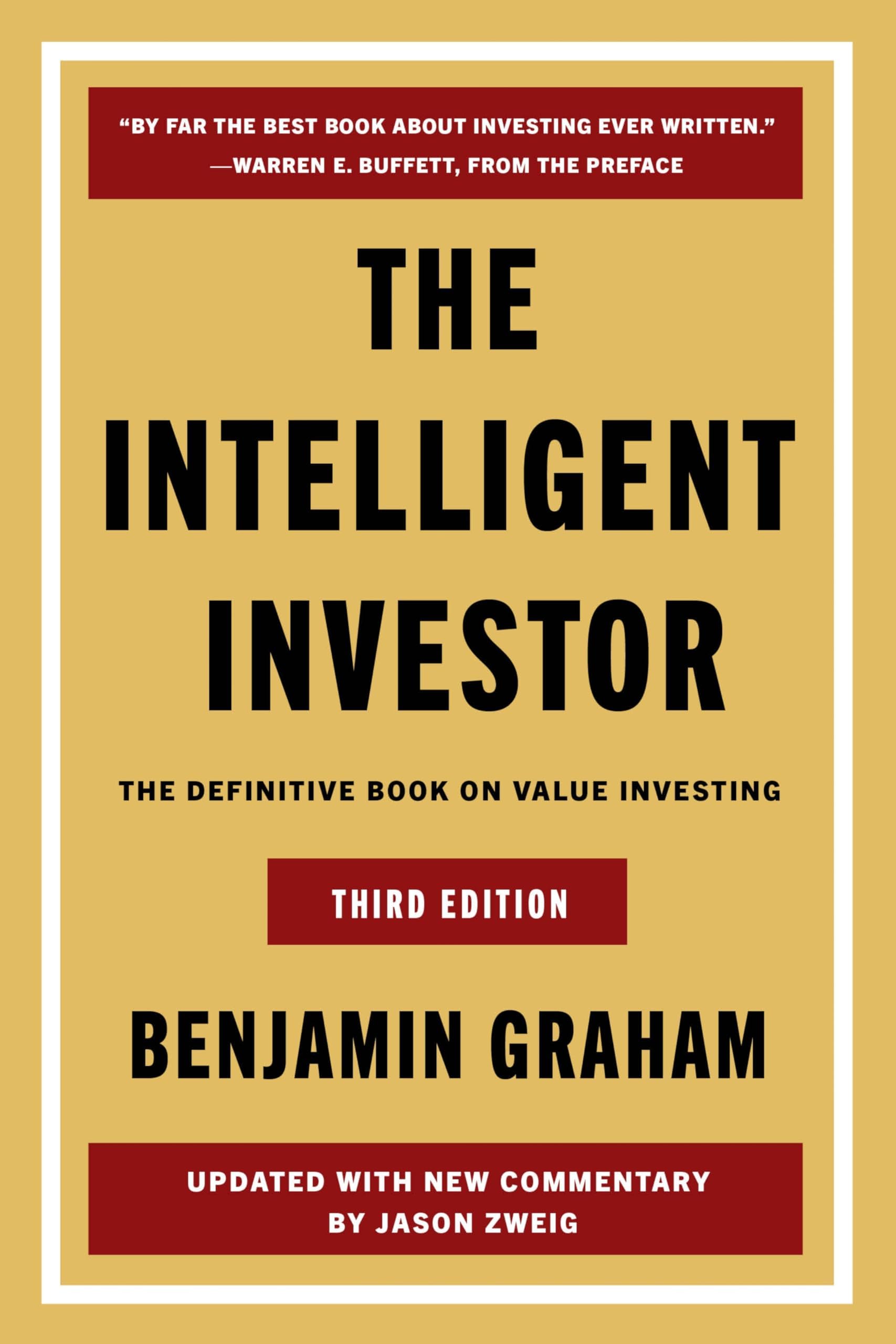
The Intelligent Investor : The Definitive Book on Value Investing (Third Edition)
Product ID: 653479636
Buy anything from 5,000+ international stores. One checkout price. No surprise fees. Join 2M+ shoppers on Desertcart.
Desertcart purchases this item on your behalf and handles shipping, customs, and support to Vanuatu.
75th Anniversary Edition The classic work on investing, filled with sound and safe principles that are as reliable as ever, now revised with an introduction and appendix by financial legend Warren Buffett—one of the author’s most famous students—and newly updated commentaries on each chapter from distinguished Wall Street Journal writer Jason Zweig. “By far the best book on investing ever written.”—Warren Buffett Since its original publication in 1949, Benjamin Graham’s revered classic, The Intelligent Investor , has taught and inspired millions of people worldwide and remains the most respected guide to investing. Graham’s timeless philosophy of “value investing” helps protect investors against common mistakes and teaches them to develop sensible strategies that will serve them throughout their lifetime. Market developments over the past seven decades have borne out the wisdom of Graham’s basic policies, and in today’s volatile market, The Intelligent Investor remains essential. It is the most important book you will ever read on making the right decisions to protect your investments and make them grow. Featuring updated commentaries which accompany every chapter of Graham’s book—leaving his original text untouched—from noted financial journalist Jason Zweig, this newly revised edition offers readers an even clearer understanding of Graham’s wisdom and how it should be applied by investors today. Review: Investing is more a matter of ‘character’ than ‘brain’ - This book is perhaps the most important and insightful book on investing, and an eternal classic. It is not a book that promises ‘How to become rich…’ or ‘Mastering Stock market in a week….’ or ‘Beating the market made easy…’ or any shortcut to a quick buck. The book teaches three powerful lessons of how one can: - minimize the odds of suffering irreversible losses - maximize the chance of achieving sustainable gains - practice emotional control and behavior to help the investor achieve full potential. The book is about investing and having said that, investing is for the long term. Short term investing is like saying one is a spendthrift miser. While long term investors buy stocks or bonds for its intrinsic value and hold them, the 'short termers' play on its price like a video game, high on dopamine, ‘seeing price patterns’. While the intrinsic value of the security is stable, the markets, built upon the greed and fear of speculators, fluctuate widely and it is this constant flow of price movements that is the juice of speculation. The intelligent investor is the one who estimates the value of a stock based on some key parameters like the company’s long-term prospects, quality of management, financial strength and capital structure, dividend record, and current dividend. Graham lists two types of intelligent investors. The ‘active’ or ‘enterprising’ who does continuous researching, selecting and monitoring a dynamic mix of stocks, bonds and mutual funds. The ‘passive’ or ‘defensive’ investor on the other hand, creates a permanent portfolio that runs on autopilot and requires no further effort (but generates very little excitement) argues the author so elegantly. Quoting the investment thinker Charles Ellis, ‘’the enterprising approach is physically and intellectually taxing, while the defensive approach is emotionally demanding’’. For the long-term defensive investor, who has abundant emotional courage not to be distracted by daily price movements, there is no need to look at the daily price. In fact, the investor ‘’would be better off if his stocks had no market quotation at all, for he would be spared the mental anguish caused by other persons’ mistakes of judgement.’’ We don’t check the price of our house every hour! The intelligent investor would make use of any opportunity if a good company is facing a temporary crisis and add more shares to his portfolio at lower price. (In cases of extreme exuberance, it is also wise to sell if the price seems too high to be real). A prudent investment methodology would be to add on more of high quality stocks on a regular basis, thus paving way for ‘dollar cost averaging’. A well-diversified stock and bond portfolio ensures long term risk mitigation. Though the book is highly acclaimed in investment circles, in practice, only a miniscule of market participants adhere to the key principles the world over. Hence, situations like the Dot com bubble, the financial crisis of the last decade and the collapse of high priced so called ‘high growth stocks’ of unworthy and nefarious companies happen repeatedly. ‘’A man is known by the books he reads” said Ralph Waldo Emerson. Invest in companies that have proven track record, stellar management capabilities and high ethical standards of corporate citizenry. Being an intelligent investor is more a matter of ‘character’ than ‘brain’, is the key message of this great tome. Review: Investment - The book gives an idea about financial freedom


| Best Sellers Rank | #476 in Books ( See Top 100 in Books ) #1 in Money & Monetary Policy #3 in Public Finance |
| Customer Reviews | 4.5 out of 5 stars 51,909 Reviews |
B**Y
Investing is more a matter of ‘character’ than ‘brain’
This book is perhaps the most important and insightful book on investing, and an eternal classic. It is not a book that promises ‘How to become rich…’ or ‘Mastering Stock market in a week….’ or ‘Beating the market made easy…’ or any shortcut to a quick buck. The book teaches three powerful lessons of how one can: - minimize the odds of suffering irreversible losses - maximize the chance of achieving sustainable gains - practice emotional control and behavior to help the investor achieve full potential. The book is about investing and having said that, investing is for the long term. Short term investing is like saying one is a spendthrift miser. While long term investors buy stocks or bonds for its intrinsic value and hold them, the 'short termers' play on its price like a video game, high on dopamine, ‘seeing price patterns’. While the intrinsic value of the security is stable, the markets, built upon the greed and fear of speculators, fluctuate widely and it is this constant flow of price movements that is the juice of speculation. The intelligent investor is the one who estimates the value of a stock based on some key parameters like the company’s long-term prospects, quality of management, financial strength and capital structure, dividend record, and current dividend. Graham lists two types of intelligent investors. The ‘active’ or ‘enterprising’ who does continuous researching, selecting and monitoring a dynamic mix of stocks, bonds and mutual funds. The ‘passive’ or ‘defensive’ investor on the other hand, creates a permanent portfolio that runs on autopilot and requires no further effort (but generates very little excitement) argues the author so elegantly. Quoting the investment thinker Charles Ellis, ‘’the enterprising approach is physically and intellectually taxing, while the defensive approach is emotionally demanding’’. For the long-term defensive investor, who has abundant emotional courage not to be distracted by daily price movements, there is no need to look at the daily price. In fact, the investor ‘’would be better off if his stocks had no market quotation at all, for he would be spared the mental anguish caused by other persons’ mistakes of judgement.’’ We don’t check the price of our house every hour! The intelligent investor would make use of any opportunity if a good company is facing a temporary crisis and add more shares to his portfolio at lower price. (In cases of extreme exuberance, it is also wise to sell if the price seems too high to be real). A prudent investment methodology would be to add on more of high quality stocks on a regular basis, thus paving way for ‘dollar cost averaging’. A well-diversified stock and bond portfolio ensures long term risk mitigation. Though the book is highly acclaimed in investment circles, in practice, only a miniscule of market participants adhere to the key principles the world over. Hence, situations like the Dot com bubble, the financial crisis of the last decade and the collapse of high priced so called ‘high growth stocks’ of unworthy and nefarious companies happen repeatedly. ‘’A man is known by the books he reads” said Ralph Waldo Emerson. Invest in companies that have proven track record, stellar management capabilities and high ethical standards of corporate citizenry. Being an intelligent investor is more a matter of ‘character’ than ‘brain’, is the key message of this great tome.
D**L
Investment
The book gives an idea about financial freedom
S**L
Insightful Read
"The Intelligent Investor" by Benjamin Graham, I must say, this book is a must-read for anyone interested in investing. Despite being published decades ago, the insights and principles in this book are still very relevant today. Graham's approach to investing is based on thorough research and analysis, as well as a focus on long-term strategies rather than short-term gains. The book is very well-written and easy to understand, even for those who may not have a lot of experience in the stock market. One of the things I appreciated most about this book is that it emphasizes the importance of maintaining a rational and disciplined approach to investing. Graham provides a lot of practical advice on how to avoid common pitfalls and make sound investment decisions. Overall, I would highly recommend "The Intelligent Investor" to anyone looking to improve their investment strategy and knowledge. The book is a classic for a reason and is definitely worth the read. Whether you're a beginner or an experienced investor, there is a lot to learn from Graham's wisdom and expertise.
A**A
book
very good book
P**J
Book quality and knowledge
Go for hardcover if you really care about books and keep them with love and care because paperback most of time got tear up in case of big books.By the way this books is a true gem indeed.GO FOR IT!!
Y**I
Good
Good
A**R
Good concepts. Bad articulation.
I think the author tried to instill important lessons and they are very useful indeed. However, there are several problems with this book as listed below. 1. The original version of the book may have been well written. I wouldn't know. But after the original version, in the name of making the book relevant to the present day, people added/removed stuff. And I think, as yet new versions were released, even more editing was done. The book now reads like a teenager edited it. Outdated examples are so badly articulated, that instead of understanding the concept of relevance, you just end up getting super confused. 2. Tables/Graphs aren't matching with the text!! - When you first see a table full of financial figures about different companies, what would be your expectation? That a) The table has something to do with the text in that chapter, and, b) The author will walk you through those figures explaining away why you should choose to invest in company A and not in company B etc.. But you would be so wrong! At best, the author will describe different figures in the table and half-way through explaining, just walk away to a different topic. This happens repeatedly in the book. It is *very* annoying. 3. I expected the author to state his philosophy, state a few "rules" derived from that philosophy, and show how to employ these rules while making decisions in the real world. I also expected the author to show counter-examples - where a "rule" wasn't followed and how it costed the investor dearly. The author tries to do all of this - but much more. There is an attempt to cramp too many ideas into a few pages. Often many ideas are tangential to the core ideas and they distract you away from the core ideas. I think the messed up editing is to blame. I also think that the editors themselves realized it - They added a 'Commentary' for every chapter of the book - and the Commentary is as big as a chapter! These commentaries, thankfully, are each written by reputed people in the discipline. They are well written and easily understandable. I advise readers to first read all the 'Commentary's and then proceed to read the Chapters if you really feel like it. Otherwise you can close the book after reading the commentaries.
R**K
Delivery damage
The book was a bit damaged , when I opened. Guess it happened during delivery. The book overall is the good
P**M
Damaged item
When I received the book, the package was not damaged but the book was already bent (as shown in the photo). I am pretty disappointed with this delivery :(
A**Z
Gran libro
Habia leido muy buenas reseñas de este libro ya que estaba interesado en aprender un poco más sobre todo lo relacionado a inversiones a través de bolsa. Es una lectura pesada ya que tiene muchos tecnicismos, pero me ha sido de mucha utilidad. Si estás buscando guía en estos temas, este libro te ayudara a orientarte.
B**K
Terrible quality and outdated information
Binding on the book was horrendous couldn't flip between pages because they were all different sizes and came damaged
C**H
Un ouvrage de référence que tout investisseur doit avoir lu.
Le livre de Benjamin Graham est une pièce de référence qui a permis à de nombreux investisseurs de débuter dans la gestion de fond d'investissement en évitant les erreurs commises par le passé. Ce livre se lit un peu comme on déguste une friandise et chaque chapitre aborde un principe ou une stratégie appliquée en finance. Le livre datant du début des années 70 chaque chapitre est suivi d'un commentaire par Jason Zweig qui replace le chapitre dans le contexte actuel en montrant les développements qui sont survenus au cour des 40 dernières années. Un ouvrage très complet qui défend les principes de la gestion passive et de l'investissement par opposition à la spéculation. Si l'on ne lit qu'un ouvrage avant de débuter dans la gestion d'actifs financiers c'est celui ci qu'il faut choisir car finalement de nombreux autres ouvrages s'en inspirent.
D**D
It’s a comprehensive and informative book about investing.
It’s an excellent and comprehensive book about investing, written in an easy readable style and understandable by most people. It outlasts many other texts because in the many oscillations of markets it explains the reasons for the many market variations. In particular I like the explanation of an intelligent investor on page 13, a concept that is carried throughout the book - all 600 pages of it.
Trustpilot
1 month ago
2 weeks ago