Buy anything from 5,000+ international stores. One checkout price. No surprise fees. Join 2M+ shoppers on Desertcart.
Desertcart purchases this item on your behalf and handles shipping, customs, and support to Vanuatu.
🖨️ Elevate your 3D prints with industrial-grade strength and speed — don’t get left behind!
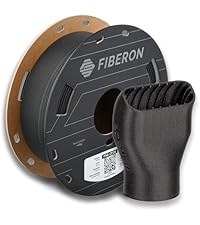
Polymaker Fiberon PA6-GF is a 1.75mm glass fiber reinforced Nylon 6 filament designed for high-speed, high-performance 3D printing. It offers exceptional mechanical strength, heat resistance, and compatibility with most mainstream printers. Packaged in a tangle-free, resealable bag on an eco-friendly spool, it’s ideal for functional parts like drone frames, brackets, and prosthetics that demand durability and precision.


| ASIN | B0D4Q464VB |
| Additional Features | High-speed printability, excellent thermal and mechanical properties, compatibility with most printers, and suitability for high-performance parts. |
| Best Sellers Rank | #364 in Industrial & Scientific ( See Top 100 in Industrial & Scientific ) #35 in 3D Printing Filament |
| Brand | POLYMAKER |
| Brand Name | POLYMAKER |
| Color | 114 - 1.75mm Fiberon Pa6-gf25 Grey 0.5kg (Hex Code: #75787b) |
| Customer Reviews | 4.6 out of 5 stars 921 Reviews |
| Global Trade Identification Number | 06938936714620 |
| Item Diameter | 1.75 Millimeters |
| Item Weight | 0.5 Kilograms |
| Manufacturer | Polymaker |
| Manufacturer Part Number | FG02001 |
| Material | Nylon |
| Material Type | Nylon |
| Number of Items | 1 |
| Special Feature | High-speed printability, excellent thermal and mechanical properties, compatibility with most printers, and suitability for high-performance parts. Special Feature High-speed printability, excellent thermal and mechanical properties, compatibility with most printers, and suitability for high-performance parts. See more |
| Unit Count | 17.637 Ounce |
J**E
Best filament you will ever use.
I printed the above image with a stock Kobra Max (260° max nozzle temperature. Although some people suggest it runs hot), 0.8mm nozzle(not a nozzle suggested for small gears)... I have been printing for a well over 5 years and it's not just a side hobby. It's not work but it's an obsession. I've had many printers, I've tried innumerable brands and types of filaments. This is my first favorite. I'm going to write a simple list of why you should buy this filament. By far the strongest filament I have ever used. It's a different kind of strength though. PC FG/cf, peek etc might be stronger in certain ways, But having the same volume as a regular kilogram, yet half the weight, it's just something special. Just a note, the way this filament works is a lot like say porcelain. It's an incredibly strong substance, but if you kind of chip away at it with say a pair of bolt cutters, it'll break easier with scary pieces flying at you.. Kinda like that. Dimensional accuracy is off the charts. You make a hole, the whole will be the size you make it. I only have one printer that prints perfect every time. A toybox printer.. If you know what that is, you'll understand. Anyway, this filament in my Kobra Max, is officially my new most consistent and reliable print. I use Cura to do the "print one at a time" (instead of all at once), and I can have 19 different prints I want done all in that one platform, and it'll just go through one after the other and print them all completely accurate. No more checking every 30 minutes or hour. No need for a camera mounted on it or special failed print sensor... Keep the support material as low density as you can, but when it comes to the support interface and removing this support, it's amazing. The support interface ACTUALLY works...... Really. And once you break off the support which CAN require a lot of strength (ice pick or smaller nozzle size suggested) You're left with a manufacturer quality part. No post-processing necessary. A real quick note, I tried doing the flow reduction for the support material and it ended up failing. I'm sure it's because this material is very thick/.8 nozzle/and printed well below the suggested print temp, But that did fail me. Anyway, I'm sure if you actually have the appropriate setup/settings you'll be fine. Print your support flow to give you ~0.2 mm support line width. Then it should break off super easy, clean and without any excessive strength. Guess that's really all I have to say. Aside from the fact that it also has a really nice texture. Oh, and make sure you use "alternate wall printing direction" or something like that. I'm sure even if you use a smaller nozzle size, there will be a little pull like with metal field or glass filled filaments. You want to make sure it changes direction each layer to avoid that warp and shit. If you use Cura, the newest update has that option in experimental or somewhere at the bottom. This is my summary. I'm using a stock printer, oversized nozzle, and very little is done to try and accommodate this filament suggested print settings. I'm honestly not even sure how it works. But regardless, I'm getting manufacture quality parts. Truly functional. I have every other filament. And although some might have higher strength in certain areas(and usually some disadvantages), but they all require some specialty equipment, tons of work to get it to stick or print clean. High build plate temperatures that waste electricity and often result in warping. And so on and on. And maybe ridiculous for me to say, but I think this is the best filament ever produced...(Aside from basic PLA for prototyping). I just want to know if it comes in 5 kg.
C**N
Great Filament if you have Hardened Nozzle!
I recently started using PA612-CF15 filament in my 3D printer, and it's been an excellent material for high-performance, industrial-grade prints. Here's my detailed review: Print Quality & Ease of Use: The PA612-CF15 filament is a 3D printing material that combines polyamide (nylon) with carbon fiber. It’s a bit more challenging to print with compared to standard filaments like PLA, but it produces outstanding results. The carbon fiber reinforcement provides extra rigidity and strength, and the printed parts come out with a nice matte finish. I’ve found that it’s crucial to adjust the print settings for optimal results—slower print speeds, higher temperatures, and a hardened steel nozzle are key to getting the best quality. Strength & Durability: This filament’s main selling point is its strength. It offers excellent mechanical properties, including high tensile strength and low moisture absorption, which means printed parts stay tough and won’t warp or weaken easily. I’ve used it to print functional parts that need to withstand a bit of wear and tear—things like brackets and connectors—and they’ve held up impressively well. The carbon fiber content also adds to the durability, making it ideal for parts that will be exposed to high stress. Printing Performance: While the PA612-CF15 filament prints relatively well, it’s a bit finicky when it comes to adhesion. I highly recommend using a heated bed, as well as a build surface that’s designed for high-performance filaments (like PEI). Once you’ve dialed in the settings, however, it adheres well and delivers smooth, strong prints. Post-Processing: Another benefit of this filament is its ease of post-processing. You can sand, drill, or machine it with minimal effort, which makes it ideal for parts that need to be further customized. However, because of the carbon fiber content, it can cause additional wear on your print head, so you’ll want to use a hardened nozzle to avoid clogging or damage. Finish & Aesthetics: The carbon fiber content gives the prints a unique, matte black finish that looks both sleek and industrial. This is great if you’re looking for a functional yet stylish end product. The finish is slightly rough to the touch, which adds to the overall durability and strength, but it’s also one of those materials that looks even better the more you use it. Overall: PA612-CF15 filament is a fantastic choice for anyone needing durable, strong, and heat-resistant 3D prints. It’s best suited for functional prototypes, automotive parts, or anything that requires robust mechanical properties. While it takes a little effort to get the settings just right, the results are definitely worth it for demanding applications. Rating: 4.7/5 Pros: High strength, excellent durability, easy post-processing, great finish Cons: Requires careful calibration, can cause wear on nozzles, difficult to print with for beginners
E**E
Easy to print, accurate benchy, really good layer adhesion. Wear gloves.
Printed a benchy within a few hours of receiving my spool. I printed directly from my dryer, but didn't wait for it to dry out after loading - call it a factory packaging check. The little boat came out nearly perfect. The only thing I've noticed is that the open-air extrusion is kind of wavy, like the fibers aren't happy about going through my 0.4mm nozzle. I bet a 0.6mm would alleviate this completely. As it stands with the 0.4mm, there is some light waving that makes it into the print but not much. I saw no stringing at all, and the overhangs look fantastic. Surface finish has a unique sheen to it and is *extremely* rough due to the carbon fibers sticking out of it, if I was printing something that will be handled a lot I'd want to put a few coats of clear paint over it first. Flicking the benchy with my fingernail it sounds kind of glassy, suggesting that the part is as stiff as it feels. I like to break the chimney off of benchys to check layer adhesion and this stuff hurt my thumb and took a couple of tries. I bet with annealing and conditioning it would have hurt my thumb even more. Great filament, will reorder when I need it again.
C**U
Print well
Good and strong filament. Print well
F**Z
Polymaker doesnt disappoint
Very nice filament. Comes decently dry out of the box and prints very well. I use the bambu preset for it and I haven't had to do any tinkering with the settings, the surface is beautiful and the print is very solid. Its a little expensive but its tempting to switch over to this for everything. Using glue on the bed i have never had problems with adhesion like I have with abs or asa
E**S
Good Filament, Narrow Lane
Fiberon PA6-CF prints cleanly on a Bambu Lab P1S using Polymaker's own default profile. No custom tuning, no drama, good layer adhesion out of the gate. I dried it minimally and it performed well. After annealing at 210°F for several hours alongside a PA6-GF print, there was no warping or noticeable dimensional change. That's the carbon fiber doing its job, keeping the part dimensionally stable through heat treatment. The surface finish is a flat matte black. It looks intentional and industrial, which works for functional parts. In the hand, it's rough. The carbon fiber gives it an almost sandpaper-like texture that you'll feel immediately. That texture is where the limitations start. Carbon fiber is abrasive. Any part that interfaces with metal, where surfaces slide or wear against each other, is going to chew up the metal side over time. That rules this material out for a meaningful category of functional prints. Polymaker's own PA6-GF avoids this problem entirely. Glass fiber is softer, causes far less wear on mating surfaces, and prints just as reliably on the same default profiles. PA6-CF is stiffer than GF, which matters for parts that need rigidity without flexibility. Brackets, housings, rigid mounts. If your part sits still and holds shape, CF is the better pick. If it touches metal or takes impact, GF wins. It does what it's supposed to. It just occupies a narrow lane, and for most functional printing, the PA6-GF sitting next to it on the shelf is the more versatile choice. I have no doubt this filament will handle the heat. Price seems slightly inflated for what you get. For a specialty filament with a specific use case, that adds up quickly.
M**R
Impressive stuff
This is impressive stuff. I am designing motorized equatorial telescope mounts and needed a material that is rock solid for some of the parts. After much consideration I settled on the PA612-CF and it has performed well. I am using an A1mini with a glass bed and glue stick. With a little trial and error, I got my temps set. Then a flow calibration dialed in perfect prints. I actually have to use a metal scraper to get the prints to release. To get more out of this filament I anneal everything at 90°C for at least 6 hours. To compensate for shrinkage, since I am printing precision parts, I increase X and Y axes to 100.10% and Z axis to 100.50%.
T**R
Easy to print
Easy to start printing with and had quality bed adhesion, maybe too much bed adhesion. The only issue I’m having is on me and that is it quickly clogged the printer’s nozzle. I suggest purging the filament before it cools if you’re using a high flow nozzle. It came tightly wound and fairly dry making setting up printing take a short time.
S**R
Sehr gute Ergebnisse - mit etwas Aufwand
Liefert sehr gute Ergebnisse, robust mit einer schönen Oberfläche. Allerdings ist hier ein gewisser Aufwand erforderlich, die hohen Temperaturen müssen genau eingehalten werden und die Trocknung muss regelmäßig erfolgen. Am besten ist es, aus einer beheizten Trockenbox zu drucken.
M**O
Ottima qualità
Stampato perfettamente con Qidi Plus 4.
A**N
Filament haute qualité
Très bon filament belle bobine demande d'avoir un ace pro.
S**I
pa6-CF
ottimo. mi sono trovato subito bene. resistenza impressionante
D**E
Excellent filament - needs plenty of drying
Prints really well. Needs lots of drying, but well worth it. High quality parts produced.
Trustpilot
5 days ago
2 months ago