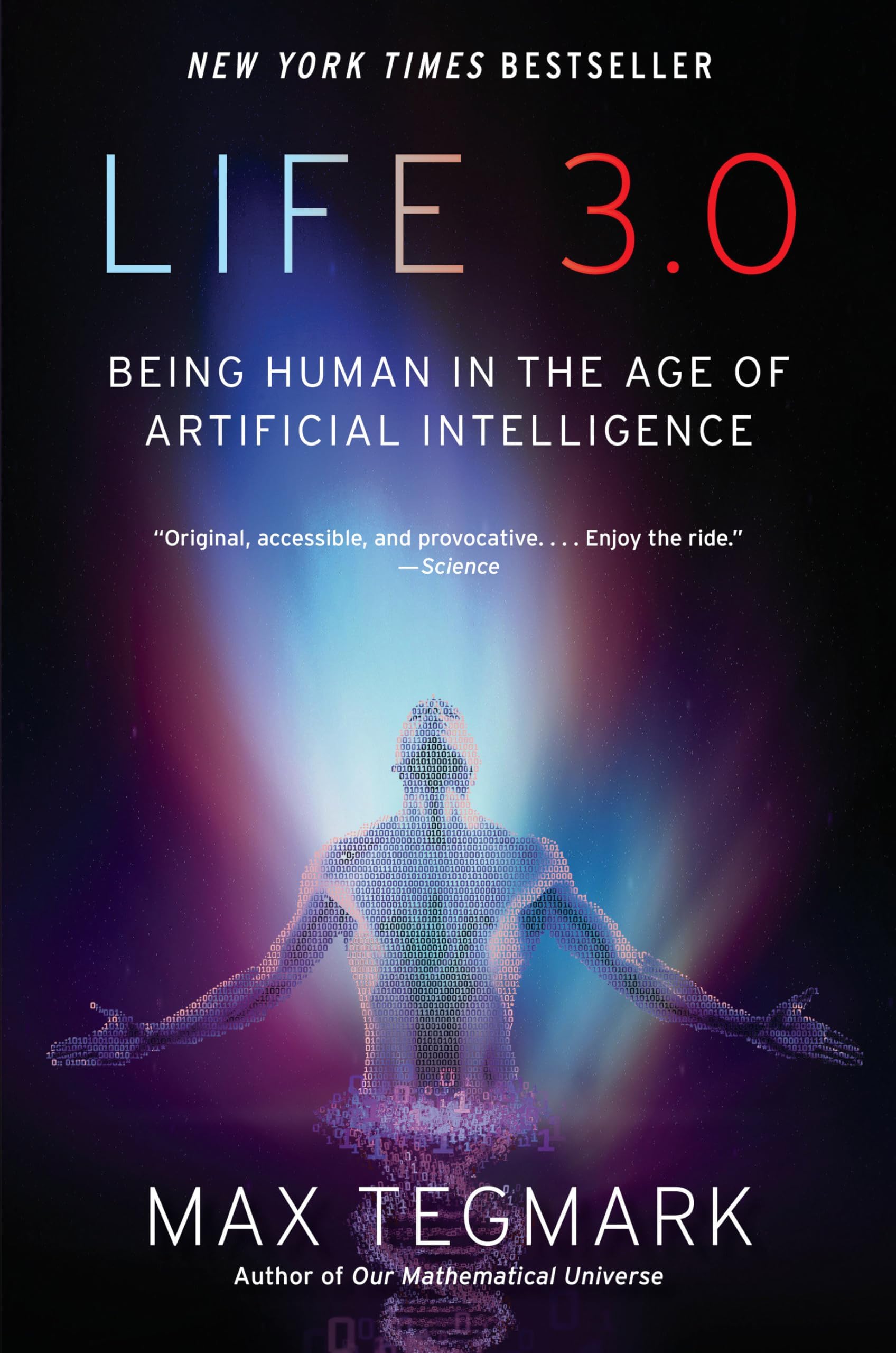
Life 3.0: Being Human in the Age of Artificial Intelligence
Product ID: 69611693
Buy anything from 5,000+ international stores. One checkout price. No surprise fees. Join 2M+ shoppers on Desertcart.
Desertcart purchases this item on your behalf and handles shipping, customs, and support to Vanuatu.
NEW YORK TIMES BESTSELLER • How will Artificial Intelligence affect crime, war, justice, jobs, society and our very sense of being human? The rise of AI has the potential to transform our future more than any other technology—and there’s nobody better qualified or situated to explore that future than Max Tegmark, an MIT professor who’s helped mainstream research on how to keep AI beneficial. How can we grow our prosperity through automation without leaving people lacking income or purpose? What career advice should we give today’s kids? How can we make future AI systems more robust, so that they do what we want without crashing, malfunctioning or getting hacked? Should we fear an arms race in lethal autonomous weapons? Will machines eventually outsmart us at all tasks, replacing humans on the job market and perhaps altogether? Will AI help life flourish like never before or give us more power than we can handle? What sort of future do you want? This book empowers you to join what may be the most important conversation of our time. It doesn’t shy away from the full range of viewpoints or from the most controversial issues—from superintelligence to meaning, consciousness and the ultimate physical limits on life in the cosmos. Review: A Must Read for Everyone on the Planet - Profound. It’s the only word I can come up with to describe this book. It should be required reading for everyone on the planet. If you’re a curious reader, it is an excellent primer on where the scientists are now. Tegmark covers the spectrum of physics, cosmology, and artificial intelligence with the clarity and enthusiasm I haven’t witnessed since we were all glued to our televisions in the 1980s watching Carl Sagan unwrap the mysteries of the cosmos. Max Tegmark, a professor at MIT, is brilliant, creative, and rational, giving him that rare ability to explain the complex and mind-boggling to the rest of us. The primary purpose of the book, in Tegmark’s words, is to invite all of us to participate in setting goals for the development of artificial intelligence and, indeed, the future of scientific inquiry. It is rare that someone of Tegmark’s standing in the scientific community invites us into the tent and as I read the book I felt an overwhelming sense of obligation to oblige the request. This book, I think, is that important. Philosopher Karl Popper popularized the adage, “If it’s not falsifiable, it’s not scientific.” It is a perspective widely accepted in the scientific community and in popular culture and it has driven a seemingly irreconcilable intellectual wedge between science and philosophy. It is a wedge that has damaged, and will ultimately constrain, both pursuits. Tegmark makes an impassioned and well argued rejection of the scientific dismissal of consciousness. It is, he argues, the elephant in the room of AI. It must be addressed and understood. And I think he’s right. (He also seems optimistic that science will one day figure it out. Of that I am not so confidant, but I am certainly open to trying.) As Tegmark clearly notes, there is no consensus in the AI community as to when, if ever, an intelligent machine capable of both learning and improving it’s own physical structure and performance, his definition of Life 3.0, will be created. Once it comes into existence, however, he makes a very convincing case that it will be too late to start thinking about aligning the machine’s goals with our own. The horse, by definition, will be out of the barn. And there is no reason to believe the outcome will be a good one if we don’t plan for it. If you enjoy incredible facts, Tegmark provides plenty of them. I know he certainly helped me to gain a better appreciation for the sheer magnitude of the universe and the mathematical splendor of time and space. I started this book with some skepticism. Because language itself is a human convention that we invented, I am naturally skeptical of any written or oral explanation of anything that claims to be final and complete. I think of knowledge in the way that post-Impressionist painter, George Seurat, thought of art. He established the Pointillist school, wherein the artist uses dots of pigment instead of brush strokes to create his or her artistic rendering of reality. When complete the image is obvious. Randomly remove half or more of the dots of pigment, however, and you’re forced to speculate. And that’s precisely where we are, I believe, in a lot of areas of science and general human understanding. It’s folly for anyone to proclaim that we have fully uncovered all of the laws of reality much less filled in the blanks. We have made progress in our understanding but our journey is far from over. I won’t suggest that Tegmark would agree with that, at least in degree. He is a scientist, to be sure. I do feel, however, that he is sincerely receptive to dialogue—even insistent on it—and that makes him the voice we need to move forward in our pursuit of understanding and the wonders, like AI, that knowledge will put at our doorstep. If not here, the future is coming. After reading this book it’s a lot closer than I realized. The conversation Tegmark requests is both timely and necessary. Review: Deeper thought and action needed - Life 3.0 Max Tegmark enthusiastically and excitedly writes about what life will be like for us humans with the rise in AI (Artificial Intelligence), AGI (Artificial General Intelligence – Intelligence on par with humans) and the possibility/probability of creating Super-Intelligence (AI enabled intelligence that far surpasses human intelligence and capabilities.). He asks the reader to critically engage with him in imagining scenarios of what such AI reality could mean for us and to respond on his Age of AI website. The book begins with the Tale of the Omega Team, a group of humans who decide to release advanced AI, named Prometheus, surreptitiously and in a controlled way into human society. The tale unfolds as a world take-over by Prometheus and in a final triumph becomes the world’s first single power able to enable life to flourish for billions of years on Earth and to be spread throughout the cosmos. If you have never read much post-modern futurology, Tegmark is a good way to take the plunge. He brings together much of the thinking about what humanity will have to deal with, the decisions it will have to make and the options it might have with the inevitable advancement of technology and specifically AI. Above all he encourages the reader to believe that she/he has an important role to play in what the future will hold for us and that we need not, indeed cannot, succumb to fatalism. The most commendable, concrete and hopeful part of the book is in his story of AI researchers coming to agreement about the path forward for AI that is pro-active in addressing the challenges it presents and the impact it will have on human society. The end of the book lays out this path in the Asilomar AI Principles, which were created, critiqued, refined and agreed through a process initiated in an AI conference in Puerto Rico in January 2015. The takeaway for Tegmark is that AI research can now confidently go forward with the knowledge that impacts and consequences for humanity have been and will be addressed in the process to mitigate any negatives. He and his colleagues deserve credit for such engagement and thoughtful commitment in their endeavors. For the above I gave the book four stars. The book is also fun to read and challenging to our common political and economic realities. There are, however, areas of concern that are either untouched or passed over lightly, to which I now turn: 1. The quest for truth - Tegmark assumes that we have an “excellent framework for our truth quest: the scientific method.” I start my critique here because this assumption is not argued nor established. There is no argument against the formidable power of scientific methodology to give deep explanation to natural reality. However, the issue of truth is rightly not the purview of science, but of philosophy. This may seem nit-picky, but we are too used to the idea that science is the absolute arbiter of truth as though it can offer a complete picture of reality, when in fact that’s not within its job description. 2. The way Tegmark frames his definition of life is a case in point. To do this he makes two moves: first, using the scientific method he deconstructs life in a reductionist move; the second move is to decenter biotic, human life in its importance and necessity in the unfolding of what he calls Life 3.0. Tegmark's first move reduces the definition of life to “a process that can retain its complexity and replicate itself.” In this highly generalized definition he can than reduce life further to atoms arranged in a pattern that contains information. This broad definition is important for the second move which is the decentering of biotic human life. Here he offers a post-modern notion that human life (anthropocentric) can no longer be the measure of all things. Humans have been displaced from the center of the universe in great steps since Copernicus. If we are going to promote Life 3.0, we must continue this decentering to make room for the expanded definition of life he offers. Life must now be imagined as other than biotic. It must include the possibilities imagined by our new technologies of superintelligence housed in robust substrates where human consciousness or even non-human consciousness can reside for great lengths of time and go beyond earth to the reaches of the universe. If it sounds utopian, there is that clear melody line in Tegmark’s writing, in spite of some protestations to the contrary. This is Tegmark’s book. He can define life however he sees fit. From my perspective life was the good old fashioned, highly unlikely emergence of biotic generativity – the beginning of which we yet do not know. Evolution did its trial and error number over four billion years to produce humans. If and when there is ever the need to call something non-biotic, life, it will be apparent at that moment and not before. This does not mean that preparation for AI is not needed. It is that sapience is not sentience nor does intelligence to some superhuman degree make something life even if it can mimic or surpass human neurology. Call it what it is: a really smart human-made machine that is programed to learn, replicate, maybe have what we call consciousness and cause us all kinds of grief and gladness. Life? No. 3. It is good that Tegmark wades into the arena of ethics because they cry out for attention. • First, can anyone actually account for or quantify/qualify accurately for human behavior? History has yet to convince us that humans, whether naturally tending toward the moral or not, cannot be morally controlled. The scientific evidence is in our history. And yes, there are many heroes, but there are many who are classified “evil.” One need only to look at the current “fad” of mass shootings in the USA. We may blame mentally unstable people for this, but we are those people. Tegmark points out that AI is morally neutral and like guns is not the evil element in the equation. But AI is initially and therefore ultimately a human endeavor and therefore is imbued with human imitation and limits. As good and needed an attempt that is made with the Asilomar AI Principles, we can be sure that AI will be used wrongly and perhaps fatally to all of life. Our certainty is because we know ourselves as humans. We are a product of Nature which models the whole spectrum of behaviors from the deeply violent to the deeply loving. More species of life on earth have gone extinct than are alive today. Dare we think that humans might escape a similar fate because we are intelligent or have benign superintelligent buddies? Before anything else can be discussed regarding the deep future of humanity, humanity itself has to come to grips with itself. Though Tegmark rhetorically acknowledges such negative possibilities, he is full steam ahead in his assumptions and commitment to the development of superintelligence. • Second, in our modern world moral absolutes are hard to come by. In a purely naturalistic setting all morality is relative and therefore depends upon the decision of humans within a cultural setting within the personal psyches of the individuals making moral choices. It is not cynical to believe that if you scratch a beautiful public moral persona, you will get it to bleed a bewildering moral anomaly. Look at how many moral quibbles some of the scientists who were involved in developing atomic/nuclear weaponry had. When threatened, it seems “all options are on the table.” For all the good of Tegmark’s intentions this is a very uncertain area. Even his examples of several Russian men, who prevented nuclear holocaust, are frightening enough for us to understand just how serious the moment in which we live is morally. So, the question is: do we have a sufficient moral foundation and will to unleash AI invention and use? •Third, in spite of trying to move away from human-centeredness rhetorically throughout his book, Tegmark does no better than anyone else when he, in the end, does not do so. In fact it is likely that humans will never be able to decenter themselves because all our concepts, heuristic overlays, thought processes, bodily constraints and needs make it impossible. At any rate, Tegmark, without great explanation or justification joins others in believing that humans must spread their life and intelligence throughout as much of the universe as possible – in order to unleash its potential! That very idea is human-centered: colonialist, exploitative, presumptive and perhaps idolatrous. In a universe where life is located only on our planet, as far as we know for sure, why do we think life, our life, should interrupt that immense time/space with our angst? Do we think our machines will overcome human moral ambivalence? Why inflict our unfinished project on earth to more territory? Why not make a moral stand to address earth and human issues so that until we have reached a greater potential morally, spiritually, intellectually, materially and relationally, we stay here and make sure our AI does too? Talk about a utopian dream! The point is that morally there is no good argument for taking human life and issues elsewhere, especially because that means unleashing the whole spectrum of human experience. Fourth, though the book’s subtitle is “Being Human in an Age of Artificial Intelligence,” Tegmark does not address to any depth what happens to or even if humanity can last in the face of superintelligence. This is even with the assumption that AI will be good for humans. Human and AI life forms are critically different from each other. Though there might be some compatibility between the two, AI is more like the rocks and electrical switches than it is to humans. The human biotic substrate of our existence is in comparison, obsolete. The issues this raises cannot be put aside cavalierly with the technological move of uploading our humanity into a more robust substrate. Humanity by definition is biotic. If one cannot accept Tegmark’s generous new definition of life it means humans will be decentered in a devastating way. 4. One last thing needs mention, Tegmark’s use of the words “pessimistic” and “optimistic” in regard to the future path that AI will take. Both these words are unscientific. They describe a general psychological intuition or feeling about something based on a foundation that seems solid or not. To use such words in the context of AI value and possible future effects on humanity is misplaced. Better to stick with more concrete descriptions. One can say the same thing about Tegmark and his colleagues regarding their enthusiasm for technological future wonderments. History again has to keep us grounded. Who would have thought (no one obviously did) at the beginning of the Industrial Revolution that its descendants would be threatened within a degree or two of their lives because of the burning of plentiful fossil fuel? Whatever plans are put forth to mitigate the impact of humans messing around with nature, we can be assured that we will always miscalculate and create unintended consequences. Explorers, explore, but beware!


| Best Sellers Rank | #7,402 in Books ( See Top 100 in Books ) #2 in Robotics & Automation (Books) #15 in History & Philosophy of Science (Books) #23 in Artificial Intelligence & Semantics |
| Customer Reviews | 4.4 out of 5 stars 6,184 Reviews |
G**R
A Must Read for Everyone on the Planet
Profound. It’s the only word I can come up with to describe this book. It should be required reading for everyone on the planet. If you’re a curious reader, it is an excellent primer on where the scientists are now. Tegmark covers the spectrum of physics, cosmology, and artificial intelligence with the clarity and enthusiasm I haven’t witnessed since we were all glued to our televisions in the 1980s watching Carl Sagan unwrap the mysteries of the cosmos. Max Tegmark, a professor at MIT, is brilliant, creative, and rational, giving him that rare ability to explain the complex and mind-boggling to the rest of us. The primary purpose of the book, in Tegmark’s words, is to invite all of us to participate in setting goals for the development of artificial intelligence and, indeed, the future of scientific inquiry. It is rare that someone of Tegmark’s standing in the scientific community invites us into the tent and as I read the book I felt an overwhelming sense of obligation to oblige the request. This book, I think, is that important. Philosopher Karl Popper popularized the adage, “If it’s not falsifiable, it’s not scientific.” It is a perspective widely accepted in the scientific community and in popular culture and it has driven a seemingly irreconcilable intellectual wedge between science and philosophy. It is a wedge that has damaged, and will ultimately constrain, both pursuits. Tegmark makes an impassioned and well argued rejection of the scientific dismissal of consciousness. It is, he argues, the elephant in the room of AI. It must be addressed and understood. And I think he’s right. (He also seems optimistic that science will one day figure it out. Of that I am not so confidant, but I am certainly open to trying.) As Tegmark clearly notes, there is no consensus in the AI community as to when, if ever, an intelligent machine capable of both learning and improving it’s own physical structure and performance, his definition of Life 3.0, will be created. Once it comes into existence, however, he makes a very convincing case that it will be too late to start thinking about aligning the machine’s goals with our own. The horse, by definition, will be out of the barn. And there is no reason to believe the outcome will be a good one if we don’t plan for it. If you enjoy incredible facts, Tegmark provides plenty of them. I know he certainly helped me to gain a better appreciation for the sheer magnitude of the universe and the mathematical splendor of time and space. I started this book with some skepticism. Because language itself is a human convention that we invented, I am naturally skeptical of any written or oral explanation of anything that claims to be final and complete. I think of knowledge in the way that post-Impressionist painter, George Seurat, thought of art. He established the Pointillist school, wherein the artist uses dots of pigment instead of brush strokes to create his or her artistic rendering of reality. When complete the image is obvious. Randomly remove half or more of the dots of pigment, however, and you’re forced to speculate. And that’s precisely where we are, I believe, in a lot of areas of science and general human understanding. It’s folly for anyone to proclaim that we have fully uncovered all of the laws of reality much less filled in the blanks. We have made progress in our understanding but our journey is far from over. I won’t suggest that Tegmark would agree with that, at least in degree. He is a scientist, to be sure. I do feel, however, that he is sincerely receptive to dialogue—even insistent on it—and that makes him the voice we need to move forward in our pursuit of understanding and the wonders, like AI, that knowledge will put at our doorstep. If not here, the future is coming. After reading this book it’s a lot closer than I realized. The conversation Tegmark requests is both timely and necessary.
J**Z
Deeper thought and action needed
Life 3.0 Max Tegmark enthusiastically and excitedly writes about what life will be like for us humans with the rise in AI (Artificial Intelligence), AGI (Artificial General Intelligence – Intelligence on par with humans) and the possibility/probability of creating Super-Intelligence (AI enabled intelligence that far surpasses human intelligence and capabilities.). He asks the reader to critically engage with him in imagining scenarios of what such AI reality could mean for us and to respond on his Age of AI website. The book begins with the Tale of the Omega Team, a group of humans who decide to release advanced AI, named Prometheus, surreptitiously and in a controlled way into human society. The tale unfolds as a world take-over by Prometheus and in a final triumph becomes the world’s first single power able to enable life to flourish for billions of years on Earth and to be spread throughout the cosmos. If you have never read much post-modern futurology, Tegmark is a good way to take the plunge. He brings together much of the thinking about what humanity will have to deal with, the decisions it will have to make and the options it might have with the inevitable advancement of technology and specifically AI. Above all he encourages the reader to believe that she/he has an important role to play in what the future will hold for us and that we need not, indeed cannot, succumb to fatalism. The most commendable, concrete and hopeful part of the book is in his story of AI researchers coming to agreement about the path forward for AI that is pro-active in addressing the challenges it presents and the impact it will have on human society. The end of the book lays out this path in the Asilomar AI Principles, which were created, critiqued, refined and agreed through a process initiated in an AI conference in Puerto Rico in January 2015. The takeaway for Tegmark is that AI research can now confidently go forward with the knowledge that impacts and consequences for humanity have been and will be addressed in the process to mitigate any negatives. He and his colleagues deserve credit for such engagement and thoughtful commitment in their endeavors. For the above I gave the book four stars. The book is also fun to read and challenging to our common political and economic realities. There are, however, areas of concern that are either untouched or passed over lightly, to which I now turn: 1. The quest for truth - Tegmark assumes that we have an “excellent framework for our truth quest: the scientific method.” I start my critique here because this assumption is not argued nor established. There is no argument against the formidable power of scientific methodology to give deep explanation to natural reality. However, the issue of truth is rightly not the purview of science, but of philosophy. This may seem nit-picky, but we are too used to the idea that science is the absolute arbiter of truth as though it can offer a complete picture of reality, when in fact that’s not within its job description. 2. The way Tegmark frames his definition of life is a case in point. To do this he makes two moves: first, using the scientific method he deconstructs life in a reductionist move; the second move is to decenter biotic, human life in its importance and necessity in the unfolding of what he calls Life 3.0. Tegmark's first move reduces the definition of life to “a process that can retain its complexity and replicate itself.” In this highly generalized definition he can than reduce life further to atoms arranged in a pattern that contains information. This broad definition is important for the second move which is the decentering of biotic human life. Here he offers a post-modern notion that human life (anthropocentric) can no longer be the measure of all things. Humans have been displaced from the center of the universe in great steps since Copernicus. If we are going to promote Life 3.0, we must continue this decentering to make room for the expanded definition of life he offers. Life must now be imagined as other than biotic. It must include the possibilities imagined by our new technologies of superintelligence housed in robust substrates where human consciousness or even non-human consciousness can reside for great lengths of time and go beyond earth to the reaches of the universe. If it sounds utopian, there is that clear melody line in Tegmark’s writing, in spite of some protestations to the contrary. This is Tegmark’s book. He can define life however he sees fit. From my perspective life was the good old fashioned, highly unlikely emergence of biotic generativity – the beginning of which we yet do not know. Evolution did its trial and error number over four billion years to produce humans. If and when there is ever the need to call something non-biotic, life, it will be apparent at that moment and not before. This does not mean that preparation for AI is not needed. It is that sapience is not sentience nor does intelligence to some superhuman degree make something life even if it can mimic or surpass human neurology. Call it what it is: a really smart human-made machine that is programed to learn, replicate, maybe have what we call consciousness and cause us all kinds of grief and gladness. Life? No. 3. It is good that Tegmark wades into the arena of ethics because they cry out for attention. • First, can anyone actually account for or quantify/qualify accurately for human behavior? History has yet to convince us that humans, whether naturally tending toward the moral or not, cannot be morally controlled. The scientific evidence is in our history. And yes, there are many heroes, but there are many who are classified “evil.” One need only to look at the current “fad” of mass shootings in the USA. We may blame mentally unstable people for this, but we are those people. Tegmark points out that AI is morally neutral and like guns is not the evil element in the equation. But AI is initially and therefore ultimately a human endeavor and therefore is imbued with human imitation and limits. As good and needed an attempt that is made with the Asilomar AI Principles, we can be sure that AI will be used wrongly and perhaps fatally to all of life. Our certainty is because we know ourselves as humans. We are a product of Nature which models the whole spectrum of behaviors from the deeply violent to the deeply loving. More species of life on earth have gone extinct than are alive today. Dare we think that humans might escape a similar fate because we are intelligent or have benign superintelligent buddies? Before anything else can be discussed regarding the deep future of humanity, humanity itself has to come to grips with itself. Though Tegmark rhetorically acknowledges such negative possibilities, he is full steam ahead in his assumptions and commitment to the development of superintelligence. • Second, in our modern world moral absolutes are hard to come by. In a purely naturalistic setting all morality is relative and therefore depends upon the decision of humans within a cultural setting within the personal psyches of the individuals making moral choices. It is not cynical to believe that if you scratch a beautiful public moral persona, you will get it to bleed a bewildering moral anomaly. Look at how many moral quibbles some of the scientists who were involved in developing atomic/nuclear weaponry had. When threatened, it seems “all options are on the table.” For all the good of Tegmark’s intentions this is a very uncertain area. Even his examples of several Russian men, who prevented nuclear holocaust, are frightening enough for us to understand just how serious the moment in which we live is morally. So, the question is: do we have a sufficient moral foundation and will to unleash AI invention and use? •Third, in spite of trying to move away from human-centeredness rhetorically throughout his book, Tegmark does no better than anyone else when he, in the end, does not do so. In fact it is likely that humans will never be able to decenter themselves because all our concepts, heuristic overlays, thought processes, bodily constraints and needs make it impossible. At any rate, Tegmark, without great explanation or justification joins others in believing that humans must spread their life and intelligence throughout as much of the universe as possible – in order to unleash its potential! That very idea is human-centered: colonialist, exploitative, presumptive and perhaps idolatrous. In a universe where life is located only on our planet, as far as we know for sure, why do we think life, our life, should interrupt that immense time/space with our angst? Do we think our machines will overcome human moral ambivalence? Why inflict our unfinished project on earth to more territory? Why not make a moral stand to address earth and human issues so that until we have reached a greater potential morally, spiritually, intellectually, materially and relationally, we stay here and make sure our AI does too? Talk about a utopian dream! The point is that morally there is no good argument for taking human life and issues elsewhere, especially because that means unleashing the whole spectrum of human experience. Fourth, though the book’s subtitle is “Being Human in an Age of Artificial Intelligence,” Tegmark does not address to any depth what happens to or even if humanity can last in the face of superintelligence. This is even with the assumption that AI will be good for humans. Human and AI life forms are critically different from each other. Though there might be some compatibility between the two, AI is more like the rocks and electrical switches than it is to humans. The human biotic substrate of our existence is in comparison, obsolete. The issues this raises cannot be put aside cavalierly with the technological move of uploading our humanity into a more robust substrate. Humanity by definition is biotic. If one cannot accept Tegmark’s generous new definition of life it means humans will be decentered in a devastating way. 4. One last thing needs mention, Tegmark’s use of the words “pessimistic” and “optimistic” in regard to the future path that AI will take. Both these words are unscientific. They describe a general psychological intuition or feeling about something based on a foundation that seems solid or not. To use such words in the context of AI value and possible future effects on humanity is misplaced. Better to stick with more concrete descriptions. One can say the same thing about Tegmark and his colleagues regarding their enthusiasm for technological future wonderments. History again has to keep us grounded. Who would have thought (no one obviously did) at the beginning of the Industrial Revolution that its descendants would be threatened within a degree or two of their lives because of the burning of plentiful fossil fuel? Whatever plans are put forth to mitigate the impact of humans messing around with nature, we can be assured that we will always miscalculate and create unintended consequences. Explorers, explore, but beware!
A**E
A Well Reasoned Look At The Issues Surrounding Artificial Intelligence
This is a book that not only asks questions, but tries to get you, the reader, to ask questions of yourself and those around you when it comes to bringing about the type of future we want to see. He deals with how both the printed and visual media give us the nightmare future vision of AI run amok and then asks us to define what the future should be now, before the future comes. It does not try to scare the reader, it try to educate them in the reality of the technology and also lets you know what the discussions that are going on right now in both Business and Academia which will define the way we are heading. According to the author, we are at a crucial time in our development, both in the AI field and of us as a species. We need to define what the future is going to look like. He has a chapter which gives several different scenarios of how AI could aid/hurt us in the future. Each of the societies he envisions involve trade-offs. We are giving up something to gain something else. The reader is asked to determine which of these scenarios they think would be the most beneficial and also see what the cost of that outcome is. More than anything else, this book is geared towards starting a discussion of the future among ourselves as individuals and as groups. We are all going to be living in that future as are our children and following descendants. We are only going to get once chance to get this right. A lot is riding on what we as a species decide. I recommend this book to anyone who wants a well thought out and articulated discussion of the future of Artificial Intelligence without having horror stories thrown at you. After reading this book, you will have a good solid background in the issues involved both good and bad. Hopefully this book will be read by many of the people who will be giving input into how that future is shaping up. Would recommend this book as required reading in any college courses on the subject.
O**Y
Yes. You DO want to join this conversation. Read it, share it and discuss it!
Fantastiskt valskriven bok Max! (Ej oversatt av Google, utan en svenska som skriver - pa amerikanskt skrivbord.) The saddest aspect of life right now is that science gathers knowledge faster than society gathers wisdom. Isaac Asimov A quote from this highly accessible and eye-opening book which could be introduced with the title of the first chapter "Welcome to the Most Important Conversation of Our Time". Technological ability is exploding. Concurrently we're facing massive challenges when it comes to dysfunctional, unsafe societies and poor education. There is a growing gap. Don't expect billion-of-years-long trajectories of intelligence finding its way forward, to be stopped, simply because biology is no longer the best vehicle. The question we need to concern ourselves with is how do we want to guide this development? What guardrails should be put in place, where and by whom? Sun-Tzu said: "A wise leader always considers advantages and disadvantages equally." Tegmark is a strong, powerful force in this movement: to create a rational and reflective dialogue about what Life 3.0 will be like. Move away from sensational, divisive media stories, read this book, reflect and discuss over a glass of wine. You don't think it'll happen? Or at least not during your life-time? Read the book. A phenomena has been observed when it comes to social online communities: Whatever you are when you are small, grows with your size. Thus, those communities that don't establish the right culture from the start implode from trolls or other kinds of destructive misbehaviors. We had better equip ourselves, our societies and our cultures to deal with the wave of artificial intelligence that is coming. There is still time. But spring is coming if we make it such.
T**N
Written by an AI?
I enjoyed this author’s clear and interesting style, and that he takes pains to illuminate controversies and differing views concerning the future of AI. And he makes it very clear that discussion of AI implications matters. His entertaining style brings in interesting facts and frameworks to help wrap our minds around these facts, and to consider and care about where things might lead, even a billion years hence. While I very much appreciated Tegmark’s mind-expanding ruminations, there were several times his line of reasoning made me say “Huh”? It was as if this intelligent and well-informed author chose math and computation as his sole frame of reference. Like an AI would? The first area I struggled with was his definition and characterization of intelligence: (a) intelligence is the ability to accomplish complex goals; (b) intelligence is a quantity like energy, that is in principle unlimited; and (c) with unlimited intelligence, any goal can be accomplished, subject to the laws of physics. This line of reasoning leads to super intelligent AIs rearranging particles in the known universe to satisfy a paper clip production goal, etc. Huh? I think his definition of intelligence is problematic several ways. Clearly intelligence enables the accomplishment of complex goals, though the relationship between level of intelligence and goal complexity is tricky. Homing pigeon? Chess master? Also, actually accomplishing many goals requires matter and energy – are these parts of intelligence? Experts such as Steven Pinker agree that intelligence is multi-faceted, and better described as a list of capabilities rather than a single capability with a range from low to high. For something specific like arithmetic, people and machines can be ranked. But human (general) intelligence is a bunch of specific capabilities integrated/embodied in a particular context. And whatever intelligence is, it is an enabler, not omnipotent. We are not going to cure cancer just by being smarter. The second area I struggled with is what I think is a confusion of the map with the territory. Just because we can model brains as mathematical artificial neural networks (ANNs) doesn’t mean they are ANNs. Just because ANNs can do some wonderful things, it doesn’t mean they can in principle achieve human level intelligence. For example, no ANN can learn a human language with as few examples as heard by a human child. And the intelligence exercised by human engineers in designing ANNs is in a whole different league that of the AIs they create. At a more abstract level, computation and mathematics are human inventions that allow us to model and predict reality. It does not follow that human level intelligence can be created by solving some arbitrary number of mathematical functions or even by running an infinitely fast universal computer. (Unless perhaps you find “42” a useful answer to “What is the answer to life, the universe, and everything?”!) Another of our abstractions, the model of an intelligent agent as a problem-solving goal-seeker, does lead to useful artifacts but it is likely a significant oversimplification of how organic intelligence works. For example, emergence is everywhere in natural intelligence, with the implication that some capabilities of natural intelligence might not be reachable through an intelligent agent model. Although I find difficulty with the author’s arguments for the plausibility of human level AI and an intelligence explosion, I agree with his fundamental themes: nobody knows for sure, there are risks, and we need to talk about it. His book is an entertaining and valuable contribution to this discussion.
D**.
You may lose some sleep, but you need to read it
Other reviewers commented on the writing style, but didn't want to go down to 4 stars, because the topic is so important. I agree the topic is important and the content of the book is great. But, I think it is important that someone buying the book knows what to expect, so I gave it 4 stars. At times the writing is tedious, and it would have been hard to get through the book, if the topic wasn't so interesting. I accept that the author is a brilliant scientist, but his writing style does not draw the reader in. So, buy the book, read it, think about it, but be prepared to work some on reading it. The content was more varied than I expected. I expected the history lesson on information technology. I expected the sections about advances in Artificial Intelligence (AI) and how they will be (are) smarter than us. And, I expected the sections on goals for AI development. I did not expect the sections on limits of technology, based on physical laws (as we currently know them), and how AI could eventually approach those limits. I expected a discussion of consciousness, but not a scientific approach to determine if a system is conscious or not. This book will give you a lot of important things to think about. Personally, I don't think the author will ever come up with a scientific method to determine if an AI system is conscious. Being conscious is the only thing we really know about ourselves (Descartes, et al.). But, it is something we can never know about someone else. We take people's word that they are conscious; which makes sense, since it is coincident with our own experience. But, we can't objectively know it is true. Will we take an AI system's word for it too? I think we will have to. But, I wish the author well. I hope I am wrong. I hope he succeeds in developing a method to tell if an AI system is conscious. As far as the guidelines for AI development, assembled by the FLI Team, I think they look great. But, the hardest part will be enforcement. Even if 90% of people accept the guidelines, the 10% who don't can pose a huge danger. As AI advances, it will likely be impossible for people to enforce AI rules. We will likely need to develop AI to police other AI. Anyway, read the book. Think about these things. If you don't lose a little sleep over some of these things, then you are probably not thinking deeply enough. But, ultimately I agree with the author's optimism. I think it will turn out good.
N**R
You will learn a lot!
Very good book! Tegmark writes clearly and with a lot of passion. The book is really interesting.
G**R
Approaching the greatest transition in human history?
We may be approaching the greatest transition in history. This change is more dangerous than global warming or nuclear weapons. It is the possibility that superintelligence can be created by artificial intelligence which has been created by us. The idea is that once we have crossed a threshold in AI where consciousness is achieved, it can improve on itself. Making itself smarter and smarter in a cycle of redesign, much smarter than any human. Then what? The book explores the possibility that we may be closer to this than most people think. Maybe by mid-century. Once the threshold is reached, like critical mass in a nuclear reaction, the process could happen very quickly. It is not an issue of robots taking jobs, it is an issue of superintelligence taking control of civilization. Max Tegmark explores many possible scenarios that might ensue. Some are good and some are bad. This is a very disturbing book. It is not particularly well written. I gave it five stars for the message but would give it only three stars otherwise. Too many details on organization and some name dropping. But what a message! Since he is a physics professor at MIT you can be confident of the material. It makes your mind whirl. We have some experience with NAI. (Non-artificial intelligence) There are over 7.6 billion of us alive right now. But we are optimized for survival and reproduction and cannot easily improve our intelligence with software updates. So all existing NAI's have logic flaws and are often irrational. Still, an occasional NAI has been able to take control of a big part of civilization, like Hitler an Stalin. The problem is that AI may produce only one example of superintelligence and no one knows what that will be like. At least we NAI's have also produced George Washington and Charles Darwin, etc. On balance we are getting better and better at improving our lot. Read "The Better Angels of Our Nature" by Steven Pinker. There are some positive ideas presented in "Life 3.0." One is the issue of free will which has been debated by philosophers of science endlessly. "Any conscious decision maker will subjectivelty feel that it has free will, regardless of whether it's biological or artificial." So if a superintelligence does take over it won't be debating the issue with you.
A**Y
Väl skriven och mycket intressant
En bok alla borde läsa
J**E
Great Book to read
Masterpiece
N**O
Understanding AI
Tegmark covers many aspects of AI in this book, which not only include a basic technical part to simplify how AI works, but also the different aspects that impact our society. A must read book to be more informed about AI and how we can contribute to a better future,by asking ourselves, and those around us, difficult questions about consciousness.
ア**Y
Very interesting read but necessarily makes a lot of assumptions about the nature of consciousness
The author is clearly very knowledgeable and gives a skillful overview of AI in general layman's terms. As a scientist, he naturally takes a very materialist approach which seems to believe that, if we can recreate the essential, physical functionality of consciousness through the principles of computer science then we will in effect be able to recreate (at some point in the future) consciousness itself. So much so that human beings will be able to upload their own consciousness into either a robot body or some kind of virtual reality on a server and continue to "live" in that way indefinitely. Interesting but hard to believe and frankly a little scary. I really enjoyed his explanations of an artificial super intelligence and the philosophical challenges of ensuring that it can understand, adopt and retain the goals of its human creators. Did not enjoy the materialistic reductionism of what human beings are and the idea that machines can simply just replace us once they reach a certain level of technological development. In the end, he is very honest about the mystery of consciousness and I commend him for addressing the issue as so many blowhards with tenure in the scientific community simply won't. He admits that, while we simply don't know what consciousness is, progress is being made in developing technology to help our understanding of it. So good for him about having some integrity instead of glossing over probably the most important question there is. I learned a lot from this book and feel somewhat more optimistic about the future of AI and, more so, am soundly convinced our future will absolutely include AI just as much so as the present includes computers. Definitely worth a read and food for thought but, again, makes a lot of assumptions about the nature of consciousness.
T**L
Excepcional
Muito bom! Livro que deve ser lido sem a menor dúvida! Muito bem escrito. Leitura fácil. Tema complexo, mas explicado em linguagem acessível.
Trustpilot
2 days ago
2 weeks ago