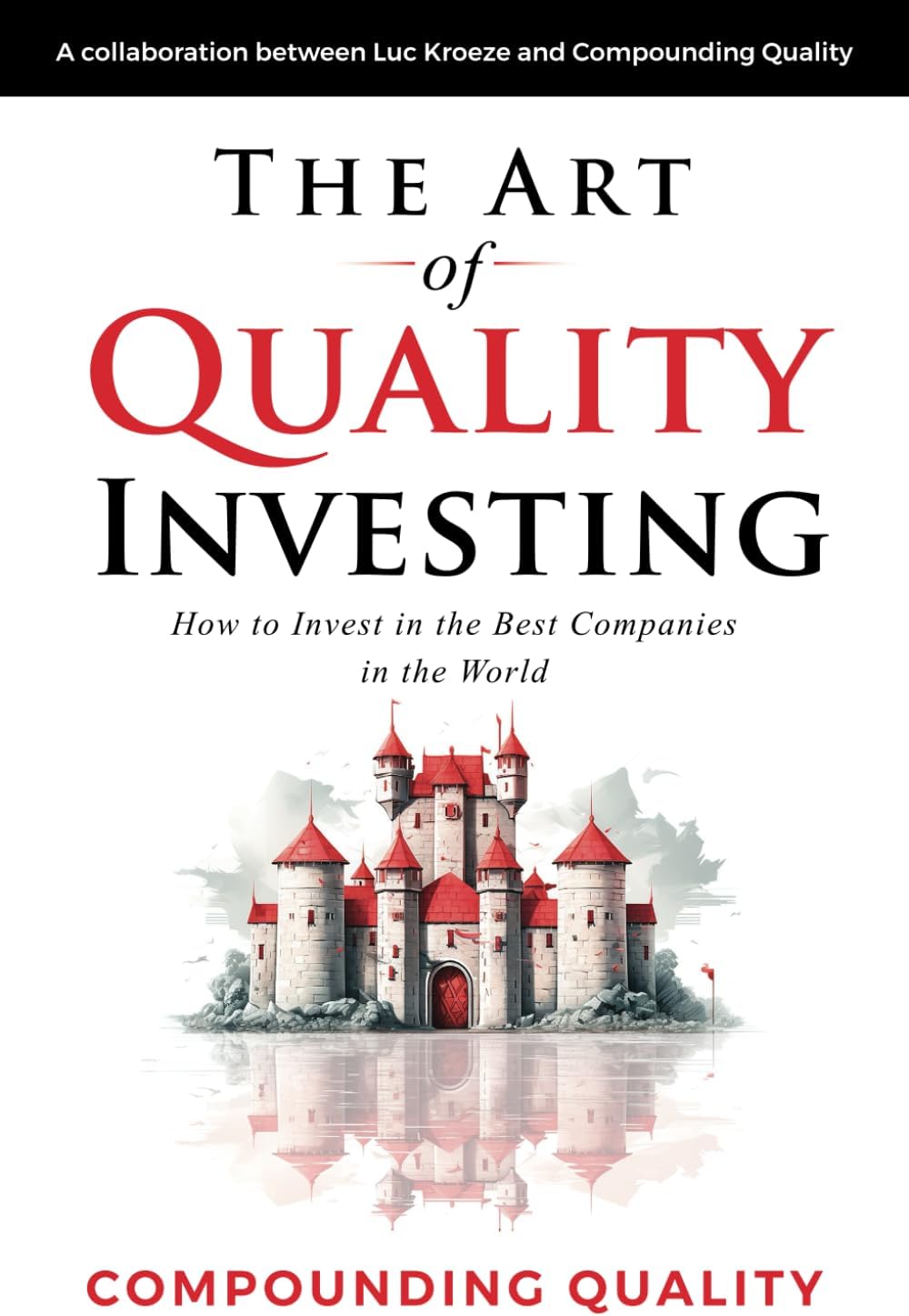
The Art of Quality Investing: How to invest in the best companies in the world
Product ID: 698643531
Buy The Art of Quality Investing: How to invest in the best companies in the world by Quality, Compounding, Kroeze, Luc online on desertcart.ae at best prices. ✓ Fast and free shipping ✓ free returns ✓ cash on delivery available on eligible purchase. Review: Summary If you have any interest in learning about Quality Investing or “how to buy and hold the best companies in the world at the right price”, then this is the book for you. I enjoyed reading it, learned something new, and highly recommend it! Detailed review Form factor and layout - I have the paperback version and I like that the size is more like a hardcover book (a bit bigger in size compared to your ‘classic’ paperback format). - The font size is perfect for my aging eyes Readability - This book is an easy read. Each chapter is divided into small blocks of knowledge which creates a certain flow. - The text is sprinkled with images and quotes which greatly enhance readability - The length of the book is perfect. To quote Antoine de Saint-Exupéry: 'Perfection is achieved, not when there is nothing more to add, but when there is nothing left to take away.' -> Every word needs to be in this book. Content - The book provides context on what quality investing means - It gives you a 13-point checklist you can use - Each point is discussed in detail to show you how to identify quality companies - The valuation chapter provides an introduction to how to value these companies - Finally, a chapter on portfolio management teaches how to manage a portfolio and more importantly when to sell a position while always taking a long-term view - Several companies are mentioned as an example to illustrate the different concepts Can you take action? Yes. This is not a mere theoretical book. The book provides a checklist and advice which you can implement while reading. You can use the book as a reference afterwards while implementing your investment process. Who is this for? - Beginning investors will receive a wealth of information. They will learn the most by reading this book. - More experienced investors will be able to improve their skills and process even further. I consider myself experienced (but still a lot to learn) and have made improvements to my own checklists and process based on this book (example: You can talk about revenue, but what does Quality revenue look like beyond just its growth metrics?) Review: This little book is the "best of the best" when it comes to helping one learn how to think about investing in high quality companies that compound value for long periods of time. I have great respect for all writers who truly have something of value to share, and this is a prime example. Investing has been one of my lifelong passions and I have managed our family office for over 30 years. Our investment objectives are preservation of wealth, maintenance of purchasing power, and protection against currency devaluation. I have written investing manuals with links to spreadsheet models for my grandchildren on various aspects of investing. The enables them to learn by doing. The book fits in nicely and supplements my emphasis on investing in good quality companies. It's hard to think of much to add to the other comments about the merits of this book. Based on my decades long investing experience, investing in high quality compounders has paid off. That's the good news. The bad news is that most of my investments have such huge unrealized gains that I'm virtually locked into holding them until they get a step-up in basis in my estate. In many cases, the dividends exceed my adjusted basis, and the yield on cost is astronomical. Also, with some notable exceptions, the compound rates of growth have declined. There are some much better compounders to consider, and they are on our buy list for new money. I would like to reply to the person who was critical that the book didn't include much on valuation. Please read chapter 5 and consider the context carefully. Otherwise, you are missing an important point of the focus of this book. Then read "Valuation" 7th edition by McKinsey & Company if you want the best book on valuation, understand accounting, have access to high quality accounting data and are proficient in Excel. In my opinion, valuation is the most challenging part of investing, and the competition is overwhelming. Reading "How to Win the Looser's Game" by Charlie Ellis will provide a dose of reality and enhance your appreciation for "The Art of Quality Investing".
| ASIN | B0D181X6CP |
| Best Sellers Rank | #117,823 in Books ( See Top 100 in Books ) #1,171 in Investing #1,648 in Economics #4,875 in Business Management & Leadership |
| Customer reviews | 4.6 4.6 out of 5 stars (104) |
| Dimensions | 15.24 x 1.32 x 22.86 cm |
| ISBN-13 | 979-8321662656 |
| Item weight | 290 g |
| Language | English |
| Publication date | 15 April 2024 |
| Publisher | Independently published |
K**)
Summary If you have any interest in learning about Quality Investing or “how to buy and hold the best companies in the world at the right price”, then this is the book for you. I enjoyed reading it, learned something new, and highly recommend it! Detailed review Form factor and layout - I have the paperback version and I like that the size is more like a hardcover book (a bit bigger in size compared to your ‘classic’ paperback format). - The font size is perfect for my aging eyes Readability - This book is an easy read. Each chapter is divided into small blocks of knowledge which creates a certain flow. - The text is sprinkled with images and quotes which greatly enhance readability - The length of the book is perfect. To quote Antoine de Saint-Exupéry: 'Perfection is achieved, not when there is nothing more to add, but when there is nothing left to take away.' -> Every word needs to be in this book. Content - The book provides context on what quality investing means - It gives you a 13-point checklist you can use - Each point is discussed in detail to show you how to identify quality companies - The valuation chapter provides an introduction to how to value these companies - Finally, a chapter on portfolio management teaches how to manage a portfolio and more importantly when to sell a position while always taking a long-term view - Several companies are mentioned as an example to illustrate the different concepts Can you take action? Yes. This is not a mere theoretical book. The book provides a checklist and advice which you can implement while reading. You can use the book as a reference afterwards while implementing your investment process. Who is this for? - Beginning investors will receive a wealth of information. They will learn the most by reading this book. - More experienced investors will be able to improve their skills and process even further. I consider myself experienced (but still a lot to learn) and have made improvements to my own checklists and process based on this book (example: You can talk about revenue, but what does Quality revenue look like beyond just its growth metrics?)
D**Y
This little book is the "best of the best" when it comes to helping one learn how to think about investing in high quality companies that compound value for long periods of time. I have great respect for all writers who truly have something of value to share, and this is a prime example. Investing has been one of my lifelong passions and I have managed our family office for over 30 years. Our investment objectives are preservation of wealth, maintenance of purchasing power, and protection against currency devaluation. I have written investing manuals with links to spreadsheet models for my grandchildren on various aspects of investing. The enables them to learn by doing. The book fits in nicely and supplements my emphasis on investing in good quality companies. It's hard to think of much to add to the other comments about the merits of this book. Based on my decades long investing experience, investing in high quality compounders has paid off. That's the good news. The bad news is that most of my investments have such huge unrealized gains that I'm virtually locked into holding them until they get a step-up in basis in my estate. In many cases, the dividends exceed my adjusted basis, and the yield on cost is astronomical. Also, with some notable exceptions, the compound rates of growth have declined. There are some much better compounders to consider, and they are on our buy list for new money. I would like to reply to the person who was critical that the book didn't include much on valuation. Please read chapter 5 and consider the context carefully. Otherwise, you are missing an important point of the focus of this book. Then read "Valuation" 7th edition by McKinsey & Company if you want the best book on valuation, understand accounting, have access to high quality accounting data and are proficient in Excel. In my opinion, valuation is the most challenging part of investing, and the competition is overwhelming. Reading "How to Win the Looser's Game" by Charlie Ellis will provide a dose of reality and enhance your appreciation for "The Art of Quality Investing".
R**O
Loving this book so far. Investing should be simple, its the market noise that makes it complicated and stops you doing what you should. This book helps keep you on the straight and narrow.
D**E
What a great book on investing! It is very well written and nicely laid out. They explain all their methods with their reasoning behind them. It will be my constant companion and remain as a reference book when valuing companies. Thank you, Luc and Pieter!
L**E
Era para un regalo y genial.
Trustpilot
2 days ago
2 weeks ago