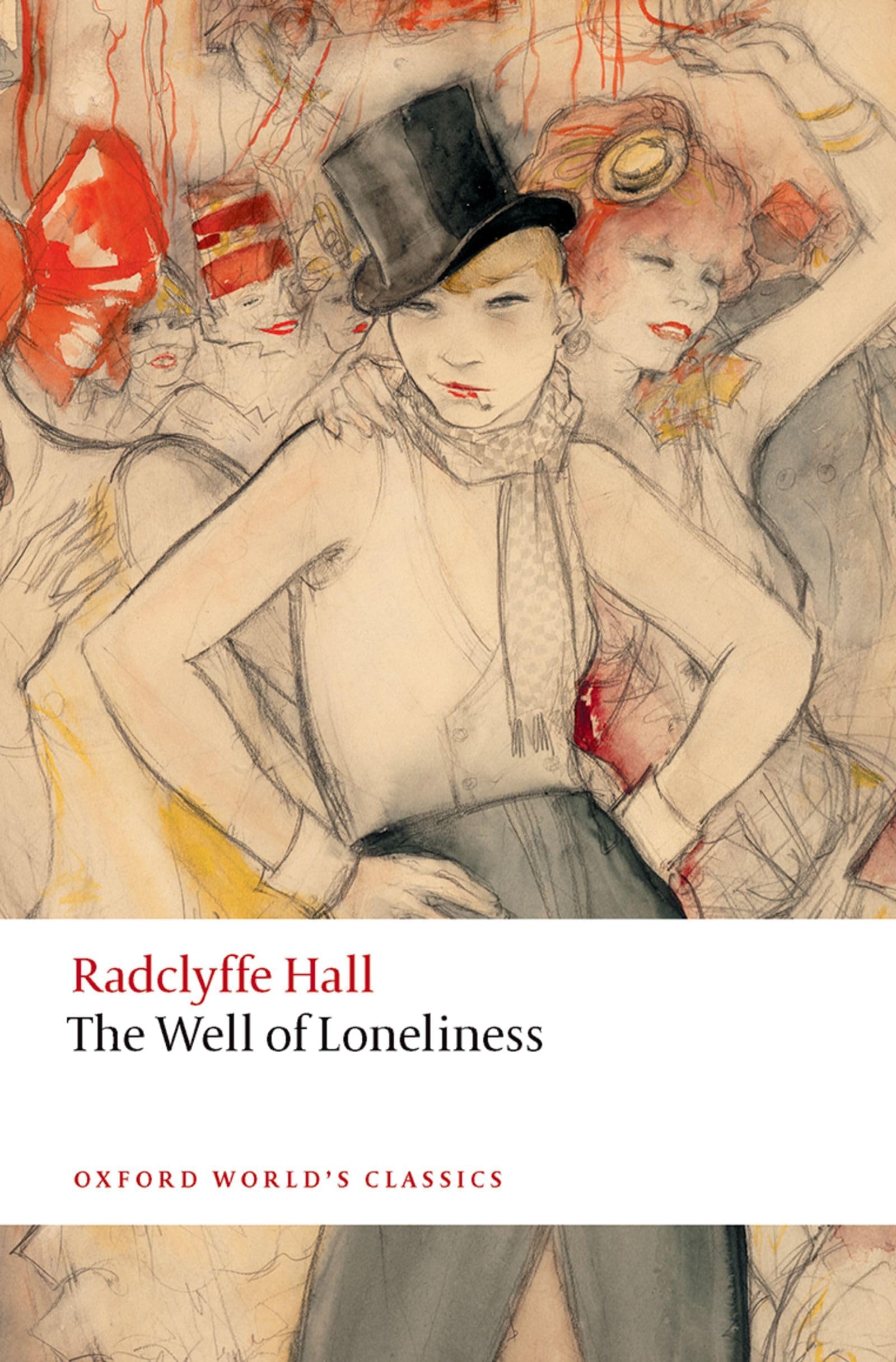
The Well of Loneliness (Oxford World's Classics)
Product ID: 705848224
Buy anything from 5,000+ international stores. One checkout price. No surprise fees. Join 2M+ shoppers on Desertcart.
Desertcart purchases this item on your behalf and handles shipping, customs, and support to Vanuatu.
The Well of Loneliness (Oxford World's Classics) [Hall, Radclyffe, Funke, Jana, Roche, Hannah] on desertcart.com. *FREE* shipping on qualifying offers. The Well of Loneliness (Oxford World's Classics) Review: Former Banned Book Still Speaks Sooth - I read this as a part of a year long book reading challenge; "The Well of Loneliness" had been banned so naturally I wanted to see why! It is widely accepted as a thinly-veiled autobiography of the lesbian writer Radclyffe Hall. The protagonist, Stephen, who is given a masculine name because her parents wanted a boy, grows up with masculine proclivities in sport, and love as well. Her wealthy parents were indulgent when she was young but her mother gradually withdraws as Stephen becomes more enigmatic to the traditionally feminine mother, a celebrated beauty, while her father begins to understand what drives his daughter's eccentric personality. A tree branch falls on him before he makes up his mind to divulge to Stephen's mother what he suspects then, with his last gasp, tries to vindicate his daughter but dies. Lonely without her father's mature companionship and increasingly estranged from her mother, Stephen becomes embroiled in a disastrous affair with the wife of a neighbor. When the truth explodes, Stephen is forced to leave her childhood home with orders from her mother to behave as if nothing is wrong and to make regular pilgrimages back to Morton to that end which results in little more than painful recollections for all concerned. Throughout this time, Stephen's governess-turned-companion, "Puddle" a secret lesbian herself and only too aware of what Stephen is suffering, agonizes privately whether she should speak up or remain silent about the condition of being an "invert." First living in London and becoming a successful author, then settling in Paris to seek her muse, life is disrupted by WWI. Stephen, as well as many other Inverts, finds they are welcome to serve their country as ambulance drivers and do so with distinction. Stephen finds Mary during this time as they suffer the tragedies of wartime then eventually return to Stephen's house in Paris to set up housekeeping together, becoming involved in the Paris nightlife of similarly shunned "others." Mary is dissatisfied with being outcast but is unwilling to give up her love for Stephen. Stephen loves Mary fiercely but suffers because she cannot legitimize her love for Mary in the eyes of the world. A young man who had unsuccessfully courted Stephen in her youth shows up in Paris, understanding of the truth, and becomes a welcome confidante once again. However, after months of conviviality, Martin confides in Stephen that he is in love with Mary and thinks Mary is fond of him. An emotional and intellectual duel follows between these two honorable lovers in which Stephen ultimately concedes the field to Martin, recognizing that only a marriage between a man and a woman affords Mary the protection she craves. Throughout the book, Stephen wonders why God would make something unworthy of love, why society has to be so unforgiving, and why she was made the way she was. The legal and social ramifications of being different are examined from various angles with hope for future generations the constant theme. ( For the record, God made you so He loves you! ) From a technical standpoint, this book is well-written, well-paced, and absorbing. The characters are drawn with a fine eye for detail and examples of the author's own good heart are found in dialogue with the animals, of all things! One can imagine Stephen leaning her head against the horse Raftery, as she murmurs the kind of nothings we all say to our beloved pets. As a straight reader, I saw life from a different perspective through Radclyffe's eyes, and had to ask myself why I still resisted the idea of same-sex marriage. It is making me think and isn't that purpose of excellent literature? Review: A hard, but fulfilling read. - The archaic language, and the occasional lapse into French, made this book hard to read. Hardly a page went by, without me having to look up a word, or translate a phrase. Reading a few pages went from a half hour diversion, to an afternoon slog. In the end, I still really enjoyed it. Hall would spend a page or two, describing something that could easily be summed up in a couple of sentences. Normally I would hate that, but with Hall it worked. Her words painted pictures, setting moods as well as scenes. Really bringing the feel of the characters to life. I just kept thinking, so this is what those other authors were trying to do. Hall's quick change in perspective, could get confusing, at times. One minute you're in one character thoughts, the next you're in another's. At a few spots, we got treated to a dog's point of view, on the events, of the story. The end was a bit to hard to take, but I wasn't expecting a story book ending, given the time period it was written. All in all, I enjoyed the book, and got a sense of accomplishment, when I finished it.
| Best Sellers Rank | #120,924 in Books ( See Top 100 in Books ) #38 in Gothic & Romantic Literary Criticism (Books) #236 in Literary Criticism & Theory #2,368 in Classic Literature & Fiction |
| Customer Reviews | 4.3 4.3 out of 5 stars (1,001) |
| Dimensions | 5.12 x 0.98 x 7.68 inches |
| ISBN-10 | 0192894455 |
| ISBN-13 | 978-0192894458 |
| Item Weight | 13.6 ounces |
| Language | English |
| Print length | 576 pages |
| Publication date | January 9, 2025 |
| Publisher | Oxford University Press |
R**H
Former Banned Book Still Speaks Sooth
I read this as a part of a year long book reading challenge; "The Well of Loneliness" had been banned so naturally I wanted to see why! It is widely accepted as a thinly-veiled autobiography of the lesbian writer Radclyffe Hall. The protagonist, Stephen, who is given a masculine name because her parents wanted a boy, grows up with masculine proclivities in sport, and love as well. Her wealthy parents were indulgent when she was young but her mother gradually withdraws as Stephen becomes more enigmatic to the traditionally feminine mother, a celebrated beauty, while her father begins to understand what drives his daughter's eccentric personality. A tree branch falls on him before he makes up his mind to divulge to Stephen's mother what he suspects then, with his last gasp, tries to vindicate his daughter but dies. Lonely without her father's mature companionship and increasingly estranged from her mother, Stephen becomes embroiled in a disastrous affair with the wife of a neighbor. When the truth explodes, Stephen is forced to leave her childhood home with orders from her mother to behave as if nothing is wrong and to make regular pilgrimages back to Morton to that end which results in little more than painful recollections for all concerned. Throughout this time, Stephen's governess-turned-companion, "Puddle" a secret lesbian herself and only too aware of what Stephen is suffering, agonizes privately whether she should speak up or remain silent about the condition of being an "invert." First living in London and becoming a successful author, then settling in Paris to seek her muse, life is disrupted by WWI. Stephen, as well as many other Inverts, finds they are welcome to serve their country as ambulance drivers and do so with distinction. Stephen finds Mary during this time as they suffer the tragedies of wartime then eventually return to Stephen's house in Paris to set up housekeeping together, becoming involved in the Paris nightlife of similarly shunned "others." Mary is dissatisfied with being outcast but is unwilling to give up her love for Stephen. Stephen loves Mary fiercely but suffers because she cannot legitimize her love for Mary in the eyes of the world. A young man who had unsuccessfully courted Stephen in her youth shows up in Paris, understanding of the truth, and becomes a welcome confidante once again. However, after months of conviviality, Martin confides in Stephen that he is in love with Mary and thinks Mary is fond of him. An emotional and intellectual duel follows between these two honorable lovers in which Stephen ultimately concedes the field to Martin, recognizing that only a marriage between a man and a woman affords Mary the protection she craves. Throughout the book, Stephen wonders why God would make something unworthy of love, why society has to be so unforgiving, and why she was made the way she was. The legal and social ramifications of being different are examined from various angles with hope for future generations the constant theme. ( For the record, God made you so He loves you! ) From a technical standpoint, this book is well-written, well-paced, and absorbing. The characters are drawn with a fine eye for detail and examples of the author's own good heart are found in dialogue with the animals, of all things! One can imagine Stephen leaning her head against the horse Raftery, as she murmurs the kind of nothings we all say to our beloved pets. As a straight reader, I saw life from a different perspective through Radclyffe's eyes, and had to ask myself why I still resisted the idea of same-sex marriage. It is making me think and isn't that purpose of excellent literature?
J**N
A hard, but fulfilling read.
The archaic language, and the occasional lapse into French, made this book hard to read. Hardly a page went by, without me having to look up a word, or translate a phrase. Reading a few pages went from a half hour diversion, to an afternoon slog. In the end, I still really enjoyed it. Hall would spend a page or two, describing something that could easily be summed up in a couple of sentences. Normally I would hate that, but with Hall it worked. Her words painted pictures, setting moods as well as scenes. Really bringing the feel of the characters to life. I just kept thinking, so this is what those other authors were trying to do. Hall's quick change in perspective, could get confusing, at times. One minute you're in one character thoughts, the next you're in another's. At a few spots, we got treated to a dog's point of view, on the events, of the story. The end was a bit to hard to take, but I wasn't expecting a story book ending, given the time period it was written. All in all, I enjoyed the book, and got a sense of accomplishment, when I finished it.
M**S
We exist. Like everyone else, We were made by nature. Therefore we are natural.
The Well of Loneliness is an engaging story that shows the challenges, indignities suffered and, yes, the loneliness of being gay, particularly at the time this book was written. Imagine growing up with people judging you and condemning you because you are some not-quite-definably kind of different? This difference is nothing you did; it isn't the result of any decision or choice you made; it is simply the way you are. People talk about you in whispers as you pass; they snicker. Often, they quite obviously reject you and condemn you because they are like the majority whereas you are not. The story does a very good job of making you feel the ostracizing by society just because you are not like others. This ostracizing begins long before sexuality comes into play. And, by the way, there is no sex in this book other than kissing. And yet the book was condemned as obscene simply because the kissing was between two women. Stephan, the protagonist, likes to ride horses and finds riding side-saddle dumb. She takes up fencing and lifting weights because she enjoys the physicality. She feels foolish wearing dresses. Are any of those things truly outrageous and deserving of condemnation? She makes a wonderful friend with a young man who she feels close to because he treats her exactly the same as he would a man. That she recoils in horror when the young man declares his love for her was not her decision; it was simply her reaction. When she forms a relationship with another woman with kissing involved and eventually declares her love for the woman only to have the woman recoil makes her feel just how alone and different she is. Stephan thinks she must be the only person to be this way. She is unaware that others exist. She experiences multiple snubs and rejections because of how she is. Stephan makes an important and, I think, irrefutable point somewhere in the book: "We exist. Like everyone else, We were made by nature. Therefore we are natural." I think this book should be read by heterosexuals. I am not so foolish as to think that the scales would fall from the eyes of those blinded by prejudice. But, I would hope that many people would find the mile walked in another's shoes to be a reminder to be kinder and much more tolerant of others. It needn't be limited to those in sexual minorities but also racial, religious, nationalities or any other kinds of different. From a purely literary point of view, I also found the writing to be interesting. Occasionally, I would have to reread a sentence to understand it but then I found that I enjoyed the non-standard (perhaps only by modern standards?) phrasing to be interesting. Overall, I found this to be one of the best books I've read in quite a while.
L**H
Received a USED copy when I paid for a NEW copy
I added a new copy of the book to my cart but upon delivery received a USED copy. It is obvious that the book is used as the back cover is bent and there was what looks to be a sticker removed from the front cover. There is a sticker on the back claiming the book as New. LIES!
P**I
Practicar el inglés
G**S
An amazing book full of emotion and heartache. I've cried so much!!! I love the style and the development of the characters. It is one of the best books i've ever read!
N**N
I first read this novel when I was 16 working in a library. It disturbed me then although I did not fully understand anything about homosexuality as it was in the 50's and most of us ignorant about the subject. I saw it on Amazon lately and decided to re- read it ( 60 years later ! ) It was written in the 1920's and immediately banned but in later years available . I knew of the author as she had been in celebrity circles and notoriously dressed and acted as a man. The book is clearly an undisguised semi autobiography but what makes it stand out is the intense description of her own inner feelings as the main character. It is just so sad and heart rendering in how she describes the frustrating situation that in those days such people could not express their natural way of living as everyone else could. Her skill at describing the landscape and countryside is delightful and the plot very good. Reading her description of 1920 Montmartre is interesting. Do read the very helpful history of the book after the finish. I found the photos of her dressed as a man quite terrifying though even if tragic. Worth reading as it is a classic in it's way and you can see how such situations nowadays ,nearly a hundred years later ,have been changed .
A**D
This book offers an analysis of the emotions and experiences of a sensitive, gifted and intelligent woman who is born with too many male genes, and the result of that on her life, on the way she is perceived and treated by her family and by society, and on the choices which she is driven to take in order to protect herself and those she loves. If it is read objectively, it can open one's eyes (as it did mine) to how homosexuals feel, to the fact that they are neither depraved nor despicable per se. They seek to give and receive love as their nature dictates. But, inevitably, they most often face the open or concealed approbrium of others. The message is beautifully told. The writing is exquisite.
B**E
Her tarafı yırtık kitap yollamışlar. İnsanda utanma olur demek isterdim ama çoğu insanda yok maalesef.
Trustpilot
3 days ago
2 weeks ago